
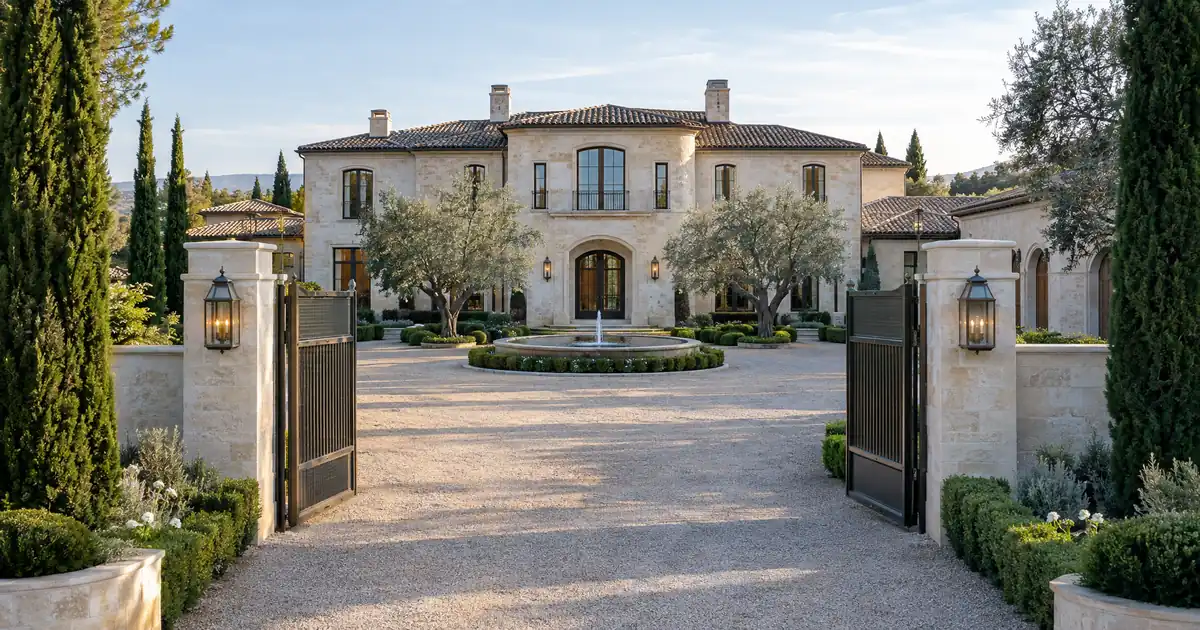
Can A Rental On Twenty Acres Qualify For A Jumbo DSCR Loan — The Quick Read: Sometimes, but not on the full parcel. Most programs cap eligible acreage well under 20 acres, and twenty is squarely outside standard limits. Through select lenders in Lendmire’s wholesale network, a twenty-acre rental can size up to $3,000,000, with acreage above ten reviewed case by case. The workaround, when the parcel qualifies at all, usually involves the appraiser valuing the homesite rather than the whole property.
That’s the honest version. Below is how the underwriting actually plays out, where lenders draw the acreage line, and what an investor with a large-lot rental should do before writing an offer.
DSCR Calculator
Run the numbers in your market
Rate source: Freddie Mac 30-yr average via FRED® — Federal Reserve Bank of St. Louis · effective Sep 17, 2026
Prefilled with local estimates — enter your own rent or nightly figures, taxes, insurance, and HOA for a more accurate picture.
Program parameters update from Lendmire’s centralized guideline source. Taxes and insurance are editable estimates.
As of Sep 17, 2026 · General Freddie Mac market benchmark, not a Lendmire loan offer. Rent, nightly rate, occupancy, taxes, and insurance are editable estimates. Short-term rental figures are estimates only and vary significantly by season, property type, management approach, and local short-term-rental rules — confirm local regulations before relying on them. Qualifying income for short-term rentals varies by program — some use appraisal market rent, others use documented STR history or projections — and is confirmed in underwriting. Not a Loan Estimate, approval, or commitment to lend. Program availability and eligibility are subject to lender guidelines, credit approval, property review, and underwriting.
Why Twenty Acres Trips Up Most DSCR Programs
Acreage caps aren’t set by any federal rule — DSCR loans are non-agency products, so each lender’s investor sets its own ceiling. That said, the pattern across the non-QM market is consistent: most programs stop somewhere between five and ten acres. Twenty acres sits outside that band entirely for a lot of shelves.
The concern isn’t really the acreage number itself. It’s what acreage signals about the property’s character. A rental on five acres in a subdivision reads like a house with a yard. A rental on twenty acres often reads like farmland with a house on it — and farmland brings appraisal and marketability questions that a residential rent-based loan isn’t built to answer.
Through select lenders in Lendmire’s wholesale network, standard rural acreage tops out at five acres for the best leverage, with twenty acres eligible up to $3,000,000 and anything above ten acres reviewed case by case, subject to underwriting. That’s meaningfully more room than a typical shelf offers — but it’s a review, not a rubber stamp.
How Underwriters Actually Evaluate Large-Lot Rentals
The appraiser’s judgment call matters more than any single acreage number. Before a lender even gets to the acreage math, most files get checked against rural-status tools, and then the appraiser decides how the neighborhood reads on the ground.
Rural status gets checked first, separate from acreage. Lenders may reference the federal consumer-finance regulator Rural or Underserved Areas Tool, which offers a safe-harbor rural determination under 12 CFR 1026.35. Some appraisers also glance at the USDA Rural Development Property Eligibility Map, even though that tool exists for an entirely different loan program. The two can disagree on the same address — one says rural, one doesn’t — and that mismatch alone can decide whether a file moves forward.
The neighborhood’s “built-up” percentage is its own pass-fail test. Appraisal standards look at how developed the surrounding area is, not just the subject lot. A house surrounded by open farmland, with few nearby structures, tends to struggle here regardless of how nice the house is. This is often the actual point of failure on rural files — not the acreage cap at all.
Agricultural zoning is a separate tripwire from acreage size. A twenty-acre parcel zoned or actively used for farming, ranching, or orchard income gets treated differently than a twenty-acre residential lot with a rental house on it. Working farm income isn’t rental income, and that distinction matters to how a lender views the deal.
The excess-land carve-out is the practical fix. When a parcel exceeds a program’s acreage ceiling, the appraisal can sometimes value just the homesite — the house plus a reasonable amount of surrounding land — and exclude the rest. This mirrors long-standing appraisal theory around “excess land,” land not needed to support the home’s use, which shows up in Fannie Mae’s own selling guide on site requirements — useful background even though DSCR loans aren’t Fannie or Freddie products. The catch: excluding acreage from the appraisal usually lowers the appraised value, which lowers loan proceeds at any given leverage point.
That carve-out is also where investors get tripped up on a related but different question — what happens when a barn, guest house, or accessory structure was converted into the rental itself. Lendmire’s guide on converted rentals qualifying for a jumbo DSCR loan covers that scenario directly.
The Jumbo Question Is a Separate Conversation
A jumbo loan and a large-acreage property are two different underwriting issues, not one. Loan size is set by how much the investor is borrowing; acreage eligibility is set by the property itself. Clearing one says nothing about the other — a twenty-acre rental can be a modest loan amount, and a $500,000 loan can sit on a quarter-acre lot in a subdivision.
Where this article uses “jumbo,” it means the larger loan-amount tiers on Lendmire’s business-purpose DSCR ladder — the sizing that runs past what a standard DSCR shelf handles. Through select lenders in the network, loan amounts run from $150,000 up to $10,000,000 on the portfolio investor program, well above the $3,000,000 ceiling on Lendmire’s standard DSCR program. Short-term-rental and no-ratio files stop at $2,000,000.
Leverage steps down as the loan gets bigger, and it’s worth walking through because this is where a twenty-acre file gets real. Up to $1,000,000, purchase and rate-and-term financing can reach 80% loan-to-value with credit around 660 or better, subject to underwriting. From $1,000,000 to $1,500,000, leverage steps down to 75% with credit typically 700 or higher. From $1,500,000 up to $3,000,000, purchase and rate-and-term still run around 75%, though cash-out compresses to roughly 60% in that upper band. Move into the $3,000,000 to $4,000,000 range and leverage drops to about 65%, purchase or rate-and-term only — no cash-out. From $4,000,000 to $10,000,000, leverage sits around 60% and every request in that range gets reviewed case by case before submission, subject to underwriting — never a flat “up to” number.
Twenty acres specifically caps at the $3,000,000 tier through the network’s rural allowance; go above ten acres and the deal works into case-by-case review regardless of loan size. That’s the honest ceiling — a twenty-acre parcel isn’t going to reach the $6,000,000-plus tiers on rural acreage alone.
Does Coverage Change on a Large-Acreage File?
No — the DSCR math itself doesn’t change because of acreage. Coverage is still rent divided by the monthly obligation, and the property either clears that ratio or it doesn’t, regardless of lot size. What acreage affects is the appraised value and the leverage available against it, not the rent-to-payment formula.
A rental clearing 1.00 coverage earns full leverage under the ladder above. Coverage between roughly 0.75 and 0.99 is a real path through select programs in the network, up to $2,000,000, though leverage and terms adjust to compensate, subject to underwriting. No-ratio qualification — where the lender doesn’t calculate a coverage number at all — is available through select programs up to $2,000,000 for borrowers with a seven-year clean housing history and no late payments in the past two years, subject to underwriting; no minimum ratio is published for that path because none applies.
Here’s the honest read: acreage and coverage are two separate risk boxes a lender checks. A twenty-acre rental with strong rent can clear coverage easily and still get stuck on the acreage-and-rural review. The rent number doesn’t fix the land question.
What Actually Disqualifies a Large-Acreage Rental
Run through DSCR files with acreage over ten and a few patterns repeat often enough to call them rules of thumb. Manufactured or modular housing on rural acreage is a stacked risk factor most shelves won’t touch at all. Agricultural income from the land — hay, boarding, crop leases — isn’t rental income and won’t count toward coverage. And no-appraisal or automated-valuation shortcuts are off the table entirely on large-acreage files; a full appraisal is required regardless of loan size.
Short-term rental income can factor in on a twenty-acre property, subject to the same rules as any other STR file: coverage of 1.00 or higher, loan amounts to $2,000,000, and income based on twelve months of operating history on a refinance or the appraisal’s short-term-rent analysis on a purchase, counted at 80% of gross. Whether short-term rental use is even permitted on a given twenty-acre parcel is a local question — zoning and STR rules vary by county and municipality, so investors should confirm local rules before relying on projected rental income rather than assuming acreage alone means fewer restrictions.
If the property carries multiple structures under one legal parcel — a rental house on one side, unimproved land on the other, all one deed — that split-parcel structure is exactly where excess-land appraisal treatment gets used, and it’s worth raising with the appraiser before the report is ordered rather than after.
Key Terms Defined
DSCR (debt service coverage ratio): the property’s monthly rent divided by its full monthly housing obligation — the core number a rental-income loan is underwritten around.
Excess land: the portion of a large lot not needed to support the home’s normal residential use, which an appraiser can value or exclude separately from the house and its immediate site.
No-ratio loan: a DSCR program that skips the coverage calculation altogether and qualifies the file on credit, reserves, and leverage instead.
DSCR vs. conventional financing
Two common ways to finance an investment property in this market. They qualify you differently — here’s how investors weigh them.
Why investors choose it
- Qualifies on the property’s rental income — no personal tax returns, W-2s, or pay stubs needed to document income.
- No personal debt-to-income ceiling to clear, so existing mortgages and obligations don’t cap your borrowing the same way.
- Can be closed in an LLC, keeping the property inside a business entity.
- Built for scaling — not held to the limit on number of financed properties that conventional financing applies.
- Underwriting centers on the deal: generally qualifies when the rent covers the payment, a 1.00x coverage ratio being a common baseline (confirmed in underwriting).
- Designed specifically for investment property, including long-term and, where the program allows, short-term rentals.
Where it’s strong
- Often the lowest ongoing financing cost for a buyer who fully qualifies on personal income — a fit for a first property or a cost-first purchase.
Trade-offs for investors
- Requires full personal income documentation and must fit within a debt-to-income limit — salary, existing debts, and other mortgages all count.
- Typically held in your personal name rather than a business entity.
- Caps how many financed properties you can carry, which can become a ceiling as a portfolio grows.
- Evaluates you as a borrower as much as the property, which usually means more paperwork.
How investors usually choose: a first or single property often optimizes for the lowest financing cost; portfolio builders often optimize for leverage, vesting in an LLC, and scaling past conventional caps. The right answer depends on your goals, the property, and current guidelines — both paths run through select lenders in Lendmire’s wholesale network, with eligibility and terms confirmed in underwriting.
Rural or underserved determination: a federal safe-harbor test, run through a government tool, that flags whether a property sits in a rural area for certain regulatory purposes.
Business-purpose loan: financing for a non-owner-occupied investment property, reviewed under different rules than a loan for a home the borrower lives in.
A Practical Scenario
Picture an investor eyeing a rental house on eighteen acres, with a chunk of the land unimproved and no agricultural use in play. The house itself rents for enough to clear coverage comfortably above 1.00. Under a standard five- or ten-acre program, this file gets declined outright before anyone looks at the rent roll.
Through select lenders in the network, the same property gets reviewed under the twenty-acre allowance, sized to $3,000,000 with the acreage tripping the case-by-case review because it’s above ten. The appraiser may end up valuing just the homesite plus a reasonable curtilage, excluding the rest of the acreage from the valuation — which can pull the appraised value down and, with it, the loan proceeds at any given leverage tier. The investor should model both numbers before making an offer: value on the full parcel, and value if the excess land gets carved out. That gap decides whether the deal actually pencils.
Lendmire’s complete DSCR loans guide walks through the broader qualification framework this scenario sits inside — how rent, credit, and reserves interact across loan sizes.
Reserves on files like this typically run six months of the property’s monthly obligation, or twelve months if the borrower is a first-time investor; the network doesn’t stack extra reserves for other financed properties the borrower already holds. Credit tends to float around 660 as a working floor, moving to roughly 700 above the $3,000,000 mark, with a clean two-year payment history and any qualifying event seasoned at least four years out. Two appraisals typically come into play above $2,000,000, which matters directly here since acreage disputes are exactly the kind of thing a second opinion resolves.
Investors titling the property in an LLC or similar entity can generally do so, subject to program guidelines and single-entity vesting — Lendmire’s piece on how to vest a jumbo DSCR rental covers the mechanics.
Tax treatment can depend on how the funds are used and how the property is held; investors should keep clear records and speak with a qualified tax professional before relying on any deduction.
Frequently Asked Questions
Does a twenty-acre lot automatically disqualify a rental from DSCR financing?
Not automatically — it disqualifies the property from most standard shelves, which typically stop at five to ten acres, but select programs in Lendmire’s wholesale network review twenty-acre rurals up to $3,000,000, with anything past ten acres going through case-by-case review, subject to underwriting.
Why does acreage matter if the DSCR math still works?
Because coverage and land risk are separate checks. A property can clear 1.00 coverage easily and still fail the acreage or rural review — the rent number doesn’t offset appraisal and marketability concerns tied to a large, land-heavy parcel.
What happens if the appraiser excludes some of the acreage from the valuation?
The appraised value typically drops, which lowers the loan proceeds available at any given leverage tier — investors should model the deal both with and without the excess land included before making an offer.
Can agricultural income from the land count toward the rent used in coverage?
No — income from farming, ranching, hay, or crop leases isn’t treated as rental income under DSCR underwriting, and a property with active agricultural use is evaluated on a separate, stricter basis than a straightforward residential rental.
Is a jumbo loan harder to get on large acreage than a smaller loan would be?
Loan size and acreage are assessed independently — a twenty-acre property caps around $3,000,000 under the rural allowance regardless of whether the loan itself would otherwise qualify for a larger tier, so “jumbo” sizing doesn’t unlock more acreage room on its own.
If you’re evaluating a rental on a large parcel and want to see how the acreage, rent, and leverage actually line up, Lendmire can help you compare DSCR loan options based on the property’s income, credit profile, and program fit.
For current guidelines and terms, see Lendmire’s super jumbo DSCR loan programs page.
Self-employed borrowers can compare both super jumbo programs on Lendmire’s self-employed mortgages page.
About Lendmire
Lendmire (NMLS# 2371349) is a mortgage brokerage focused on DSCR investor financing, helping arrange programs through wholesale and investor-lending channels in 40 markets, including Washington, D.C. DSCR loans are evaluated by the lender on property cash flow rather than personal income, subject to lender guidelines, supporting LLC closings and accommodating investors with four or more financed properties. Scotsman Guide Top Mortgage Workplace in both 2025 and 2026.
Get Started
Ready to find the right loan for you?
In about 30 seconds you can review financing options available for your home or investment property. No commitment required.
Informational only. Not a Loan Estimate, approval, or commitment to lend. Program availability and eligibility are subject to lender guidelines, credit approval, property review, and underwriting.
References
1. CFPB Rural or Underserved Areas Tool
2. USDA Rural Development Property Eligibility Map
Brandon Miller
Founder & CEO, Mortgage Loan Originator, Lendmire LLC
- Mortgage Loan Originator · NMLS# 1129696 · Verify on NMLS Consumer Access
- North Carolina Real Estate Broker · License# 343312 · Verify on NCREC
- North Carolina Insurance Producer · License# 19053198 · Property, Casualty, Life, Health · Verify on NAIC SBS
- Lendmire LLC · Firm NMLS# 2371349 · Verify firm licensure
Compliance and disclosures. Lendmire (NMLS# 2371349) is a licensed mortgage broker and is not a direct lender, depository institution, financial advisor, or tax professional. Content in this article is general market analysis and educational information — not financial, legal, or tax advice for any specific situation. Lendmire does not guarantee loan approval; every transaction is subject to underwriting by the funding lender. Mortgage pricing and loan program guidelines are subject to change at any time without notice and vary by borrower characteristics, property type, and state regulations. Lendmire complies with Equal Housing Opportunity. Licensure verification: NMLS Consumer Access.


