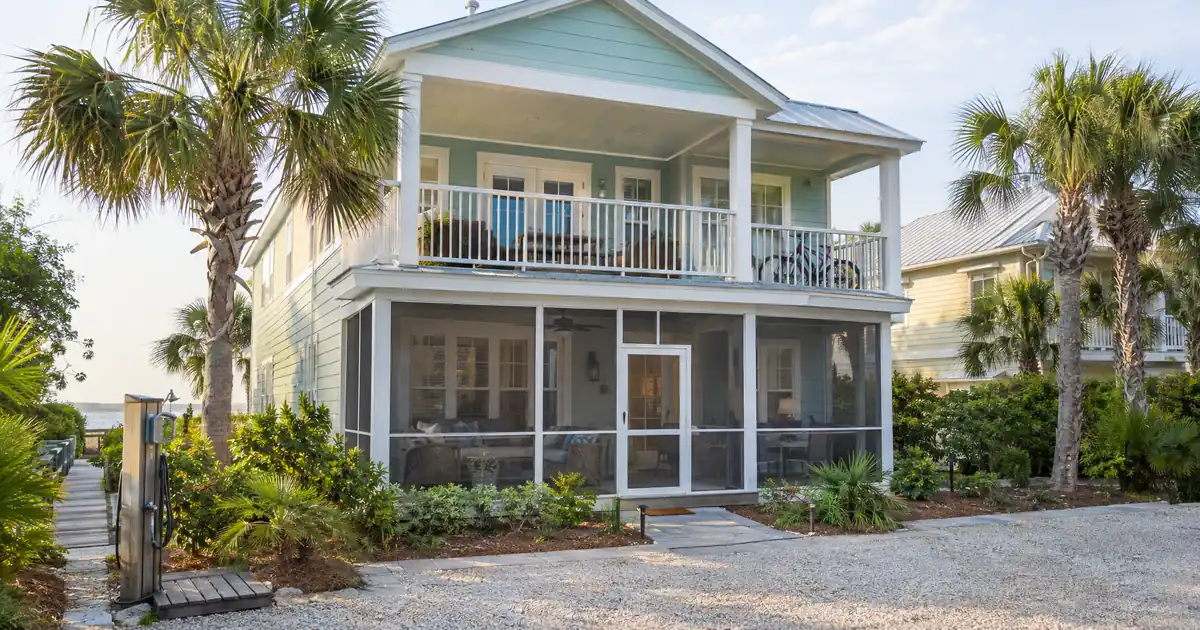
What HOA Dues And Insurance Do To A Vacation Rental DSCR Loan — The Quick Read: They go straight into the payment math, dollar for dollar, the same as principal and interest. A DSCR loan measures rent against the full monthly obligation, and that obligation includes taxes, insurance, and HOA dues if the property has them. A $500-a-month HOA fee doesn’t nibble at your margin — it competes directly with the mortgage payment for the same rent dollars. Insurance is worse in one way: the wrong policy type can sink the file even when the ratio looks fine on paper.
Here’s the short version most vacation-rental buyers miss: a DSCR loan (a business-purpose loan that is reviewed around the property’s rental income instead of your traditional personal-income documentation) doesn’t care about your real operating costs. It cares about exactly four line items — principal, interest, taxes, and insurance, plus HOA dues if the property has them. That combined number is called PITIA. Everything else — cleaning fees, platform commissions, management costs, maintenance — is invisible to the ratio. HOA dues are not invisible. They’re baked in at full weight.
Short-Term Rental Calculator
Run the STR numbers in your market
Rate source: Freddie Mac 30-yr average via FRED® — Federal Reserve Bank of St. Louis · effective Sep 17, 2026
Prefilled with local estimates — enter your nightly rate, occupancy, taxes, and insurance for a more accurate picture.
Short-term rental income is documented with a 12-month history or a market data report. Program parameters update from Lendmire’s centralized guideline source.
As of Sep 17, 2026 · General Freddie Mac market benchmark, not a Lendmire loan offer. Nightly rate, occupancy, taxes, and insurance are editable estimates. Qualifying income for short-term rentals varies by program — some use appraisal market rent, others use documented STR history or projections — and is confirmed in underwriting. Not a Loan Estimate, approval, or commitment to lend. Program availability and eligibility are subject to lender guidelines, credit approval, property review, and underwriting.
Key Terms Defined
DSCR (Debt Service Coverage Ratio): rent divided by the full monthly payment. A ratio of 1.00 means rent exactly covers the payment; above 1.00 means there’s cushion.
PITIA: principal, interest, taxes, insurance, and association dues — the full monthly obligation used in the DSCR denominator.
HOA (Homeowners Association): an organization that manages a shared community or condo building and charges monthly or annual dues for upkeep, reserves, and amenities.
HO-6 policy: an individual condo-unit insurance policy that covers what the HOA’s master policy doesn’t — typically interior finishes, personal property, and liability.
Non-warrantable condo: a condo project that doesn’t meet standard agency ownership or litigation criteria — a separate underwriting classification from HOA cost or insurance adequacy.
How HOA Dues Actually Move the Ratio
HOA dues get annualized and dropped straight into PITIA — no partial credit, no negotiation. If the property has a monthly HOA fee, it counts at 100% of its stated amount, the same way a $500 increase in the mortgage payment would count. There’s no soft treatment the way there is for, say, projected maintenance costs, which the ratio ignores entirely.
That means two otherwise-identical vacation condos can qualify very differently. One with a low monthly HOA fee leaves more room under the rent for the mortgage payment itself. One with a high monthly HOA fee eats into that same room. From the lender’s side, a high-dues building is functionally a bigger loan payment, even though the purchase price and loan amount are the same.
This is also where the appraisal enters the picture. For a single-unit vacation rental, the appraiser typically completes the Fannie Mae Single-Family Comparable Rent Schedule. This report is built to establish monthly market rent from comparable long-term leases — not nightly short-term-rental rates multiplied out into a monthly number. For 2-4 unit properties, a similar form captures HOA dollar amounts directly on the report grid. That form is often the first place an underwriter sees the exact HOA figure that lands in the denominator, rather than relying on a number the borrower estimated off a listing sheet.
Here’s the part investors miss most often: HOA dues today aren’t guaranteed to be HOA dues in year three. Buildings undergoing structural reserve studies, deferred-maintenance catch-up, or post-storm remediation can see dues jump inside a single budget cycle, sometimes paired with a lump-sum special assessment. The number baked into your DSCR at closing is a snapshot, not a floor. Pulling recent board minutes and the reserve study before you buy tells you more about your real long-term ratio than any loan paperwork will.
Why Insurance Hits Twice
Insurance affects the ratio two separate ways, and only one of them is about cost. The dollar amount of the premium gets annualized into PITIA just like HOA dues — that part is simple math. The second effect is the one that catches people: the type of policy has to actually be eligible for the use, or the file doesn’t close at all, regardless of what the DSCR calculator says.
Standard homeowners insurance is built for owner-occupied use. Once a property takes nightly guests, it’s operating as a business. Ordinary homeowners or even basic landlord policies commonly carry exclusions for that kind of activity. A borrower might assume coverage transfers automatically, but it usually doesn’t. A short-term rental typically needs a hospitality-style or vacation-rental-specific policy. If the file goes to underwriting with the wrong policy type attached, expect it to bounce on insurance review — even if the coverage ratio sits comfortably above 1.00.
Flood coverage layers on separately. This is one spot where a real federal rule applies, not just a lender convention. Properties in a mapped flood zone are required to carry flood insurance as a condition of a federally backed mortgage. Lenders enforce that mandatory-purchase requirement, per the Congress.gov CRS summary of the National Flood Insurance Program. Private flood policies are an accepted substitute, as long as they meet the statutory coverage standard. Either way, the flood premium still lands in the insurance line of PITIA when the property sits in a Special Flood Hazard Area.
For condos, there’s a third wrinkle. The HOA’s master policy only covers part of the building, and where that coverage line falls depends on the association’s own bylaws — not on any universal rule. A “walls-in” master policy might cover interior drywall. A “bare walls” policy covers structure only, leaving the unit owner to insure everything inside with their own policy. Most lenders require that individual unit policy no matter which master-policy style the building carries. This means a condo vacation rental often needs its own coverage layered on top of the HOA’s, and both premiums matter to the ratio.
Where the HOA Kills the Deal Before Insurance Even Matters
Sometimes the math never gets a chance to run — the HOA’s rules simply prohibit the business model. An association’s governing documents can ban short-term rentals outright, cap the percentage of units allowed to rent short-term, or set minimum stay lengths that rule out nightly bookings entirely. This is a title and eligibility question, and it sits ahead of DSCR math, not inside it. Also note that DSCR loans are business-purpose financing and fall outside TRID’s consumer-disclosure requirements, so there’s no closing disclosure to lean on here.
Short-term rental rules can vary by city, county, HOA, and property type, so investors should confirm local rules — including the association’s — before relying on projected rental income. That confirmation has to happen at the individual property level. Nobody can tell you a whole city or state permits vacation rentals; the HOA can override the city, and the city can override the HOA. Both have to say yes.
Where the Numbers Actually Land
Across the wholesale network Lendmire arranges loans through, standard DSCR programs for vacation and long-term rentals run from $150,000 up through $3,000,000, with a separate size ladder carrying qualified investors past that on a portfolio-style program up to $10,000,000. Short-term-rental-specific and no-ratio files cap at $2,000,000 through select programs.
Leverage steps down as loan size climbs. On most files, purchase leverage tops out around 80% up to $1,000,000, then narrows to roughly 75% through $3,000,000, and tightens further — into the 60-65% range — above that, reviewed case by case rather than offered as a flat ceiling. Cash-out follows a steeper curve on the same collateral: up to roughly 75% on standard rentals below $1,000,000, stepping down as loan size grows, with cash-out unavailable above $3,000,000 entirely. Where the collateral is a short-term rental, cash-out leverage is generally capped closer to 70% rather than the 75% ceiling standard rentals see at the same size — the distinction matters when HOA dues and vacation-rental insurance are already compressing the ratio.
A coverage ratio of 1.00 or better typically earns full leverage on most files. Coverage between roughly 0.75 and 0.99 is a real path through select programs up to $2,000,000, though LTV and terms adjust to compensate, subject to underwriting. No-ratio qualification is also available up to $2,000,000 through select lenders in the network — this is where the lender doesn’t calculate a coverage number against rent at all. It generally requires a clean multi-year housing payment history, subject to underwriting. That path is not open to the sub-1.00 short-term-rental scenario described above.
On the underwriting side, credit floors typically run around 660 on most files. They move up toward 700 on loans above $3,000,000. Reserve requirements generally sit around six months of the full monthly obligation on the subject property for experienced investors. First-time investors typically need closer to twelve months. Loans above $2,000,000 typically require two separate appraisals rather than one. Interest-only structuring is available on many files up to roughly 75% LTV. This can widen the coverage math on a heavy-HOA property by removing principal from the monthly obligation for a defined period.
For short-term rentals, refinance qualifying income usually comes from twelve months of documented operating history. On a purchase, it comes from the appraisal’s short-term-rental income analysis. That analysis is typically discounted to around 80% of projected gross income. Lenders use this haircut because vacation income is seasonal and variable. They want a cushion built in before HOA dues and insurance even enter the picture.
DSCR vs. conventional financing
Two common ways to finance an investment property in this market. They qualify you differently — here’s how investors weigh them.
Why investors choose it
- Qualifies on the property’s rental income — no personal tax returns, W-2s, or pay stubs needed to document income.
- No personal debt-to-income ceiling to clear, so existing mortgages and obligations don’t cap your borrowing the same way.
- Can be closed in an LLC, keeping the property inside a business entity.
- Built for scaling — not held to the limit on number of financed properties that conventional financing applies.
- Underwriting centers on the deal: generally qualifies when the rent covers the payment, a 1.00x coverage ratio being a common baseline (confirmed in underwriting).
- Designed specifically for investment property, including long-term and, where the program allows, short-term rentals.
Where it’s strong
- Often the lowest ongoing financing cost for a buyer who fully qualifies on personal income — a fit for a first property or a cost-first purchase.
Trade-offs for investors
- Requires full personal income documentation and must fit within a debt-to-income limit — salary, existing debts, and other mortgages all count.
- Typically held in your personal name rather than a business entity.
- Caps how many financed properties you can carry, which can become a ceiling as a portfolio grows.
- Evaluates you as a borrower as much as the property, which usually means more paperwork.
How investors usually choose: a first or single property often optimizes for the lowest financing cost; portfolio builders often optimize for leverage, vesting in an LLC, and scaling past conventional caps. The right answer depends on your goals, the property, and current guidelines — both paths run through select lenders in Lendmire’s wholesale network, with eligibility and terms confirmed in underwriting.
Program parameters here reflect typical ranges across select lenders in Lendmire’s wholesale network. Every file is underwritten individually, and terms are subject to change and lender guidelines. For the full mechanics of how DSCR lender review works, Lendmire’s complete DSCR loans guide walks through the ratio, the documentation, and the program structure in more depth. Investors weighing whether an HOA fee will sink a specific file may also want to see how HOA dues reduce qualifying rent inside an LLC purchase structure specifically.
Common Mistakes Investors Make
Assuming maintenance and management costs offset a high HOA fee in the ratio — they don’t. The DSCR calculation only counts taxes, insurance, and HOA dues. Real operating costs outside that list are invisible to underwriting even though they’re very real to your bank account.
Assuming the HOA’s master policy covers the interior of the unit. It often doesn’t, and the gap is set by that association’s specific bylaws, not by any standard formula.
Assuming a standard landlord policy covers nightly-stay activity. It typically doesn’t, and discovering that during underwriting — rather than before you shop for insurance — is how a clean-looking file stalls late in the process.
Assuming today’s HOA dues are locked in for the life of the loan. Reserve-funding rules in several states are pushing older buildings toward large dues increases and special assessments that weren’t in the picture at closing.
Frequently Asked Questions
Do HOA dues count against my DSCR loan qualification?
Yes, in full. HOA dues get added to principal, interest, taxes, and insurance to form the full monthly obligation the rent has to cover. There’s no partial credit or negotiated discount — the stated dues amount goes into the calculation exactly as billed.
Can I get a DSCR loan if the HOA bans short-term rentals?
Not on that property’s short-term income. If the association’s governing documents prohibit nightly rentals, that income can’t be used regardless of what the city or county allows. Investors in that situation sometimes pivot to a long-term or mid-term rental strategy on the same property instead.
What kind of insurance does a vacation rental need for a DSCR loan?
Generally a policy built for short-term or hospitality-style use, not a standard homeowners or basic landlord policy. Condo units typically also need an individual HO-6 policy layered on top of the HOA’s master coverage, since the master policy usually doesn’t insure everything inside the unit.
Will a big HOA dues increase after closing hurt my existing loan?
It won’t change the original loan terms, but it will change your actual cash flow going forward. A ratio calculated on today’s dues can weaken materially if the association raises fees or levies a special assessment, which is why checking the reserve study before buying matters more than it looks like it should.
Does a non-warrantable condo classification affect HOA or insurance treatment?
Not directly — warrantability is a separate underwriting question about the building’s ownership mix, litigation status, and budget health. A building can be non-warrantable and still have perfectly adequate HOA dues and insurance, or warrantable and still have a thin, underfunded reserve account.
If you’re buying or refinancing a vacation rental and want to see how HOA dues, insurance, and the property’s rent actually pencil out, Lendmire can help you compare DSCR loan options based on the property’s income, your credit profile, leverage, and your goals as an investor. Reach Lendmire at 828-256-2183 or request a pricing quote to run the numbers on a specific property.
DSCR loans are designed for non-owner-occupied investment properties. Because they are business-purpose investor loans, they are reviewed differently from a standard owner-occupied mortgage. Tax treatment can depend on how the funds are used and how the property is held; investors should keep clear records and speak with a qualified tax professional before relying on any deduction.
Investors focused on short-term rentals can review DSCR loans for Airbnb and short-term rentals.
For current guidelines and terms, see Lendmire’s super jumbo DSCR loan programs page.
Self-employed borrowers can compare both super jumbo programs on Lendmire’s self-employed mortgages page.
About Lendmire
Lendmire (NMLS# 2371349) is a DSCR-focused mortgage broker that helps arrange investor financing across 40 markets, including Washington, D.C., through wholesale and investor-lending channels. DSCR eligibility is generally reviewed by the lender around the property’s rental income rather than personal income documentation, subject to lender guidelines — which works for self-employed investors, LLC operators, and portfolios above four financed properties. Scotsman Guide named Lendmire a Top Mortgage Workplace in both 2025 and 2026.
Get Started
Ready to find the right loan for you?
In about 30 seconds you can review financing options available for your home or investment property. No commitment required.
Informational only. Not a Loan Estimate, approval, or commitment to lend. Program availability and eligibility are subject to lender guidelines, credit approval, property review, and underwriting.
References
1. Fannie Mae — Single-Family Comparable Rent Schedule (Form 1007)
2. Congress.gov CRS — National Flood Insurance Program (NFIP)
Brandon Miller
Founder & CEO, Mortgage Loan Originator, Lendmire LLC
- Mortgage Loan Originator · NMLS# 1129696 · Verify on NMLS Consumer Access
- North Carolina Real Estate Broker · License# 343312 · Verify on NCREC
- North Carolina Insurance Producer · License# 19053198 · Property, Casualty, Life, Health · Verify on NAIC SBS
- Lendmire LLC · Firm NMLS# 2371349 · Verify firm licensure
Required disclosures. Lendmire (NMLS# 2371349) operates as a licensed mortgage broker, not a direct lender or depository. The discussion in this article is general in nature and should not be relied upon as financial, legal, or tax advice — every investment scenario is unique and should be reviewed by a qualified professional. Any loan inquiry is subject to lender underwriting, and this article is not a commitment to lend or a guarantee of approval. Mortgage rates, loan terms, and program guidelines vary by borrower, property, and state, and may change without notice. Equal Housing Opportunity. Verify licensure at NMLS Consumer Access.