
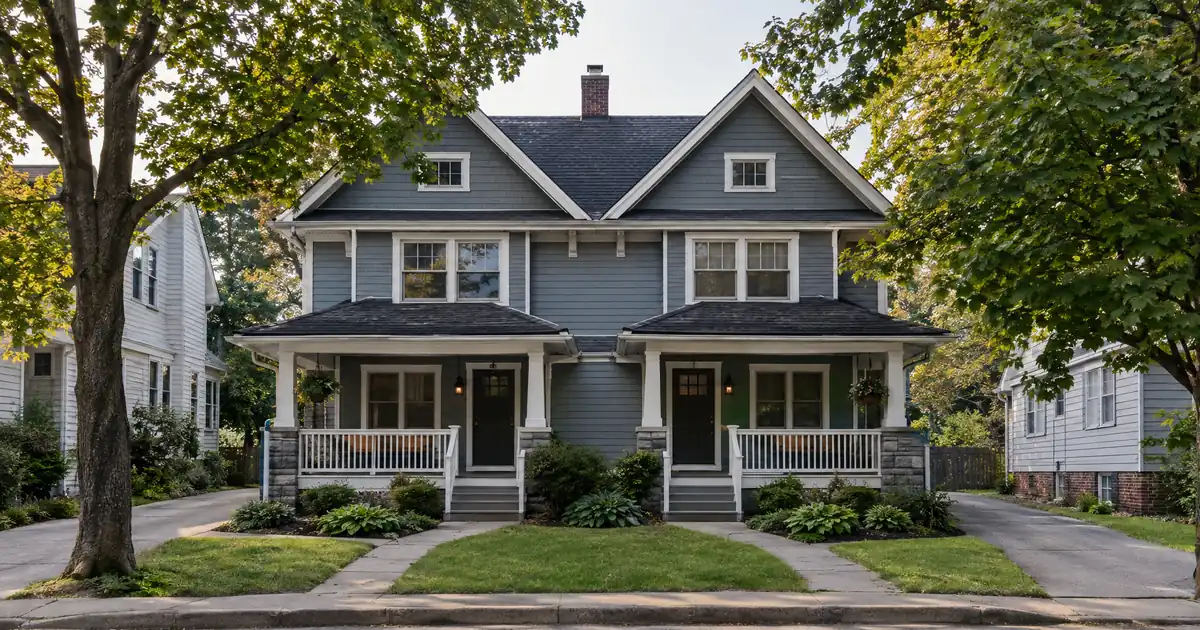
Akron screens at a 12.06 percent gross rental yield, against 10.17 percent across Ohio, on an average home value of $131,255 and a median asking rent of $1,350, per SFR Analytics. That is a wide spread for a city that still houses Goodyear’s headquarters and three major hospital systems. It also hides the catch. When a house is worth that little, the loan-to-value ceiling on a cash-out refinance leaves a thin slice of equity to pull. This piece covers how to size that slice, what has to hold for the file to work, and where Akron equity is thick enough to redeploy.
The Quick Read: A DSCR cash-out refinance on an Akron, Ohio rental is underwritten primarily on the property’s rental income measured against its full monthly obligation, with the appraised value, the seasoning period, and a loan-to-value ceiling setting how much equity can come out, all subject to lender guidelines.
DSCR Cash-Out Calculator
Run the cash-out numbers in Akron, OH
Rate source: Freddie Mac 30-yr average via FRED® — Federal Reserve Bank of St. Louis · effective Sep 24, 2026
Prefilled with starting assumptions — enter your property’s value, balance, taxes, and insurance for a more accurate picture.
Program parameters update from Lendmire’s centralized guideline source. Taxes and insurance are editable estimates.
As of Sep 24, 2026 · General Freddie Mac market benchmark, not a Lendmire loan offer. Property value, balance, taxes, and insurance are editable estimates. Maximum loan-to-value varies by lender, program, property type, and seasoning. Not a Loan Estimate, approval, or commitment to lend. Program availability and eligibility are subject to lender guidelines, credit approval, property review, and underwriting.
- Citywide gross yield screens near 12.06 percent per SFR Analytics, a first-pass screen and not a coverage number.
- Cash-out caps at 75 percent loan-to-value, with about six months of seasoning from title recording.
- Three-bedroom house rents cluster between about $1,200 and $1,360 depending on source, per Zumper and RentCafe.
- Duplexes and triplexes in Highland Square, Goodyear Heights, and Firestone Park carry the strongest equity-recycling logic.
- Sub-$100K properties may return little cash. DSCR cash-out fits seasoned or renovated holdings best.
Lendmire (NMLS# 2371349) places DSCR investor loans on Akron, Ohio properties through wholesale lending channels reaching 41 markets, including D.C. It is a mortgage broker, not a lender. It arranges the file, and the lender reviews eligibility and approves. Investors can see Lendmire’s Ohio DSCR loan programs for the statewide picture.
Akron Market Snapshot
A quick read on the Akron investor landscape — figures come from the cited sources below. Confirm current property-level numbers before underwriting.
| Metric | Detail |
|---|---|
| Typical rents | $1,350 (SFR Analytics) |
| Recent appreciation | 2–4% (Lofty Akron marketplace) |
| University enrollment | 15,318 total fall 2025 (University of Akron Fact Sheet) |
| Vacancy | 7.1% q2 2024 (Matthews, Northeast Ohio) |
Why Akron Equity Is Thinner Than the Yield Suggests
Akron’s low price base is what produces the high yield, and the same low base limits how much cash a refinance can return. Value sources disagree, so it helps to read them as a range and let an appraiser settle the number.
Zillow puts the average home value at $141,611, up 3.2 percent over the past year. Resideline reports a median sold price of $135,678 across 1,508 closed sales, with the middle half of sales between $90,000 and $197,000. Redfin shows a $148K median for the latest three months, up 8.2 percent year over year, with about three offers per sale on average. Redfin’s own page also cites an “average” price down 4.5 percent, so its two figures conflict. Don’t build a refinance thesis on a headline trend. Build it on the comps the appraiser pulls.
The demand side is steady rather than spectacular. Census Bureau QuickFacts puts the city at 189,669 residents with a median household income of $48,521, well below the $71,364 reported for the Akron metro. That gap tells you something about the rent ceiling. Akron works as a cash-flow market, and Lofty, a commercial source whose forecast is unverified, frames it the same way, with only modest 2–4 percent expected price growth. Equity here usually comes from buying right, renovating, and holding, not from a market-wide surge.
Walking Through the Cash-Out Math, Step by Step
The mechanics run in a fixed order, and each step can cap the next. Here is the sequence a lender reviews.
1. Seasoning. Programs in the network typically look for about six months of ownership, measured from title recording, before a cash-out file is reviewed.
2. Value. An appraisal sets the number everything else hangs on.
3. The ceiling. Total debt on the property can’t exceed 75 percent of appraised value. That cap is firm for cash-out, even though purchases can run higher.
4. Payoff. The existing mortgage balance comes out of the new loan first. What’s left is the potential cash.
5. Reserves. Expect to document roughly six months of full monthly obligation in liquid reserves, subject to lender guidelines.
6. Coverage. Monthly rent is divided by the full monthly obligation: principal, interest, taxes, insurance, and any HOA dues. Most standard programs use 1.00 as the baseline, and some lenders review lower ratios with stronger compensating factors. For the longer explanation, see the guide “What Is a DSCR Loan”.
Now run the numbers on three modeled cases. These are assumptions, not market data.
The workforce house. Assume a 3BR appraised at $135,000, near the Resideline median, and a conservative $1,200 rent. At 75 percent loan-to-value, with taxes and insurance included, coverage lands around 1.3. That is comfortable. Equity is the constraint, not coverage.
The duplex. Assume a $150,000 appraisal and two units renting for about $600 and $800, or $1,400 combined, the unit range seen in Akron listing examples. Under the same structure, including taxes and insurance, coverage lands around 1.4. Small buildings tend to clear the number with a bit more cushion because the appraisal and the rent grow together.
The duplex with a vacant side. Now suppose one unit sits empty and only one unit’s rent is in place. Coverage drops below 1.00. Sub-1.00 deals sometimes get reviewed through a sub-1.00 program, an interest-only structure, or a lender that credits market rent from the appraisal. Those options usually come with lower leverage, stronger credit, or more reserves, and qualification stays subject to lender guidelines, credit approval, and property review. The more useful question is whether the unit should be leased before the file goes in.
DSCR files in markets like this one typically look the same from file to file. Appraisal value is the swing factor. Rents are modest per unit, so coverage clears easily, and the cash-out amount ends up as the thing that decides whether the file is worth doing. Experienced investors tend to run the payoff-versus-ceiling arithmetic before ordering an appraisal, not after. The sorting of small balances matters too. Standard programs run up to $3,000,000, and most Akron balances sit far below that, so they route through select lenders in the network that handle smaller loans. Confirm minimums early. For the broader mechanics, the equity-extraction mechanics page walks through the full structure.
| Structure | Rent signal | Cash-out watch point |
|---|---|---|
| 3BR single-family | About $1,200–$1,360 | Low value limits proceeds |
| Duplex or triplex | Units near $575–$900 | Vacant units can sink coverage |
| 5 or more units | Varies by building | Commercial underwriting typically applies |
Where the Equity Is Thick Enough (Neighborhood by Neighborhood)
Akron is, as local investors on BiggerPockets put it, a very block-by-block city. A citywide yield tells you little about any one address, so treat these as directional.
Highland Square. Arts-district character, Victorian homes, and apartment stock make this one of the most market-rate submarkets in Akron, alongside Goodyear Heights. Listing-portal data on Homes.com shows single-family prices that give it more appraisal room than most of the city. Small buildings here show individually modest unit rents, as a Redfin listing with units priced well below typical single-family rents illustrates. Stacking those units is how a building competes with a single 3BR house. Lofty also places renovated turnkey product in Highland Square and Merriman Valley at a lower entry price, with higher rents from young professionals and families. Those are stronger appraisal candidates at slightly lower coverage, and it’s a trade the borrower should size on purpose.
Goodyear Heights and Firestone Park. Both were built by tire executives to house workers, which is why doubles and small buildings sit alongside single-family homes. The City of Akron’s housing strategy names both as historic neighborhoods, along with Highland Square and West Hill, while acknowledging disinvestment and vacant lots elsewhere. Older, denser lots mean more duplex and triplex inventory, though that density point is inference, not sourced fact. These are the neighborhoods where a seasoned small building most plausibly supports a meaningful refinance.
East Akron and the 44306 ZIP. Redfin shows an East Akron median of $108K, up 10.9 percent year over year, with homes taking longer to sell than a year earlier. PropertyIQ shows $90K in 44306, up just 1.8 percent. These are the widest rent-to-price spreads and the thinnest exit liquidity. Coverage looks great on paper, but appraisals are the weak link. Honestly, this is a toss-up: the math is easy, the cash-out proceeds are small, and comps can be thin.
Skip the Student-Rent Premium.
Fifteen thousand students sounds like a rental engine. It isn’t one. The University of Akron reports 15,318 total enrollment in its most recent fall term, including 552 international students from 83 countries, a 3.4 percent increase per Akron.com. Enrollment is still about half its earlier peak, per Ideastream. Student demand near campus has stabilized, which makes it a floor and not a growth story. Underwrite at standard market rent.
The steadier anchors are employers. A market source cites nearly 20,000 businesses in the county, key sectors in polymers and advanced materials, and three major hospital systems as the foundation of its biomedical industry. Cleveland Clinic Akron General is one of them, alongside Summa Health and Akron Children’s Hospital. Goodyear remains headquartered in the city. Nurses, technicians, and residents are a natural workforce-rental tenant profile here, though that’s inference. This kind of employment base supports long-term lease durability on older small buildings more than on student product.
Supply is worth watching. A published report on Northeast Ohio showed Akron multifamily vacancy at 7.1 percent after five straight quarters of negative net absorption. That figure is older, metro-level, and covers institutional apartments, and the report mixes Akron and Cleveland text, so treat it cautiously. Large-complex deliveries compete with newer product, not 2–4 unit stock. Still, no reliable Akron vacancy figure exists, so every file should be run on its own rent comps.
What Happens to the Proceeds
The cash-out thesis depends on what the investor does with the money. Pulling equity from a seasoned duplex to buy another small building in Goodyear Heights or Firestone Park, where coverage still clears, is a clean use. Pulling equity to chase an out-of-state deal that doesn’t pencil is a different decision worth stress-testing first.
The BRRRR caution applies here too. A local practitioner on BiggerPockets calls BRRRR a good strategy in Akron but “not necessarily a fix all” for pulling out every dollar. Lofty’s model example, a $55,000 purchase plus a $30,000 rehab refinanced at 70 percent of after-repair value, lands the refinance right around the all-in cost. At these price points, a sub-$100K property may return little or no original capital. Pitch DSCR cash-out as a way to recycle equity from seasoned or renovated holdings, with no promise of a full return of capital.
If the plan is to refinance an LLC-held building, eligibility varies, and entity-owned files are subject to lender program eligibility. For the wider menu, look at the other refinancing options available. Investors ready to test a specific property can get a rental-income loan quote or call 828-256-2183.
Is DSCR the Right Lane Here?
For a W-2 owner with one or two rentals and clean traditional personal-income documentation, conventional financing may carry a lower cost and fewer non-QM constraints. DSCR pulls ahead for entity-held portfolios, self-employed investors, or anyone beyond four financed properties, where the conventional lane runs out. Conventional vs DSCR on investor loans lays out the comparison. Akron’s low balances matter here as well, since a small loan can make DSCR pricing and minimums more of a factor than the income-documentation question.
Frequently Asked Questions
How do you qualify for a DSCR cash-out refinance in Akron, Ohio?
The property has to show about six months of ownership from title recording, an appraised value that supports no more than 75 percent loan-to-value after the existing loan is paid off, and rent that covers the full monthly obligation at or above the program baseline, typically 1.00. Pricing and available terms vary by lender, borrower profile, property type, and full underwriting review. All of this is subject to lender guidelines.
DSCR vs. conventional financing
There are two common ways to finance an investment property in Akron, OH, and they qualify you differently — here’s how investors weigh them.
Why investors choose it
- Qualifies on the property’s rental income — no personal tax returns, W-2s, or pay stubs needed to document income.
- No personal debt-to-income ceiling to clear, so existing mortgages and obligations don’t cap your borrowing the same way.
- Can be closed in an LLC, keeping the property inside a business entity.
- Built for scaling — not held to the limit on number of financed properties that conventional financing applies.
- Underwriting centers on the deal: generally qualifies when the rent covers the payment, a 1.00x coverage ratio being a common baseline (confirmed in underwriting).
- Designed specifically for investment property, including long-term and, where the program allows, short-term rentals.
Where it’s strong
- Often the lowest ongoing financing cost for a buyer who fully qualifies on personal income — a fit for a first property or a cost-first purchase.
Trade-offs for investors
- Requires full personal income documentation and must fit within a debt-to-income limit — salary, existing debts, and other mortgages all count.
- Typically held in your personal name rather than a business entity.
- Caps how many financed properties you can carry, which can become a ceiling as a portfolio grows.
- Evaluates you as a borrower as much as the property, which usually means more paperwork.
How investors usually choose: a first or single property often optimizes for the lowest financing cost; portfolio builders often optimize for leverage, vesting in an LLC, and scaling past conventional caps. The right answer depends on your goals, the property, and current guidelines — both paths run through select lenders in Lendmire’s wholesale network, with eligibility and terms confirmed in underwriting.
What are the requirements for an investment property loan in Akron, Ohio?
Expect a credit score of at least 620 on most files, a rent figure from a lease or appraisal that the lender uses for review, and reserves in the neighborhood of six months. Eligible properties include single-family homes and 2–4 unit buildings, while manufactured homes, log homes, and barndominiums fall outside these programs. Review details are subject to lender overlays.
Will a cash-out refinance on a cheap Akron rental return much cash?
Often not. With a 75 percent ceiling and a median sold price of $135,678, the gap between the payoff and the cap can be small, and the middle half of sales spans $90,000 to $197,000. Seasoned or renovated holdings, and small buildings with strong appraisals, tend to produce meaningful proceeds.
Does a 12 percent gross yield mean coverage will clear in Akron?
Usually coverage clears more easily than in higher-priced markets, but the gross yield ignores taxes, insurance, vacancy, and rehab. Local investors describe pricing as block by block, so the property’s own comps matter more than any citywide screen.
Can a self-employed investor buying in Akron be reviewed for DSCR financing?
Yes, DSCR files are generally reviewed on property cash flow instead of traditional personal-income documentation, subject to lender guidelines.
Where Akron Goes From Here
Over the next 6 to 24 months, the likeliest path is modest appraisal growth, not a surge. Lofty’s 2–4 percent forecast, Zillow’s 3.2 percent, and Redfin’s stronger 8.2 percent all point to values drifting up from a low base. If that holds and university enrollment keeps edging higher, seasoned duplexes in Highland Square, Goodyear Heights, and Firestone Park should see their equity grow. The cash-out opportunity will favor holders who’ve owned past the seasoning window and kept units leased, while investors counting on a quick appraisal jump on a $90,000 East Akron house are likely to find the 75 percent ceiling leaves little to pull. Local rental rules, taxes, and insurance are worth confirming with qualified local professionals before any refinance.
For current guidelines and terms, see Lendmire’s DSCR loan programs page.
About Lendmire
A DSCR-focused mortgage broker, Lendmire (NMLS# 2371349) places investor financing across 41 markets, 40 states plus Washington, D.C., with eligibility generally reviewed by the lender on property cash flow instead of traditional personal-income documentation, subject to lender guidelines. Lendmire was recognized by Scotsman Guide in 2025 and recognized by Scotsman Guide as a 2026 Top Workplace.
Get Started
Ready to find the right loan for you?
See your offer in seconds. No credit pull, no obligation.
Informational only. Not a Loan Estimate, approval, or commitment to lend. Program availability and eligibility are subject to lender guidelines, credit approval, property review, and underwriting.
References
1. SFR Analytics, Akron rental yields
2. Zumper
3. RentCafe
4. Lofty
5. University of Akron fact sheet
7. Zillow
8. Resideline
9. Redfin, Akron housing market
10. Census Reporter, Akron profile
11. BiggerPockets
12. Homes.com
13. City of Akron housing strategy
14. Redfin
15. PropertyIQ
16. Akron.com
17. Ideastream
18. Cleveland Clinic Akron General
19. recognized by Scotsman Guide in 2025
20. recognized by Scotsman Guide as a 2026 Top Workplace
This article is part of Lendmire’s investment property cash-out refinance program — full qualification details, guidelines, and scenarios live on the program page.
Related reading: Cash Out Refinance Investment Property in Akron, Ohio: Will Rents Cover the New Loan After Cash-Out? · DSCR Loans in Akron / Canton, Ohio: Investor Financing for Fairlawn, North Canton, Stark County & Real Estate Investors · DSCR Cash Out Refinance in Cleveland, Ohio: East Side Equity and Medical-Corridor Demand
Guides: Investment Property Cash-Out Refinance in Akron, OH · Investment Property Cash-Out Refinance in Ohio
Brandon Miller
Founder & CEO, Mortgage Loan Originator, Lendmire LLC
- Mortgage Loan Originator · NMLS# 1129696 · Verify on NMLS Consumer Access
- North Carolina Real Estate Broker · License# 343312 · Verify on NCREC
- North Carolina Insurance Producer · License# 19053198 · Property, Casualty, Life, Health · Verify on NAIC SBS
- Lendmire LLC · Firm NMLS# 2371349 · Verify firm licensure
Disclosure information. Lendmire is a state-licensed mortgage brokerage under NMLS# 2371349. Lendmire is not a depository institution, direct lender, or financial advisor — all loans referenced are placed through wholesale lender partners and are subject to each lender's underwriting standards. This article is provided for general informational purposes and is not a commitment to lend, nor does it constitute financial, legal, or tax advice. Loan programs, terms, rates, and qualification standards change without notice and depend on borrower profile, property type, and the state in which the subject property is located. Equal Housing Opportunity provider. NMLS Consumer Access: nmlsconsumeraccess.org.