
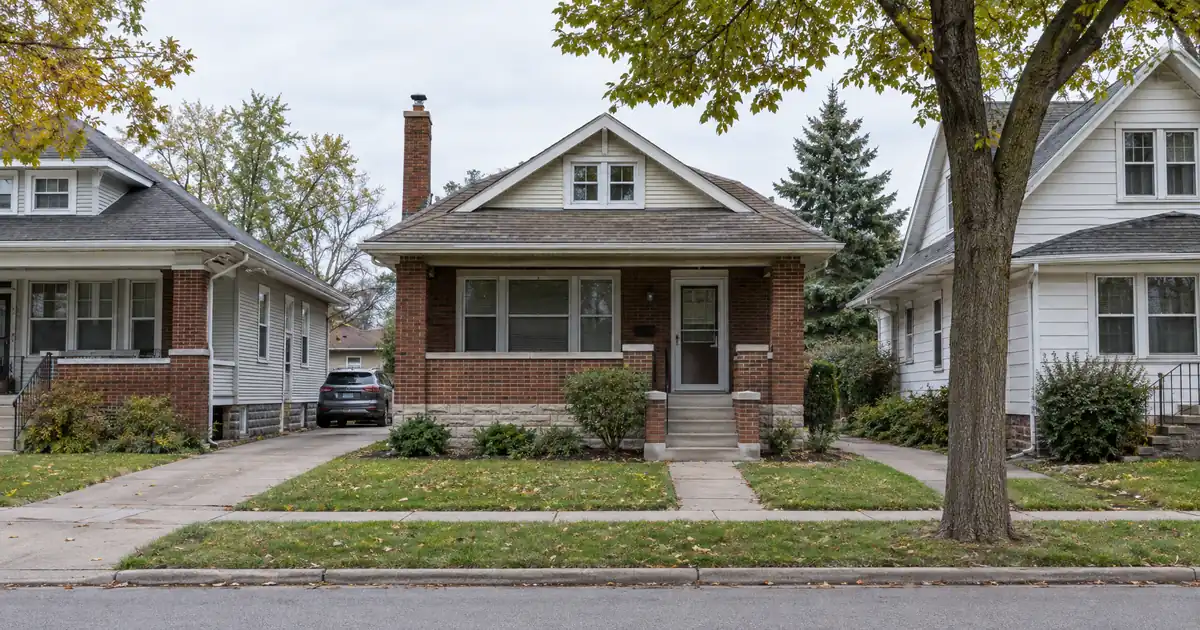
Over the next 6 to 18 months, De Pere’s east side will absorb a wave of new downtown apartments while older small rentals a few blocks away keep competing for the same tenants. That sequencing matters if you own a duplex here and are thinking about pulling equity out. Appraisals will pick up some of the redevelopment halo, but lease-up pressure could flatten rent growth on the older units your coverage ratio depends on.
Lendmire is a DSCR-focused mortgage broker (NMLS# 2371349). For De Pere, Wisconsin rental property financing, Lendmire helps arrange DSCR loans through lenders operating in 41 markets, including Washington, D.C. This article stays on the equity side: what a cash-out refinance on a property you already own looks like in De Pere, and where the paperwork and the math tend to snag.
DSCR Cash-Out Calculator
Run the cash-out numbers in De Pere, WI
Rate source: Freddie Mac 30-yr average via FRED® — Federal Reserve Bank of St. Louis · effective Sep 24, 2026
Prefilled with starting assumptions — enter your property’s value, balance, taxes, and insurance for a more accurate picture.
Program parameters update from Lendmire’s centralized guideline source. Taxes and insurance are editable estimates.
As of Sep 24, 2026 · General Freddie Mac market benchmark, not a Lendmire loan offer. Property value, balance, taxes, and insurance are editable estimates. Maximum loan-to-value varies by lender, program, property type, and seasoning. Not a Loan Estimate, approval, or commitment to lend. Program availability and eligibility are subject to lender guidelines, credit approval, property review, and underwriting.
TL;DR: A DSCR cash-out refinance on a De Pere, Wisconsin investment property is underwritten primarily on the rental income the building produces against its full monthly obligation, with the new loan sized to the appraised value rather than to your personal paychecks.
- Small multi-unit buildings are the realistic fit; median-priced single-family strains coverage.
- The cash-out ceiling is 75% of appraised value, subject to lender guidelines.
- Ownership of about 6 months, measured from title recording, is the typical seasoning baseline.
- Thin duplex comps in De Pere can cap the appraised value your equity is measured against.
- Borrowing below the ceiling is often how coverage clears 1.00 here.
De Pere Market Snapshot
A quick read on the De Pere investor landscape — figures come from the cited sources below. Confirm current property-level numbers before underwriting.
| Metric | Detail |
|---|---|
| Home prices | 87 sales in may (Redfin De Pere Housing Market) |
| Recent appreciation | +19.2% yoy (Redfin De Pere Housing Market) |
| University enrollment | ~500-student drop (Fox 11 SNC enrollment article) |
East De Pere and the Fox River Rebuild
East De Pere is the strongest equity-extraction story in the city because public money is reshaping the blocks around the older rental stock. The former Shopko site now carries four projects: a five-story apartment building, a city parking garage, a new five-story hotel, and a restored street grid.
Alongside it, the Lockside riverfront project includes 173 residential units, 29 of them condos, and the city expects it to bring 245 to 290 new long-term residents downtown. Pricing and available terms vary by lender, borrower profile, property type, and full underwriting review. The city’s own development project list also shows a proposed apartment project and a three-unit residential building in the pipeline.
Why does this matter for a refinance? Appraisers reading a downtown with fresh capital investment tend to be more comfortable with value. Older duplexes and small buildings on the east side are the likely beneficiaries. No reliable source breaks out east-side duplex prices or rents separately, so treat the idea as a thesis rather than a measured fact.
Here’s the tradeoff. The new supply that supports value also competes for tenants. Investors holding older 1- and 2-bedroom units near the river and the college should underwrite conservatively and check current concessions on the new buildings before assuming any rent trend continues. Owners planning to sit tight and let the neighborhood mature can treat the pressure as noise. Owners planning to pull equity and redeploy should treat it as a reason to size the new loan with a cushion.
West De Pere is a different animal. Builders such as Best Built are active there with new single-family construction, and it reads more owner-occupant than investor. If your rental sits on that side, expect single-family coverage math rather than duplex math.
What Does the Rent Side Actually Look Like?
The rent side is more fragmented than the headline numbers suggest, and that matters because coverage is only as good as the rent the lender accepts. Zumper puts average De Pere rent at $1,532 a month, but that is an all-property listing average from a small sample, and the year-over-year movement has been volatile. Describe it as rising per listing data and stop there.
Apartment-style listings run lower. Apartments.com shows an average of $1,120 within a range of $953 to $1,708. Rentcafe lists 2-bedrooms from $1,225 up to $2,822, with the top end probably reflecting new luxury buildings. For older 1- and 2-bedroom units, a working band near $1,100 to $1,300 per unit is a more defensible underwriting assumption than the headline average.
Demand itself looks stable rather than explosive. Census Bureau QuickFacts shows a population of 25,301 across 12 square miles, a median household income of $84,869, and a median age of 36.3. Rentcafe, citing Census estimates, says 35% of De Pere housing is rented, and 70% of apartments sit in complexes under 50 units. A duplex or fourplex here competes with other small buildings, not with institutional complexes.
Sale prices need the same caution. Redfin shows a median sale price of $406K, with the price per square foot at $202, up 5.8% on the year. The headline price jump is far larger than that, which suggests the mix of homes sold shifted toward pricier ones. Don’t call it appreciation. When you’re estimating equity, the per-square-foot trend is the more honest guide.
Duplex Math Versus Single-Family Math
Stacked units are the realistic route to a coverage number at or above 1.00 in De Pere, and a median-priced single-family rental is the wrong tool for a cash-out DSCR file. The coverage ratio is monthly rent divided by the full monthly obligation: principal, interest, taxes, insurance, and any HOA dues. The guide “What Is a DSCR Loan” is worth a quick read if the ratio is new to you.
The table below is modeled, not sourced market data. It assumes a 75% LTV and includes taxes and insurance, with coverage rounded down. Every figure here varies by lender and program — guidelines, property type, leverage, and credit profile all apply.
| Scenario (modeled) | Rent assumption | Coverage incl. Taxes/insurance |
|---|---|---|
| Single-family near $406K | $1,532 average | About 0.55x |
| Duplex near $360K | $1,100-$1,300 per unit | Low 0.9s to just over 1.0x |
| Same duplex at 65% LTV | Same rents | Roughly 1.1x |
Run the numbers on that duplex. Compass shows small multi-family asking prices from $289,900 to $439,999, so $360,000 sits mid-range. Two units at the modeled band make coverage land right around the 1.00 benchmark at the full 75% ceiling. Pull back to 65% LTV and the same rents clear it with room. The takeaway is straightforward: the maximum cash-out is not always the right cash-out. Final terms depend on lender guidelines, property type, leverage, and the borrower’s complete credit picture.
That reverses the usual instinct. If you own a single-family rental free and clear and want the maximum extraction, the file may fall short of 1.00 on long-term rent alone. In that case, a lender might review lower-leverage or sub-1.00 structures, or an interest-only option, but those usually mean stronger credit, more reserves, or a smaller loan, and all of it is subject to lender guidelines. Conventional financing may suit the owner with strong traditional employment income and one or two properties. The side-by-side comparison lays out where that flip point tends to fall.
DSCR files in markets like this one typically look like a small building with modest but documentable rents, a loan sized well under the ceiling, and an appraisal that leans on whatever comps are closest. The strongest files arrive with a signed lease for each unit, a rent schedule that matches the leases, and a payoff figure from the current servicer in hand. Files built on the highest asking rent in the neighborhood tend to get re-cut when the appraiser’s market rent comes back lower.
Seasoning, Appraisal, and the Paperwork Plumbing
Most friction on a De Pere cash-out comes from three places: seasoning, comps, and documents. Seasoning is the simplest. The typical baseline is about 6 months of ownership measured from title recording, so a recent purchase made with a renovation plan still has to age on the clock before the cash-out clears.
Comps are the real constraint. Multi-family inventory in De Pere is thin. Homes.com showed only 2 multi-family listings in a snapshot, with prices from $289,900 to $2,462,000. That top figure includes a large portfolio package, so ignore it as a pricing guide. LoopNet showed 2 listings and Trulia showed 3.
Multi-family here also tends to sell more slowly than homes overall. An appraiser with few recent sales may lean on single-family or Green Bay comps, and that can limit how much equity the 75% ceiling actually supports. Think of the ceiling as a maximum, not a promise.
Then the documents:
- A current lease for each unit, plus a rent schedule that matches them.
- Entity paperwork if the building sits in an LLC, subject to lender program eligibility.
- A payoff statement from the current servicer, and title work that shows the recording date.
- Proof of reserves, typically about 6 months of the full monthly obligation.
- Credit that clears the program floor of 620, with pricing tiers stepping up at 660, 680, and 700.
Condo units, if you own one of the downtown-style products, add a project-level review. Properties that fall outside the programs, such as manufactured homes, log homes, and barndominiums, aren’t reviewable through these DSCR channels at all. All of this varies by borrower, property, and loan scenario. Verify current local rental rules, taxes, and insurance with qualified local professionals before underwriting.
Tenant Demand Beyond the Campus (Smaller Than It Looks)
De Pere’s tenant base leans on the Green Bay employment market rather than on its college. HUD describes the metro economy as anchored by a long history of paper and food product manufacturing, and calls it stable. It also puts the Packers’ economic impact on Brown County at about $400 million in a recent season. Names from HUD’s older employer list include Schneider National, Bellin Health, Georgia-Pacific, Aurora Health Care, UnitedHealthcare, and American Foods Group, though the headcounts in that report are stale and not worth quoting.
The Greater Green Bay Chamber adds that UnitedHealth and Humana each employ 1,000 or more in the state, and lists four major hospital systems. Most of those jobs sit in Green Bay, a short commute away. That supports long-term renters in De Pere without making the city a one-employer town.
St. Norbert College deserves honest treatment. U.S. News reports undergraduate enrollment of 1,695, and Fox 11 reports a drop of about 500 students in recent years, with two rounds of layoffs. A four-year on-campus residence requirement also limits off-campus student demand. Staff and faculty renters still matter, but a plan that depends on student leasing is fragile.
This one’s a genuine judgment call. The east-side location near campus and the river helps appraised value, though the college’s softening pushes against the rent side. An owner with long-tenured working renters can reasonably ignore the enrollment story. An owner whose rent roll is student-heavy should stress-test it before borrowing against it.
Skip the Luxury Chase
The new downtown product matters as a demand signal, not as a purchase target for DSCR math. At the condo prices Lockside is showing, coverage on a rented unit would sit well below the 1.00 benchmark. Equity pulled from an older duplex is better aimed at another small building where the rent-to-price ratio still works.
That ratio is the thread running through every De Pere decision. Equity from one property can fund the down payment on the next, but only if the next property pencils at the loan size you’d actually take. If the answer is that it only works at a price nobody will sell at, the cash-out is a solution looking for a deal. Better to find that out before the appraisal than after.
DSCR vs. conventional financing
There are two common ways to finance an investment property in De Pere, WI, and they qualify you differently — here’s how investors weigh them.
Why investors choose it
- Qualifies on the property’s rental income — no personal tax returns, W-2s, or pay stubs needed to document income.
- No personal debt-to-income ceiling to clear, so existing mortgages and obligations don’t cap your borrowing the same way.
- Can be closed in an LLC, keeping the property inside a business entity.
- Built for scaling — not held to the limit on number of financed properties that conventional financing applies.
- Underwriting centers on the deal: generally qualifies when the rent covers the payment, a 1.00x coverage ratio being a common baseline (confirmed in underwriting).
- Designed specifically for investment property, including long-term and, where the program allows, short-term rentals.
Where it’s strong
- Often the lowest ongoing financing cost for a buyer who fully qualifies on personal income — a fit for a first property or a cost-first purchase.
Trade-offs for investors
- Requires full personal income documentation and must fit within a debt-to-income limit — salary, existing debts, and other mortgages all count.
- Typically held in your personal name rather than a business entity.
- Caps how many financed properties you can carry, which can become a ceiling as a portfolio grows.
- Evaluates you as a borrower as much as the property, which usually means more paperwork.
How investors usually choose: a first or single property often optimizes for the lowest financing cost; portfolio builders often optimize for leverage, vesting in an LLC, and scaling past conventional caps. The right answer depends on your goals, the property, and current guidelines — both paths run through select lenders in Lendmire’s wholesale network, with eligibility and terms confirmed in underwriting.
If you want to see how a specific building’s numbers shake out, see how the math pencils or reach the team at 828-256-2183. For broader program context, see DSCR loans in Wisconsin, pulling equity with a DSCR cash-out, and investor refinance options.
Frequently Asked Questions
Can a single-family rental in De Pere support a DSCR cash-out refinance?
Usually only with low leverage. At the median price and the average listing rent, modeled coverage with taxes and insurance included lands around 0.55x at the full 75% LTV ceiling. Borrowers sometimes pair a smaller loan with stronger credit and extra reserves, subject to lender guidelines. A duplex generally gives the file more room.
How long do I have to own a De Pere property before cashing out?
The typical baseline is about 6 months of ownership, measured from title recording rather than from the contract date.
Will thin duplex inventory hurt my appraisal?
Yes, it can. With only a handful of multi-family listings at any time, an appraiser may borrow comps from single-family sales or from Green Bay. That may cap the appraised value your 75% ceiling applies to. Documented rents and recent improvements help the appraiser support the figure.
Does the downtown redevelopment help or hurt my equity?
Both, in different ways. Public investment on the Shopko site and along the river tends to support value, while new apartments add competition for older small units. Underwrite rents conservatively and treat any value lift as upside rather than something to borrow against.
Which rent figure should I use for coverage in De Pere?
Use leases and the appraiser’s market-rent schedule. Zumper’s average of $1,532 mixes in larger homes, while apartment-style listings average closer to $1,120. A band of $1,100 to $1,300 per older unit is a more cautious starting assumption.
Before You Pull the Equity
De Pere rewards the owner who treats appraised value as the starting number and rent as the deciding one. A duplex near the river, a lease file that matches the rent schedule, and a loan sized a notch under the ceiling make a very different file than a maxed-out single-family request. So when you look at the property you already own, would its rents still cover the debt at the loan size you’d actually take, or only at the ceiling?
About Lendmire
As a non-QM mortgage broker (NMLS# 2371349), Lendmire facilitates DSCR investor loans across 41 markets, including Washington, D.C. Eligibility is generally reviewed around a property’s rental income rather than personal income documentation, subject to lender guidelines, which fits LLC-structured portfolios and self-employed borrowers who sit outside conventional boxes. Lendmire is a 2025 Scotsman Guide Top Mortgage Workplace, and was also recognized by Scotsman Guide as a 2026 Top Workplace.
Get Started
Ready to find the right loan for you?
In about 30 seconds you can review financing options available for your investment property. No commitment required.
Informational only. Not a Loan Estimate, approval, or commitment to lend. Program availability and eligibility are subject to lender guidelines, credit approval, property review, and underwriting.
References
1. Redfin
2. Fox 11
3. Dailyreporter.com — Four Projects Reshape Former Shopko Site Downtown
4. nbc26.com — De Pere Scales Back Major Downtown Development Council Advances Project
5. deperewi.gov — Development project list
6. Best Built
7. Zumper
9. Rentcafe
11. Homes.com
12. LoopNet
13. HUD
15. 2025 Scotsman Guide Top Mortgage Workplace
16. recognized by Scotsman Guide as a 2026 Top Workplace
This article is part of Lendmire’s investment property cash-out refinance program — full qualification details, guidelines, and scenarios live on the program page.
Related reading: DSCR Cash Out Refinance in De Pere, Wisconsin: How the Rent Math Clears at 75% LTV Here · Cash Out Refinance Investment Property in Stevens Point, Wisconsin: How the Rent Math Clears at 75% LTV · DSCR Cash Out Refinance in La Crosse, Wisconsin: How Much Equity Investors Can Pull in La Crosse
Guides: Investment Property Cash-Out Refinance in Wisconsin
Brandon Miller
Founder & CEO, Mortgage Loan Originator, Lendmire LLC
- Mortgage Loan Originator · NMLS# 1129696 · Verify on NMLS Consumer Access
- North Carolina Real Estate Broker · License# 343312 · Verify on NCREC
- North Carolina Insurance Producer · License# 19053198 · Property, Casualty, Life, Health · Verify on NAIC SBS
- Lendmire LLC · Firm NMLS# 2371349 · Verify firm licensure
Legal disclosures. Lendmire (NMLS# 2371349) is a state-licensed mortgage brokerage that arranges financing through wholesale lender relationships. Lendmire is not a direct lender, depository institution, or registered financial advisor. The discussion above is general informational content about real estate financing — it is not financial, legal, or tax advice, and readers should consult licensed professionals for guidance on their individual circumstances. Loan inquiries are subject to lender underwriting; this article does not represent a commitment to lend. Loan terms, rates, and qualification standards vary by borrower, property, and state, and are subject to change at any time. Equal Housing Opportunity. NMLS Consumer Access: nmlsconsumeraccess.org.