
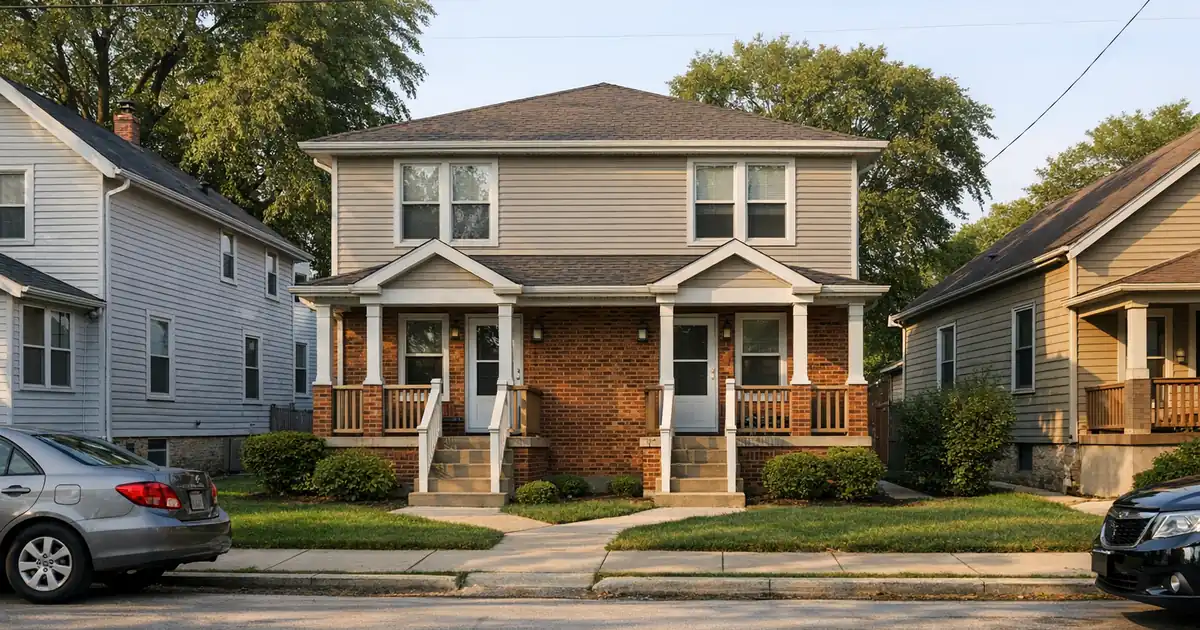
Refinance for Joliet investment property using a DSCR cash-out loan that qualifies on rental income alone. You don’t need a W-2, a pay stub, or a tax return to refinance an investment property in Joliet — and most real estate investors don’t know that conventional income rules simply don’t apply here. A DSCR cash-out refinance qualifies entirely on the property’s rental income, not the owner’s personal financial profile. That shift changes everything for landlords sitting on accumulated equity in one of Illinois’ most active rental markets.
Joliet investors can access up to 75% LTV through a DSCR cash-out refinance — pulling out capital to acquire more rentals, retire hard money debt, or fund renovations — without ever opening a tax return. Lendmire, a non-QM mortgage broker (NMLS# 2371349), works directly with real estate investors across Joliet and throughout Illinois through investment property refinance options built specifically for portfolios that don’t fit the conventional income model.
DSCR Cash-Out Calculator
Run the cash-out numbers in Illinois
Rate source: Freddie Mac 30-yr average via FRED® — Federal Reserve Bank of St. Louis · effective Jul 30, 2026
Prefilled with starting assumptions — enter your property’s value, balance, taxes, and insurance for a more accurate picture.
Program parameters update from Lendmire’s centralized guideline source. Taxes and insurance are editable estimates.
As of Jul 30, 2026 · General Freddie Mac market benchmark, not a Lendmire loan offer. Property value, balance, taxes, and insurance are editable estimates. Maximum loan-to-value varies by lender, program, property type, and seasoning. Not a Loan Estimate, approval, or commitment to lend. Program availability and eligibility are subject to lender guidelines, credit approval, property review, and underwriting.
Key Takeaways:
- DSCR loans qualify on rental income alone — no W-2s, tax returns, or personal income documentation required
- Joliet investors can access up to 75% LTV on a cash-out refinance after just 6 months of ownership
- LLC and entity ownership is supported, subject to lender program eligibility
- Lendmire closes DSCR loans in as few as 15 days, working across 41 markets as a dedicated non-QM broker
DSCR Loan Basics for Investment Properties
DSCR cash-out refinancing measures whether a property’s rental income covers its debt obligations — and nothing else. No DTI calculation. No W-2 review. No personal income analysis. If the rent covers the payment, the loan qualifies.
For a deeper look at DSCR loans, the guide “What Is a DSCR Loan” breaks down the full qualification mechanics for investment properties.
How DSCR Is Calculated: Gross Monthly Rent ÷ Monthly PITIA = DSCR | Below 1.00 = cash flow negative | At or above 1.00 = property covers its debt.
A ratio at or above 1.00 means the property pays for itself. Properties above 1.25 typically qualify for the broadest program options and highest LTV access.
Joliet’s Rental Market and the Case for Equity Access
Joliet, Illinois has quietly become one of the Chicago metro’s most investor-friendly rental markets — and with equity levels having risen substantially in recent years, the opportunity to extract and redeploy that capital has never been more accessible.
Situated at the intersection of I-55 and I-80, Joliet serves as a major logistics and distribution hub for the region. Amazon, Walmart, and Uline operate major fulfillment and distribution centers nearby, drawing a large, stable workforce that drives consistent rental demand across the city’s neighborhoods. The expansion of the BNSF Logistics Park — one of the largest inland intermodal facilities in North America — has brought thousands of permanent jobs to the south and east sides of the metro, supporting occupancy rates that active landlords recognize immediately.
Rental demand also flows from Joliet Junior College’s enrollment base and the Presence Saint Joseph Medical Center campus, both of which generate steady tenant pools for investors holding properties near downtown and the Collins Street corridor. The Rock Island and Heritage Corridors Metra lines connect Joliet directly to Chicago’s Loop, making longer-term tenants out of commuters who need affordable rents within train distance of the city.
For investors holding properties in Joliet, this combination of employment anchors and commuter access has translated directly into property appreciation. Lendmire works directly with real estate investors in Joliet, Illinois, providing DSCR cash-out refinance solutions without income documentation requirements — letting landlords monetize that equity and put it back to work in the same market or beyond.
The Case for DSCR Cash-Out Refinancing
Pulling equity from a rental property doesn’t have to mean wading through tax returns or explaining depreciation schedules to an underwriter. DSCR programs exist specifically to separate investment property financing from personal income analysis.
The six core advantages Joliet investors use most:
- No income documentation required: — qualification is based entirely on the property’s gross rental income relative to PITIA; no W-2s, no Schedule E review, no pay stubs
- Cash-out proceeds applied to investment debt: — use extracted equity to pay off a hard money loan, bridge loan, or private lender note on another rental property
- Short-term rental flexibility: — properties operating on Airbnb or VRBO qualify using a market rent analysis or 12-month rental history, giving investors access to STR equity as well
- LLC and entity ownership supported: — DSCR loans allow closings in an LLC or trust name, subject to lender program eligibility, keeping investment properties off personal credit profiles
- No cap on financed properties: — conventional programs restrict investors to 10 financed properties; DSCR programs impose no such limit, making them the natural tool for portfolio scaling
- Faster seasoning requirement: — DSCR cash-out programs require only 6 months of ownership versus the 12-month seasoning requirement under conventional underwriting guidelines
These benefits apply directly to Joliet investors holding residential rentals, 2-4 unit buildings, and mixed-use properties across the city’s established neighborhoods.
Turning these benefits into real cash-out proceeds starts with one conversation about your rental portfolio.
Holding equity in a Joliet rental? Lendmire’s DSCR programs let investors access it without submitting W-2s, tax returns, or pay stubs. Get a DSCR quote in 30 seconds or call Lendmire at 828-256-2183 to run the numbers.
Meeting DSCR Loan Requirements
DSCR loan qualification runs on a small set of verified parameters — no DTI, no employment history, no personal income verification. Here’s what actually matters:
Credit score thresholds:
- 660 FICO minimum for most cash-out refinance transactions
- 700 FICO minimum for first-time real estate investors
- 680 FICO minimum for interest-only loan structures on 1-4 unit properties
The 660 minimum is lower than the 720+ threshold required for best conventional pricing — because DSCR underwriting evaluates the property’s income as the primary risk variable, not the borrower’s creditworthiness. That fundamental difference opens doors for investors whose tax returns show aggressive depreciation or complex passive income structures.
LTV and cash-out limits:
- Cash-out refinance: up to 75% LTV (620+ FICO, DSCR ≥ 1.00, loans up to $3,000,000)
- Illinois properties carry a declining market overlay: maximum 70% LTV on refinance transactions
- 2-4 unit properties: maximum 70% LTV on refinance
DSCR ratios:
- Standard minimum: 1.00 or above
- Sub-1.00 DSCR available with restrictions (640+ FICO, reduced LTV), program-dependent
DSCR programs require a minimum of 6 months of ownership before a cash-out refinance — a window designed to establish the property’s rental income track record and protect against immediate equity extraction after purchase.
DSCR cash-out essentials: 620+ FICO | 75% LTV ceiling | own 6 months before refinancing | 6 months reserves on a cash-out (cash-out proceeds may count toward them).
Reserves: none at or below $1,500,000 and 70% LTV; 6 months PITIA above 70% LTV; 9 months above $1,500,000; 6 months on a cash-out (cash-out proceeds may satisfy). Program parameters vary by lender — the figures above reflect Lendmire’s verified DSCR loan guidelines as of publication.
Understanding how DSCR stacks up against conventional alternatives is where the real strategic picture emerges.
DSCR vs. Conventional: A Side-by-Side Look
Conventional investment loans follow Fannie Mae guidelines that create real friction for active portfolio investors. Here’s how the programs compare — starting with the most overlooked differences:
- Reserves: Conventional requires 6 months PITIA on every financed property in the portfolio — not just the subject property. A 5-property investor needs 30 months of reserves sitting in a bank account. DSCR reserves follow leverage and loan size (none at or below $1,500,000 and 70% LTV; 6 months above 70% LTV; 9 months above $1,500,000).
- Portfolio cap: Conventional programs cap investors at 10 financed properties (6+ require 720 FICO minimum). DSCR imposes no financed property limit, making it the only viable tool for investors beyond the first five doors.
- Seasoning: Conventional requires an existing first mortgage to be at least 12 months old before a cash-out refinance. DSCR programs allow cash-out after just 6 months of ownership.
- LLC ownership: Conventional loans must close in an individual borrower’s name — LLC ownership is not permitted. DSCR fully supports LLC and entity closings, subject to lender program eligibility.
- Income documentation: Conventional requires full income documentation — W-2s, tax returns with Schedule E, pay stubs — and applies a DTI cap around 45%. DSCR requires none of these; qualification is based entirely on rental income relative to debt obligations.
For a full breakdown, DSCR vs conventional investment loans covers every parameter in detail.
Investing in Joliet: Neighborhoods, Equity, and Strategy
The Downtown and Bluff Street Corridor
The downtown Joliet core — anchored by the Joliet Area Historical Museum, the Rialto Square Theatre, and the developing Riverfront area — has attracted long-term rental demand from renters priced out of Chicago’s south suburbs. Properties along Bluff Street and Jefferson Street have seen steady occupancy driven by healthcare workers at Presence Saint Joseph and administrative staff at Will County government offices.
Investors who acquired single-family rentals and small multifamily properties in this corridor have accumulated meaningful equity through a combination of principal paydown and property appreciation. A DSCR cash-out refinance allows those investors to extract that equity at 70% LTV (Illinois declining market overlay applies) without a single income document crossing an underwriter’s desk.
The West Side and Caton Farm Road Submarkets
Joliet’s west side — particularly the neighborhoods running along Caton Farm Road and the US-30 corridor toward Plainfield — attracts rental tenants employed in the massive distribution and logistics operations anchored by Walmart’s regional fulfillment center and multiple Amazon facilities.
Rents in this submarket have held firm given sustained demand for rental housing close to these employment centers. For investors holding two or three rentals in this pocket, DSCR cash-out refinancing provides a path to extract equity and redeploy it into additional units without the reserve requirements that would stall a conventional application.
Multifamily Strategy in the Rock Island Metra Zone
Properties within walking distance of Joliet’s Rock Island and Heritage Corridors Metra stations command a rent premium from Chicago commuters seeking affordable alternatives to Cook County. Two-to-four unit buildings in this zone generate strong DSCR ratios precisely because rents scale with unit count while operating expenses remain relatively fixed.
The most common scenario Lendmire sees is an investor with a fully occupied duplex or triplex near the Metra line who has accumulated equity through appreciation and paydown — and wants to recycle it into a purchase without liquidating the asset. DSCR cash-out programs handle this exactly, using combined gross rents across all units as the numerator in the debt service coverage calculation.
Short-Term Rental Properties and Equity Access
Joliet’s proximity to Chicagoland event venues, the Illinois Route 66 corridor, and the Hollywood Casino draws short-term rental activity that generates above-average gross rents. DSCR loans for Airbnb and short-term rentals accommodate STR properties by using either a 12-month rental history or a market rent analysis to calculate the DSCR ratio — with gross rents reduced 20% before the coverage calculation.
Scaling a Portfolio Using Cash-Out Proceeds
The cleanest application of DSCR cash-out refinancing in Joliet: pull equity from a stabilized rental, use the cash-out proceeds to retire a bridge loan on a recently acquired property, and reduce the overall debt load across the portfolio. This approach converts high-cost private lending into long-term DSCR financing without adding personal income obligations to a tax return.
Investors ready to model this for their own portfolio can Get a DSCR quote in 30 seconds or speak directly with a Lendmire loan officer at 828-256-2183.
Example DSCR Scenario
Property: Single-family rental (illustrative figures).
Current Appraised Value: $220,000.
Original Purchase Price: $160,000.
Outstanding Loan Balance: $118,000.
Maximum Cash-Out at 70% LTV (Illinois overlay): $154,000.
Estimated Closing Costs: $5,500.
Net Cash-Out Proceeds After Payoff: $154,000 − $118,000 − $5,500 = $30,500.
Monthly Gross Rent: $1,650.
Estimated Monthly PITIA: $1,310.
DSCR Calculation: $1,650 ÷ $1,310 = 1.26.
This property qualifies comfortably above the 1.00 minimum threshold. No income documents required — LLC ownership welcome, subject to lender program eligibility.
This is exactly how many investors scale using DSCR loans in Joliet.
Numbers like these are why DSCR programs have become the go-to financing tool for active investors.
Your Joliet equity is accessible now. Lendmire’s DSCR programs close in as few as 15 days — no W-2s, no tax returns, LLC-friendly (subject to lender program eligibility). Get a DSCR quote in 30 seconds or reach Lendmire at 828-256-2183.
What Makes Lendmire Different for DSCR Lending
Lendmire’s approach differs from retail banks and traditional mortgage lenders in ways that matter directly to real estate investors.
Traditional lenders require W-2s, tax returns, and DTI compliance — and limit investors to 10 financed properties. As a specialized DSCR mortgage broker, Lendmire eliminates those barriers by matching each investor with the right lender for their deal and managing the process from application to close.
Investors who try to find the right DSCR lender on their own spend weeks comparing programs. Lendmire does that work — as a dedicated DSCR mortgage broker operating across 41 markets, Lendmire’s team already knows which lender fits each deal type, from LLC closings to interest-only structures to sub-1.00 DSCR scenarios.
DSCR investor loan programs across 41 markets are available through Lendmire’s platform, covering Illinois and every major investment market in the country.
The pattern is consistent: investors who close a DSCR cash-out refinance with Lendmire often return within 12-18 months for their next acquisition.
Lendmire at a Glance: Non-QM mortgage broker specializing in DSCR loans | NMLS# 2371349 | 40-state coverage | Multiple lender access | As few as 15 days to close | No income documentation required | LLC and entity closings available (subject to lender program eligibility) | No limit on financed properties | 828-256-2183.
Real estate investors across 41 markets work with Lendmire (NMLS# 2371349), a non-QM mortgage broker that specializes in DSCR investment property loans and closes in as few as 15 days.
DSCR Refinance Paths for Portfolio Growth
Real estate investors in Joliet use DSCR cash-out refinancing as the primary mechanism for recycling equity into new acquisitions — and the timing advantage over conventional programs is significant. After just 6 months of ownership, a property with sufficient rental income qualifies for a cash-out refinance under non-QM underwriting guidelines — half the seasoning period required under Fannie Mae conventional programs.
Explore cash-out refinance options for investment properties to understand the full range of structures available — rate-and-term, cash-out, and interest-only combinations.
The equity extraction mechanics are straightforward: the appraised value is established, the 70% LTV ceiling (Illinois overlay) is applied, the outstanding loan balance and closing costs are subtracted, and the net proceeds are wired at closing. Those proceeds can retire hard money debt, fund a down payment on the next acquisition, or cover renovation costs on a property being prepared for refinance. Cash-out proceeds cannot be used to pay off personal debts, credit cards, or personal tax obligations — the capital must stay in the investment stack.
For investors with larger portfolios, Lendmire’s team structures DSCR cash-out refinances alongside rate-and-term refinances across multiple properties simultaneously — a strategy that lowers average debt costs while unlocking capital across the whole portfolio. Explore investment property refinance programs that cover all three refinance structures in detail. Given the sustained demand for rental housing across Joliet’s employment-anchored submarkets, stabilized cash flow positive properties in this market are well-positioned for equity access today.
Frequently Asked DSCR Loan Questions
I have a 1.25+ DSCR rental property in Joliet, Illinois — what credit score do I need to cash-out refinance?
A 660 FICO minimum applies to most DSCR cash-out refinance transactions. First-time investors need a 700 FICO minimum. With a 1.25+ DSCR ratio, your property is above the standard threshold, which qualifies for the broadest program access. In Joliet, Illinois, that 660 minimum is a meaningful advantage over the 720+ required for best conventional pricing on investment properties.
Do DSCR loans require tax returns or W-2s?
No — DSCR loans require no personal income documentation. Qualification is based entirely on the property’s gross rental income relative to its monthly PITIA obligations. No W-2s, no tax returns, and no pay stubs are required at any stage of underwriting. For Joliet investors with complex tax situations or significant depreciation schedules, this distinction is the defining advantage of non-QM lending.
Can I use an LLC to get a DSCR loan?
Yes — DSCR loans support LLC and entity closings, subject to lender program eligibility. This is one of the clearest structural differences from conventional financing, which requires loans to close in an individual borrower’s name. For Joliet investors managing multiple properties through an LLC, this keeps investment debt properly separated from personal credit.
How does Lendmire find the best DSCR lender for my investment property?
The right DSCR lender depends on the specific deal — the property type, DSCR ratio, loan amount, and ownership structure all affect which lender offers the best terms. Lendmire is a specialized non-QM mortgage broker (NMLS# 2371349) working with multiple DSCR lenders across 41 markets. Lendmire’s team matches each investor to the right lender and manages the process from application to close — including LLC closings, interest-only structures, and sub-1.00 DSCR scenarios. For Joliet investors, that expertise translates directly to better program fit and a close in as few as 15 days.
How does the Illinois declining market overlay affect my Joliet cash-out refinance?
Illinois properties are subject to a declining market overlay under DSCR program guidelines — meaning the maximum LTV on a refinance is 70% rather than the standard 75% available in other states. For a $220,000 Joliet rental, that’s a maximum loan of $154,000 versus $165,000 at 75%. Investors should factor this into their net proceeds calculation when modeling a cash-out refinance in the Joliet market.
Explore More
- Learn how DSCR loans work for real estate investors
- See how DSCR stacks up against conventional investment loans
- The guide “The Refi Options”
- Explore DSCR refinance loan programs
About Lendmire
As a non-QM mortgage broker (NMLS# 2371349), Lendmire facilitates DSCR investor loans across 41 markets, including Washington, D.C. DSCR eligibility is generally reviewed around property-level rental income instead of personal income documentation, subject to lender guidelines, serving LLC-structured portfolios and self-employed borrowers who don’t fit conventional boxes. Scotsman Guide named Lendmire a Top Mortgage Workplace in both 2025 and 2026.
Get Started
Ready to find the right loan for you?
In about 30 seconds you can review financing options available for your investment property. No commitment required.
Informational only. Not a Loan Estimate, approval, or commitment to lend. Program availability and eligibility are subject to lender guidelines, credit approval, property review, and underwriting.
This article is part of Lendmire’s investment property cash-out refinance program — full qualification details, guidelines, and scenarios live on the program page.
Related reading: DSCR Cash Out Refinance for Joliet Rental Properties · DSCR Cash Out Refinance Arlington Heights Illinois · DSCR Cash Out Refinance Springfield Illinois
Guides: Investment Property Cash-Out Refinance in Joliet, IL · Investment Property Cash-Out Refinance in Illinois
Brandon Miller
Founder & CEO, Mortgage Loan Originator, Lendmire LLC
- Mortgage Loan Originator · NMLS# 1129696 · Verify on NMLS Consumer Access
- North Carolina Real Estate Broker · License# 343312 · Verify on NCREC
- North Carolina Insurance Producer · License# 19053198 · Property, Casualty, Life, Health · Verify on NAIC SBS
- Lendmire LLC · Firm NMLS# 2371349 · Verify firm licensure
Compliance and disclosures. Lendmire (NMLS# 2371349) is a licensed mortgage broker and is not a direct lender, depository institution, financial advisor, or tax professional. Content in this article is general market analysis and educational information — not financial, legal, or tax advice for any specific situation. Lendmire does not guarantee loan approval; every transaction is subject to underwriting by the funding lender. Mortgage pricing and loan program guidelines are subject to change at any time without notice and vary by borrower characteristics, property type, and state regulations. Lendmire complies with Equal Housing Opportunity. Licensure verification: NMLS Consumer Access.