
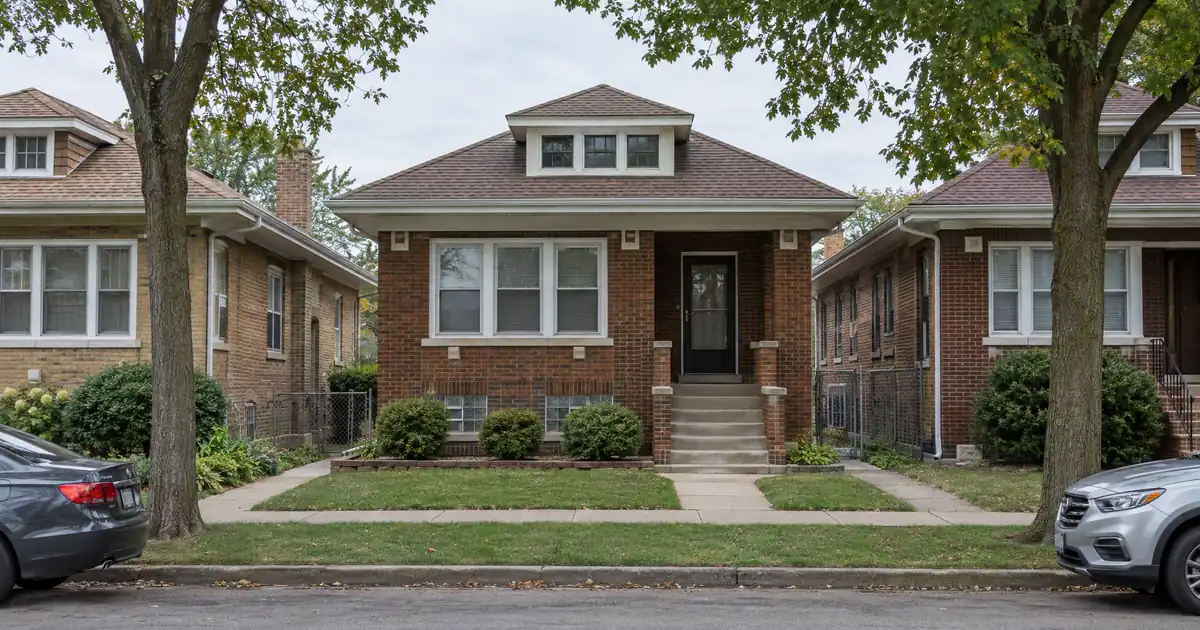
A brick two-flat near the Cermak Road corridor hits the DSCR math like this. Assume it appraises at $300,000, with two 2-bedroom units renting at $1,400 each, the Zumper 2BR median. Modeled at 75 percent LTV with full taxes and insurance in the debt figure, rent coverage lands near 1.3x. Swap in a single-family 3BR at $1,900 on a $285,000 appraisal and coverage slips to roughly 0.95x. Same town, same LTV, opposite outcomes. The property type decides the cash-out, and the appraisal decides how much cash there is.
(Every price and rent input in that example is a modeled assumption anchored to the research figures below. It is not a quote or a market statistic.)
DSCR Cash-Out Calculator
Run the cash-out numbers in Cicero, IL
Rate source: Freddie Mac 30-yr average via FRED® — Federal Reserve Bank of St. Louis · effective Sep 24, 2026
Prefilled with starting assumptions — enter your property’s value, balance, taxes, and insurance for a more accurate picture.
Program parameters update from Lendmire’s centralized guideline source. Taxes and insurance are editable estimates.
As of Sep 24, 2026 · General Freddie Mac market benchmark, not a Lendmire loan offer. Property value, balance, taxes, and insurance are editable estimates. Maximum loan-to-value varies by lender, program, property type, and seasoning. Not a Loan Estimate, approval, or commitment to lend. Program availability and eligibility are subject to lender guidelines, credit approval, property review, and underwriting.
The Short Version:
A DSCR cash-out refinance in Cicero, Illinois is underwritten primarily on the property’s rental income measured against its full monthly obligation, so the file turns on a seasoned title, a rent schedule at or near the standard 1.00 benchmark after taxes and insurance, and an appraisal that holds up on thin comps, subject to lender guidelines.
- Redfin’s city guide shows a $290,000 median sale price, with single-family at $285,000.
- Modeled two-flat coverage runs about 1.3x or better; a single-family 3BR sits near 0.95x.
- Sales volume is thin, only 19 homes in the latest monthly count, so appraisal risk is real.
- Cash-out tops out at 75 percent LTV after roughly six months of seasoning.
- Blocks near the Pink Line stations carry the strongest commuter-driven demand.
Lendmire (NMLS# 2371349) is a DSCR-focused mortgage broker that arranges DSCR investor loans across 40 states plus Washington, D.C. The team places these files with wholesale lenders, which review eligibility and make the credit decisions. The DSCR fundamentals come down to one idea: the property’s rent, not the owner’s W-2s, carries the qualification, and Lendmire’s refi programs apply that logic to owners who already hold the asset. This article skips purchase mechanics and looks only at pulling equity out of a Cicero rental already owned.
Cicero Market Snapshot
A quick read on the Cicero investor landscape — figures come from the cited sources below. Confirm current property-level numbers before underwriting.
| Metric | Detail |
|---|---|
| Typical rents | $2,200–$2,800 (Deal Run Cicero) |
| Recent appreciation | +7.9% yoy (Rocket Homes) |
| Employment | 16,577 jobs (Redfin Cicero investment) |
Why Cicero Equity Is Harder to Read Than the Headline Numbers
Cicero’s equity is real but noisy, and the noise runs in both directions. Redfin’s city guide puts the overall median sale price at $290,000. It splits that into $285,000 for single-family, $230,000 for townhouses and $140,000 for condos and co-ops. Redfin’s monthly market page tells a hotter story: a $310,000 median, up 24.0 percent year over year, at $160 per square foot. That jump rests on 19 sales against 33 a year earlier. A sample that small can swing 24 percent on two or three unusual transactions.
Treat the 24 percent as a curiosity. Other portals show much milder movement, including a 2 percent gain on Homes.com and a 7.9 percent gain from Rocket Homes over a different window. One broker report went the other way, showing sold prices down. The honest read: Cicero prices are probably rising modestly, and nobody has clean enough data to say how modestly.
Why does that matter for a cash-out? Because a lender’s cash-out depends on the appraised value, not the portal median. An owner who bought at a discount and expects a 24 percent markup on paper may find the appraiser working from three or four comps of mixed vintage. Underwrite to the conservative end of the range.
Two contextual anchors help. The Redfin Chicago page shows a $426,000 median, up 9.3 percent, which puts Cicero well over $100,000 below its neighbor’s median. The Redfin Illinois page shows a $328,632 statewide median, up 4.3 percent. Cicero sits under both. That gap is the bull case for its rental math, and also a reminder that a discount to Chicago is not the same as a discount to fair value.
Two-Flats Carry the Math (Single-Family Struggles)
Multi-unit stock is where Cicero cash-outs pencil. Redfin’s investment-property page counted 55 multi-family listings against just 5 condos and 2 townhouses, and the listings skew toward brick two-flats with 2-bed or 3-bed units, plus some 3-unit and 6-unit buildings. Homes.com’s multi-family page showed 32 multi-family homes for sale. Listings and closed sales are not the same measure, so this says the stock is deep, not that it turns over.
The rent side of the equation is where sources fight. Zumper’s Cicero rent report shows a $1,200 median, up 4.3 percent year over year, with 2BR at $1,400, 3BR at $1,900 and 4-plus-bedroom at $3,500. RentHop’s figures run higher for 2BR at $1,800, likely reflecting a different listing mix. This article uses the Zumper set throughout and treats RentHop as upside to verify, not a base case. Other portals show averages well under $1,000, but they skew toward older apartment stock and are stale.
Run the numbers on both structures, modeled with a standard 30-year amortization and including taxes and insurance in the debt figure:
| Scenario | Modeled rent | Modeled coverage at 75% LTV |
|---|---|---|
| Two-flat, $300K appraisal | $2,800 (2 x $1,400) | About 1.3x |
| Two-flat, $300K appraisal | $3,800 (2 x $1,900) | Above 1.7x |
| Single-family, $285K appraisal | $1,900 (3BR) | Roughly 0.95x |
The pattern is not subtle. A single unit renting near $1,900 against a price near $285,000 is a gross rent-to-price ratio of about 0.67 percent monthly, and that does not carry a full tax-and-insurance load at 75 percent LTV. Stacking a second unit changes the ratio entirely. One broker-marketing page, Deal Run, claims typical two-flat rents of $2,200 to $2,800 on $200,000 to $260,000 prices. That would be a stronger ratio still, but it is marketing copy, and its price band sits below the sold medians. Test it against actual rent rolls before believing it.
The single-family case is not dead. It is just the case where the owner pays for leverage with lower proceeds. If coverage sits below 1.00 at the full 75 percent LTV, the usual paths are a lower-LTV structure, a sub-1.00 program, or an interest-only structure. A lender would review each, and none is a promise. Dropping to about 65 percent LTV on the same single-family file models near 1.05x, which is workable on paper but trims the cash the refinance produces. A lender reviewing the file will weigh credit, reserves and property condition alongside the number.
A brief note on condos. Cicero’s $140,000 condo median looks like cheap entry and cheap equity. But HOA dues sit inside the debt figure and can push coverage below 1.00 even at modest balances. Skip the condo unless the dues are documented and the rent clearly outruns them.
What Does the Appraisal Do to the Cash-Out?
The appraisal is the single largest variable in a Cicero cash-out, and this market gives it little to work with. Redfin’s investment page shows only 19 closed sales in the latest month, with homes typically sitting about 60 days and drawing one offer. Two-flats and single-family homes get pulled into the same comp set, and buildings with different unit counts value differently. Expect conservative appraised values. Expect less cash-out than a headline price gain implies.
That points to a practical rule for skeptical owners. Buying below market and holding for seasoning matters more here than in a deep-comp metro, because the appraiser needs a defensible story for the value. A renovated two-flat with a documented rent roll and photographed unit-level improvements gives the appraiser something to anchor to.
The program mechanics are short. Cash-out on these files is generally capped at 75 percent LTV, and the purchase-side 80 percent figure does not apply here. Seasoning is typically about six months of ownership measured from title recording. Reserves generally run around six months of PITIA, and most files need a credit score in the 620-plus range, with better tiers at 660, 680 and 700. Coverage is typically benchmarked at 1.00x, since rent covers the payment at that level. Some lenders may review lower scenarios with stronger compensating factors, less leverage or more cash in. Loan amounts on standard programs run up to $3,000,000, though most Cicero files will be far below that. Investors holding title in an LLC can generally proceed, subject to lender program eligibility. All of this reflects select wholesale-network guidelines and varies by borrower, property and loan scenario.
Equity available is not a fixed number. It flows from the appraisal, the rent used for lender review, PITIA, reserves and the 75 percent ceiling, in that order of importance. The refi options page walks through the structure, and the calculator turns the percentages into dollars.
Where Tenants Come From
Cicero rents rely on regional job access, not local employers. Redfin’s page puts the town at about 83,505 people and 16,577 jobs, roughly one local job for every five residents. Census Reporter’s ACS profile shows a 2024 estimate of 82,093 residents and a 29.3-minute mean commute. Most tenants work elsewhere, and the file’s strength depends on how easily they can get there.
That makes transit the screening factor. The CTA Pink Line’s 54th/Cermak station is in Cicero, and it logged 502,100 boardings in the most recent annual count, with 175 parking spaces. The Cicero Avenue Pink Line stop recorded 258,487. A Metra BNSF station at 26th and Cicero sits in fare zone 2, but average weekday boardings were only 136 in the dated count. Metra is a footnote. Underwrite around Pink Line and CTA bus access, and treat blocks within walking distance of those stops as the strongest candidates.
Local employment adds a floor under the commuter base. Homes.com’s local guide names industrial employers south of I-290, including an Amazon fulfillment center, Corey Steel and Frank Korinek & Co., plus a box-store corridor on Cicero Avenue south of Cermak. No verified headcounts exist for any of them, so this is qualitative support only. Morton College enrolls roughly 3,500 to 3,900 students depending on the source, and the Town of Cicero says the town became the state’s largest manufacturing center after Chicago on the strength of its rail lines. The Hawthorne Works site near 22nd Street and Cicero Avenue once employed a peak of 45,000 workers, per Wikipedia. The factory is long gone, but the built-out grid it left behind is still here.
One more anchor sits just across the border. Loyola MacNeal Hospital in Berwyn is a 374-licensed-bed teaching hospital immediately east of Cicero. It is a regional employer, though no verified employee counts exist, so treat it as a demand signal rather than a quantified driver.
Blocks to Favor, Blocks to Question
Cicero’s own eight districts are Grant Works, Hawthorne, Warren Park, Drezel, Clyde, Morton Park, Boulevard Manor and Parkholme, per the Town of Cicero. No reliable district-level price or rent data exists for any of them, and this article does not pretend otherwise. The neighborhood medians Redfin publishes cover adjacent Chicago and Berwyn areas, not Cicero’s districts.
What the data does support is a corridor view. The 5.87-square-mile town packs in about 14,500 people per square mile. It is fully built out, so new land supply is minimal. That is an inference, not a sourced supply figure, and the town’s Comprehensive Plan and Unified Development Code, described on its development page, were not reviewed for detail.
Two corridors deserve the closest look. Blocks near the Pink Line stations, along Cermak Road, carry the transit-linked demand described above. Blocks near the Cicero Avenue retail and industrial stretch south of Cermak sit closer to local employers. Both are worth a rent survey before underwriting, because listing snapshots show wide gaps. A 2BR in the Clyde area lists at $1,400, while Berwyn 2BR listings nearby ask $2,000 to $2,450, per Redfin’s Clyde rental page. Those Berwyn buildings appear newer or more amenitized, so the comparison is imperfect. Still, older Cicero two-flats may carry a rent-to-value edge if Berwyn purchase prices for comparable flats are not clearly higher. That is a hypothesis to test, not a finding.
Here is the catch for skeptics. A cash-out refinance on a below-market-rent two-flat looks attractive because a rent increase at turnover lifts coverage. But that assumes the rent can rise. If the current tenants pay $1,400 and comparable listings hold near that level, the model’s upside is imaginary. Underwrite to in-place leases.
What the Deal Desk Sees on Files Like This
The common friction point in dense, inner-ring markets like this one is the gap between rent roll and paper. Cleaner files from a documentation standpoint tend to show signed leases, a clear unit-by-unit schedule and payment history in hand before the refinance is even submitted. Files that stall tend to have one of three problems: a two-flat where one unit sits on a verbal arrangement, an appraisal that compares the building to single-family sales, or reserves that fall short of the program’s expectation once proceeds are counted. Sorting those out early keeps a good rent number from being undone by a weak appraisal package.
Where the Proceeds Go
The proceeds are only valuable if the next deployment has better math than the property that produced them. This is where skeptical underwriting matters most. Pulling cash from a Cicero two-flat and buying another Cicero two-flat doubles exposure to the same thin-comp market. Pulling cash to buy where sales volume is deeper, or where rents already sit well above the debt load, diversifies it. Neither is wrong, but the second is safer.
The gap between Cicero at $290,000 and Chicago at $426,000 suggests some owners will use cash-out proceeds to stay in the inner ring. Others may prefer paying down higher-cost debt or funding a renovation that lifts the next appraisal. For owners weighing a conventional refinance instead, the side-by-side comparison covers where DSCR and conventional financing diverge. Illinois owners can browse Illinois DSCR investor loans for the statewide picture, and the team is reachable at 828-256-2183 for structuring questions.
Before underwriting any of this, verify current local rental rules, property taxes and insurance costs with qualified local professionals. Review details are subject to lender overlays, credit approval and property review.
DSCR vs. conventional financing
Two common ways to finance an investment property in Cicero, IL. They qualify you differently — here’s how investors weigh them.
Why investors choose it
- Qualifies on the property’s rental income — no personal tax returns, W-2s, or pay stubs needed to document income.
- No personal debt-to-income ceiling to clear, so existing mortgages and obligations don’t cap your borrowing the same way.
- Can be closed in an LLC, keeping the property inside a business entity.
- Built for scaling — not held to the limit on number of financed properties that conventional financing applies.
- Underwriting centers on the deal: generally qualifies when the rent covers the payment, a 1.00x coverage ratio being a common baseline (confirmed in underwriting).
- Designed specifically for investment property, including long-term and, where the program allows, short-term rentals.
Where it’s strong
- Often the lowest ongoing financing cost for a buyer who fully qualifies on personal income — a fit for a first property or a cost-first purchase.
Trade-offs for investors
- Requires full personal income documentation and must fit within a debt-to-income limit — salary, existing debts, and other mortgages all count.
- Typically held in your personal name rather than a business entity.
- Caps how many financed properties you can carry, which can become a ceiling as a portfolio grows.
- Evaluates you as a borrower as much as the property, which usually means more paperwork.
How investors usually choose: a first or single property often optimizes for the lowest financing cost; portfolio builders often optimize for leverage, vesting in an LLC, and scaling past conventional caps. The right answer depends on your goals, the property, and current guidelines — both paths run through select lenders in Lendmire’s wholesale network, with eligibility and terms confirmed in underwriting.
Frequently Asked Questions
How much equity can a Cicero owner realistically pull out?
Less than the portal medians suggest. Proceeds depend on the appraised value, the 75 percent LTV ceiling, rent used for lender review and reserves. With only 19 recorded sales in a recent month, appraisals lean conservative, so plan for the low end of the price range.
Does a Cicero single-family rental work for a cash-out refinance?
Sometimes, but the modeled coverage is tight. A 3BR renting near $1,900 against a $285,000 appraisal models near 0.95x at 75 percent LTV including taxes and insurance. Lower leverage, a sub-1.00 program or an interest-only structure may apply, subject to program review.
Why are two-flats treated differently from single-family homes here?
Two rent streams cover one debt payment. At $1,400 per unit on a $300,000 appraisal, the modeled coverage is about 1.3x, well above the single-family case. Lenders also compare two-flats to other multi-unit sales, so the comp set matters.
Do Pink Line stations affect rental coverage?
Not directly in the math, but they affect demand. The 54th/Cermak terminal logged 502,100 boardings in the latest annual count, and most Cicero tenants commute out. Blocks with walkable transit access tend to support steadier occupancy than blocks that depend on driving.
How long must a Cicero owner hold before a cash-out?
Programs typically look for about six months of ownership, measured from title recording. That window applies whether the property was bought for cash or financed. Owners who renovated should also have unit-level documentation ready for the appraiser.
Bottom Line for Cicero Owners
Cicero rewards the owner who reads the appraisal risk as carefully as the rent roll. The investors who season the title, document every lease and model coverage on the full debt load right now will come out ahead.
For current guidelines and terms, see Lendmire’s DSCR loan programs page.
About Lendmire
Lendmire (NMLS# 2371349) is a mortgage brokerage focused on DSCR investor financing, helping arrange programs through wholesale and investor-lending channels in 41 markets, including Washington, D.C. DSCR loans are evaluated by the lender on property cash flow rather than personal income, subject to lender guidelines, supporting LLC closings and accommodating investors with four or more financed properties. Scotsman Guide Top Mortgage Workplace in both 2025 and 2026.
Get Started
Ready to find the right loan for you?
In about 30 seconds you can review financing options available for your investment property. No commitment required.
Informational only. Not a Loan Estimate, approval, or commitment to lend. Program availability and eligibility are subject to lender guidelines, credit approval, property review, and underwriting.
References
2. Deal Run
3. Rocket Homes
4. Redfin – Cicero investment property listings
5. Redfin – Cicero housing market
6. Chicago page
8. Homes.com — Cicero IL Multi Family Homes for Sale
9. Zumper – Cicero rent research
10. figures
11. ACS profile
15. Wikipedia
16. Loyola Medicine – MacNeal Hospital
17. thetownofcicero.com — Government Project Management Development
19. a 2026 Scotsman Guide Top Mortgage Workplace
20. recognized by Scotsman Guide in 2025
This article is part of Lendmire’s investment property cash-out refinance program — full qualification details, guidelines, and scenarios live on the program page.
Related reading: Cash Out Refinance Investment Property Cicero Illinois · Cash Out Refinance on Loves Park Investment Property · DSCR Cash Out Refinance Naperville Illinois
Guides: Investment Property Cash-Out Refinance in Cicero, IL · Investment Property Cash-Out Refinance in Illinois
Brandon Miller
Founder & CEO, Mortgage Loan Originator, Lendmire LLC
- Mortgage Loan Originator · NMLS# 1129696 · Verify on NMLS Consumer Access
- North Carolina Real Estate Broker · License# 343312 · Verify on NCREC
- North Carolina Insurance Producer · License# 19053198 · Property, Casualty, Life, Health · Verify on NAIC SBS
- Lendmire LLC · Firm NMLS# 2371349 · Verify firm licensure
Compliance and disclosures. Lendmire (NMLS# 2371349) is a licensed mortgage broker and is not a direct lender, depository institution, financial advisor, or tax professional. Content in this article is general market analysis and educational information — not financial, legal, or tax advice for any specific situation. Lendmire does not guarantee loan approval; every transaction is subject to underwriting by the funding lender. Mortgage pricing and loan program guidelines are subject to change at any time without notice and vary by borrower characteristics, property type, and state regulations. Lendmire complies with Equal Housing Opportunity. Licensure verification: NMLS Consumer Access.