
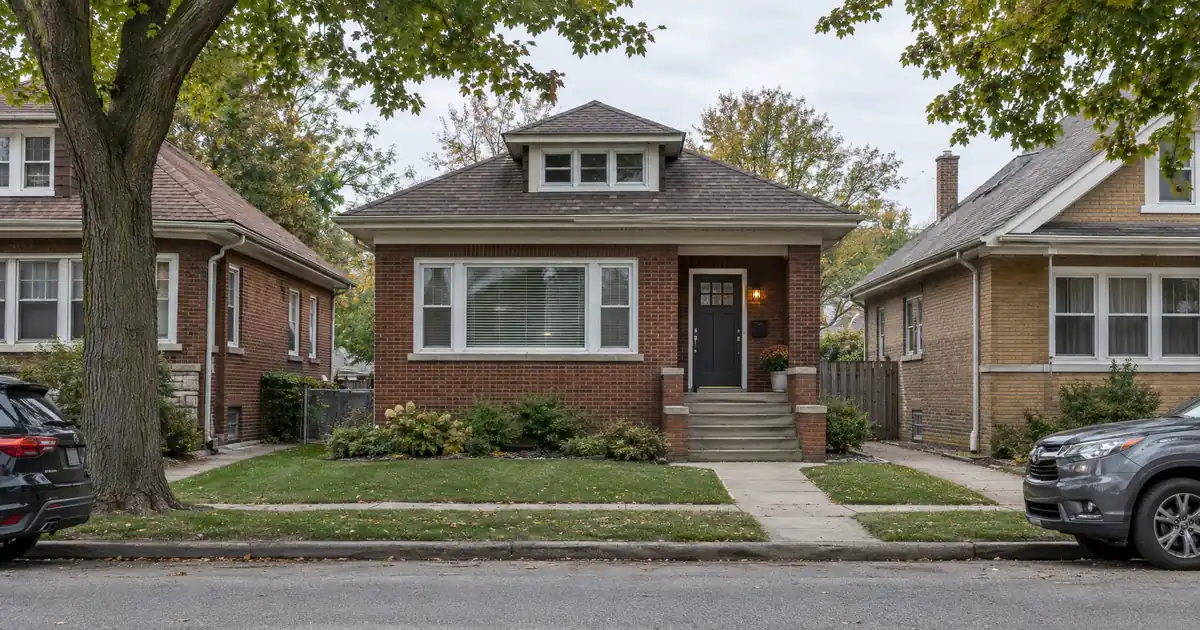
Two owners in Downers Grove can hold equity that looks identical on paper and get very different results from a cash-out refinance. One owns a detached house in Oakwood, where Redfin’s rental page lists a median rent of $3,100. The other owns an attached unit within walking distance of the Main Street Metra platform, where the same page lists a downtown median of $2,737. Appraised equity and pullable equity aren’t the same thing here.
Lendmire (NMLS# 2371349) is a DSCR-focused mortgage broker. Investors in Downers Grove, Illinois work with Lendmire to place DSCR financing through wholesale lenders reaching 41 markets, including D.C. The rest of this article is about what that placement looks like for an investor who already owns here and wants to pull capital out.
DSCR Cash-Out Calculator
Run the cash-out numbers in Downers Grove, IL
Rate source: Freddie Mac 30-yr average via FRED® — Federal Reserve Bank of St. Louis · effective Oct 1, 2026
Prefilled with starting assumptions — enter your property’s value, balance, taxes, and insurance for a more accurate picture.
Program parameters update from Lendmire’s centralized guideline source. Taxes and insurance are editable estimates.
As of Oct 1, 2026 · General Freddie Mac market benchmark, not a Lendmire loan offer. Property value, balance, taxes, and insurance are editable estimates. Maximum loan-to-value varies by lender, program, property type, and seasoning. Not a Loan Estimate, approval, or commitment to lend. Program availability and eligibility are subject to lender guidelines, credit approval, property review, and underwriting.
The Quick Read: A DSCR cash-out refinance in Downers Grove, Illinois is underwritten primarily on the property’s rental income measured against its full monthly obligation, and in a suburb where Redfin shows a $521K median sale price, the rent-to-value gap, not the 75% LTV ceiling, usually decides how much equity an investor can actually pull.
- Homes.com’s $2,900 median single-family rent struggles to cover a typical-leverage loan on a $521K house.
- Redfin shows median sale price up 13.1% year over year, so appraised equity is growing.
- Two- to four-unit stock is scarce, so appraisal comps for small buildings run thin.
- Typical guidance is about 6 months of seasoning and a 75% cash-out LTV ceiling, subject to lender guidelines.
- Renters are only 25% of households, so the tenant pool is real but narrow.
Downers Grove Market Snapshot
A quick read on the Downers Grove investor landscape — figures come from the cited sources below. Confirm current property-level numbers before underwriting.
| Metric | Detail |
|---|---|
| Home prices | $521K median (3 months) (Redfin) |
| Typical rents | $1,688 median gross (City-Data) |
| Recent appreciation | +13.1% yoy (Redfin) |
| University enrollment | 2,567 students (Data USA) |
| Employment | 45,680 jobs (Redfin investment-property page) |
The Main Street Corridor: Where the Equity Case Is Strongest
The strongest cash-out case in Downers Grove sits near the downtown Metra station, though not for the reason most owners assume. It isn’t cheap rent-to-price. It’s a deep, transit-anchored tenant pool and a station that carries real weight. The Main Street station averages 1,530 weekday boardings, which ranks sixth among Metra’s 236 non-downtown stations, and it sits 21.1 miles from Union Station. Apartments.com puts the ride to Chicago at about 30 to 40 minutes, and there are three BNSF stops in the village: Main Street, Fairview Avenue, and Belmont.
Rents downtown run high, though not the highest in the research. Redfin’s rental page shows a downtown median in the upper-$2,000s in an older snapshot, and its listings span a wide band for the same bedroom count: Prentiss Creek at $1,590 and up, The Easton at $2,442 and up, and Burlington Station at $3,952 for a two-bedroom. That’s roughly a 2.5x spread, driven by building age and location.
That spread matters for underwriting. A rent opinion on an older small property should be built off older-stock rent, not off Burlington Station-type rent. Appraisers and lenders know the difference.
Then there’s supply. The Opus development downtown (now marketed as Dash Downers Grove) added 167 units across seven stories, and a 138-unit, six-story project is planned on the old Village Hall site (verify construction status before relying on it). Opus itself describes rental availability in Downers Grove as limited, which supports landlords. But new Class A product also puts a ceiling on what an owner of an older downtown unit can ask. If your rent assumption depends on matching the new buildings, shave it.
Oakwood and Belmont: Two Rent Numbers, Two Warnings
Oakwood’s $3,100 median looks great until you ask what it measures. It’s almost certainly a small sample of larger single-family homes, and large single-family homes carry the heaviest price tags in a market where City-Data puts the mean detached house at $615,368. Skip treating Oakwood’s headline rent as a coverage solution. High rent against a very high price is still a thin yield.
Belmont is the opposite story, and it’s unproven. Redfin lists a median rent near $1,700 there, the lowest of the neighborhoods it breaks out. Lower rent can mean a lower entry price and a better rent-to-price balance, but no sales data in the research confirms that. This one’s a genuine toss-up: Belmont may be the best rent-to-value pocket in town, or it may just be a more affordable rent. An owner there should pull the actual closed sales before assuming cash-out math works.
Fairview and the Highland Avenue area near the hospital have clear demand anchors, but the research found no reliable price or rent data for either. Naming them as opportunities without numbers would be guesswork.
Why the 75% Cap Isn’t the Real Limit
The 75% cash-out LTV ceiling gets all the attention, and in Downers Grove it’s rarely the binding constraint. Coverage is. Most standard DSCR programs are built around a 1.00x benchmark: the rent used for lender review divided by the full monthly obligation (principal, interest, taxes, insurance, and any association dues). Some lenders review lower ratios, but that typically means lower leverage, stronger credit, more reserves, or different pricing.
Run the numbers on a modeled single-family property. Assume a $521,000 value, the Redfin median, and $2,900 of monthly rent, the Homes.com single-family median. These are modeled assumptions, not a quote or a sourced deal. Including taxes and insurance, the coverage ratio looks like this:
| Cash-out LTV | Modeled coverage | Read |
|---|---|---|
| 75% | In the 0.7s | Well under 1.00x |
| About 60% | Low 0.9s | Still short |
| About 50% | Right around 1.00x | Barely clears |
Those bands are rounded down on purpose. Homes.com reports a price-to-rent ratio of 16.2 for the area, and that ratio is the whole problem in one number. Most single-family purchases here struggle to reach 1.00x at typical investor leverage without a large down payment, and a cash-out is just a purchase in reverse. If the existing balance already sits near half the value, the owner is basically at the place where coverage clears, and every extra dollar pulled pushes the number down.
Here’s the catch for owners hoping to take the full 75%: the ceiling is a maximum, not an entitlement. Equity available depends on rent used for lender review, the full monthly obligation, reserves, and the LTV cap together. It isn’t a guaranteed cash figure.
What About Sub-1.00 Structures?
A sub-1.00 structure may be available through select lenders, but the better question is whether it should be used. Options a lender might review include a sub-1.00 program, an interest-only period that lowers the monthly obligation, or a lower loan amount paired with stronger credit and more reserves. Qualification stays subject to lender guidelines, credit approval, and property review.
Sub-1.00 is defensible if the investor has a documented reason to hold: a downtown-adjacent property where rents are likely to reprice upward, say, or an owner who simply wants to pull modest capital and keep leverage low. It’s the wrong tool if the investor is reaching for it because every Downers Grove property they own misses coverage at any sensible loan size. That’s a signal to rethink the pool of properties, not the loan type.
The Appraisal Problem: Asking Prices vs. Sales
Size the loan off closed sales, not asking prices. Several sources describe this market at several different price points, and an appraiser will use only one of them.
Redfin’s median sale price of $521K is the figure used throughout this article, and it’s the one an appraiser’s comps most resemble. By contrast, the same market shows a $492K median listing price on Redfin’s investment-property page, while Movoto puts the median listing at $599K and NeighborhoodScout puts estimated median value at $572,645, an estimate, not a sales median. City-Data’s lower estimate of $470,141 and Niche’s older, lower figure show how methodology moves the number. A cash-out sized on a listing-price assumption can come in low at appraisal.
Appreciation is real but uneven. Redfin shows median sale price up 13.1% year over year and price per square foot up 8.1% to $295, with 182 homes sold in May. Yet Redfin’s separate average-price line shows no change. The trend isn’t uniform, and three months of strength isn’t a seasoning story. An owner who bought several months ago and expects a big value jump to unlock a larger refinance should wait for the appraisal before planning around it.
Competition on the buy side (Redfin reports multiple offers per listing) supports resale value and appraisal comps. It also tells you that anyone buying the next property here will pay near asking, which weakens coverage on that next deal. Keep that in mind when deciding where proceeds go.
Attached Units and the Rare Duplex
Attached product probably has the better cash-out math in Downers Grove, with a caveat about the data. City-Data’s mean price for attached units is $320,907, against $615,368 for detached houses, while Homes.com shows townhouses renting at $3,625 against $2,900 for single-family homes and $1,890 for condos. Those come from two different data sets, so the ratio is an inference, not a published yield. Still, it points the same direction: more rent per dollar of value in attached product. Condos need extra care, since building eligibility is a lender-level question.
Two- to four-unit buildings look attractive on paper. City-Data’s means for them are far below detached homes, at $250,844 for two-unit and $207,250 for three- to four-unit structures. But the stock is tiny and those figures come from a very small sample. Redfin’s investment page shows just one multi-family listing next to 39 condos, 10 townhouses, and 29 houses sold. A Homes.com search turned up a rare duplex with one unit leased and one open for owner occupancy, and a six-unit brick building that appears to sit on the Woodridge edge, not clearly inside the village. Treat any small multi-unit owner here as holding a one-off asset. Comps for a refinance appraisal will be thin, which can create friction.
RentCafe shows apartment buildings averaging about 35 years old, with 27% built since 2000, and one-bedrooms at 63% of rental stock. Family-sized rentals (three-bedroom houses and townhouses) face little apartment competition. That supports the higher single-family bands, but as the math above shows, it doesn’t fix the yield against price.
Larger multifamily is a different universe. Institutional capital dominates the 138- and 167-unit end of the market, and buildings of five or more units fall outside typical one- to four-unit DSCR programs.
One pattern from Lendmire’s deal desk applies directly here. In suburbs where price per unit is high and the renter base is thin, the files that move most cleanly from a documentation standpoint tend to carry a signed lease, an appraiser rent schedule that matches the lease, and a loan amount sized conservatively against coverage. The common friction point is a rent assumption built from the best-looking comp in the building next door, which the lender’s review then discounts.
Tenants Who Stay: Hospital, Campus, Rail
Demand in Downers Grove doesn’t depend on one employer, which matters for a long hold. According to Redfin, the village has about 48,135 residents and 45,680 jobs, so local employment nearly equals population, and renters can also commute by Metra. Census Bureau QuickFacts shows 50,054 residents and a median household income of $115,114, about 25% above the Chicago metro figure of $90,887, with growth that Data USA describes as flat (49,996 down to 49,867 in one year). Demand here is a supply-constraint story, not a population-growth story.
The anchors:
- Advocate Good Samaritan Hospital is a 333-bed community hospital and operates the only Level I trauma center in DuPage County, per Wikipedia. An unofficial local blog lists about 2,500 employees there, and an older NIST Baldrige profile cites 2,700 associates and 950 independent physicians.
- Midwestern University enrolled 2,567 students at its Downers Grove campus, per Data USA. On-campus housing covers only 180 beds, so roughly 2,400 students compete for off-campus housing.
- Corporate offices, including Univar and Dover headquarters, add professional demand, though the research found no verified employer counts for them.
That tenant base (nurses, residents, travel clinicians, graduate students, and hospital support staff) tends to sign medium-term leases. Stable tenancy helps a cash-out file because lease-backed rent is the cleanest income evidence.
Now the skeptical read. RentCafe counts 5,028 renter households (25%) against 15,329 owner households (75%). That’s a thin pool. Rent growth readings conflict: RentCafe shows an average rent up 3.56% to $2,045, while Zumper shows a decline of about 4% over the same stretch, with an average of $1,910. Redfin’s rental page shows a month-over-month drop. The honest summary is flat-to-choppy. Underwrite to today’s lease, not to next year’s raise. No reliable vacancy figure turned up in the research, so none is cited here.
Where Should the Proceeds Go?
The cash-out thesis depends on what the investor does with the money. Pulling equity to buy another Downers Grove single-family rental runs straight back into the 16.2 price-to-rent problem, and it adds acquisition-side competition on top, since owner-occupant buyers are bidding too. Pulling it to pay down a higher-cost balance or fund improvements that lift rent at an existing property is a more conservative use. Deploying it into a market where coverage clears at standard leverage is a third option, and one that deserves a real stress test before committing.
There’s no universally right answer. An investor with a downtown-adjacent attached unit, solid lease-backed rent, and balance well under the cap has a straightforward refinance. An investor with a single detached house and a balance near 60% of value has a harder conversation, and “wait or pull less” may be the correct advice. Honestly, the smaller cash-out often beats the maximum one here: a modest draw at stronger coverage costs less over a hold than the largest available draw at coverage that barely clears.
DSCR vs. conventional financing
There are two common ways to finance an investment property in Downers Grove, IL, and they qualify you differently — here’s how investors weigh them.
Why investors choose it
- Qualifies on the property’s rental income — no personal tax returns, W-2s, or pay stubs needed to document income.
- No personal debt-to-income ceiling to clear, so existing mortgages and obligations don’t cap your borrowing the same way.
- Can be closed in an LLC, keeping the property inside a business entity.
- Built for scaling — not held to the limit on number of financed properties that conventional financing applies.
- Underwriting centers on the deal: generally qualifies when the rent covers the payment, a 1.00x coverage ratio being a common baseline (confirmed in underwriting).
- Designed specifically for investment property, including long-term and, where the program allows, short-term rentals.
Where it’s strong
- Often the lowest ongoing financing cost for a buyer who fully qualifies on personal income — a fit for a first property or a cost-first purchase.
Trade-offs for investors
- Requires full personal income documentation and must fit within a debt-to-income limit — salary, existing debts, and other mortgages all count.
- Typically held in your personal name rather than a business entity.
- Caps how many financed properties you can carry, which can become a ceiling as a portfolio grows.
- Evaluates you as a borrower as much as the property, which usually means more paperwork.
How investors usually choose: a first or single property often optimizes for the lowest financing cost; portfolio builders often optimize for leverage, vesting in an LLC, and scaling past conventional caps. The right answer depends on your goals, the property, and current guidelines — both paths run through select lenders in Lendmire’s wholesale network, with eligibility and terms confirmed in underwriting.
On the mechanics, a typical DSCR cash-out guideline is about 6 months of ownership measured from title recording, credit tiers that generally start near 620 and improve at 660, 680, and 700, and reserves of roughly 6 months of the full monthly obligation. Loan amounts run up to $3,000,000 on standard programs, subject to lender guidelines. LLC-titled holdings are common in DSCR files, subject to lender program eligibility. For investors comparing alternatives, DSCR versus conventional comes down to this: conventional tends to cost less when personal income documents cleanly support the file, while DSCR becomes the practical path for entity-owned or self-employed investors, or when the rental income is the cleaner story.
For the broader picture, see the guide “What Is a DSCR Loan”, pulling equity with a DSCR cash-out, the refi programs overview, and Lendmire’s page on Illinois DSCR financing. Program details change, and eligibility is confirmed at the lender level. To test a specific property, investors can pull a DSCR quote or call 828-256-2183. Verify current local rental rules, taxes, and insurance with qualified local professionals before sizing any deal.
Frequently Asked Questions
How do you qualify for a DSCR cash-out refinance in Downers Grove?
Qualification centers on the property’s rent compared with its full monthly obligation, plus credit, reserves, and equity. Typical guidance is a 1.00x coverage benchmark, a 75% LTV ceiling for cash-out, and about 6 months of seasoning, though exact eligibility varies by lender, borrower, and property. In Downers Grove, coverage is usually the hurdle before LTV is.
What are the requirements for an investment property loan in Downers Grove, Illinois?
Most programs look at credit (a 620 floor, with better tiers at 660, 680, and 700), reserves near 6 months, and rent-based coverage. Manufactured homes, log homes, and barndominiums fall outside these programs. Local price levels near the $521K Redfin median mean many owners will need lower leverage to clear coverage.
Will a Downers Grove single-family rental clear 1.00x on a cash-out?
Usually not at maximum leverage. Modeled with a $2,900 rent against a $521,000 value and including taxes and insurance, coverage lands in the 0.7s at 75% LTV and only reaches roughly 1.00x near 50% LTV. An attached unit or lower-priced property may do better, but that requires property-level numbers.
Does Midwestern University or the hospital make a duplex a safer cash-out candidate?
It makes tenancy more stable, but the bottleneck is supply and appraisal support, not demand. Redfin’s investment page shows only one multi-family listing next to dozens of condo, townhouse, and house sales, so refinance comps for a duplex can be thin.
What documents matter most for a Downers Grove DSCR cash-out review?
A current lease or rent schedule, proof of ownership and seasoning, and entity paperwork if the property sits in an LLC. Lendmire places DSCR investor loans, and a key program feature is that qualification is reviewed primarily around the property’s rental income, subject to lender guidelines.
About Lendmire
Lendmire, NMLS# 2371349, is a non-QM mortgage broker serving real estate investors in 41 markets, including Washington, D.C., through DSCR investor loan programs. Qualification is generally reviewed around the subject property’s rental income rather than the borrower’s W-2 history, which suits LLC-titled portfolios and self-employed investors. Every scenario remains subject to lender review and program guidelines. The firm was recognized by Scotsman Guide as a 2026 Top Workplace and was a top-ranked workplace in 2025, two consecutive Top Mortgage Workplace recognitions.
Keep one number in view when sizing a Downers Grove cash-out: Homes.com’s price-to-rent ratio of 16.2 means a dollar of annual rent costs more than sixteen dollars of price, and that gap, not the 75% ceiling, is what sets how much equity a landlord here can actually take out.
Get Started
Ready to find the right loan for you?
In about 30 seconds you can review financing options available for your investment property. No commitment required.
Informational only. Not a Loan Estimate, approval, or commitment to lend. Program availability and eligibility are subject to lender guidelines, credit approval, property review, and underwriting.
References
2. Homes.com — Downers Grove IL Homes for Rent
3. City-Data puts the mean detached house at $615,368
4. Data USA
5. Redfin’s investment-property page
8. opus-group.com — Opus Announces Start 20of Construction on Luxury Apartments in Downers Grove Ill
9. constructionowners.com — Conor Lci Launch 138 Unit Luxury Apartments in Downers Grove
11. RentCafe
13. Data USA
14. Wikipedia
16. RentCafe
17. recognized by Scotsman Guide as a 2026 Top Workplace
18. Scotsman Guide — Top Workplaces 2025
This article is part of Lendmire’s investment property cash-out refinance program — full qualification details, guidelines, and scenarios live on the program page.
Related reading: Luxury Rental DSCR Loans In New Jersey · Jersey Shore Vacation Rental Loans: DSCR Financing In Ocean City, Cape May And Long Beach Island · DSCR Cash-out Refinance In New Jersey: Pulling Equity From A Rental
Guides: Investment Property Cash-Out Refinance in Downers Grove, IL · Investment Property Cash-Out Refinance in Illinois
Brandon Miller
Founder & CEO, Mortgage Loan Originator, Lendmire LLC
- Mortgage Loan Originator · NMLS# 1129696 · Verify on NMLS Consumer Access
- North Carolina Real Estate Broker · License# 343312 · Verify on NCREC
- North Carolina Insurance Producer · License# 19053198 · Property, Casualty, Life, Health · Verify on NAIC SBS
- Lendmire LLC · Firm NMLS# 2371349 · Verify firm licensure
Important disclosures. Lendmire (NMLS# 2371349) is a licensed mortgage brokerage. Lendmire is not a direct lender, depository institution, or financial advisor. All loan inquiries are subject to lender underwriting; this article does not constitute a commitment to lend. Rates, terms, and program guidelines are subject to change without notice and vary by borrower profile, property type, and state. Information in this article is general in nature and is not financial, legal, or tax advice. Equal Housing Opportunity. NMLS Consumer Access: nmlsconsumeraccess.org.