
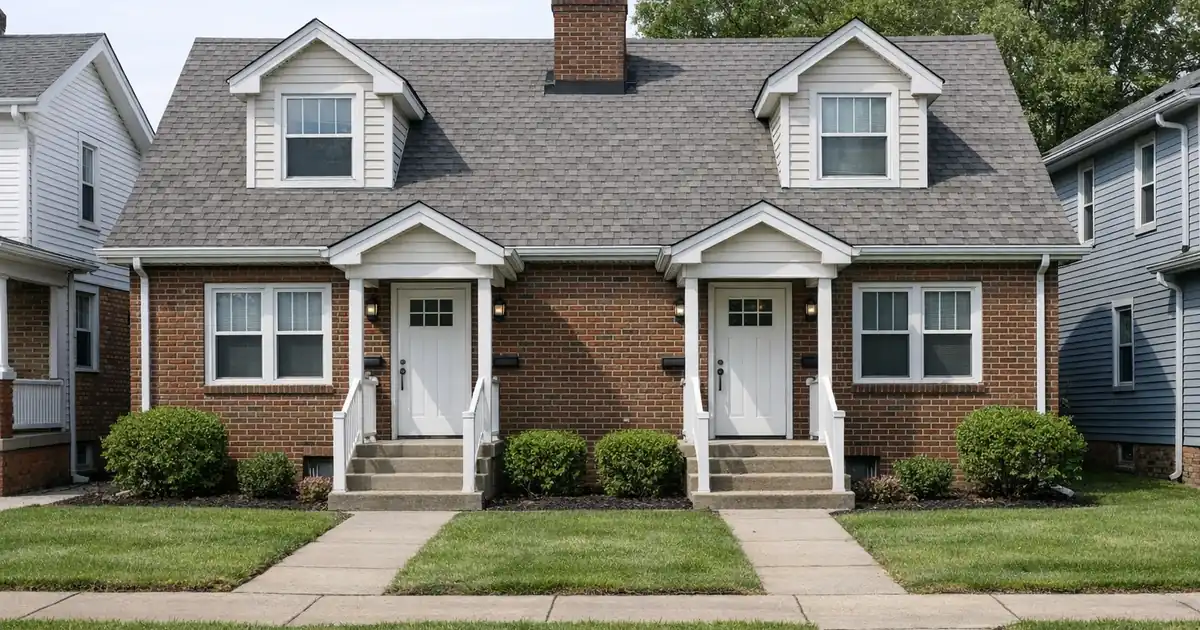
A rental property in Evansville that has appreciated $60,000 or more since purchase is generating zero return on that built-up equity — until an investor does something about it. A cash out refinance investment property strategy changes that equation entirely, pulling dormant equity out of the asset and redirecting it into new acquisitions, renovation projects, or portfolio expansion.
DSCR loans qualify on the property’s rental income — not the investor’s W-2s, tax returns, or personal DTI. That distinction makes them the dominant refinancing tool for real estate investors who hold properties in LLCs, show losses on Schedule E, or simply can’t satisfy conventional income documentation requirements.
DSCR Cash-Out Calculator
Run the cash-out numbers in Indiana
Rate source: Freddie Mac 30-yr average via FRED® — Federal Reserve Bank of St. Louis · effective Jul 30, 2026
Prefilled with starting assumptions — enter your property’s value, balance, taxes, and insurance for a more accurate picture.
Program parameters update from Lendmire’s centralized guideline source. Taxes and insurance are editable estimates.
As of Jul 30, 2026 · General Freddie Mac market benchmark, not a Lendmire loan offer. Property value, balance, taxes, and insurance are editable estimates. Maximum loan-to-value varies by lender, program, property type, and seasoning. Not a Loan Estimate, approval, or commitment to lend. Program availability and eligibility are subject to lender guidelines, credit approval, property review, and underwriting.
Lendmire (NMLS# 2371349) is a non-QM mortgage broker that works directly with real estate investors in Evansville, Indiana, matching each deal to the right DSCR mortgage broker program. Explore investment property refinance options across Lendmire’s full product menu to see what applies to your portfolio.
Key Takeaways:
- Cash out refinance investment property transactions qualify on rental income — no W-2s or tax returns required
- DSCR programs allow LLC ownership, have no financed property cap, and require only 6 months of seasoning before cash-out
- Lendmire closes DSCR loans in as few as 15 days across 41 markets, including Indiana markets like Evansville
What Is a DSCR Loan?
A DSCR loan — debt service coverage ratio loan — qualifies a real estate investor based entirely on whether the property’s rental income covers its monthly debt obligations. There are no W-2s, no tax returns, and no personal income calculation involved.
The formula is straightforward: monthly gross rent divided by PITIA (principal, interest, taxes, insurance, and HOA) equals the DSCR ratio. A ratio at or above 1.00 means the property covers its own debt. Below 1.00, restricted programs may still apply.
DSCR Math: Gross Rent ÷ (Principal + Interest + Taxes + Insurance + HOA) = DSCR | 1.00+ = qualifies | Below 1.00 = restricted programs.
For a full breakdown of how these programs work, see the guide “What Is a DSCR Loan” on Lendmire’s resource library.
The Evansville Investment Market and Why Equity Access Matters Now
Evansville sits at the southwestern tip of Indiana along the Ohio River — a mid-sized market with a fundamentally different investor profile than Indianapolis or Fort Wayne. The city’s economy is anchored by healthcare, manufacturing, and higher education. Toyota Motor Manufacturing Indiana operates a major production facility in nearby Princeton, drawing a steady workforce into the regional rental market. Deaconess Health System and Ascension St. Vincent are two of Evansville’s largest employers, creating consistent demand for rental housing from medical professionals, support staff, and rotating clinical personnel.
The University of Southern Indiana and the University of Evansville together enroll tens of thousands of students, generating strong demand for single-family and small multifamily rentals within a 3-mile radius of each campus. Neighborhoods like Haynie’s Corner, the Jacobsville area, and the East Side corridor have seen sustained property appreciation as investors respond to tight vacancy rates and limited new construction in the affordable rental price tier.
Given the sustained demand for rental housing, investors who entered the Evansville market several years ago have accumulated meaningful equity — equity that conventional lenders won’t touch due to LLC ownership restrictions, documentation requirements, or the number of properties already financed. A DSCR cash out refinance sidesteps every one of those barriers, qualifying solely on what the property produces each month.
Lendmire works directly with real estate investors in Evansville, Indiana, providing DSCR cash-out refinance solutions without income documentation requirements. For investors holding properties near the USI campus, the downtown medical corridor, or along the Lloyd Expressway rental belt, Lendmire’s DSCR programs provide a direct path to accessing built-up equity.
Key Benefits of DSCR Cash-Out Refinancing
DSCR cash-out refinancing delivers a set of structural advantages that conventional programs simply cannot match for active investors:
- No income documentation: No W-2s, pay stubs, or tax returns required. Qualification is based entirely on the property’s rental income relative to its PITIA — a clean break from conventional income verification.
- LLC and entity ownership supported: Properties held in LLCs or other business entities can close through DSCR programs, subject to lender program eligibility — a critical advantage for asset protection.
- Short-term rental flexibility: DSCR programs accommodate Airbnb and vacation rental income, with gross rents reduced 20% before the DSCR calculation, making them viable for STR portfolios.
- No cap on financed properties: Conventional programs cap investors at 10 financed properties. DSCR programs carry no such restriction, allowing unlimited portfolio scaling.
- Cash-out proceeds for investment use: Proceeds from a DSCR cash-out refinance can fund down payments on new acquisitions, retire hard money or private lending on investment properties, or finance renovations across the portfolio.
- 6-month seasoning vs. 12 months conventional: DSCR cash-out refinance eligibility begins at 6 months of ownership — half the seasoning window required by Fannie Mae — enabling faster equity recycling.
Every benefit listed above is available right now — the next step takes 30 seconds.
Evansville rental property owners are pulling equity with DSCR loans — no income verification, no conventional red tape. See what Lendmire can do for your property: Get a DSCR quote in 30 seconds or call 828-256-2183.
DSCR Loan Requirements
DSCR loan qualification is driven by the property’s income, not the borrower’s personal finances. Understanding the parameters helps investors structure their approach before engaging a lender.
Qualification snapshot: 620 FICO floor for refinance | 75% maximum LTV on cash-out | 6 months seasoning | 6 months PITIA in reserves on a cash-out (cash-out proceeds may count toward them).
Credit Score: A 660 FICO minimum applies to most cash-out refinance transactions — a meaningful difference from the 720+ typically required for best conventional pricing. First-time investors need a 700 FICO minimum. Sub-1.00 DSCR programs also require 660 FICO, though options narrow significantly below 680.
LTV: Cash-out refinances max out at 75% LTV for loans up to $3,000,000 with a 620+ FICO and DSCR at or above 1.00. This means an investor with a $300,000 appraised value property can extract up to $225,000, minus any outstanding loan balance and closing costs.
DSCR Ratio: The standard minimum is 1.00. Sub-1.00 programs are available with restrictions — reduced LTV and tighter credit requirements — and some structures allow as low as 0.75.
Seasoning: A minimum of 6 months of ownership is required before a cash-out refinance — a window designed to establish the property’s rental income track record and protect against immediate equity extraction after purchase.
Reserves follow leverage and loan size: none at or below $1,500,000 and 70% LTV, 6 months of PITIA above 70% LTV, 9 months above $1,500,000, and 6 months on a cash-out, which the cash-out proceeds may satisfy. Cash-out proceeds can satisfy reserve requirements on 1-4 unit properties, making the requirement less of a barrier than it appears.
Loan Amounts: $100,000 minimum to $3,000,000 standard maximum on 1-4 unit properties, with select jumbo structures up to $6,000,000.
Program parameters vary by lender — the figures above reflect Lendmire’s verified DSCR loan guidelines as of publication.
DSCR vs. Conventional Investment Loans
DSCR and conventional investment loans serve the same asset class but operate under fundamentally different qualification logic — and those differences favor active investors in almost every scenario.
Conventional investment loans require full income documentation: W-2s, two years of tax returns including Schedule E, pay stubs, and a debt-to-income ratio at or below approximately 45%. For investors who show rental losses on Schedule E or who derive income from sources that don’t produce clean W-2 documentation, this alone disqualifies them. DSCR underwriting ignores personal income entirely — the rental income covers the loan, or it doesn’t. Conventional programs also prohibit LLC ownership, forcing investors to take title personally. DSCR programs support LLC and entity closings, subject to lender program eligibility, which matters enormously for investors managing liability across a multi-property portfolio. For a detailed side-by-side analysis, review DSCR vs conventional investment loans.
Conventional seasoning requires the existing first mortgage to be at least 12 months old before a cash-out refinance can be initiated. DSCR programs require only 6 months — half the wait. On the portfolio scale front, Fannie Mae caps conventional investors at 10 financed properties, with 720+ FICO required beyond property number six. DSCR programs carry no financed property cap, meaning the portfolio can grow without hitting a ceiling that forces investors into commercial financing at terms they didn’t plan for.
LTV on cash-out refinances aligns closely between the two programs for single-unit properties — both cap at 75% LTV. The reserve requirement, however, diverges significantly. Conventional programs require 6 months PITIA in reserves on every financed property in the investor’s portfolio — not just the subject property. An investor with 8 financed properties must demonstrate reserves across all 8. DSCR reserves follow leverage and loan size (none at or below $1,500,000 and 70% LTV; 6 months above 70% LTV; 9 months above $1,500,000), a dramatically lower liquidity burden that keeps more capital available for active investing.
DSCR Cash-Out Strategies for Evansville Rental Property Investors
Recycling Equity From Appreciated Rentals
Evansville’s property values have risen substantially in recent years, particularly in established rental corridors near the medical district and the university zones. An investor who purchased a duplex in the Jacobsville neighborhood several years back at $120,000 may now hold an asset appraised closer to $190,000. That $70,000 in property appreciation represents extractable equity — but only if the investor acts on it.
A DSCR cash-out refinance allows equity extraction up to 75% of the appraised value minus the outstanding balance. Those proceeds fund down payments on the next acquisition without requiring the investor to sell the performing asset. The original rental continues generating income while the extracted capital goes to work in a second property — a compounding effect that builds portfolios far faster than saving from cash flow alone.
Exiting Hard Money and Private Lending
Experienced investors in this market know that bridge loans and hard money financing are entry tools, not permanent structures. An investor who used hard money to acquire and renovate a property near USI’s campus now carries a loan at a cost of capital that erodes monthly cash flow. A DSCR cash-out refinance serves as a clean hard money exit, replacing the short-term high-cost debt with a 30-year fixed or interest-only structure based on the property’s stabilized rental income.
This strategy works because DSCR underwriting evaluates the property as it currently performs — not as it was when acquired. A recently renovated property with a signed lease and documented rent roll qualifies on its current income, not its pre-renovation value. The DSCR lender underwrites the stabilized asset, and the investor converts expensive short-term capital into long-term investment property financing.
Scaling With No Financed Property Cap
The conventional 10-property cap stops many investors cold. At property number seven or eight, DSCR becomes not just an option but a necessity — it’s the only non-QM loan path that doesn’t impose a portfolio ceiling. Investors scaling across Evansville’s rental submarkets — picking up single-family rentals on the East Side, adding a duplex near the Lloyd Expressway, acquiring a small multifamily near downtown — can continue growing without hitting a wall that conventional bank programs build at 10 doors.
Each new DSCR acquisition builds on the last. Cash-out proceeds from an appreciated property fund the down payment on the next. The new property generates income, which strengthens the next DSCR ratio calculation. This is what portfolio-building looks like when the financing tool matches the strategy — cash flow positive acquisitions stacked without artificial limits.
Interest-Only DSCR Options for Cash Flow Optimization
For investors focused on monthly cash flow rather than aggressive principal paydown, interest-only DSCR structures offer a meaningful advantage. An interest-only DSCR loan replaces the full PITIA obligation with an ITIA calculation — interest plus taxes, insurance, and HOA — which lowers the monthly debt service and improves the DSCR ratio on qualifying analysis.
This structure is particularly useful on properties where the DSCR ratio is tight at 1.00-1.10 on a fully amortizing basis. Switching to a 10-year interest-only period creates breathing room in the coverage ratio, qualifies the loan more cleanly, and generates stronger monthly cash flow during the interest-only period. Lendmire’s team has structured transactions across rate-and-term, cash-out, and interest-only DSCR combinations for portfolios of every size — making it easier to find the right structure for each individual property.
Repositioning the Portfolio With Cash-Out Proceeds
Not all equity recycling means buying another property. Some investors use DSCR cash-out proceeds to fund major renovations on existing rentals, upgrading units to command higher rents and improve DSCR ratios on those same properties going forward. A well-executed renovation in a demand-driven submarket like Haynie’s Corner or the area surrounding Deaconess Midtown can push rents meaningfully higher, converting a property with a marginal DSCR into one that cash flows and qualifies comfortably for future refinancing.
Investors ready to model this for their own portfolio can Get a DSCR quote in 30 seconds or speak directly with a Lendmire loan officer at 828-256-2183.
Short-Term Rental Applications
DSCR programs support short-term rental properties, including Airbnb and VRBO listings in Evansville’s tourism-adjacent submarkets near the riverfront and event corridors.
For STR qualification, gross rental income is reduced 20% before the DSCR calculation. Properties must demonstrate market rental income through documented booking history or a market analysis. Financing Airbnb properties with a DSCR loan follows the same no-income-verification structure as long-term DSCR loans — the property’s income qualifies, not the owner’s W-2.
Example DSCR Scenario
Here’s how the math works on a real Evansville-area transaction structure:
Property: Single-family rental (illustrative figures).
Original Purchase Price: $175,000.
Current Appraised Value: $265,000.
Outstanding Loan Balance: $138,000.
Maximum Cash-Out at 75% LTV: $265,000 × 0.75 = $198,750.
Estimated Closing Costs: $6,500.
Net Cash-Out Proceeds: $198,750 − $138,000 − $6,500 = $54,250.
Monthly Gross Rent: $2,050.
Estimated Monthly PITIA: $1,640.
DSCR Calculation: $2,050 ÷ $1,640 = 1.25.
At 1.25 DSCR, this property is cash flow positive and qualifies cleanly. No income documentation required, and LLC ownership is welcome, subject to lender program eligibility.
Evansville investors who understand this math are already applying it across their portfolios.
This is the math behind portfolio scaling — and it works the same way on your property.
The math works — now make it real. Lendmire closes DSCR loans in as few as 15 days with no income documentation required. LLC ownership supported, subject to lender program eligibility. Get a DSCR quote in 30 seconds or call Lendmire at 828-256-2183 to start your Evansville refinance.
Why Investors Choose Lendmire
Lendmire stands apart from retail banks and conventional mortgage lenders because the entire practice is built around one product category: DSCR and non-QM investment property loans.
Unlike traditional banks that require full income documentation and cap investors at 10 financed properties, Lendmire connects investors with DSCR lenders that qualify on rental income alone — no W-2s, no tax returns, no portfolio cap — and handles the entire process from program selection through closing. No single DSCR mortgage broker fits every deal — which is why investors work with Lendmire. As a specialized non-QM mortgage broker, Lendmire matches each property and investor profile to the lender offering the best terms, handles underwriting navigation, and closes in as few as 15 days across 41 markets.
Access rental income–based financing in 41 markets through Lendmire’s network of DSCR lenders — a nationwide footprint that includes Evansville and all of Indiana.
Lendmire’s repeat investors confirm what the numbers show: DSCR programs that close in as few as 15 days with no income documentation create a financing advantage investors don’t find elsewhere.
Why Lendmire — Key Facts: NMLS# 2371349 | Non-QM mortgage broker | Exclusive DSCR loan specialization | Operates across 41 markets | Multiple lender programs | 15-day close capability | No W-2s, no tax returns | LLC closings supported (subject to lender program eligibility) | No property count cap | 828-256-2183.
As a dedicated non-QM mortgage broker (NMLS# 2371349), Lendmire has built its practice around one thing: DSCR investment property loans across 41 markets, with closings in as few as 15 days.
DSCR Refinance Options
DSCR cash-out refinancing gives Evansville investors multiple structural paths to equity extraction, each suited to different holding timelines and portfolio goals.
The standard 30-year fixed DSCR refinance is the most common structure — it maximizes cash-out proceeds, locks in a long-term payment, and converts an appreciated rental into working capital without any income documentation requirement. Investors can access cash-out refinance options for investment properties through Lendmire’s DSCR mortgage broker network, covering structures from standard fixed to 40-year amortization with interest-only periods.
DSCR programs require a minimum of 6 months of ownership before a cash-out refinance — compared to the 12-month seasoning requirement under conventional guidelines. For Evansville investors who acquired properties at favorable prices and have seen values rise, that 6-month window means faster access to equity and a shorter cycle between acquisition and portfolio reinvestment. Explore full investment property refinance programs to compare rate-and-term versus cash-out structures, and evaluate ARM versus fixed options based on the intended hold period.
Evansville investors benefit from the same DSCR programs available across Indiana — programs built for portfolios that don’t fit the conventional income documentation model. The rental market remains strong in Evansville’s core neighborhoods, supporting the rental income calculations that underpin DSCR qualification.
Frequently Asked Questions
What credit and DSCR requirements does Lendmire look at for investment properties in Evansville, Indiana?
For cash-out refinances, Lendmire’s DSCR programs require a 660 FICO minimum. First-time investors need a 700 FICO minimum. Standard DSCR minimum is 1.00, though sub-1.00 programs down to 0.75 are available with restricted LTV and tighter credit thresholds. In Evansville, the 660 FICO floor makes DSCR refinancing accessible to a broad range of investors who can’t meet the 720+ threshold required for best conventional pricing.
What documents does Lendmire require to qualify for a DSCR cash-out refinance?
No W-2s, pay stubs, or tax returns are required. Qualification is based entirely on the property’s gross monthly rent relative to PITIA. Lendmire typically requires a current lease agreement or market rent analysis, a property appraisal, and standard title and insurance documentation. Evansville investors holding properties in LLC names don’t need to unwrap the entity to qualify — the loan closes in the entity name, subject to lender program eligibility.
Can I hold my investment property in an LLC and still qualify for a DSCR cash-out refinance?
Yes. DSCR programs support LLC and entity ownership, subject to lender program eligibility. This is one of the sharpest contrasts with conventional financing, which requires individual borrower ownership. For Evansville investors using LLCs for liability protection across multi-property portfolios, DSCR cash-out refinancing is often the only viable path to pulling equity without restructuring ownership.
Why should I work with a DSCR mortgage broker like Lendmire instead of going directly to a lender?
No single DSCR lender offers the best terms for every deal. Lendmire (NMLS# 2371349) is a specialized non-QM mortgage broker that works with multiple DSCR lenders across 41 markets — matching each investor’s property type, credit profile, and deal structure to the lender offering the most favorable program. For Evansville investors, that means one conversation instead of shopping five lenders independently, expert underwriting navigation, and a closing timeline as few as 15 days from application.
How long do I have to own a rental property before doing a DSCR cash-out refinance?
DSCR programs require a minimum of 6 months of ownership before a cash-out refinance can be initiated. This seasoning window establishes the property’s rental income track record and protects against immediate equity extraction post-acquisition. Compare this to conventional guidelines, which require the existing first mortgage to be at least 12 months old before a cash-out refinance proceeds — DSCR cuts that wait in half.
What can I use DSCR cash-out proceeds for?
Cash-out proceeds from a DSCR refinance can fund down payments on new investment acquisitions, retire hard money or private lending on other investment properties, or finance renovations that increase the rental value of existing portfolio assets. Proceeds cannot be used to pay off personal debt obligations such as personal credit cards, personal tax liens, or personal judgments — the program is designed exclusively for investment-related use.
Explore More
- The guide “What Is a DSCR Loan”
- Compare DSCR vs conventional investment financing
- Cash-out refinance strategies for rental property investors
- Review DSCR refinance loan structures
About Lendmire
Lendmire is a non-QM mortgage brokerage (NMLS# 2371349) arranging DSCR investor loans in 41 markets, including Washington, D.C. DSCR eligibility is generally reviewed around property-level rental income rather than personal income, subject to lender and program guidelines, making it a fit for self-employed investors and LLC-owned portfolios. Scotsman Guide named Lendmire a Top Mortgage Workplace in both 2025 and 2026.
Get Started
Ready to find the right loan for you?
In about 30 seconds you can review financing options available for your investment property. No commitment required.
Informational only. Not a Loan Estimate, approval, or commitment to lend. Program availability and eligibility are subject to lender guidelines, credit approval, property review, and underwriting.
This article is part of Lendmire’s investment property cash-out refinance program — full qualification details, guidelines, and scenarios live on the program page.
Related reading: DSCR Cash Out Refinance Evansville Indiana · Cash Out Refinance Investment Property in Portage, IN · Cash Out Refinance on Westfield IN Investment Property
Guides: Investment Property Cash-Out Refinance in Evansville, IN · Investment Property Cash-Out Refinance in Indiana
Brandon Miller
Founder & CEO, Mortgage Loan Originator, Lendmire LLC
- Mortgage Loan Originator · NMLS# 1129696 · Verify on NMLS Consumer Access
- North Carolina Real Estate Broker · License# 343312 · Verify on NCREC
- North Carolina Insurance Producer · License# 19053198 · Property, Casualty, Life, Health · Verify on NAIC SBS
- Lendmire LLC · Firm NMLS# 2371349 · Verify firm licensure
Legal disclosures. Lendmire (NMLS# 2371349) is a state-licensed mortgage brokerage that arranges financing through wholesale lender relationships. Lendmire is not a direct lender, depository institution, or registered financial advisor. The discussion above is general informational content about real estate financing — it is not financial, legal, or tax advice, and readers should consult licensed professionals for guidance on their individual circumstances. Loan inquiries are subject to lender underwriting; this article does not represent a commitment to lend. Loan terms, rates, and qualification standards vary by borrower, property, and state, and are subject to change at any time. Equal Housing Opportunity. NMLS Consumer Access: nmlsconsumeraccess.org.