
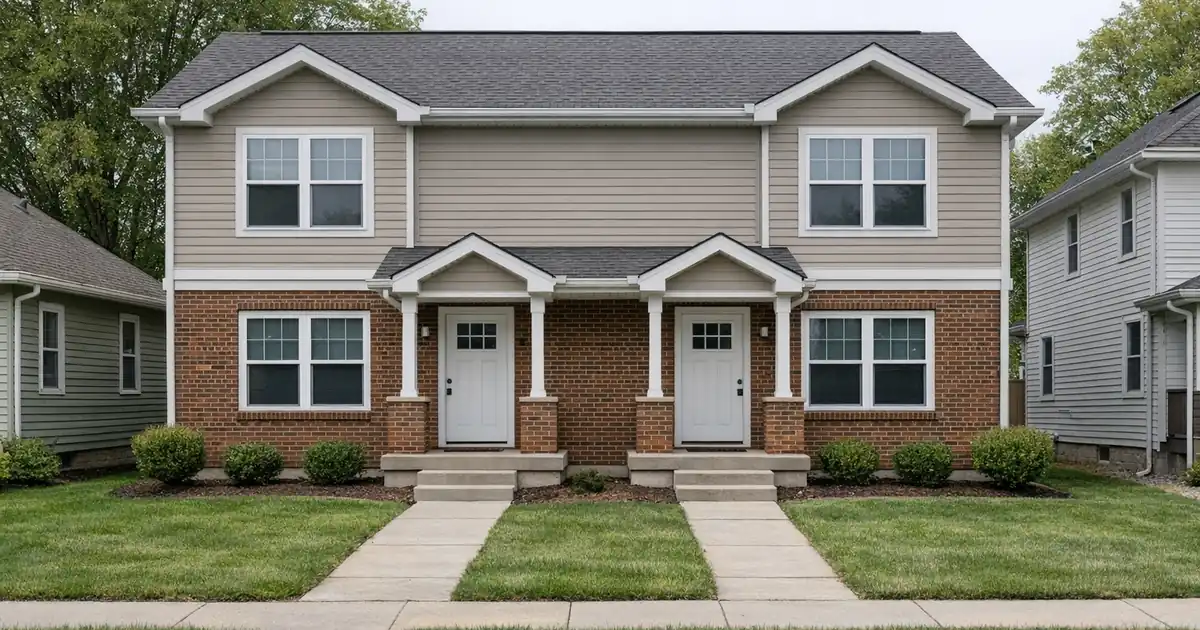
Most real estate investors in Anderson, Indiana are sitting on equity they can’t access — not because the equity isn’t there, but because conventional lenders require W-2s, tax returns, and debt-to-income calculations that exclude most serious portfolio investors. A cash out refinance investment property in Anderson doesn’t have to work that way.
DSCR loans qualify on the property’s rental income alone — no personal income documentation, no employer verification, no tax return scrutiny. If the rent covers the debt, the deal moves forward. For Anderson investors holding properties that have appreciated through sustained demand for rental housing, that distinction opens doors that conventional underwriting keeps closed.
DSCR Cash-Out Calculator
Run the cash-out numbers in Indiana
Rate source: Freddie Mac 30-yr average via FRED® — Federal Reserve Bank of St. Louis · effective Jul 30, 2026
Prefilled with starting assumptions — enter your property’s value, balance, taxes, and insurance for a more accurate picture.
Program parameters update from Lendmire’s centralized guideline source. Taxes and insurance are editable estimates.
As of Jul 30, 2026 · General Freddie Mac market benchmark, not a Lendmire loan offer. Property value, balance, taxes, and insurance are editable estimates. Maximum loan-to-value varies by lender, program, property type, and seasoning. Not a Loan Estimate, approval, or commitment to lend. Program availability and eligibility are subject to lender guidelines, credit approval, property review, and underwriting.
Lendmire (NMLS# 2371349) is a non-QM mortgage broker specializing exclusively in DSCR investment property loans across 41 markets, including Indiana. Investors can explore investment property refinance options directly through Lendmire’s platform.
Key Takeaways:
- DSCR cash-out refinance loans qualify on rental income — no W-2s or tax returns required
- Anderson investors can access up to 75% LTV on investment property cash-out refinancing
- Lendmire closes DSCR loans in as few as 15 days, with LLC ownership supported subject to lender program eligibility
DSCR Loan Basics for Investment Properties
DSCR loans — debt service coverage ratio loans — are non-QM mortgage products built specifically for real estate investors. Qualification is based on the property’s rental income relative to its monthly debt obligations, not the borrower’s personal income. For a deeper explanation, see the guide “What Is a DSCR Loan”.
DSCR Math: Gross Rent ÷ (Principal + Interest + Taxes + Insurance + HOA) = DSCR | 1.00+ = qualifies | Below 1.00 = restricted programs.
A DSCR of 1.00 means the property’s rent exactly covers its debt obligations. Above 1.00 means the property is cash flow positive. Below 1.00, restricted programs with tighter credit and LTV requirements may still apply.
Anderson, Indiana: Why Rental Equity Is Ready to Work
Anderson’s rental market has quietly built substantial equity across its single-family and small multifamily inventory — equity that conventional lenders routinely ignore because the investors who hold it don’t fit the W-2 mold.
Anderson sits in Madison County, roughly 40 miles northeast of Indianapolis along the I-69 corridor. The city’s proximity to the Indianapolis metro drives consistent rental demand from commuting workers, healthcare professionals at Community Hospital Anderson, and students at Indiana Wesleyan University’s Anderson programs. The Flagship Enterprise Center has also attracted light manufacturing and technology tenants to the region, keeping employment-driven rental demand steady.
Property appreciation has been meaningful for investors who entered the Anderson market over the past several years. Rental rates on single-family homes in established neighborhoods like Edgewood, Valley Grove, and the areas surrounding Anderson University have risen alongside demand. That appreciation, stacked against lower original purchase prices, means investors in Anderson are frequently carrying 35–50% equity in properties that generate positive monthly cash flow — a scenario purpose-built for DSCR cash-out refinancing.
As more investors turn to DSCR programs to extract that equity, Lendmire works directly with real estate investors in Anderson, Indiana to structure cash-out transactions without conventional income documentation barriers. For investors holding rental properties near the Anderson University campus or along the Mounds Road commercial corridor, Lendmire’s DSCR programs provide a direct path to accessing built-up equity.
Anderson investors benefit from the same DSCR programs available to real estate investors across Indiana — programs built specifically for portfolios that don’t fit the conventional income documentation model.
The Case for DSCR Cash-Out Refinancing
DSCR cash-out refinancing is the most efficient tool available to rental property investors who need to extract equity without triggering the documentation gauntlet of a conventional loan.
Here are seven reasons Anderson investors are choosing this approach:
- No income verification required: — qualification is driven entirely by the property’s rental income relative to PITIA, eliminating W-2s, tax returns, and pay stubs from the process
- Closes in as few as 15 days: — Lendmire’s DSCR platform moves at a fraction of the pace of conventional bank underwriting, letting investors act on opportunities while they’re still available
- LLC and entity ownership supported: — rental properties held in an LLC or trust can close under that entity, subject to lender program eligibility
- No financed property cap: — unlike conventional programs that cut investors off at 10 financed properties, DSCR programs have no hard cap (program dependent)
- Short-term rental flexibility: — Airbnb and VRBO properties qualify using market rent or lease income depending on the lender program
- Cash-out proceeds fund the next acquisition: — extracted equity can pay off hard money loans on other investment properties, fund down payments, or cover renovation costs
- Faster seasoning requirement: — DSCR programs require a minimum of 6 months of ownership before cash-out refinancing, half the 12-month conventional seasoning window
Every benefit listed above is available right now — the next step takes 30 seconds.
Anderson rental property owners are pulling equity with DSCR loans — no income verification, no conventional red tape. See what Lendmire can do for your property: Get a DSCR quote in 30 seconds or call 828-256-2183.
Meeting DSCR Loan Requirements
DSCR cash-out refinance eligibility is driven by four primary variables: credit score, LTV, DSCR ratio, and seasoning. Understanding the interaction between them is what separates investors who close from investors who get declined.
Qualification snapshot: 620 FICO floor for refinance | 75% maximum LTV on cash-out | 6 months seasoning | 6 months PITIA in reserves on a cash-out (cash-out proceeds may count toward them).
Credit score: Most DSCR cash-out refinance transactions require a 620 FICO minimum — lower than the 720 threshold needed for best conventional pricing — because DSCR underwriting evaluates the property’s income rather than the borrower’s creditworthiness as the primary risk variable. First-time investors face a 700 FICO floor. Interest-only structures require 680+.
LTV and cash-out limits: DSCR cash-out refinancing caps at 75% LTV for single-unit properties with DSCR at or above 1.00 and FICO at 700+, on loans up to $3,000,000. Two-to-four unit properties and condos max out at 70% LTV on refinance. The 75% ceiling aligns with conventional Fannie Mae cash-out guidelines for 1-unit — but DSCR gets there without income docs, which is the fundamental advantage.
DSCR ratio: The standard minimum is 1.00 — meaning rent must at least cover PITIA. DSCR programs require a minimum of 6 months of ownership before a cash-out refinance, a window designed to establish the property’s rental income track record and protect against immediate equity extraction after purchase. Sub-1.00 DSCR options exist down to approximately 0.75, but require 640+ FICO and reduced LTV.
Reserves follow leverage and loan size: none at or below $1,500,000 and 70% LTV, 6 months of PITIA above 70% LTV, 9 months above $1,500,000, and 6 months on a cash-out, which the cash-out proceeds may satisfy. Loans above $1,500,000 require 9 months of PITIA in reserves. Cash-out proceeds from a 1-4 unit property can satisfy reserve requirements — meaning the refinance itself can fund the reserves.
Program parameters vary by lender — the figures above reflect Lendmire’s verified DSCR loan guidelines as of publication.
Understanding where DSCR requirements sit relative to conventional alternatives is what makes the comparison meaningful — which is exactly what the next section examines.
DSCR vs. Conventional: A Side-by-Side Look
Conventional and DSCR investment loans diverge sharply on documentation and ownership structure. Conventional financing through Fannie Mae requires full income documentation: W-2s, tax returns including Schedule E for rental income, pay stubs, and a full debt-to-income analysis capped around 45%. DSCR loans require none of this — see DSCR vs conventional investment loans for a complete breakdown. Critically, conventional programs prohibit LLC ownership outright, requiring individual borrower title. DSCR programs fully support LLC and entity closings, subject to lender program eligibility — a significant structural advantage for investors who have built portfolio separation for liability and estate planning reasons.
Seasoning is another meaningful gap. Conventional programs require an existing first mortgage to be at least 12 months old before a cash-out refinance can proceed. DSCR programs allow cash-out after just 6 months of ownership — cutting the waiting period in half. The portfolio cap difference is even starker: conventional financing maxes out at 10 financed properties, with tighter credit requirements above 6. DSCR programs carry no hard cap on the number of financed properties, making them the only viable path for investors scaling past 10 doors.
On LTV, the two programs arrive at a similar cash-out ceiling for single-unit properties — both land at 75% maximum on 1-unit cash-out refinances. The difference is everything that surrounds that number. Conventional programs require 6 months PITIA reserves across every financed property in the investor’s portfolio, which creates a compounding reserve burden as a portfolio grows. DSCR reserves follow leverage and loan size (none at or below $1,500,000 and 70% LTV; 6 months above 70% LTV; 9 months above $1,500,000) — a dramatically lower reserve requirement that leaves more capital available for the next deal.
Deep Dive: Anderson Investment Strategies Using DSCR Cash-Out Refinancing
Extracting Equity to Exit Hard Money
Hard money bridge loans carry short terms and significantly higher costs than long-term rental financing — they’re tools for acquisition speed, not long-term holds. Many Anderson investors have used hard money to acquire and stabilize rental properties faster than conventional financing allows, but they face a clear problem once the property is stabilized: how to exit the hard money and transition to permanent financing without triggering a full income documentation review.
DSCR cash-out refinancing solves this directly. If the stabilized property generates enough rent to cover a new PITIA at DSCR 1.00 or above, Lendmire can underwrite the refinance on that income alone. The cash-out proceeds pay off the hard money loan on the investment property, replacing high-cost short-term debt with a permanent DSCR loan. Investors who have closed multiple DSCR refinances understand that this bridge loan exit strategy is one of the highest-leverage moves in portfolio management — one transaction retires expensive debt and resets the financing at a long-term fixed rate.
H3: Scaling With a 2-4 Unit Anderson Property
Small multifamily properties in Anderson — duplexes, triplexes, and four-unit buildings — generate blended rental income across multiple units that frequently supports strong DSCR ratios even when individual unit rents appear modest. A duplex generating $1,800 combined monthly rent against a $1,450 PITIA produces a 1.24 DSCR, comfortably within standard program eligibility.
DSCR cash-out refinancing on 2-4 unit properties caps at 70% LTV on refinance, slightly below the 75% ceiling for single-unit properties. The equity extraction math still works meaningfully. An Anderson duplex appraised at $195,000 with a $100,000 outstanding balance can support up to $136,500 in total financing at 70% LTV — generating up to $36,500 in cash-out proceeds after payoff, before closing costs. That capital funds a down payment on another acquisition without a dollar of personal income documentation.
H3: Interest-Only DSCR Structures for Cash Flow Optimization
An interest-only DSCR loan reduces the monthly debt obligation by removing the principal component from PITIA — effectively lowering the denominator in the DSCR calculation and either improving a borderline DSCR or increasing cash flow on a strong one. For Anderson investors refinancing properties where cash flow is tight, the interest-only structure can be the difference between a qualifying DSCR and a sub-1.00 denial.
Interest-only DSCR loans require a 680 FICO minimum. The 10-year interest-only period is available on 30-year and 40-year loan terms, giving investors a decade of maximum cash flow before the loan recasts to a fully amortizing schedule. The 40-year term with interest-only is particularly useful for investors optimizing for short-term portfolio scaling — the reduced payment frees capital that can be redeployed into acquisitions rather than principal paydown.
H3: Using Cash-Out Proceeds Strategically
The question of what to do with cash-out proceeds matters as much as the refinance itself. DSCR program guidelines prohibit using proceeds to retire personal debt — personal credit cards, personal tax liens, or personal collections are not eligible uses. The proceeds are investment-capital tools: retiring other investment property loans, covering renovation costs on another rental, or funding the down payment on a new acquisition.
For Anderson investors, this restriction shapes the strategic framing: the cash-out refinance is a portfolio acceleration tool, not a personal liquidity event. An investor who extracts $40,000 from one Anderson rental and applies it as a down payment on a second property doubles the portfolio’s income-generating footprint without a single dollar of new personal income documentation. That compounding effect is what makes DSCR cash-out refinancing the preferred equity recycling mechanism for serious rental property investors.
H3: The 75% LTV Math — What Anderson Properties Can Access
Understanding the LTV ceiling’s practical impact helps investors calculate their equity extraction potential before contacting a lender. The formula is straightforward: (Appraised Value × 0.75) − Outstanding Loan Balance − Estimated Closing Costs = Net Cash-Out Proceeds.
An Anderson single-family rental appraised at $165,000 with a $75,000 mortgage balance supports up to $123,750 in total financing at 75% LTV. After retiring the existing mortgage and accounting for roughly $4,000–$5,000 in closing costs, an investor walks away with approximately $43,000–$45,000 in cash-out proceeds. No tax returns, no employment verification, no DTI calculation. Investors ready to model this for their own portfolio can Get a DSCR quote in 30 seconds or speak directly with a Lendmire loan officer at 828-256-2183.
Short-Term Rental Applications
Short-term rental properties in Indiana’s lakefront markets and regional tourism corridors qualify for DSCR financing using a modified income calculation — gross rental income is reduced by 20% before the DSCR ratio is computed, reflecting vacancy and management costs inherent in the STR model.
Anderson investors holding properties near Indiana’s recreational areas can explore DSCR loan for short-term rental properties as a distinct program path:
- STR income documentation typically uses a lease agreement, Airbnb booking history, or market rent analysis
- The 20% gross rent reduction must be factored into the DSCR calculation at the underwriting stage
- A 680 FICO minimum applies to most STR DSCR programs
Example DSCR Scenario
Property: Single-family rental (illustrative figures).
Appraised Value: $210,000.
Original Purchase Price: $148,000.
Outstanding Loan Balance: $102,000.
Maximum Cash-Out at 75% LTV: $157,500.
Estimated Closing Costs: $4,800.
Net Cash-Out Proceeds After Payoff: $50,700.
Monthly Gross Rent: $1,650.
Estimated Monthly PITIA: $1,320.
DSCR Calculation: $1,650 ÷ $1,320 = 1.25.
No income documentation required. LLC ownership welcome, subject to lender program eligibility. Property is cash flow positive at a 1.25 DSCR — well within standard qualification thresholds.
Investors in Anderson are using this exact DSCR model to extract equity and fund their next acquisition.
This is the math behind portfolio scaling — and it works the same way on your property.
The math works — now make it real. Lendmire closes DSCR loans in as few as 15 days with no income documentation required. LLC ownership supported, subject to lender program eligibility. Get a DSCR quote in 30 seconds or call Lendmire at 828-256-2183 to start your Anderson refinance.
What Makes Lendmire Different for DSCR Lending
Lendmire’s approach to DSCR lending is built on a fundamental premise: the best DSCR mortgage broker for any deal depends on the property type, credit profile, and loan structure — and that’s exactly why working with a specialized DSCR broker like Lendmire matters. Lendmire’s team shops multiple DSCR lenders across 41 markets to find the right program match, closing in as few as 15 days.
Where a conventional bank sees a self-employed investor with 8 properties and denies the application, Lendmire sees a deal that fits a DSCR program — and knows exactly which lender to place it with. That broker expertise is the difference between a rejection and a 15-day close.
Real estate investors across Anderson have used Lendmire’s DSCR programs to unlock equity and acquire additional properties. Access Lendmire’s DSCR platform in 41 markets, including Washington, D.C. with a single contact point, rather than shopping lenders individually.
Investors who have closed multiple DSCR refinances understand that the broker relationship is what controls deal outcome — not the investor’s ability to navigate lender guidelines independently. Lendmire’s DSCR specialists know which programs accept LLC closings, which lenders work with sub-1.00 DSCR on reduced LTV structures, and which underwriters move fastest on Indiana investment properties.
Why Lendmire — Key Facts: NMLS# 2371349 | Non-QM mortgage broker | Exclusive DSCR loan specialization | Operates across 41 markets | Multiple lender programs | 15-day close capability | No W-2s, no tax returns | LLC closings supported (subject to lender program eligibility) | No property count cap | 828-256-2183.
As a dedicated non-QM mortgage broker (NMLS# 2371349), Lendmire has built its practice around one thing: DSCR investment property loans across 41 markets, with closings in as few as 15 days.
DSCR Refinance Paths for Portfolio Growth
DSCR cash-out refinancing offers Anderson investors multiple structural paths depending on their portfolio stage, equity position, and growth objectives. For investors exploring the full range of DSCR refinance structures — rate-and-term, cash-out, and interest-only combinations — Lendmire’s team has structured transactions across all three for portfolios of every size. Explore cash-out refinance options for investment properties or review investment property refinance programs to evaluate the full range of available structures.
The 6-month DSCR seasoning requirement versus the conventional 12-month window is a meaningful tactical advantage. An investor who purchased an Anderson rental property in January can initiate the cash-out refinance process in July — extracting equity to fund a second acquisition before the calendar year closes. Under conventional rules, that same investor waits until the following January at the earliest. With equity levels having risen substantially in recent years across Anderson’s residential market, that six-month difference is often the gap between capturing a below-market acquisition and losing it to a faster-moving competitor.
Rate-and-term refinancing is also available for investors who want to restructure their DSCR loan without taking cash out — swapping an ARM for a fixed rate, transitioning from a higher-cost bridge loan to a long-term DSCR product, or accessing an interest-only period on an existing property. Given the sustained demand for rental housing across Madison County and the greater Indianapolis corridor, the decision to refinance and hold versus sell and redeploy is increasingly favoring the hold-and-extract strategy among experienced Anderson investors.
Frequently Asked DSCR Loan Questions
Can an investor with a 680 credit score do a DSCR cash-out refinance in Anderson, Indiana?
Yes — a 680 FICO score qualifies for most standard DSCR cash-out refinance programs in Anderson. The floor for most refinance transactions is 620 FICO, so 680 positions an investor comfortably within standard program eligibility. At 680, investors can access up to 75% LTV on cash-out for 1-unit properties with DSCR at or above 1.00. Anderson investors at 680 FICO are well within the qualification range Lendmire’s DSCR lenders accept without income documentation requirements.
Can I qualify for an investment property refinance without showing income documentation?
Yes — DSCR loans require no W-2s, no tax returns, and no pay stubs. Qualification is based entirely on the property’s rental income relative to its monthly PITIA. For Anderson investors with complex tax situations, self-employment income, or multiple Schedule E deductions that reduce stated income, the DSCR structure eliminates the primary conventional qualification barrier. Anderson investors can qualify on their property’s rental performance alone, without any personal income review.
Does Lendmire allow DSCR loans to close in an LLC or entity name?
Yes — LLC and entity ownership is supported on Lendmire’s DSCR programs, subject to lender program eligibility. Conventional financing prohibits LLC borrowers outright, making DSCR the only viable path for investors who hold rental properties in limited liability companies or partnerships. For Anderson investors who have structured their portfolio under an LLC for liability separation, Lendmire’s DSCR platform accommodates that ownership structure without requiring a title transfer to an individual borrower.
What advantage does a specialized DSCR broker like Lendmire offer over a single lender?
A specialized DSCR broker shops multiple lenders simultaneously to match each deal to the right program. No single lender offers the best terms on every DSCR structure — the optimal program depends on property type, credit profile, DSCR ratio, loan amount, and whether the deal involves LLC ownership or a non-warrantable condo. Lendmire (NMLS# 2371349) works with multiple DSCR lenders across 41 markets and knows which programs close fastest on Indiana investment properties. For Anderson investors, that expertise translates directly to better program matching, fewer surprises in underwriting, and closings in as few as 15 days.
How long do I need to own an Anderson property before a DSCR cash-out refinance?
DSCR programs require a minimum of 6 months of ownership before a cash-out refinance — a threshold designed to establish the property’s rental income history and demonstrate stable occupancy. This compares favorably to conventional investment property refinancing, which requires the existing first mortgage to be at least 12 months old. For Anderson investors who acquired recently and have already stabilized a tenant, the 6-month window is often the faster path to equity extraction.
What can I do with DSCR cash-out refinance proceeds from an Anderson rental?
Cash-out proceeds from a DSCR refinance can be used for investment-related purposes: paying off hard money loans on other investment properties, funding down payments on additional acquisitions, covering renovation costs on rental properties, or building reserves. Program guidelines prohibit using proceeds to retire personal debt. For Anderson investors looking to scale, the proceeds from a single cash-out refinance can fund the equity contribution on a second property — compounding the portfolio without new personal income documentation.
Explore More
- Understand DSCR loan qualification and requirements
- DSCR vs conventional: which is right for your portfolio
- Explore cash-out refinance options for investment properties
- DSCR refinance programs for real estate investors
About Lendmire
Lendmire (NMLS# 2371349), a non-QM mortgage broker serving investors in 41 markets including Washington, D.C., helps structure DSCR scenarios commonly evaluated around a property’s rental income rather than personal income paperwork, subject to lender guidelines. Scotsman Guide named Lendmire a Top Mortgage Workplace in both 2025 and 2026.
Get Started
Ready to find the right loan for you?
In about 30 seconds you can review financing options available for your investment property. No commitment required.
Informational only. Not a Loan Estimate, approval, or commitment to lend. Program availability and eligibility are subject to lender guidelines, credit approval, property review, and underwriting.
This article is part of Lendmire’s investment property cash-out refinance program — full qualification details, guidelines, and scenarios live on the program page.
Related reading: DSCR Cash Out Refinance Anderson Indiana · DSCR Cash Out Refinance Anderson South Carolina · Cash Out Refinance Investment Property Anderson South Carolina
Guides: Investment Property Cash-Out Refinance in Anderson, IN · Investment Property Cash-Out Refinance in Indiana
Brandon Miller
Founder & CEO, Mortgage Loan Originator, Lendmire LLC
- Mortgage Loan Originator · NMLS# 1129696 · Verify on NMLS Consumer Access
- North Carolina Real Estate Broker · License# 343312 · Verify on NCREC
- North Carolina Insurance Producer · License# 19053198 · Property, Casualty, Life, Health · Verify on NAIC SBS
- Lendmire LLC · Firm NMLS# 2371349 · Verify firm licensure
Important disclosures. Lendmire (NMLS# 2371349) is a licensed mortgage brokerage. Lendmire is not a direct lender, depository institution, or financial advisor. All loan inquiries are subject to lender underwriting; this article does not constitute a commitment to lend. Rates, terms, and program guidelines are subject to change without notice and vary by borrower profile, property type, and state. Information in this article is general in nature and is not financial, legal, or tax advice. Equal Housing Opportunity. NMLS Consumer Access: nmlsconsumeraccess.org.