
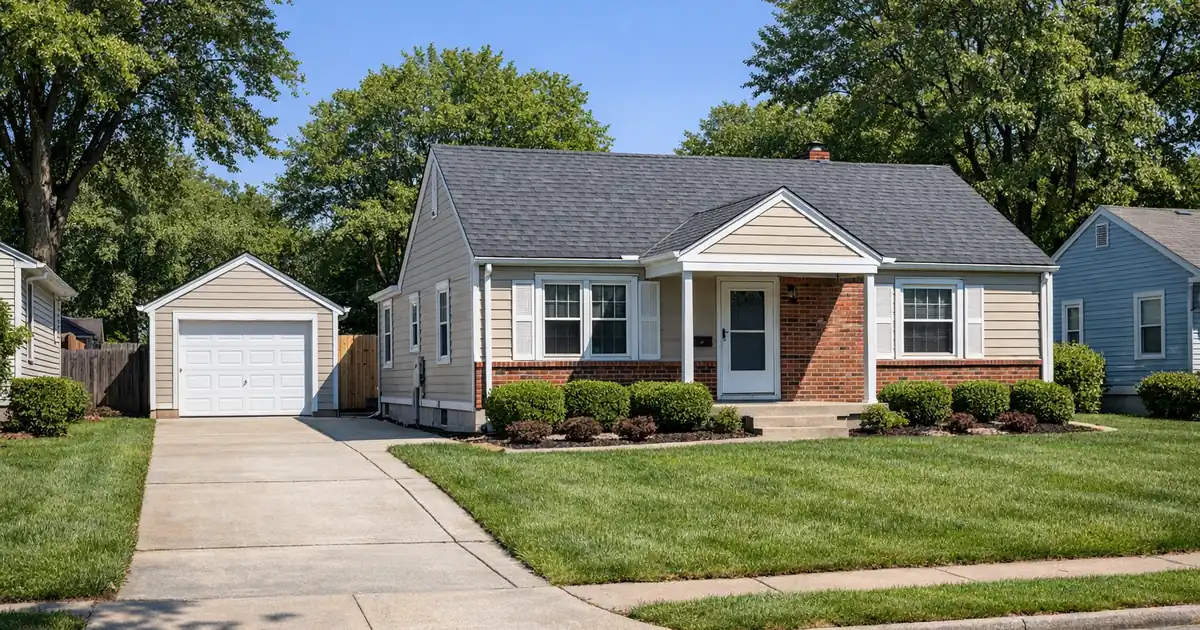
You don’t need a W-2, a pay stub, or a tax return to pull equity out of a Kansas City rental property — and most investors carrying performing rentals have no idea that option exists. The cash out refinance investment property process looks entirely different when the loan qualifies on rental income rather than your personal financial profile.
For Kansas City real estate investors, that distinction matters. The metro’s rental market has produced consistent appreciation across multiple corridors, and investors who bought even a few years back are sitting on real equity — equity that a DSCR-based approach can mobilize without the documentation burden of conventional lending.
DSCR Cash-Out Calculator
Run the cash-out numbers in Missouri
Rate source: Freddie Mac 30-yr average via FRED® — Federal Reserve Bank of St. Louis · effective Jul 30, 2026
Prefilled with starting assumptions — enter your property’s value, balance, taxes, and insurance for a more accurate picture.
Program parameters update from Lendmire’s centralized guideline source. Taxes and insurance are editable estimates.
As of Jul 30, 2026 · General Freddie Mac market benchmark, not a Lendmire loan offer. Property value, balance, taxes, and insurance are editable estimates. Maximum loan-to-value varies by lender, program, property type, and seasoning. Not a Loan Estimate, approval, or commitment to lend. Program availability and eligibility are subject to lender guidelines, credit approval, property review, and underwriting.
Lendmire, a non-QM mortgage broker (NMLS# 2371349), specializes exclusively in DSCR and investment property loans across 41 markets, including Missouri. Explore investment property refinance options directly through Lendmire’s platform or read on to understand exactly how this works.
Key Takeaways:
- DSCR cash-out refinances qualify on rental income — no W-2s, tax returns, or pay stubs required
- Kansas City investors can access up to 75% LTV in cash-out proceeds with a 620+ FICO and DSCR at or above 1.00
- LLC ownership is supported, and there’s no cap on the number of financed properties in DSCR programs
- Lendmire closes DSCR loans in as few as 15 days, compared to 30–45 days at traditional banks
Kansas City’s Investment Property Market and Why Equity Access Matters Now
Kansas City sits at the intersection of Midwest affordability and sustained rental demand — a combination that has made it one of the more attractive markets for long-term residential investors. Major employers including Cerner (now Oracle Health), H&R Block, Hallmark Cards, and a growing healthcare sector anchored by the University of Kansas Health System have kept the labor market stable and tenant demand strong across price ranges.
Neighborhoods like Westport, Midtown, the Crossroads Arts District, and Brookside have seen consistent rent growth driven by young professionals priced out of homeownership. Further east, areas around Troost Avenue and Independence Avenue have attracted investor interest as values have climbed while gross rent yields remain strong. The Plaza and Waldo corridors continue to generate premium rents from long-tenure tenants, which supports favorable DSCR calculations on properties in those submarkets.
With equity levels having risen substantially in recent years across Kansas City, investors are in a position to extract equity from performing rentals and redeploy it without triggering a tax event. A DSCR cash-out refinance accomplishes exactly that — and unlike conventional lending, it doesn’t require investors to document personal income to qualify. The no income verification mortgage structure that DSCR programs offer is purpose-built for investors whose personal returns don’t reflect actual investment performance.
Lendmire works directly with real estate investors in Kansas City, Missouri, providing DSCR cash-out refinance solutions without income documentation requirements.
DSCR Loan Basics for Investment Properties
DSCR loans qualify an investment property based on one simple metric: does the rental income cover the debt? Understanding what is a DSCR loan is the foundation for every equity strategy covered in this article.
Coverage Ratio: Monthly Rental Income ÷ Total Monthly PITIA = DSCR | At 1.00 the property covers its own debt | Above 1.00 = positive cash flow.
A property generating $2,000 per month with a $1,600 PITIA has a DSCR of 1.25 — cash flow positive and well above the standard minimum. Sub-1.00 DSCR options exist for investors with the right credit profile, though program eligibility narrows below 1.00.
Meeting DSCR Loan Requirements
DSCR cash-out refinancing has specific parameters that govern eligibility — and knowing them before you apply prevents surprises at the underwriting stage.
Credit score requirements reflect a tiered structure. Most cash-out refinance transactions require a 620 FICO minimum — lower than the 720 threshold often needed for best conventional pricing — because DSCR underwriting evaluates the property’s income as the primary risk variable rather than the borrower’s personal creditworthiness. First-time investors need a 700 FICO minimum, and interest-only loan structures require a 680 FICO minimum on 1–4 unit properties.
LTV caps protect against over-leveraging. Cash-out refinance transactions are capped at 75% LTV for DSCR-qualifying properties when the borrower holds a 620+ FICO and the loan is at or below $1,500,000. That ceiling applies to single-unit properties. Two-to-four unit and condo properties are further restricted to 70% LTV on refinances. Understanding the appraised value of your property — not just the purchase price — is what determines how much cash-out proceeds you can actually extract.
Seasoning is a firm requirement. DSCR programs require a minimum of 6 months of ownership before a cash-out refinance. That window exists to establish the property’s rental income track record and prevent immediate equity extraction after purchase. Conventional programs extend this to 12 months from the note date — a meaningful distinction for investors who want to move faster.
Reserves must be in place. Reserves follow leverage and loan size. None are required at or below $1,500,000 and 70% LTV. Above 70% LTV, 6 months of PITIA are required, and above $1,500,000, 9 months. A cash-out requires 6 months, which the cash-out proceeds may satisfy. Loans above $1,500,000 require 9 months of PITIA in reserves. The cash-out proceeds from a 1–4 unit property can satisfy reserve requirements — meaning the cash you pull out can double as your required reserves at close.
Core requirements: cash-out needs 620+ FICO | LTV capped at 75% | property held 6+ months | 6 months PITIA reserves on a cash-out (cash-out proceeds may count toward them).
Minimum loan amounts start at $100,000 for 1–4 unit properties with a standard maximum of $3,000,000, and select jumbo structures extend to $6,000,000.
Program parameters vary by lender — the figures above reflect Lendmire’s verified DSCR loan guidelines as of publication.
Understanding requirements is step one. Seeing how they compare to conventional alternatives reveals exactly where the advantage concentrates — which is what the next section covers directly.
The Case for DSCR Cash-Out Refinancing
Kansas City investors have built up meaningful equity across a range of property types — and the case for accessing it through DSCR is built on six distinct advantages.
- No LLC or entity ownership restriction.: DSCR programs support LLC and entity closings — subject to lender program eligibility. Conventional loans prohibit this entirely, requiring the investor to hold title personally.
- No financed property cap.: DSCR programs place no limit on the number of properties an investor can finance. Conventional lending caps investors at 10 financed properties, with stricter credit requirements above 6.
- Faster seasoning requirement.: DSCR cash-out refinances require 6 months of ownership — half the 12-month conventional requirement.
- No income documentation.: No W-2s, no tax returns, no pay stubs. Qualification runs on rental income relative to PITIA — not the investor’s personal DTI.
- Flexible loan structures.: Investors can choose from 30-year fixed, 40-year fixed, ARM products (5/6, 7/6, 10/6), and interest-only options with a 10-year I/O period available.
- No income verification. Cash-out proceeds can be used for down payments on additional properties, paying off hard money or private lending on other investment properties, or covering acquisition costs — all without documenting personal income.
For investors ready to move, the path from benefit to action is short.
Want to see what your Kansas City rental qualifies for? Lendmire’s DSCR programs skip the W-2s and tax returns — qualification runs on the property’s income alone. Get a DSCR quote in 30 seconds or reach Lendmire at 828-256-2183.
DSCR vs. Conventional: A Side-by-Side Look
Conventional and DSCR loans diverge most sharply on two points that matter most to active investors: how income is documented and how title can be held.
Conventional investment property loans require full income documentation — W-2s, Schedule E tax returns, pay stubs, and debt-to-income compliance at approximately 45% maximum. For investors with complex tax returns that show depreciation-adjusted income, that DTI calculation often disqualifies them even when their actual cash flow is strong. DSCR loans remove DTI entirely — see DSCR vs conventional investment loans for how this plays out across different borrower profiles.
LLC ownership is another hard line. Conventional programs require the borrower to hold title individually — meaning investors who’ve built their portfolios inside LLCs for liability protection must either close personally or forgo the loan entirely. DSCR programs support entity and LLC closings subject to lender program eligibility, preserving the investor’s legal structure without sacrificing financing access.
Three additional differences compound the advantage for active portfolio builders:
- Seasoning: Conventional programs require the existing first mortgage to be at least 12 months old from the note date. DSCR programs allow cash-out refinancing after just 6 months of ownership.
- Portfolio cap: Conventional programs limit investors to 10 financed properties, with 720+ FICO required above 6. DSCR programs carry no financed property cap.
- Reserves: Conventional lenders require 6 months of PITIA reserves on every financed property in the investor’s portfolio. DSCR reserves follow leverage and loan size (none at or below $1,500,000 and 70% LTV; 6 months above 70% LTV; 9 months above $1,500,000) — a material difference for investors holding multiple rentals.
Kansas City Investor Strategies: Neighborhoods, Equity, and DSCR Growth
Crossroads Arts District and Midtown: Urban Rentals With Strong DSCR Profiles
The Crossroads Arts District has evolved from gallery row into one of Kansas City’s most sought-after live-work neighborhoods. Rents for well-maintained 1–2 bedroom units in the 18th and Vine corridor and around Southwest Boulevard command premium pricing from creative professionals and healthcare workers commuting to the Medical Center area.
For investors, the Crossroads math often works cleanly — property appreciation has been steady, and rental income relative to debt service frequently clears the 1.25 DSCR threshold that opens stronger LTV options. The most common scenario Lendmire sees is an investor who purchased a Crossroads duplex several years back, has watched the appraised value climb, and now wants to extract equity without disrupting their tax position or leaving the LLC structure.
Waldo and Brookside: Long-Hold Equity Extraction
Waldo and Brookside are Kansas City’s most stable long-term rental neighborhoods — owner-occupied households mixed with deeply-tenanted rental properties where turnover is minimal. Investors who’ve held rental property in these corridors have seen consistent equity accumulation driven by property appreciation and steady demand from families and professionals who want walkable access to the shops and dining along 75th Street and Brookside Boulevard.
Cash-out refinancing in Waldo and Brookside typically produces strong net proceeds because these properties carry lower loan balances relative to current appraised value. A rental property purchased at a modest basis that now appraises significantly higher can generate substantial cash-out proceeds — proceeds that can exit a hard money loan on a separate property or fund a down payment on the next acquisition.
Northeast Kansas City and Independence Avenue: Value-Add Investor Opportunity
Northeast Kansas City has attracted a wave of value-add residential investors drawn by lower acquisition costs and improving rent fundamentals. The Independence Avenue corridor, running northeast from downtown, offers larger lot sizes and multi-bedroom configurations that generate strong gross rent yields — which directly supports DSCR calculations on properties that might not pencil under conventional income-doc models.
Investors who bought in Northeast KC at the right basis now hold properties with real equity and rental income that easily clears a 1.00 DSCR. That combination — manageable acquisition price, post-appreciation equity, and qualifying DSCR — is exactly what DSCR cash-out programs are designed to serve. The result: cash-out proceeds available to fund further acquisitions without returning to a bank.
The Northland: Suburban Rentals and Scalable Portfolio Financing
The Northland — Platte City, Liberty, and the North Kansas City corridor — has become a serious investor target as suburban rental demand has grown among families relocating from higher-cost markets. Single-family rentals in these areas typically offer 3–4 bedroom floor plans, stable long-term tenants, and rent rates that support positive DSCR margins without requiring peak market pricing.
The DSCR investor model fits the Northland particularly well: no portfolio cap means an investor with 6, 8, or 10 properties here can continue financing without hitting conventional limits. And because DSCR underwriting is property-by-property rather than portfolio-level DTI, each new property is evaluated independently — eliminating the compounding debt burden that sinks conventional applications for active buyers.
Using DSCR Cash-Out Proceeds to Exit Hard Money
Many Kansas City investors used hard money or private lending to acquire properties during market windows. Those loans carry higher costs and short maturities — and exiting them into a long-term DSCR structure is one of the most immediate financial benefits a cash-out refinance can provide.
This is a bridge loan exit strategy executed at the property level: a DSCR cash-out refinance replaces short-term acquisition debt with a 30-year fixed instrument, stabilizes the debt service, and frequently produces additional cash-out proceeds in the process. Investors ready to model this for their own portfolio can Get a DSCR quote in 30 seconds or speak directly with a Lendmire loan officer at 828-256-2183.
Short-Term Rental Applications
Kansas City’s event-driven hospitality market — driven by Kauffman Stadium, Arrowhead Stadium, and the Power & Light District — has produced active short-term rental demand, particularly in Westport, the Crossroads, and near the Convention Center.
DSCR programs accommodate short-term rentals through DSCR loans for Airbnb and short-term rentals, though gross rents are reduced by 20% before the DSCR calculation on STR-designated properties. Investors should verify that projected rental income at the adjusted figure still supports a qualifying DSCR ratio before proceeding.
Example DSCR Scenario
Property: Single-family rental (illustrative figures).
Original Purchase Price: $185,000.
Current Appraised Value: $275,000.
Outstanding Loan Balance: $140,000.
Maximum Loan at 75% LTV: $206,250.
Gross Cash-Out Before Payoff: $66,250.
Estimated Closing Costs: $5,500.
Net Cash-Out Proceeds: ~$60,750.
Monthly Gross Rent: $2,100.
Estimated Monthly PITIA: $1,650.
DSCR Calculation: $2,100 ÷ $1,650 = 1.27.
The property is cash flow positive, clears the standard 1.00 DSCR minimum, and qualifies for cash-out at 75% LTV. No income documentation required. LLC ownership welcome, subject to lender program eligibility.
This is exactly how many investors scale using DSCR loans in Kansas City.
That scenario is playing out for investors right now.
Lendmire closes deals like this regularly in as few as 15 days. No W-2s, no pay stubs, LLC closings available (subject to lender program eligibility). Get a DSCR quote in 30 seconds or call 828-256-2183 to discuss your Kansas City property with Lendmire.
DSCR Refinance Paths for Portfolio Growth
DSCR refinancing gives Kansas City investors two distinct paths: access equity now through a cash-out structure, or reduce monthly debt service through a rate-and-term refinance. Both use the same income qualification logic — rental income relative to PITIA, not personal tax returns.
For equity extraction, the cash-out refinance options for investment properties that DSCR programs provide are structured around a 75% LTV ceiling for qualifying 1-unit properties. Investors who’ve owned the property for at least 6 months and hold a 620+ FICO can initiate the cash-out process — making DSCR seasoning requirements half the 12-month window required by conventional programs. That difference alone can mean two additional quarters of deployment opportunity.
Kansas City’s investment market has generated enough appreciation across its most active corridors that many investors are holding properties worth substantially more than their current loan balance. That spread — between current appraised value and outstanding debt — represents extractable equity that can fund down payments, retire hard money on other rentals, or cover acquisition costs on new properties.
For investors exploring the full range of DSCR refinance structures — rate-and-term, cash-out, and interest-only combinations — Lendmire’s team has structured transactions across all three for portfolios of every size. Explore investment property refinance programs through Lendmire’s platform to see which structure fits your Kansas City portfolio.
What Makes Lendmire Different for DSCR Lending
Lendmire stands apart from traditional retail banks and regional lenders on the metrics that matter most to active investors: specialization, speed, and breadth of program access.
Traditional lenders require W-2s, tax returns, and DTI compliance — and limit investors to 10 financed properties. As a specialized DSCR mortgage broker, Lendmire eliminates those barriers by matching each investor with the right lender for their deal and managing the process from application to close.
Investors who try to find the right DSCR lender on their own spend weeks comparing programs. Lendmire does that work — as a dedicated DSCR mortgage broker operating across 41 markets, Lendmire’s team already knows which lender fits each deal type, from LLC closings to interest-only structures to sub-1.00 DSCR scenarios. That institutional knowledge is what enables closings in as few as 15 days.
The DSCR investor loan programs across 41 markets Lendmire accesses include options for LLC closings, interest-only structures, jumbo DSCR, and sub-1.00 ratio scenarios — across property types from SFR to condotels to mixed-use.
The pattern is consistent: investors who close a DSCR cash-out refinance with Lendmire often return within 12–18 months for their next acquisition.
Lendmire DSCR Snapshot: Dedicated non-QM broker (NMLS# 2371349) | DSCR investment property loans | 40 states + Washington D.C. | Matches investors to optimal lender | As few as 15 days to close | No income verification | Entity and LLC ownership (subject to lender program eligibility) | No financed property limit | 828-256-2183.
Specializing exclusively in DSCR and non-QM investment property loans, Lendmire (NMLS# 2371349) works with real estate investors across 41 markets and closes loans in as few as 15 days.
Frequently Asked DSCR Loan Questions
I have a 1.25+ DSCR rental property in Kansas City, Missouri — what credit score do I need to cash-out refinance?
Most DSCR cash-out refinance transactions require a 620 FICO minimum. With a 1.25+ DSCR, the property clears the standard qualification threshold comfortably — meaning you’re eligible for up to 75% LTV on a qualifying 1-unit property at 620+ FICO. First-time investors require a 700 FICO minimum regardless of DSCR. Kansas City investors using Lendmire’s DSCR program access these thresholds without personal income documentation.
Do DSCR loans require tax returns or W-2s?
DSCR loans require no W-2s, tax returns, or pay stubs. Qualification is based entirely on the property’s rental income relative to its PITIA — a structure built specifically for investors whose personal tax returns don’t reflect actual investment performance. For Kansas City investors with depreciation-heavy returns, this often makes the difference between qualifying and not qualifying for a cash-out refinance.
Can I use an LLC to get a DSCR loan?
LLC and entity ownership is supported on DSCR programs, subject to lender program eligibility. Conventional financing prohibits LLC ownership entirely — making DSCR the only alternative for investors who hold properties in an entity structure. Kansas City investors structured in single-member or multi-member LLCs regularly close DSCR cash-out refinances through Lendmire without changing their ownership structure.
How does Lendmire find the best DSCR lender for my investment property?
The best DSCR lender depends on the specific deal — property type, credit profile, LLC structure, DSCR ratio, and loan amount all affect which lender offers the best terms. Lendmire (NMLS# 2371349) is a specialized non-QM mortgage broker that works across multiple DSCR lenders in 41 markets, matching each Kansas City investor to the lender whose program fits their deal. Lendmire handles program comparison, underwriting navigation, and the full process from application to close in as few as 15 days.
How long do I have to own a property before a DSCR cash-out refinance in Kansas City?
DSCR programs require a minimum of 6 months of ownership before a cash-out refinance can proceed. That window allows the property’s rental income track record to establish — the primary qualification variable in non-QM underwriting. This 6-month threshold is half the 12-month requirement under conventional guidelines, giving Kansas City investors a meaningful head start on equity recycling.
Explore More
- Learn how DSCR loans work for real estate investors
- See how DSCR stacks up against conventional investment loans
- The guide “The Refi Options”
- Explore DSCR refinance loan programs
About Lendmire
Lendmire — NMLS# 2371349 — is a DSCR and non-QM mortgage brokerage with investor loan programs in 41 markets, including Washington, D.C. DSCR eligibility is commonly reviewed by the lender on property-level rent rather than personal income documentation, subject to lender guidelines, and the brokerage helps arrange financing for LLC-owned portfolios beyond conventional financed-property limits. Scotsman Guide named Lendmire a Top Mortgage Workplace in both 2025 and 2026.
Get Started
Ready to find the right loan for you?
In about 30 seconds you can review financing options available for your investment property. No commitment required.
Informational only. Not a Loan Estimate, approval, or commitment to lend. Program availability and eligibility are subject to lender guidelines, credit approval, property review, and underwriting.
This article is part of Lendmire’s investment property cash-out refinance program — full qualification details, guidelines, and scenarios live on the program page.
Related reading: DSCR Cash Out Refinance Raytown Missouri · Cash Out Refinance Investment Property via DSCR in Lee’s Summit · DSCR Cash Out Refinance Raymore Missouri
Guides: Investment Property Cash-Out Refinance in Kansas City, MO · Investment Property Cash-Out Refinance in Missouri
Brandon Miller
Founder & CEO, Mortgage Loan Originator, Lendmire LLC
- Mortgage Loan Originator · NMLS# 1129696 · Verify on NMLS Consumer Access
- North Carolina Real Estate Broker · License# 343312 · Verify on NCREC
- North Carolina Insurance Producer · License# 19053198 · Property, Casualty, Life, Health · Verify on NAIC SBS
- Lendmire LLC · Firm NMLS# 2371349 · Verify firm licensure
Disclosures. The information presented in this article is general market commentary, not financial, legal, or tax advice. Lendmire is a mortgage brokerage (NMLS# 2371349) — not a direct lender or depository institution — and loan placement is subject to lender underwriting. Nothing in this content represents a commitment to lend. Loan terms, pricing, and program availability vary based on borrower qualifications, property characteristics, and state of subject property, and are subject to change at any time. Lendmire complies with Equal Housing Opportunity requirements. Consumer access: nmlsconsumeraccess.org.