
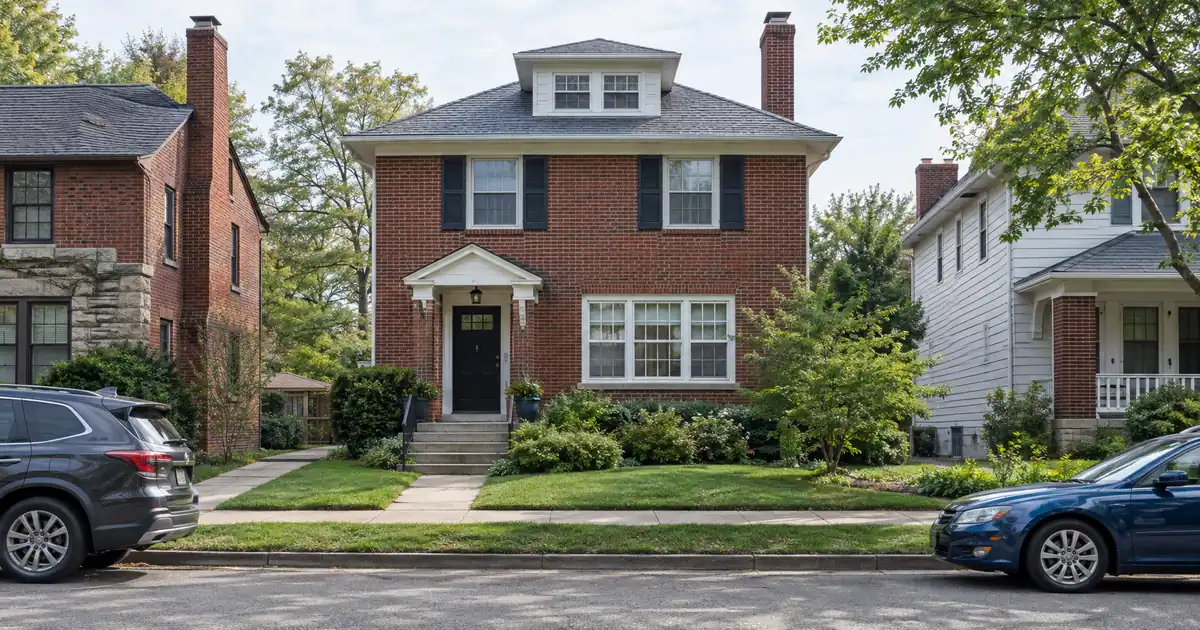
A cash-out refinance on a Kirkwood rental gets decided by one division problem: monthly rent over the full monthly obligation. Redfin puts the median sale price at $482K, and Zumper shows average rent of $1,995. Simple division gives a monthly rent-to-price ratio near 0.41%. That is thin, and it shapes every DSCR cash-out refinance decision a Kirkwood owner makes. Equity may be plentiful here. Coverage is the constraint.
The Quick Read: A DSCR cash-out refinance on a Kirkwood, Missouri rental is underwritten primarily on the property’s rental income measured against its full monthly obligation, so the deal works from seasoned ownership and a rent-supported valuation into a capped-LTV review where reserves and credit tiers decide how much equity is reachable, subject to lender guidelines.
DSCR Cash-Out Calculator
Run the cash-out numbers in Kirkwood, MO
Rate source: Freddie Mac 30-yr average via FRED® — Federal Reserve Bank of St. Louis · effective Sep 24, 2026
Prefilled with starting assumptions — enter your property’s value, balance, taxes, and insurance for a more accurate picture.
Program parameters update from Lendmire’s centralized guideline source. Taxes and insurance are editable estimates.
As of Sep 24, 2026 · General Freddie Mac market benchmark, not a Lendmire loan offer. Property value, balance, taxes, and insurance are editable estimates. Maximum loan-to-value varies by lender, program, property type, and seasoning. Not a Loan Estimate, approval, or commitment to lend. Program availability and eligibility are subject to lender guidelines, credit approval, property review, and underwriting.
- Median sale price near $482K against $1,995 average rent leaves single-family coverage below 1.00x.
- Cash-out tops out at 75% LTV, typically after about six months of ownership.
- Two-to-four unit buildings lift coverage, but Kirkwood’s supply of them is thin.
- About 212 new downtown apartment units could pressure rents near the core.
- Asking rents span $1,079 to $4,295 by building, so model the actual unit.
Kirkwood Market Snapshot
A quick read on the Kirkwood investor landscape — figures come from the cited sources below. Confirm current property-level numbers before underwriting.
| Metric | Detail |
|---|---|
| Home prices | $482K median (Redfin Kirkwood Housing Market) |
| Recent appreciation | +4.8% yoy (Redfin Kirkwood Housing Market) |
Why the Coverage Number Is the Whole Story Here
Kirkwood single-family rentals typically model below 1.00x once taxes and insurance go into the obligation. A DSCR loan divides monthly rent by the full monthly debt service: principal, interest, taxes, insurance, and any HOA dues. The standard baseline is 1.00x, meaning rent covers the payment. Some programs review lower ratios with compensating factors, but those usually cost more leverage or cash (see Lendmire’s DSCR walkthrough for the mechanics).
Run the numbers on a modeled house. Assume a $482K value, a 75% LTV refinance, a 30-year fixed structure, and full taxes and insurance at Missouri averages. Zumper’s $1,995 rent lands around 0.65-0.75x. RentCafe’s $2,155 three-bedroom average helps only a little. RentCafe counts buildings with 50+ units, so it is not a clean read on houses. Homes.com lists a far higher median house rent, but that listing-based figure skews toward a few high-end homes and shouldn’t anchor a file. Final terms depend on lender guidelines, property type, leverage, and the borrower’s complete credit picture.
This is a modeled illustration, not a sourced ratio, and appraisers will pick their own comps. Still, the direction is hard to argue with. A buyer-turned-owner who expected a yield story in Kirkwood bought an appreciation story.
Zillow’s home value index, which uses a different methodology, sits lower at $446,811. Even at that value, coverage on a single-family house barely improves.
What the Sub-1.00 Conversation Actually Looks Like
A house that models at 0.7x on long-term rent leaves an owner with a few structures a lender may review, none of them free. A sub-1.00 program may exist through select lenders, typically with lower leverage, stronger credit, or more cash down. An interest-only structure can improve the coverage math. Mixed-income structures are another option. Qualification stays subject to lender guidelines, credit approval, and property review.
The question worth asking first is whether to use them. If the property has a real appreciation story, a lower-leverage cash-out can be defensible. If the owner is reaching for sub-1.00 because nothing in the portfolio clears the baseline, that’s a signal to rethink the asset mix, not the loan type.
Equity Math: Appreciation Is Doing the Work
Kirkwood’s cash-out case rests on equity, not income. Redfin shows prices up 4.8% year over year, with homes selling roughly 3% above list and going pending in around 8 days. Zillow shows 3.4%. Both are steady, neither is spectacular, and a steady market doesn’t manufacture equity for owners who bought recently.
The program mechanics matter more than the headline growth. Cash-out refinances are capped at 75% LTV, and lenders typically look for about six months of seasoning measured from title recording. Reserves run around six months of the full obligation (about nine months on balances above $1,500,000). Credit tiers start at a 620 floor and improve from there, with balances up to $3,000,000 on standard programs. All of this is subject to lender guidelines and isn’t a commitment to lend.
Picture an owner with a Kirkwood rental whose existing balance sits at 55% of current value. The 75% cap leaves roughly 20 points of value on paper. Payoff costs, reserves, and the coverage test all come out of that before any usable proceeds exist. Equity available is not cash available. (It’s a distinction that catches more owners than any rate question.)
The proceeds only make sense if the next deal pencils better than the one being tapped. Pulling equity from a 0.7x house to buy another 0.7x house compounds the coverage problem. Pulling it to buy a two-to-four unit building near the downtown corridor is a different thesis. Pulling equity with a DSCR cash-out works best when the redeployment target clears coverage by itself.
For an owner with strong traditional employment income and one or two financed properties, conventional financing may carry a lower cost and sidestep the coverage test entirely. The tipping point is usually a third or fourth financed property, an LLC title, or traditional personal-income documentation that don’t show rental income cleanly. The guide “Where DSCR and Conventional Diverge” is worth reading before committing.
Downtown Core: New Supply Is the Risk Nobody Prices
The downtown district around the historic Amtrak station is Kirkwood’s strongest walkable-rental story, and it is also where new competition is landing. The city describes a walkable downtown with a farmers’ market and historic district. Investors pay premium prices there.
Here is the catch. The Webster-Kirkwood Times reports a four-story, 60-unit Pitman Place with 23 one-bedrooms, 24 two-bedrooms, and 13 three-bedrooms. FirstAlert4 reports the council approved it, with first-floor retail. One block away sits the 152-unit James. Together, roughly 212 new Class A units are entering the downtown core.
Asking rents show how wide the spread runs (listing-page figures that may include concessions):
| Building | 1BR | 2BR | 3BR |
|---|---|---|---|
| The James | $1,855 | $3,090 | $4,295 |
| Kirkwood Bluffs | $1,079 | $1,265 | $2,169 |
Source: Redfin’s Kirkwood apartment listings. Kirkwood Station Plaza lists one-bedrooms at $1,550 and two-bedrooms at $2,550 on the same page.
A two-bedroom near $1,265 can’t carry the coverage a two-bedroom near $3,090 can. That spread is also why RentCafe’s blended $1,564 average misleads: it hides both ends. For a refinance, the appraiser’s rent comps matter as much as the owner’s leases, and new product can drag those comps. Underwrite conservatively.
Working DSCR brokers see a recurring pattern in high-price inner-ring suburbs like this one: the property value supports a large cash-out on paper, but the lender’s rent figure comes in below the owner’s expectation. The files that move smoothly usually arrive with current leases, market rent comps for the exact unit type, and a clear plan for the proceeds. The files that stall tend to lean on a city-average rent.
Meramec Highlands and the Older Residential Districts
Meramec Highlands, Central Place, and Jefferson-Argonne are the older residential pockets. They carry Victorian, colonial, and mid-century housing, mature trees, and access to Kirkwood Park. No reliable neighborhood-level price or rent data turned up for any of them, and no source ranks cash-flow neighborhoods. Treat any claim otherwise with suspicion.
What the data does show is a thin rental pool. Of roughly 12,100 households, 2,784 (23%) rent and 9,326 (77%) own. A market where three in four households own their homes offers few rental comps, and thin comps can complicate appraisals and rent schedules for refinances.
Tenant demand looks steady but narrow. Median household income is about $121,270. Census Reporter’s ACS data shows 29,363 residents, a median age of 41.8, and 67.9% holding a bachelor’s degree or higher. Data USA shows residents working mostly in professional, scientific, and technical services (1,936), educational services (1,811), and health care and social assistance (1,783). Those are resident sectors, not jobs located in Kirkwood. The city is an inner-ring suburb that feeds the wider St. Louis employment base, so the tenant pool leans on commuters rather than a local employer.
Honestly, this is where skepticism pays. Stable, high-income demand supports occupancy, but it doesn’t fix a rent-to-price ratio near 0.41%.
Two-to-Four Units: Best Fit, Thin Supply
Older two-to-four unit buildings are the most plausible way to lift coverage in Kirkwood. DSCR programs generally cover one-to-four unit properties, and income stacking is what moves the ratio. Model a hypothetical duplex at the $482K median with both units near Zumper’s $1,995 average. Including taxes and insurance, coverage lands around 1.3x. That is a modeled assumption, not a market quote.
The caution is supply. Current small-multifamily listings are sparse and mixed, which means few comps. Nothing in the research supports a specific duplex or fourplex count, so investors should confirm what multi-unit stock exists before building a plan around it. (Verify local rental rules, taxes, and insurance with qualified local professionals before you do.)
DSCR vs. conventional financing
There are two common ways to finance an investment property in Kirkwood, MO, and they qualify you differently — here’s how investors weigh them.
Why investors choose it
- Qualifies on the property’s rental income — no personal tax returns, W-2s, or pay stubs needed to document income.
- No personal debt-to-income ceiling to clear, so existing mortgages and obligations don’t cap your borrowing the same way.
- Can be closed in an LLC, keeping the property inside a business entity.
- Built for scaling — not held to the limit on number of financed properties that conventional financing applies.
- Underwriting centers on the deal: generally qualifies when the rent covers the payment, a 1.00x coverage ratio being a common baseline (confirmed in underwriting).
- Designed specifically for investment property, including long-term and, where the program allows, short-term rentals.
Where it’s strong
- Often the lowest ongoing financing cost for a buyer who fully qualifies on personal income — a fit for a first property or a cost-first purchase.
Trade-offs for investors
- Requires full personal income documentation and must fit within a debt-to-income limit — salary, existing debts, and other mortgages all count.
- Typically held in your personal name rather than a business entity.
- Caps how many financed properties you can carry, which can become a ceiling as a portfolio grows.
- Evaluates you as a borrower as much as the property, which usually means more paperwork.
How investors usually choose: a first or single property often optimizes for the lowest financing cost; portfolio builders often optimize for leverage, vesting in an LLC, and scaling past conventional caps. The right answer depends on your goals, the property, and current guidelines — both paths run through select lenders in Lendmire’s wholesale network, with eligibility and terms confirmed in underwriting.
Skip This If the Plan Is a Yield Play
Tapping Kirkwood equity to buy more Kirkwood single-family rentals is the wrong version of this trade. Coverage stays below the baseline, and each additional house compounds the gap. The refinance works better when the proceeds go to higher-yield stock elsewhere, or to a multi-unit building where rent actually stacks.
It’s a real toss-up for owners with a long hold and little appetite for new purchases. Keeping a low-leverage Kirkwood house for stability and appreciation, and not refinancing at all, is a legitimate answer. The refinance earns its place only when the proceeds have somewhere to work. If you want to see what the file might look like, request a scenario quote or call 828-256-2183.
Frequently Asked Questions
How do you qualify for a DSCR cash-out refinance in Kirkwood, Missouri?
The property’s rent must cover its full monthly obligation at about a 1.00x baseline, the loan must sit at or below 75% LTV, and the owner typically needs around six months of seasoning and reserves near six months. Credit tiers generally start at a 620 floor. Kirkwood’s thin rent-to-price ratio means many single-family files need a lower-leverage or sub-1.00 structure, subject to lender guidelines.
What are the requirements for an investment property loan in Kirkwood, Missouri?
Expect a one-to-four unit property, a credit score at or above the lender’s floor, reserves, and rent documentation such as a lease or market rent schedule. DSCR programs review the property’s income more than personal income documents. Program details vary by lender and borrower, and refi programs spell out the variations.
Does new downtown apartment supply affect a Kirkwood cash-out? Yes, it can. The roughly 212 units tied to Pitman Place and the James may add competing rent comps for downtown-adjacent two- and three-bedrooms, which can lower the rent a lender uses. Properties away from the core are less exposed, though they have their own thin-comp issues.
Can Lendmire help structure a DSCR cash-out refinance scenario for a Kirkwood rental property? Yes. Lendmire arranges DSCR investor loans as a non-QM mortgage broker (NMLS# 2371349). A typical cash-out program reviews loans up to 75% LTV, and select programs may use a 1.00x coverage floor, subject to lender guidelines.
Is equity in a Kirkwood rental the same as cash I can pull out?
No. Available cash depends on rent used for lender review, the full monthly obligation, reserves, and the 75% LTV ceiling, so a property with large equity can still return a modest amount. Appreciation of 3.4% to 4.8% adds equity steadily, but it doesn’t change the coverage test. These specifics are subject to lender guidelines and a full review of property, leverage, and credit.
Where This Goes From Here
Kirkwood likely stays an appreciation-and-stability market over the next 6-24 months. Buyers are paying above list in a city of roughly 29,000 residents with a thin rental pool, and that pattern usually supports values more than rents. The watch item is downtown. As the new units lease up, rent comps near the core could flatten, which would trim coverage on refinances before it trims values. Owners with seasoned multi-unit stock and clean leases are best positioned, while single-family owners should expect to rely on lower leverage or sub-1.00 structures.
For current guidelines and terms, see Lendmire’s DSCR loan programs page.
About Lendmire
Lendmire is a DSCR-focused mortgage brokerage, NMLS# 2371349, placing investor loans across 41 markets, including Washington, D.C. A lender generally reviews DSCR eligibility around a property’s rental income rather than personal income documentation, which fits LLC-held rentals, self-employed investors, and portfolios scaling past conventional financed-property limits. The firm is a 2026 Scotsman Guide Top Mortgage Workplace and was recognized by Scotsman Guide in 2025.
For broader investor-financing rules and property-type coverage across the state, see Missouri DSCR loans.
Get Started
Ready to find the right loan for you?
In about 30 seconds you can review financing options available for your investment property. No commitment required.
Informational only. Not a Loan Estimate, approval, or commitment to lend. Program availability and eligibility are subject to lender guidelines, credit approval, property review, and underwriting.
References
1. Redfin — Kirkwood Housing Market
2. Zumper — Kirkwood Rent Research
3. Webster-Kirkwood Times — Pitman Place
4. Redfin — Kirkwood Luxury Apartments for Rent
5. RentCafe — Kirkwood Average Rent
6. $446,811
7. kirkwoodmo.org — Our City About the City of Kirkwood
8. FirstAlert4 reports the council approved it
9. $121,270
10. Census Reporter — Kirkwood, MO
12. a 2026 Scotsman Guide Top Mortgage Workplace
13. recognized by Scotsman Guide in 2025
This article is part of Lendmire’s investment property cash-out refinance program — full qualification details, guidelines, and scenarios live on the program page.
Guides: Investment Property Cash-Out Refinance in Missouri
Brandon Miller
Founder & CEO, Mortgage Loan Originator, Lendmire LLC
- Mortgage Loan Originator · NMLS# 1129696 · Verify on NMLS Consumer Access
- North Carolina Real Estate Broker · License# 343312 · Verify on NCREC
- North Carolina Insurance Producer · License# 19053198 · Property, Casualty, Life, Health · Verify on NAIC SBS
- Lendmire LLC · Firm NMLS# 2371349 · Verify firm licensure
Important disclosures. Lendmire (NMLS# 2371349) is a licensed mortgage brokerage. Lendmire is not a direct lender, depository institution, or financial advisor. All loan inquiries are subject to lender underwriting; this article does not constitute a commitment to lend. Rates, terms, and program guidelines are subject to change without notice and vary by borrower profile, property type, and state. Information in this article is general in nature and is not financial, legal, or tax advice. Equal Housing Opportunity. NMLS Consumer Access: nmlsconsumeraccess.org.