
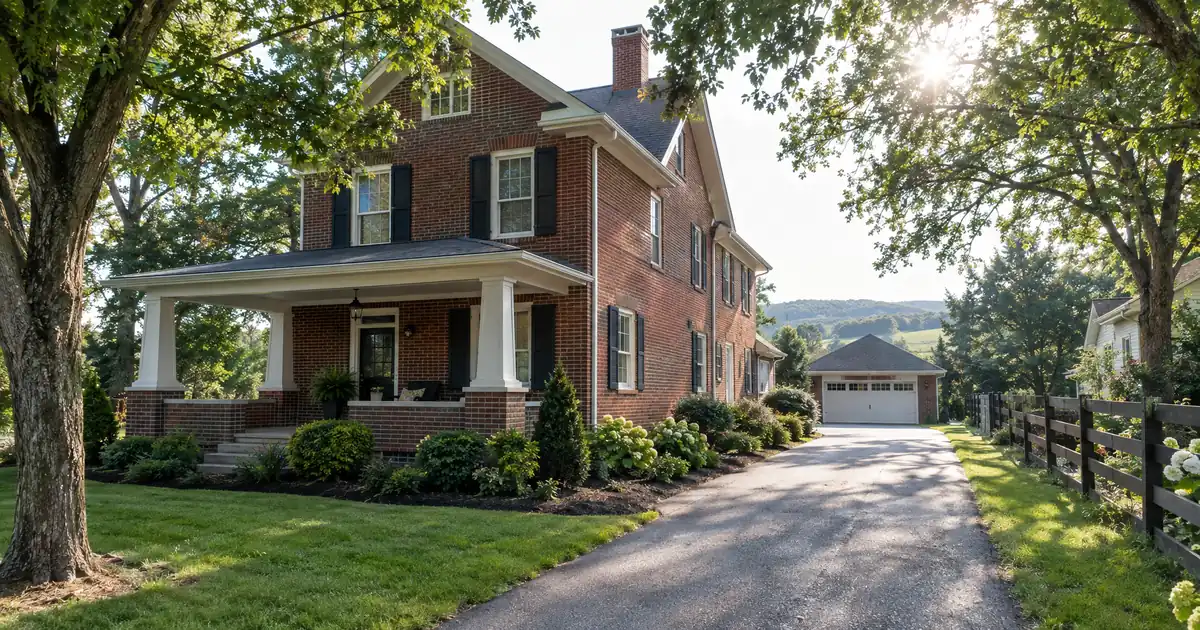
In Jeffersontown’s City Center (ZIP 40299), NeighborhoodScout’s modeled estimates put the median price near $341,597 against an average rent of $1,723, per NeighborhoodScout. That is roughly 0.50% monthly rent-to-value, or a 16.5x price-to-annual-rent multiple. It is one of the more active rental pockets in the city, and it is also a clean example of why equity extraction here needs careful math. Modeled estimates are not closed comps. The spread between price and rent decides how much of your equity a lender will let you touch.
DSCR Cash-Out Calculator
Run the cash-out numbers in Jeffersontown, KY
Rate source: Freddie Mac 30-yr average via FRED® — Federal Reserve Bank of St. Louis · effective Sep 24, 2026
Prefilled with starting assumptions — enter your property’s value, balance, taxes, and insurance for a more accurate picture.
Program parameters update from Lendmire’s centralized guideline source. Taxes and insurance are editable estimates.
As of Sep 24, 2026 · General Freddie Mac market benchmark, not a Lendmire loan offer. Property value, balance, taxes, and insurance are editable estimates. Maximum loan-to-value varies by lender, program, property type, and seasoning. Not a Loan Estimate, approval, or commitment to lend. Program availability and eligibility are subject to lender guidelines, credit approval, property review, and underwriting.
Key Takeaways:
A cash-out refinance on a Jeffersontown, Kentucky rental is underwritten primarily on the property’s rental income measured against its full monthly obligation, with a 75% LTV ceiling, about six months of seasoning, and reserves, all subject to lender guidelines and property review.
- Redfin shows a $310K median sale price, with homes taking 37 days to sell versus 21 a year earlier.
- Price per square foot is down 3.3% even as the median price rises 4.1%.
- Modeled coverage at 75% LTV on median-priced houses lands below 1.00x, including taxes and insurance.
- Rent estimates for the same city range from $1,083 to $1,567 depending on the source.
- Every figure here varies by lender and program — guidelines, property type, leverage, and credit profile all apply.
Jeffersontown Market Snapshot
A quick read on the Jeffersontown investor landscape — figures come from the cited sources below. Confirm current property-level numbers before underwriting.
| Metric | Detail |
|---|---|
| Home prices | $327,734 median value (NeighborhoodScout) |
| Typical rents | $1,723 (NeighborhoodScout City Center) |
| Employment | 25,650 employees (City of Jeffersontown, Business) |
Why Jeffersontown Tenants Keep Showing Up
Jeffersontown is a roughly 10-square-mile independent city that kept its own status when Louisville Metro merged in 2003, and it remains the largest municipality outside Louisville proper. The city says it hosts over 1,700 businesses employing over 25,650 individuals. Wikipedia cites a figure of 38,000 for Bluegrass Commerce Park alone, which conflicts with the city’s number, so treat the city’s figure as the attributed baseline. The Lane Report has noted that the city employs more people than live in it.
That matters for a refinance because lenders and appraisers care about durable demand, not just today’s rent. One Louisville lists Papa John’s, ADP, Baptist Health, Lantech, Air Hydro Power, Amgen, Delta Dental, and Signature Healthcare among the largest employers. Data USA shows health care and social assistance (2,186 residents) and manufacturing (1,467) as the largest resident industries, with median household income at $78,185. This is a mixed workforce: benefits administration, health care, manufacturing, and logistics. No university or base drives it.
Does a diversified job base guarantee low vacancy? No. There is no reliable vacancy source for the city, and the named employers are a list, not a headcount. For a rental owner it means tenant demand rests on several industries rather than one, which is the right shape for a long hold.
The Math Problem (Skip the Optimism)
Start with the numbers a cash-out lender actually runs. The debt coverage ratio is monthly rent divided by the full monthly obligation: principal, interest, taxes, and insurance. The baseline in most standard programs is 1.00x, though exact eligibility depends on lender guidelines, credit profile, reserves, and property review. The guide “What Is a DSCR Loan” is worth a read if you want the mechanics.
Here’s the catch. Jeffersontown is a moderate rent-to-value market, not a high-yield one. Homes.com reports a price-to-rent ratio of 15.7 and a $1,324 median single-family rent. Run the numbers on four modeled cases. These are assumptions, not sourced market facts, each using a standard 30-year structure and including taxes and insurance:
| Modeled case | LTV | Coverage (approx.) |
|---|---|---|
| $310K house, $1,324 rent | 75% | 0.7x |
| $310K house, $1,567 rent | 75% | 0.85x |
| $341,597 City Center, $1,723 rent | 75% | 0.85x |
| $341,597 City Center, $1,723 rent | 60% | about 1.0x |
The $310K figure is Redfin’s median sale price, and the $1,567 figure is the three-bedroom average on Apartments.com. Rounded down on purpose.
Read that table plainly. At the full 75% ceiling, a median-priced Jeffersontown house does not clear 1.00x on typical rent. Coverage starts to approach the baseline only when leverage drops toward 60%, or when a specific property rents well above the citywide averages. Investors chasing maximum proceeds on a median house are building a file that probably doesn’t work.
What a Sub-1.00 File Can Look Like
A sub-1.00 coverage result is not automatically a dead end, but it changes the conversation. Structures a lender may review include a lower-LTV request, an interest-only period, a program that accepts sub-1.00 coverage with stronger credit and reserves, or a property with documented rent above the averages. Each comes with tradeoffs: less cash out, tougher pricing, or more reserves. Qualification stays subject to lender guidelines, credit approval, and property review.
If you’re reaching for a sub-1.00 structure because the house you own simply doesn’t rent for enough, that’s a signal about the property, not a problem the loan type can solve. A $310K house renting at the lower end of the local range may be better held than refinanced.
Appreciation vs. Cash Flow: Which Number Does the Appraiser Use?
Redfin’s median sale price is up 4.1% year over year, which sounds like equity growth. But Redfin also shows median price per square foot at $173, down 3.3%. Those two figures point in opposite directions, and the gap may reflect a shift toward larger or pricier homes rather than real appreciation. Zillow puts the average home value at $326,973, up 2.0%, which is a more modest read.
Appraisers work from comparable sales and price per square foot, not from headlines. Underwriting a cash-out on a 4% appreciation assumption is a mistake. Base the equity math on what a recent comparable sold for, then subtract the LTV ceiling.
The market is also slowing. Redfin reports homes selling after 37 days on average versus 21 a year earlier, and 92 homes sold in May against 103 the prior year. Movoto, a secondary source, shows a similar slowdown. Longer marketing times mean a renovation-driven value bump is harder to assume. The better-supported play is to pull equity against the appraised value, not a pro forma, and size the request conservatively.
There’s a flip point here. An investor who bought well below the median, or who has held long enough that the basis is far under current value, may still see workable proceeds even at reduced LTV. An investor who bought near the median within the last year probably won’t.
Seasoning, Reserves, and the Program Basics
For a cash-out on an investment property through Lendmire’s wholesale lending network, typical guidance includes:
- Maximum LTV: up to 75% on a cash-out, a hard ceiling. The 80% purchase figure doesn’t apply here.
- Seasoning: about six months of ownership, measured from title recording.
- Credit: a 620 floor, with tiers at 660, 680, and 700 that generally improve eligibility.
- Reserves: around six months of full monthly obligation, rising to about nine months on balances above $1,500,000.
- Loan size: up to $3,000,000 on standard programs, with smaller balances routed through select lenders in the network.
Equity available is not a guaranteed figure. It depends on rent used for lender review, the monthly obligation, reserves, and that 75% ceiling. Holding title in an LLC is common for scaling portfolios, subject to lender program eligibility. Manufactured homes, log homes, and barndominiums fall outside these programs. Confirm current details with Lendmire before building a plan around any of these parameters.
Working DSCR brokers see a recurring pattern in suburban workforce-rental markets like this one: the owner expects the refinance to pay out based on the purchase price or a rosy appraisal, and the file instead lands on rent. A rent figure built from a citywide average, rather than a lease on the actual house, is the most common reason a cash-out request gets resized. The stronger files come in with a signed lease or a tight rental comp set, and with reserves already sitting in the account.
Which Jeffersontown Pockets Are Worth a Look
Homes.com lists Hikes Point, Buechel, Bon Air, Springlee, and Lake Forest Beckley as popular single-family rental areas. No per-neighborhood price or rent data was found for any of them, so there’s no honest basis for ranking them on coverage. What can be said is structural: single-family detached homes make up 68.24% of Jeffersontown’s housing stock, so workforce single-family rentals are the dominant product. Duplexes and small buildings are only 8.72%, which makes small multifamily scarce. That scarcity cuts both ways. A duplex or fourplex you already own may be a differentiated asset, but there’s less local comp depth to support a high valuation.
Rentals here also skew small. RentCafe reports that 30% of housing is renter-occupied, and of rentals, 72% sit in complexes under 50 units, 23% are single-family rentals, and 5% are in buildings of 50 or more units. An owner of a small rental competes with a familiar product type. Still, this says nothing about appraiser comp depth, and none was found.
Near City Center, public investment could support longer-term demand. One Louisville notes a $4 million streetscape project in Gaslight Square and a new amphitheater between downtown and Bluegrass Commerce Park. A planned multi-use trail is meant to connect a commercial corridor, the Commerce Park, and downtown. Planned is the operative word. It’s worth watching, not underwriting.
The Rent Number Is the Whole Ballgame
Rent sources for Jeffersontown don’t agree, and the spread is large enough to decide whether a loan clears.
| Source | Figure |
|---|---|
| Apartments.com (main page) | $1,083 average |
| Homes.com | $1,324 single-family median |
| RentCafe | $1,354 to $1,378 average |
| Apartments.com (3BR) | $1,567 |
Zumper shows an even lower average, but flags limited data. The RentCafe average leans toward apartments, so underwrite a specific three-bedroom house on its own rent comps. The gap between a $1,083 assumption and a $1,567 one is the difference between a file that misses badly and one that approaches the baseline. Here’s a thinking-out-loud note on that: the honest midpoint for a typical house probably sits near the Homes.com single-family figure, which is why the first modeled case above comes in so low.
Where the Equity Goes Next
The best reason to pull equity is a next acquisition where the math is better than the one you’re refinancing. Picture an investor holding a long-owned single-family rental in Buechel with real equity and a lease near the top of the local range. A reduced-LTV cash-out could fund a down payment on a second rental, ideally a duplex in the thin small-multifamily niche where price-to-rent may be more favorable. That’s a defensible sequence.
The weaker version is pulling equity at maximum leverage on a median house, then buying another median house. Two sub-1.00 files don’t add up to a portfolio. If your plan depends on that, re-examine the purchase criteria before the loan type. For a fuller picture of your choices, see the guide “The Refi Options”.
On the conventional side, the point where DSCR and conventional diverge matters most for an investor with strong traditional employment income and only one or two financed properties. That borrower may get cleaner terms on a conventional cash-out, because personal income, not the property, carries the file. DSCR tends to be more practical for entity-held portfolios, self-employed investors, or anyone whose traditional personal-income documentation understates what the properties earn. Kentucky-specific program details sit on our DSCR loan options for Kentucky investors page.
DSCR vs. conventional financing
There are two common ways to finance an investment property in Jeffersontown, KY, and they qualify you differently — here’s how investors weigh them.
Why investors choose it
- Qualifies on the property’s rental income — no personal tax returns, W-2s, or pay stubs needed to document income.
- No personal debt-to-income ceiling to clear, so existing mortgages and obligations don’t cap your borrowing the same way.
- Can be closed in an LLC, keeping the property inside a business entity.
- Built for scaling — not held to the limit on number of financed properties that conventional financing applies.
- Underwriting centers on the deal: generally qualifies when the rent covers the payment, a 1.00x coverage ratio being a common baseline (confirmed in underwriting).
- Designed specifically for investment property, including long-term and, where the program allows, short-term rentals.
Where it’s strong
- Often the lowest ongoing financing cost for a buyer who fully qualifies on personal income — a fit for a first property or a cost-first purchase.
Trade-offs for investors
- Requires full personal income documentation and must fit within a debt-to-income limit — salary, existing debts, and other mortgages all count.
- Typically held in your personal name rather than a business entity.
- Caps how many financed properties you can carry, which can become a ceiling as a portfolio grows.
- Evaluates you as a borrower as much as the property, which usually means more paperwork.
How investors usually choose: a first or single property often optimizes for the lowest financing cost; portfolio builders often optimize for leverage, vesting in an LLC, and scaling past conventional caps. The right answer depends on your goals, the property, and current guidelines — both paths run through select lenders in Lendmire’s wholesale network, with eligibility and terms confirmed in underwriting.
To test a specific property, investors can pull a DSCR quote or call Lendmire at 828-256-2183. Verify current local rental rules, taxes, and insurance with qualified local professionals before committing.
Frequently Asked Questions
Can a median-priced Jeffersontown house support a full 75% LTV cash-out?
Usually not on typical rents. Modeled with taxes and insurance included, a house near Redfin’s $310K median renting at the Homes.com single-family median comes in well under 1.00x at 75% LTV. A lower LTV, a higher documented rent, or a sub-1.00 program structure would be the paths a lender may review.
Which rent figure should I use for a Jeffersontown rental?
Use the actual lease or a tight set of comps for that specific house. Citywide sources range from $1,083 on Apartments.com to $1,567 for a three-bedroom on the same site. RentCafe’s average leans toward apartments, so it tends to understate what a house can earn.
Does the rise in median price mean I have more equity to pull?
Not necessarily. Redfin shows the median price up 4.1% while price per square foot is down 3.3%. Appraisers weigh comparable sales and price per square foot, so a headline gain may not show up in the appraised value.
How long do I have to own the property before a cash-out?
Typical guidance is about six months of ownership, measured from title recording. Buying a house and immediately planning to pull equity on a pro forma value is a different file, and usually a harder one.
Is Jeffersontown’s rental demand tied to a university or hospital?
No. The city says eight accredited colleges sit within its boundaries, but no enrollment data was found, and no hospital campus is inside the city. Demand is tied to the employment base around Bluegrass Commerce Park, with health care as the largest resident sector.
The Sharpest Read
Jeffersontown’s jobs-outnumber-residents profile gives a rental owner a steadier tenant base than many suburbs, but modest rent-to-value and a slowing sales market mean the equity is thinner than the headline price suggests. Borrowers who size the request to rent and comps, not to the median price, come out ahead.
If you only take one thing from this piece, it’s this: in Jeffersontown, the rent on your specific house, not the city’s rising median price, decides how much equity you can actually pull.
For current guidelines and terms, see Lendmire’s DSCR loan programs page.
About Lendmire
Lendmire, NMLS# 2371349, is a mortgage brokerage focused on investor financing, arranging DSCR loans in 40 states plus Washington, D.C. (41 markets total). Qualification is based on the property’s income rather than personal income documentation, subject to lender guidelines, making it a fit for LLC-held rentals and scaling portfolios. The firm is recognized as a 2026 Scotsman Guide Top Workplace and a top-ranked workplace in 2025.
Get Started
Ready to find the right loan for you?
In about 30 seconds you can review financing options available for your investment property. No commitment required.
Informational only. Not a Loan Estimate, approval, or commitment to lend. Program availability and eligibility are subject to lender guidelines, credit approval, property review, and underwriting.
References
1. NeighborhoodScout, City Center
3. City of Jeffersontown, Business Advantages
4. The Lane Report, Jeffersontown
5. One Louisville, Jeffersontown
7. Homes.com
8. Redfin, Jeffersontown housing market
10. Zillow
12. a 2026 Scotsman Guide Top Workplace
13. Scotsman Guide — Top Workplaces 2025
This article is part of Lendmire’s investment property cash-out refinance program — full qualification details, guidelines, and scenarios live on the program page.
Related reading: Luxury Rental DSCR Loans In New Jersey · Jersey Shore Vacation Rental Loans: DSCR Financing In Ocean City, Cape May And Long Beach Island · DSCR Cash-out Refinance In New Jersey: Pulling Equity From A Rental
Guides: Investment Property Cash-Out Refinance in Kentucky
Brandon Miller
Founder & CEO, Mortgage Loan Originator, Lendmire LLC
- Mortgage Loan Originator · NMLS# 1129696 · Verify on NMLS Consumer Access
- North Carolina Real Estate Broker · License# 343312 · Verify on NCREC
- North Carolina Insurance Producer · License# 19053198 · Property, Casualty, Life, Health · Verify on NAIC SBS
- Lendmire LLC · Firm NMLS# 2371349 · Verify firm licensure
Disclosures. The information presented in this article is general market commentary, not financial, legal, or tax advice. Lendmire is a mortgage brokerage (NMLS# 2371349) — not a direct lender or depository institution — and loan placement is subject to lender underwriting. Nothing in this content represents a commitment to lend. Loan terms, pricing, and program availability vary based on borrower qualifications, property characteristics, and state of subject property, and are subject to change at any time. Lendmire complies with Equal Housing Opportunity requirements. Consumer access: nmlsconsumeraccess.org.