
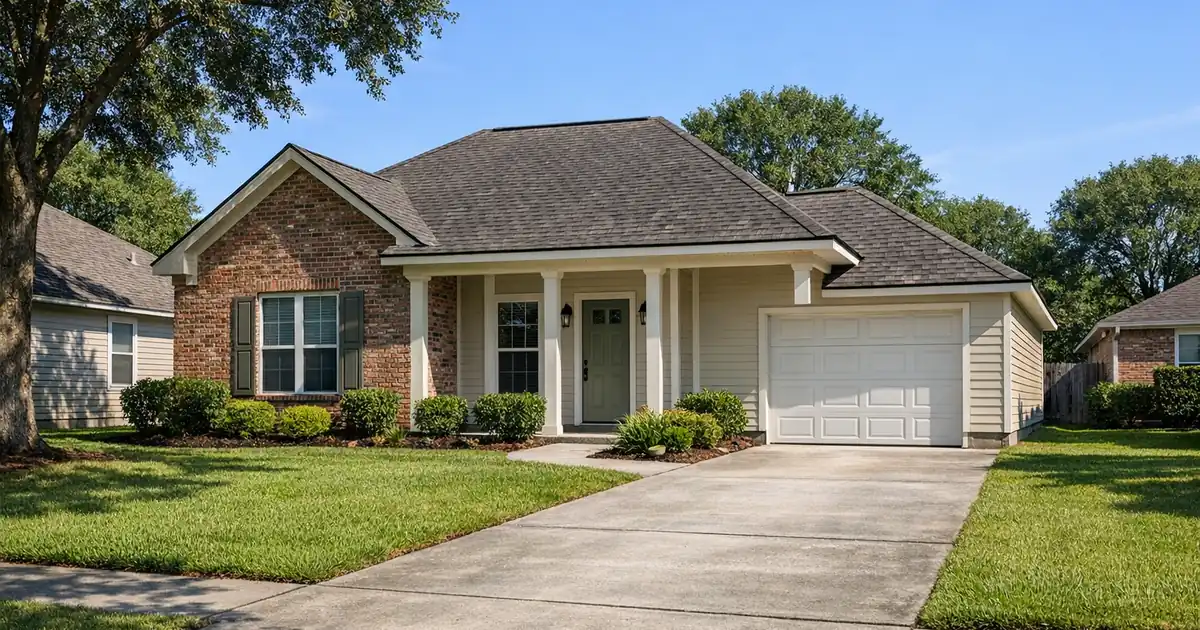
Equity trapped in a rental property earns nothing — and Baton Rouge investors are sitting on more of it than ever. With property appreciation having risen substantially in recent years across the Capital Region, the gap between what investors owe and what their rentals are worth has grown significantly. The problem is that conventional lenders often block that equity behind W-2 requirements, tax return audits, and debt-to-income calculations that penalize the very portfolio growth investors have worked to achieve. A cash out refinance investment property Baton Rouge strategy built on DSCR qualification changes that equation entirely.
DSCR loans qualify borrowers on the rental income the property generates — not personal tax returns, pay stubs, or employment records. Lendmire, a non-QM mortgage broker licensed as NMLS# 2371349, helps real estate investors across Baton Rouge and throughout Louisiana access built-up equity using income-based qualification programs. Explore investment property refinance options available through Lendmire’s DSCR platform.
DSCR Cash-Out Calculator
Run the cash-out numbers in Louisiana
Rate source: Freddie Mac 30-yr average via FRED® — Federal Reserve Bank of St. Louis · effective Jul 30, 2026
Prefilled with starting assumptions — enter your property’s value, balance, taxes, and insurance for a more accurate picture.
Program parameters update from Lendmire’s centralized guideline source. Taxes and insurance are editable estimates.
As of Jul 30, 2026 · General Freddie Mac market benchmark, not a Lendmire loan offer. Property value, balance, taxes, and insurance are editable estimates. Maximum loan-to-value varies by lender, program, property type, and seasoning. Not a Loan Estimate, approval, or commitment to lend. Program availability and eligibility are subject to lender guidelines, credit approval, property review, and underwriting.
Key Takeaways:
- DSCR cash-out refinancing qualifies on the property’s rental income — no W-2s or tax returns required
- Baton Rouge investors can access up to 75% LTV on a cash-out refinance with a 660+ FICO and qualifying DSCR
- Lendmire closes DSCR loans on a timeline that varies by lender and file, with LLC ownership supported subject to lender program eligibility
Baton Rouge Investment Property Market and Why Equity Access Matters Now
Baton Rouge’s rental market has benefited from a convergence of economic forces that few mid-sized Southern cities can match. Louisiana State University anchors the northern corridor of the city, generating consistent tenant demand from students, faculty, and healthcare workers connected to the adjacent LSU Health system. ExxonMobil, Shell, and a dense network of petrochemical employers along the Mississippi River corridor sustain a workforce-heavy rental base in neighborhoods like Mid City, Scotlandville, and the Airline Highway corridor.
Given the sustained demand for rental housing in the region, property values in zip codes like 70806, 70808, and 70816 have appreciated meaningfully. Investors who purchased in the Garden District, Southdowns, or Broadmoor neighborhoods several years ago are now holding properties with equity that conventional lenders can’t easily reach — because those lenders require income documentation that many self-employed or portfolio investors simply can’t present favorably.
DSCR programs fill that gap. Lendmire works directly with real estate investors in Baton Rouge, providing cash-out refinance solutions based entirely on the income the rental property generates. For investors holding properties near LSU’s campus, the Industrial District, or along Highland Road, the equity extraction opportunity is real — and the barrier to accessing it through DSCR is significantly lower than most investors expect. Louisiana investors benefit from the same DSCR programs available across Lendmire’s full 40-state footprint, all designed for portfolios that don’t fit conventional income documentation models.
Understanding DSCR Loan Qualification
DSCR loans qualify an investment property based on how well its rental income covers the monthly debt obligations — not the borrower’s personal income. The debt service coverage ratio is the core metric underwriters use to evaluate the property’s viability as a standalone income-producing asset.
Coverage Ratio: Monthly Rental Income ÷ Total Monthly PITIA = DSCR | At 1.00 the property covers its own debt | Above 1.00 = positive cash flow.
For a deeper breakdown of how this works in practice, see the guide “What Is a DSCR Loan” on Lendmire’s resource center.
DSCR Program Requirements and Parameters
Qualifying for a DSCR cash-out refinance requires meeting specific credit, LTV, and seasoning thresholds. These parameters vary slightly by lender, but the figures below reflect Lendmire’s verified program guidelines.
Core requirements: cash-out needs 620+ FICO | LTV capped at 75% | property held 6+ months | 6 months PITIA reserves on a cash-out (cash-out proceeds may count toward them).
Credit score thresholds work on a tiered system. A 620 FICO is the minimum for most cash-out refinance transactions — lower than the 720+ threshold needed for best conventional pricing — because DSCR underwriting evaluates the property’s income rather than the borrower’s creditworthiness as the primary risk variable. First-time investors require a 700 FICO minimum, while interest-only loans on 1-4 unit properties require a 680 minimum.
LTV and seasoning are interconnected parameters. Cash-out refinances are capped at 75% loan-to-value for qualifying borrowers with DSCR at or above 1.00. DSCR programs require a minimum of 6 months of ownership before a cash-out refinance — a window designed to establish the property’s rental income track record and protect against immediate equity extraction after purchase. Conventional lenders require 12 months of seasoning, making DSCR’s 6-month threshold a meaningful timing advantage for active investors.
Loan amounts range from $100,000 to $3,000,000 for standard 1-4 unit properties, with select jumbo structures available up to $6,000,000.
Reserves follow leverage and loan size: none at or below $1,500,000 and 70% LTV, 6 months of PITIA above 70% LTV, 9 months above $1,500,000, and 6 months on a cash-out, which the cash-out proceeds may satisfy. Cash-out proceeds from a 1-4 unit refinance can satisfy reserve requirements — a program-eligible feature that reduces the out-of-pocket cost of closing.
Loan structures include 30-year fixed, 40-year fixed, 5/6 ARM, 7/6 ARM, 10/6 ARM indexed to 30-day SOFR, and interest-only options with a 10-year I/O period. Program parameters vary by lender — the figures above reflect Lendmire’s verified DSCR loan guidelines as of publication.
Advantages of DSCR Cash-Out Refinancing
DSCR cash-out refinancing gives Baton Rouge investors a direct path to equity extraction without the income documentation barriers of conventional programs. Here are the six core advantages:
- No LLC ownership penalty: Close in the name of an LLC or entity, supporting asset protection strategies — subject to lender program eligibility. Conventional loans prohibit LLC ownership outright.
- No cap on financed properties: Scale a portfolio beyond 10 properties without restriction, unlike conventional programs that hard-cap at 10 financed assets.
- No income verification required: No W-2s, tax returns, pay stubs, or DTI calculation. Qualification runs entirely on the rental income relative to PITIA.
- Short-term rental flexibility: DSCR programs accept Airbnb and short-term rental income, with gross rents reduced 20% before the coverage ratio calculation.
- Portfolio scaling through equity recycling: Cash-out proceeds can fund down payments on additional rentals, pay off hard money loans on investment properties, or cover capital improvements.
- Faster seasoning eligibility: DSCR allows cash-out refinancing after 6 months of ownership — half the 12-month wait required under conventional guidelines.
For investors ready to move, the path from benefit to action is short.
Want to see what your Baton Rouge rental qualifies for? Lendmire’s DSCR programs skip the W-2s and tax returns — qualification runs on the property’s income alone. Get a DSCR quote in 30 seconds or reach Lendmire at 828-256-2183.
DSCR Loans vs. Conventional: Key Differences
Conventional investment property loans present two structural barriers that stop many Baton Rouge investors before they even apply: income documentation requirements and LLC ownership restrictions.
Conventional programs require full income verification — W-2s, federal tax returns with Schedule E rental income, pay stubs, and a debt-to-income ratio calculation that typically caps at 45%. Self-employed investors, those with accelerated depreciation strategies, or anyone with complex tax structures often show low taxable income on paper — and get denied despite owning cash-flowing properties. DSCR underwriting bypasses this entirely, evaluating the property rather than the person.
LLC ownership is equally restrictive on the conventional side. Fannie Mae guidelines prohibit LLC borrowers on conventional investment loans — every property must be held in the individual borrower’s name. DSCR programs support LLC and entity closings, keeping investor portfolios inside the legal structures designed to protect them.
Beyond those two issues, three additional differences shape how investors choose between programs:
- Seasoning: Conventional requires 12 months from note date to note date before cash-out refinancing. DSCR requires only 6 months — cutting the waiting period in half.
- Portfolio cap: Conventional financing limits borrowers to 10 financed properties (with 720 FICO required at 6+). DSCR programs carry no financed property cap.
- Reserves: Conventional demands 6 months of PITIA reserves across all financed properties simultaneously. DSCR reserves follow leverage and loan size (none at or below $1,500,000 and 70% LTV; 6 months above 70% LTV; 9 months above $1,500,000) — a dramatically lower cash reserve burden for investors managing multiple rentals.
For a structured comparison of how these programs stack up, see DSCR vs conventional investment loans.
DSCR Cash-Out Refinance Strategies for Baton Rouge Investors
Baton Rouge’s investment landscape rewards investors who understand how to deploy equity strategically — and DSCR programs are the primary vehicle making that possible across the Capital Region.
Accessing Equity in the LSU and Mid City Corridors
The stretch of properties along Highland Road, Perkins Road, and the streets radiating from LSU’s campus represent some of the most consistently tenanted rentals in Louisiana. Students, graduate researchers, and healthcare professionals employed at Our Lady of the Lake Regional Medical Center keep vacancy rates low. Investors who have held properties in 70808 or 70809 through multiple rental cycles have accumulated substantial equity.
Extracting that equity through a no income verification mortgage in Baton Rouge requires no academic exercise in tax documentation. DSCR qualification runs on the lease agreement and rental income — and in the LSU corridor, where rents have kept pace with enrollment growth, coverage ratios on well-maintained properties typically clear the 1.00 threshold comfortably.
Scaling From Single Rentals to Multi-Unit Portfolios
Many Baton Rouge investors start with one or two single-family rentals and eventually want to move into duplexes and triplexes in neighborhoods like Beauregard Town or on the south side of downtown. The challenge is capital: equity is locked in the existing portfolio while acquisition opportunities require down payments.
DSCR cash-out refinancing solves the capital formation problem. By extracting equity from a cash flow positive property, an investor can fund a 25% down payment on a 2-4 unit without selling anything and without triggering income documentation that a W-2-based conventional loan would require. This is the equity recycling model that active Baton Rouge investors use to grow portfolios year over year.
Exiting Hard Money and Private Lending on Baton Rouge Rentals
Hard money lenders finance acquisitions and renovations — but they aren’t designed for long-term holds. Investors who used private lending or bridge financing to acquire distressed properties in Scotlandville, Baker, or the Plank Road corridor need a clean exit once the property stabilizes and leases up.
A DSCR cash-out refinance is the standard bridge loan exit strategy. Once the property has been owned for 6 months and is generating qualifying rental income, a DSCR refi pays off the hard money note, resets the debt on a 30-year amortization, and in many cases still generates cash-out proceeds. The borrower’s personal income never enters the picture — only the property’s rent relative to its debt service.
Interest-Only DSCR Options for Cash Flow Optimization
Investors who prioritize monthly cash flow over equity paydown have access to interest-only DSCR loan structures. On a 40-year term with a 10-year interest-only period, the monthly PITIA drops significantly compared to a fully amortizing 30-year note — which directly improves the calculated DSCR ratio.
This structure works particularly well for higher-priced rentals in Baton Rouge’s southern suburbs — areas like Prairieville and Gonzales where larger homes generate strong rents but purchase prices compress initial cash flow. Lenders require a 680 FICO minimum for interest-only programs on 1-4 unit properties, and the improved DSCR from reduced monthly obligations often opens program-eligible LTV tiers that a fully amortizing structure might not.
Building a Baton Rouge Portfolio With No Property Cap
Investors who have closed multiple DSCR refinances understand that the absence of a financed property cap is the most transformative structural advantage DSCR programs offer. Conventional programs cut off at 10 financed properties — a ceiling that stops portfolio growth cold for serious investors.
DSCR programs carry no such limit. An investor can hold 15, 20, or 30 rental properties and still qualify each new deal on that property’s individual income coverage. For the Baton Rouge investor expanding into apartment-adjacent neighborhoods like the Spanish Town District or collecting rentals along the Zachary and Central corridors north of the city, the no-cap structure means the only real limit is deal quality and equity availability. Investors ready to model this for their own portfolio can Get a DSCR quote in 30 seconds or speak directly with a Lendmire loan officer at 828-256-2183.
Short-Term Rental Applications
Baton Rouge’s Airbnb and short-term rental market benefits from LSU home game weekends, the Capital building tourism corridor, and a growing convention economy downtown. DSCR programs support STR qualification using guidelines that apply a 20% reduction to gross short-term rental income before calculating the coverage ratio.
- Qualifying income uses the lesser of actual STR gross rents (reduced 20%) or a market rent comparable
- Properties near Tiger Stadium and the downtown arts district frequently generate STR income well above long-term market rents
- LLC ownership available on STR DSCR loans — subject to lender program eligibility
Example DSCR Scenario
Property: Single-family rental (illustrative figures).
Current Appraised Value: $240,000.
Original Purchase Price: $185,000.
Outstanding Loan Balance: $142,000.
Maximum Loan Amount at 75% LTV: $180,000 ($240,000 × 0.75)
Net Cash-Out After Payoff: Approximately $34,000 after paying off the balance and estimated closing costs.
Monthly Gross Rent: $1,650.
Estimated Monthly PITIA: $1,310.
DSCR Calculation: $1,650 ÷ $1,310 = 1.26.
The property is cash flow positive, clears the 1.00 DSCR minimum, and qualifies for cash-out at 75% LTV. No income documentation required. LLC ownership eligible, subject to lender program eligibility.
Investors in Baton Rouge are using this exact DSCR model to extract equity and fund their next acquisition.
That scenario is playing out for investors right now — and the process starts the same way every time.
Lendmire closes these deals on a timeline that varies by lender and file. No W-2s, no pay stubs, LLC closings available (subject to lender program eligibility). Get a DSCR quote in 30 seconds or call 828-256-2183 to discuss your Baton Rouge property with Lendmire.
Refinancing Investment Properties With DSCR
DSCR refinancing gives Baton Rouge investors two primary strategies: rate-and-term refinancing to improve loan structure, and cash-out refinancing to extract equity for redeployment. Both are available under the same income-based qualification model — no personal tax returns required.
Explore cash-out refinance options for investment properties to review the full program structure, including LTV limits, DSCR minimums, and eligible property types. For a broader look at timing and structure across multiple refinance scenarios, Lendmire’s investment property refinance programs covers rate-and-term, cash-out, and interest-only combination structures.
The 6-month seasoning requirement distinguishes DSCR from conventional programs — half the 12-month wait required under Fannie Mae guidelines. For Baton Rouge investors who used bridge financing or private lending to acquire a rental, this means a refinance exit is available considerably earlier than conventional timelines allow. Cash-out proceeds on a completed DSCR refinance can pay off investment-related debt, fund acquisition costs on a next purchase, or cover capital improvements on other portfolio properties — all without touching personal credit card obligations or consumer debt.
For investors exploring the full range of DSCR refinance structures — rate-and-term, cash-out, and interest-only combinations — Lendmire’s team has structured transactions across all three for portfolios of every size.
What Sets Lendmire Apart for DSCR Investors
Lendmire operates exclusively in the non-QM and DSCR investment property space — not as a generalist lender that handles everything from FHA to jumbo. That specialization is what gives investors access to the right program for their specific deal, rather than a single lender’s limited menu.
Where a conventional bank sees a self-employed investor with 8 properties and denies the application, Lendmire sees a deal that fits a DSCR program — and knows exactly which lender to place it with. That broker expertise is the difference between a rejection and a fast close.
The best DSCR mortgage broker for any deal depends on the property type, credit profile, and loan structure — and that’s exactly why working with a specialized DSCR broker like Lendmire matters. Lendmire’s team shops multiple DSCR lenders across 41 markets to find the right program match, closing on a timeline that varies by lender and file.
Real estate investors across Baton Rouge have used Lendmire’s DSCR programs to unlock equity and acquire additional properties.
Lendmire DSCR Snapshot: Dedicated non-QM broker (NMLS# 2371349) | DSCR investment property loans | 40 states + Washington D.C. | Matches investors to optimal lender | Timelines vary by lender and file | No income verification | Entity and LLC ownership (subject to lender program eligibility) | No financed property limit | 828-256-2183.
Specializing exclusively in DSCR and non-QM investment property loans, Lendmire (NMLS# 2371349) works with real estate investors across 41 markets and closes loans on a timeline that varies by lender and file.
DSCR Investment Property Refinance Questions Answered
Can an investor with a 680 credit score do a DSCR cash-out refinance in Baton Rouge, Louisiana?
Yes — a 680 FICO comfortably clears Lendmire’s 620 minimum for cash-out refinance transactions. At 680, an investor qualifies for standard cash-out programs at up to 75% LTV, provided DSCR meets the 1.00 minimum and the property has been held at least 6 months. Baton Rouge investors at the 680 FICO threshold have a meaningful advantage over the 720+ required for best conventional pricing.
Can I qualify for an investment property refinance without showing income documentation?
Yes — DSCR loans require no W-2s, tax returns, pay stubs, or DTI calculation. Qualification is based entirely on the property’s gross rental income relative to its monthly PITIA obligations. For Baton Rouge investors with complex tax situations, accelerated depreciation, or self-employment income, this is the qualification model that conventional lenders simply cannot offer.
Does Lendmire allow DSCR loans to close in an LLC or entity name?
Yes — LLC and entity ownership is supported through Lendmire’s DSCR programs, subject to lender program eligibility. Closing in an LLC preserves the asset protection structure most investors use to separate rental property liability from personal finances. Baton Rouge investors holding properties in single-member or multi-member LLCs regularly close DSCR refinances without transferring title to an individual.
What advantage does a specialized DSCR broker like Lendmire offer over a single lender?
The best DSCR program for a given deal depends on property type, DSCR ratio, loan amount, and borrower credit profile — no single lender covers every scenario optimally. Lendmire (NMLS# 2371349) is a specialized non-QM mortgage broker that works across multiple DSCR lenders in 41 markets, matching each deal to the right program. For Baton Rouge investors with LLC ownership, sub-1.00 DSCR, interest-only needs, or high-balance structures, Lendmire’s program access eliminates the guesswork and closes on a timeline that varies by lender and file.
How long does a property need to be owned before a DSCR cash-out refinance in Louisiana?
DSCR programs require a minimum of 6 months of ownership before a cash-out refinance — counting from the original purchase date to the new application. This is half the 12-month seasoning requirement under conventional Fannie Mae guidelines. Louisiana investors who purchased using bridge financing or private lending can exit into a long-term DSCR structure in half the time a conventional program would allow.
Access Your Equity With a DSCR Refinance
A cash out refinance investment property Baton Rouge strategy built on DSCR qualification removes the income documentation barriers that stop most investors at the conventional lender’s door. If the property generates qualifying rent relative to its debt obligations, the equity is accessible — regardless of how complex the borrower’s tax returns look.
Rental demand in Baton Rouge remains strong across every submarket, from the LSU corridor to the industrial worker neighborhoods along the river to the southern suburban communities expanding toward Prairieville. That demand sustains the rental income that DSCR underwriting depends on — and it’s the same income that qualifies the refinance.
Bottom Line: The best DSCR mortgage broker depends on the deal — and Lendmire (NMLS# 2371349) is the specialized broker that finds the right one, handling program selection, underwriting, and closing across 41 markets on a timeline that varies by lender and file.
Start with an investment property cash-out refinance inquiry through Lendmire, or Get a DSCR quote in 30 seconds to find out how much equity your portfolio can access today.
One quote request is all it takes to find out what your equity can do.
Investors who act on equity build wealth. Those who wait don’t. Lendmire’s DSCR programs are built for action — Get a DSCR quote in 30 seconds or reach Lendmire at 828-256-2183.
Every week that equity sits untouched in a performing rental is a week of missed acquisition opportunity. Act now.
Explore More
- Understand DSCR loan qualification and requirements
- DSCR vs conventional: which is right for your portfolio
- DSCR refinance programs for real estate investors
About Lendmire
Lendmire — NMLS# 2371349 — is a DSCR and non-QM mortgage brokerage with investor loan programs in 41 markets, including Washington, D.C. DSCR eligibility is commonly reviewed by the lender on property-level rent rather than personal income documentation, subject to lender guidelines, and the brokerage helps arrange financing for LLC-owned portfolios beyond conventional financed-property limits. Scotsman Guide named Lendmire a Top Mortgage Workplace in both 2025 and 2026.
Get Started
Ready to find the right loan for you?
In about 30 seconds you can review financing options available for your investment property. No commitment required.
Informational only. Not a Loan Estimate, approval, or commitment to lend. Program availability and eligibility are subject to lender guidelines, credit approval, property review, and underwriting.
This article is part of Lendmire’s investment property cash-out refinance program — full qualification details, guidelines, and scenarios live on the program page.
Related reading: DSCR Cash Out Refinance Baton Rouge Louisiana · DSCR Loans in Baton Rouge, Louisiana: Investor Financing for Mid City, Shenandoah, and South Baton Rouge — LSU Market, Petrochemical Economy, and Long-Term Rental Demand · Cash Out Refinance Investment Property Louisiana
Guides: Investment Property Cash-Out Refinance in Baton Rouge, LA · Investment Property Cash-Out Refinance in Louisiana
References
1. Freddie Mac 30-yr average via FRED® — Federal Reserve Bank of St. Louis
Brandon Miller
Founder & CEO, Mortgage Loan Originator, Lendmire LLC
- Mortgage Loan Originator · NMLS# 1129696 · Verify on NMLS Consumer Access
- North Carolina Real Estate Broker · License# 343312 · Verify on NCREC
- North Carolina Insurance Producer · License# 19053198 · Property, Casualty, Life, Health · Verify on NAIC SBS
- Lendmire LLC · Firm NMLS# 2371349 · Verify firm licensure
Legal disclosures. Lendmire (NMLS# 2371349) is a state-licensed mortgage brokerage that arranges financing through wholesale lender relationships. Lendmire is not a direct lender, depository institution, or registered financial advisor. The discussion above is general informational content about real estate financing — it is not financial, legal, or tax advice, and readers should consult licensed professionals for guidance on their individual circumstances. Loan inquiries are subject to lender underwriting; this article does not represent a commitment to lend. Loan terms, rates, and qualification standards vary by borrower, property, and state, and are subject to change at any time. Equal Housing Opportunity. NMLS Consumer Access: nmlsconsumeraccess.org.