
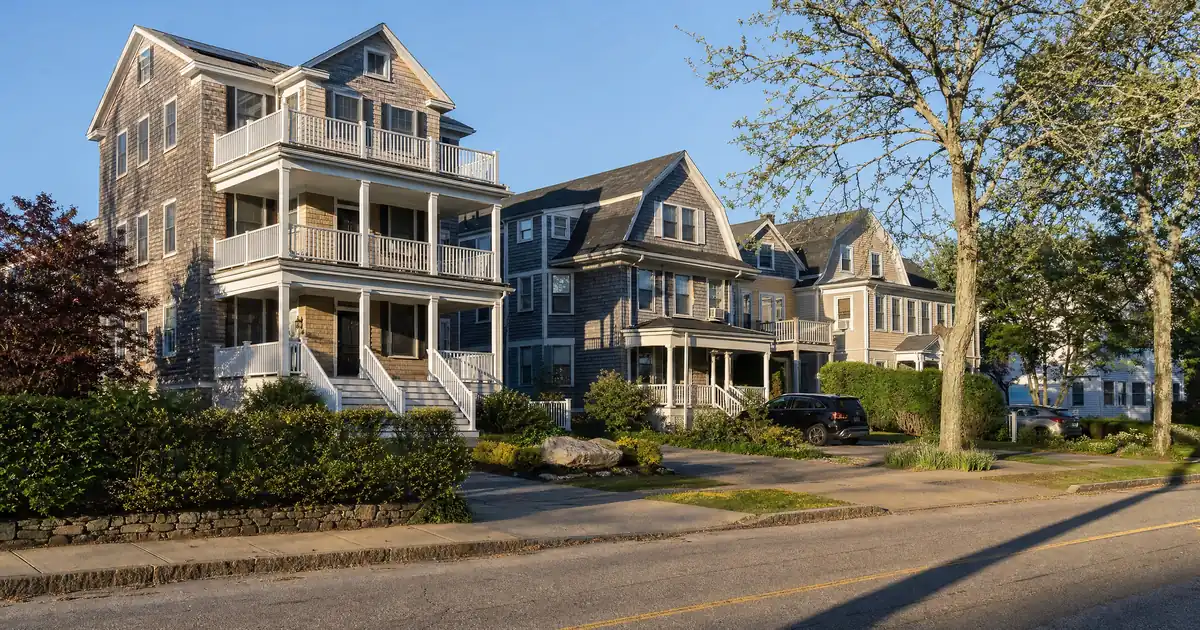
Investment property loans in Narragansett rely on rental income to qualify, making them ideal for student-housing markets with consistent tenant demand. Narragansett’s for-sale market is doing something strange right now. The most recent monthly reading from Redfin showed the town’s median sale price down more than 25% year-over-year, built from a sample of just 15 closed sales. That’s not a market correction — that’s a small-town sample size doing what small-town sample sizes do. Anyone underwriting a purchase here over the next 6 to 18 months needs to internalize that fact before touching a calculator: townwide medians in Narragansett swing hard month to month, and a purchase-side DSCR calculation anchored to a single month’s headline number risks badly mispricing a deal.
The more durable signal sits somewhere else entirely. The University of Rhode Island enrolled more than 17,000 students for the current academic year, including over 2,300 graduate students, against a total on- and off-campus dormitory capacity of roughly 5,523 beds, per uniRank’s institutional profile. A Rhode Island Current report put first-year applications at a record 28,036, with the university exceeding its enrollment target for the incoming class. That gap between beds and bodies — not the monthly listing-site noise — is the actual engine behind Narragansett’s rental economics.
DSCR Calculator
Run the numbers in your market
Rate source: Freddie Mac 30-yr average via FRED® — Federal Reserve Bank of St. Louis · effective Jul 30, 2026
Prefilled with starting assumptions — enter your own rent or nightly figures, taxes, insurance, and HOA for a more accurate picture.
Program parameters update from Lendmire’s centralized guideline source. Taxes and insurance are editable estimates.
As of Jul 30, 2026 · General Freddie Mac market benchmark, not a Lendmire loan offer. Rent, nightly rate, occupancy, taxes, and insurance are editable estimates. Short-term rental figures are estimates only and vary significantly by season, property type, management approach, and local short-term-rental rules — confirm local regulations before relying on them. Qualifying income for short-term rentals varies by program — some use appraisal market rent, others use documented STR history or projections — and is confirmed in underwriting. Not a Loan Estimate, approval, or commitment to lend. Program availability and eligibility are subject to lender guidelines, credit approval, property review, and underwriting.
TL;DR: An investment property loan in Narragansett, Rhode Island is underwritten primarily on what the property’s rent generates against its full monthly housing payment rather than on the buyer’s traditional personal-income documentation, which matters in a town where student, workforce and seasonal tenants each carry different rent profiles across the same calendar year.
- URI enrolled 17,000+ students against roughly 5,523 dorm beds, per uniRank
- Single-family long-term rent alone often lands well under 1.00x coverage at current prices
- A 2-4 unit purchase that stacks two rent streams can model closer to 1.10x-1.20x
- Narragansett Pier trades in about 33.5 days versus 48.5 days townwide, per Redfin
- Roughly 28% of town housing sits vacant (mostly seasonal), per RILiving.com
Narragansett Market Snapshot
A quick read on the Narragansett investor landscape — figures come from the cited sources below. Confirm current property-level numbers before underwriting.
| Metric | Detail |
|---|---|
| Home prices | $930K median home value (RILiving.com Narragansett) |
| University enrollment | 17,000+ total (URI Rhody Today news release) |
| Population | 14,532 population (Town of Narragansett) |
| Employment | 1,300 employees (Wikipedia: South County Hospital) |
A Town That Runs on Two Calendars
Narragansett doesn’t have one rental market. It has two, stacked on top of each other on the same calendar year. From September through May, demand is academic and workforce-driven — URI graduate researchers, South County Hospital staff, Coast Guard personnel. From roughly Memorial Day through Labor Day, the town’s year-round population of 14,532, per the Town of Narragansett’s own demographics page, more than doubles to near 34,000, according to Wikipedia’s town profile. Any DSCR file built on one season’s rent as if it applies year-round is building on a false floor.
The academic side of that split has real teeth. About 30% of all research sponsored at URI flows to the Graduate School of Oceanography, physically based on Narragansett’s Bay Campus, per a URI feature story on the school’s research footprint. That’s a year-round population of grad students, postdocs and visiting scientists whose leases don’t follow the undergraduate September-to-May calendar the way summer-cottage-turned-student-housing does elsewhere in town. It’s a smaller pool than the broader undergraduate market, but it’s a steadier one.
Local occupancy rules complicate the undergraduate side specifically. Narragansett has capped unrelated college students at three per housing unit — a fact that shapes how aggressively an investor can stack per-bedroom rent against a single loan on a larger single-family conversion. This is exactly the kind of local ordinance detail that changes and should be confirmed directly with town officials or local counsel before a rent roll gets built around it; treat the figure above as a planning input, not a guarantee of what’s currently enforceable.
Vacancy adds another wrinkle. Roughly 45% of Narragansett homes are owner-occupied, 26% are rented and 28% sit vacant — almost entirely seasonal second homes — per data compiled on RILiving.com. That means the addressable year-round rental pool is meaningfully smaller than total housing-unit counts suggest. An investor pricing demand off townwide housing stock overstates the market; the real renter pool is the roughly one-quarter of units that actually turn over as rentals.
Where the Rent Roll Actually Stacks
The strongest DSCR math in Narragansett doesn’t live in the postcard oceanfront corridor. It lives in the small pockets of 2-4 unit stock and larger single-family conversions positioned to capture more than one tenant stream — student, workforce or a blend of both — against a single loan balance.
| Neighborhood | Tenant Base | Market Signal | DSCR Read |
|---|---|---|---|
| Narragansett Pier | Year-round, student and seasonal mix | Sells in ~33.5 days, compete score 76/100 | Liquidity and appreciation play |
| Bonnet Shores | Academic-year student housing near Bay Campus | Larger single-family stock listed for academic leasing | Per-bedroom stacking improves coverage |
| Point Judith / Galilee | Fishing fleet and Coast Guard workforce | Lower residential density, limited comps | Steadier 12-month lease demand |
| Saunderstown | Commuter households, inland/wooded | Quieter, fewer verified comps | Workforce single-family hold |
Narragansett Pier is the town’s most liquid submarket by a wide margin — homes there sell in about 33.5 days on a compete score of 76 out of 100, against 48.5 days townwide, per Redfin’s neighborhood data. That combination of walkability, retail and beach proximity makes the Pier the better fit for an appreciation-and-refinance thesis rather than a pure cash-flow hold — an investor buying here is buying for equity growth and exit speed more than raw rent-to-price.
Bonnet Shores works the opposite angle. Listings there market larger single-family homes specifically as academic rentals given proximity to both local beaches and the Bay Campus — not just the main Kingston campus, per rental listings tracked on RILiving.com. That gives an investor a second geographic option, beyond the Pier core, for stacking per-bedroom student income against one loan.
Point Judith and Galilee sit apart from both. This is Rhode Island’s principal commercial fishing hub — 240 vessels and crews working out of roughly 38 acres, landing more than 48 million pounds of seafood valued at $66 million annually and supporting more than 200 fishing families, per Narragansett Times coverage of the port. Add the U.S. Coast Guard’s year-round Station Point Judith and this submarket carries a tenant base with zero exposure to the academic calendar — a real hedge against the seasonality risk baked into student- and beach-oriented rentals elsewhere in town.
Is a Single-Family Rental Even the Right Play Here?
Not on its own — not at current prices. Run a modeled scenario on a single-family purchase priced near Zillow’s current ZHVI reading of $724,602, financed at 75% loan-to-value with a townwide median rent near $3,000 per month (per Zumper’s current rental data). Using a modeled rate in the high-6s and typical Rhode Island tax and insurance assumptions, that scenario models to roughly 0.65x coverage — well under the 1.00x benchmark most standard DSCR programs are built around, because rent alone at that price doesn’t clear the full monthly obligation.
That’s the weak link in Narragansett underwriting: single-family long-term rent against a $700K-plus purchase price just doesn’t generate enough rent-to-value on its own. Stacking changes the picture. Model a 2-4 unit purchase priced near $948,729 — the trailing 12-month average sale price for Narragansett homes, up 19% year-over-year and cited in the context of two-family listings marketed for dual-income use on Homes.com — financed at the same 75% LTV, with a modeled combined rent assumption of $6,900 per month across both units. That models to roughly 1.15x, a meaningfully different file than the single-family version above. Terms vary by lender guidelines, property type, leverage, credit profile, and full file review.
That gap between 0.65x and 1.15x is the whole thesis in one sentence: in this market, coverage comes from unit count and income stacking, not from single-tenant rent at townwide median prices.
Deal desks that see recurring files from small, seasonal coastal towns like this one tend to notice the same pattern: the cleanest submissions have both a documented academic-year lease (or workforce lease) and a clear plan for the off-season, rather than a single blended rent figure that papers over the calendar split. Files that show up with only a summer-rate projection tend to get pushed back for a second look at year-round comps before moving forward.
Standard purchase leverage across Lendmire’s DSCR network typically runs 75%-80% loan-to-value — meaning 20%-25% down on most files, with the strongest borrowers occasionally reaching up to 85% by exception where guidelines allow. Credit profiles generally start in the 620-680 range depending on the specific program, and reserves typically run about six months of PITIA (closer to nine months on loan amounts above $1,500,000, which is common territory at Narragansett price points). Coverage requirements, down payment minimums and reserve thresholds vary by lender and loan scenario, and review details remain subject to lender overlays.
Where a modeled scenario lands under 1.00x on long-term rent alone, that isn’t automatically a dead file. A sub-1.00 program, an interest-only structure or additional income from a second unit or per-bedroom leasing are all paths a lender might review — never a guarantee, and always subject to credit profile, reserves and property-level review. Unlike lenders whose sub-1.00 programs add meaningful leverage and eligibility tradeoffs without much local nuance, a broker working this market file-by-file can match the right structure to a two-calendar property rather than forcing a one-size approach.
Why the Townwide Median Won’t Get You to Closing
Two major data platforms currently disagree by roughly $40,000 on what Narragansett homes are actually worth, and that gap matters more here than in most markets this size. Zillow’s ZHVI puts the typical home value at $724,602, up 2.9% over the past year. Redfin’s trailing median sits closer to $766,762. Neither is wrong exactly — they’re measuring slightly different things off a genuinely thin sales pipeline, where 11 to 15 closings in a given month can swing a median by tens of thousands of dollars.
The practical takeaway for a purchase file: appraisal-driven LTV math needs submarket-specific closed comps, not a single townwide figure pulled from whichever platform happens to be open. A Narragansett Pier comp set looks nothing like a Saunderstown or Point Judith comp set, and treating them as one market flattens exactly the differences that make certain neighborhoods here work for cash flow and others work for equity growth.
The Workforce Base Behind the Beach Town
Strip away the beach-town branding and Narragansett’s year-round tenant demand comes down to three anchors that don’t move with the tourist season: a hospital system, a federal maritime installation and a working fishing port. That combination gives investors a non-seasonal renter pool that most comparably sized coastal towns simply don’t have.
South County Hospital, based in adjacent Wakefield, is the region’s dominant healthcare employer with roughly 1,300 employees across a 100-bed, 345,000-square-foot facility, per a Wikipedia summary of the health system — treat that figure as directional rather than precise, since the hospital’s own official channels don’t publish a current headcount. Staff commuting from Narragansett rentals form a steady, non-academic tenant base. U.S. Coast Guard Station Point Judith adds a year-round federal presence with search-and-rescue responsibility across roughly 70 miles of coastline. And the Galilee fishing fleet — 240 vessels supporting more than 200 fishing families — rounds out a workforce tenant pool concentrated in the more affordable inland and Point Judith-adjacent stock rather than the oceanfront corridor.
For an investor weighing where to put a down payment, this is the honest tension: the Pier delivers liquidity and faster resale, while the workforce-and-academic corridor around Bonnet Shores, Saunderstown and Galilee delivers the steadier, less seasonal rent roll that actually clears a coverage ratio. Neither is the obviously “right” answer — it depends on whether the exit strategy is a refinance in a few years or a long-term hold.
Rhode Island’s DSCR framework runs through Lendmire’s Rhode Island DSCR investor loans page, and for investors weighing DSCR against a conventional purchase loan on a Narragansett property, Lendmire’s DSCR-versus-conventional breakdown lays out the documentation differences plainly. Anyone still working through the basics of how the qualification structure works can start with Lendmire’s primer on DSCR loans.
Frequently Asked Questions
Does the three-student occupancy cap kill a student-housing DSCR file in Narragansett?
No, but it caps how many bedrooms a lender can defensibly count toward a per-bedroom rent roll on any single unrelated-student unit. Investors targeting the academic-year rental thesis should confirm the current version of this rule with the town or local counsel before assuming a five- or six-bedroom conversion can be leased as a single student household.
Why did Narragansett’s median sale price drop over 25% in one recent month?
DSCR vs. conventional financing
Two common ways to finance an investment property in Narragansett, RI. They qualify you differently — here’s how investors weigh them.
Why investors choose it
- Qualifies on the property’s rental income — no personal tax returns, W-2s, or pay stubs needed to document income.
- No personal debt-to-income ceiling to clear, so existing mortgages and obligations don’t cap your borrowing the same way.
- Can be closed in an LLC, keeping the property inside a business entity.
- Built for scaling — not held to the limit on number of financed properties that conventional financing applies.
- Underwriting centers on the deal: generally qualifies when the rent covers the payment, a 1.00x coverage ratio being a common baseline (confirmed in underwriting).
- Designed specifically for investment property, including long-term and, where the program allows, short-term rentals.
Where it’s strong
- Often the lowest ongoing financing cost for a buyer who fully qualifies on personal income — a fit for a first property or a cost-first purchase.
Trade-offs for investors
- Requires full personal income documentation and must fit within a debt-to-income limit — salary, existing debts, and other mortgages all count.
- Typically held in your personal name rather than a business entity.
- Caps how many financed properties you can carry, which can become a ceiling as a portfolio grows.
- Evaluates you as a borrower as much as the property, which usually means more paperwork.
How investors usually choose: a first or single property often optimizes for the lowest financing cost; portfolio builders often optimize for leverage, vesting in an LLC, and scaling past conventional caps. The right answer depends on your goals, the property, and current guidelines — both paths run through select lenders in Lendmire’s wholesale network, with eligibility and terms confirmed in underwriting.
Thin sales volume, not a real value collapse. With only 11 to 15 home sales in a typical month, a handful of lower-priced or higher-priced closings can swing the townwide median dramatically. Submarket-specific comps matter far more here than the headline monthly number.
Is a duplex or 2-family purchase actually easier to qualify than a single-family in this market?
Generally, yes, at current price points. Single-family rent alone at townwide prices tends to fall well short of a 1.00x coverage benchmark, while a 2-4 unit purchase that stacks two rent streams against one loan balance models much closer to — or above — that threshold.
Does Lendmire (NMLS# 2371349) fund loans directly in Narragansett?
No.
What credit score does a DSCR purchase typically need?
Programs generally start around a 620 credit floor, with the strongest pricing and highest leverage reserved for borrowers in the high 600s to 700-plus range. Exact requirements depend on the lender, the specific program and the property, and remain subject to lender overlays.
How does an LLC-held Narragansett rental fit into this?
DSCR loans commonly close in the name of an LLC rather than an individual borrower, subject to lender program eligibility, which is one reason the product fits investors scaling a portfolio of Narragansett rentals rather than holding everything personally.
Lendmire is a multi-state mortgage brokerage that helps Narragansett, Rhode Island investors arrange DSCR financing, with qualification built around the property’s rental income rather than a borrower’s traditional personal-income documentation, subject to lender guidelines, which suits LLC-held rentals and growing portfolios alike. Investors can call Lendmire directly at 828-256-2183 to walk through how a specific Narragansett property — student conversion, 2-family or workforce single-family — models against current DSCR guidelines, or start with the guide “The Investor Loan Platform” to see where a particular file might fit.
So which side of Narragansett’s calendar is the property actually built for — and does the rent roll on the table reflect that, or just the season it’s being shown in?
About Lendmire
Lendmire, NMLS# 2371349, is a mortgage brokerage focused on investor financing, arranging DSCR loans in 40 states plus Washington, D.C. — 41 markets total. Qualification is based on the property’s income rather than personal income documentation, subject to lender guidelines, making it a fit for LLC-held rentals and scaling portfolios. Scotsman Guide named Lendmire a Top Mortgage Workplace in both 2025 and 2026.
Get Started
Ready to find the right loan for you?
In about 30 seconds you can review financing options available for your investment property. No commitment required.
Informational only. Not a Loan Estimate, approval, or commitment to lend. Program availability and eligibility are subject to lender guidelines, credit approval, property review, and underwriting.
References
1. Redfin
2. University of Rhode Island — Rhody Today enrollment release
3. uniRank — University of Rhode Island profile
4. Rhode Island Current — record freshman applications
5. RILiving.com — Narragansett commercial and rental data
7. Wikipedia — South County Hospital
8. Wikipedia — Narragansett, Rhode Island
9. URI — Graduate School of Oceanography research feature
10. Redfin — Narragansett Pier housing market
11. RILiving.com
12. Narragansett Times / ricentral.com — Port of Galilee
13. Zillow — Narragansett home values
14. Homes.com — Narragansett multi-family listings
15. a 2026 Scotsman Guide Top Workplace
This article is part of Lendmire’s DSCR loan program — full qualification details, guidelines, and scenarios live on the program page.
Related reading: DSCR Cash Out Refinance Rhode Island · DSCR Loans in State College, Pennsylvania: Investor Financing for Downtown, College Heights & Tudek Neighborhood, Penn State Rental Demand & Real Estate Investors · DSCR Loans Rhode Island: Investor Financing for Providence, Newport, Block Island, and Real Estate Investors
Guides: DSCR Loans in Narragansett, RI · DSCR Loans in Rhode Island
Brandon Miller
Founder & CEO, Mortgage Loan Originator, Lendmire LLC
- Mortgage Loan Originator · NMLS# 1129696 · Verify on NMLS Consumer Access
- North Carolina Real Estate Broker · License# 343312 · Verify on NCREC
- North Carolina Insurance Producer · License# 19053198 · Property, Casualty, Life, Health · Verify on NAIC SBS
- Lendmire LLC · Firm NMLS# 2371349 · Verify firm licensure
Compliance and disclosures. Lendmire (NMLS# 2371349) is a licensed mortgage broker and is not a direct lender, depository institution, financial advisor, or tax professional. Content in this article is general market analysis and educational information — not financial, legal, or tax advice for any specific situation. Lendmire does not guarantee loan approval; every transaction is subject to underwriting by the funding lender. Mortgage pricing and loan program guidelines are subject to change at any time without notice and vary by borrower characteristics, property type, and state regulations. Lendmire complies with Equal Housing Opportunity. Licensure verification: NMLS Consumer Access.