
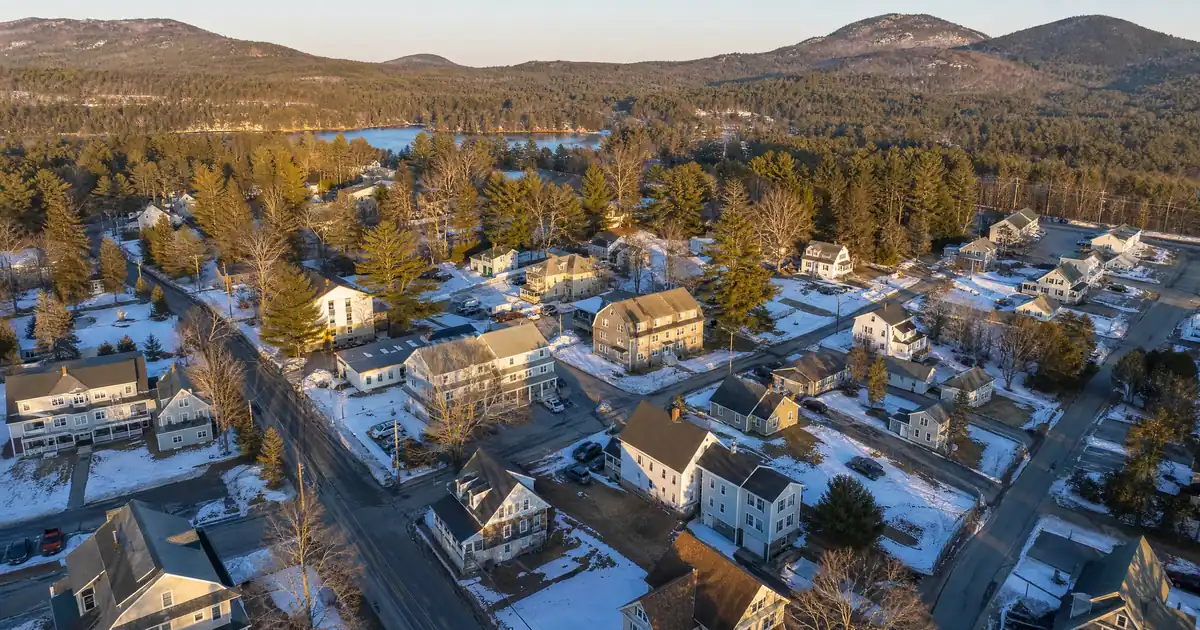
Walk Main Street in downtown Lincoln and the mismatch is obvious: a handful of aging two- and three-unit buildings sit two blocks from a five-star condo resort, and almost nobody is financing the former. Every dollar of attention in this town goes to the mountain. That’s a mistake, because the workforce stock behind those storefronts might be the tightest rental play in the White Mountains right now.
The Quick Read: Investment property loans in Lincoln, New Hampshire get underwritten against two very different rental profiles inside one 2.7-square-mile village core — downtown workforce units leased to year-round staff, and resort-condo submarkets like South Peak and RiverWalk built on nightly and seasonal guest income — with the property’s rental income measured against its full monthly obligation rather than the borrower’s traditional personal-income documentation.
DSCR Calculator
Run the numbers in your market
Rate source: Freddie Mac 30-yr average via FRED® — Federal Reserve Bank of St. Louis · effective Jul 30, 2026
Prefilled with starting assumptions — enter your own rent or nightly figures, taxes, insurance, and HOA for a more accurate picture.
Program parameters update from Lendmire’s centralized guideline source. Taxes and insurance are editable estimates.
As of Jul 30, 2026 · General Freddie Mac market benchmark, not a Lendmire loan offer. Rent, nightly rate, occupancy, taxes, and insurance are editable estimates. Short-term rental figures are estimates only and vary significantly by season, property type, management approach, and local short-term-rental rules — confirm local regulations before relying on them. Qualifying income for short-term rentals varies by program — some use appraisal market rent, others use documented STR history or projections — and is confirmed in underwriting. Not a Loan Estimate, approval, or commitment to lend. Program availability and eligibility are subject to lender guidelines, credit approval, property review, and underwriting.
- Grafton County’s rental vacancy rate sits near 0.6%, among the tightest in New Hampshire (NH Business Review)
- Lincoln’s own market-rate vacancy reads 9% — skewed by seasonal condo inventory, not workforce housing scarcity
- Data USA puts Lincoln’s median property value at $326,700, well below the statewide $516,578 average (Data USA)
- Burndy/Hubbell’s 200+ year-round manufacturing jobs anchor off-season LTR demand in a town otherwise 100% tourism-dependent
- South Peak Resort’s active build-out includes Ember Court (25 townhomes) and The Heights (28 condo units)
Lincoln isn’t one market. It’s two markets sharing a zip code, and the DSCR math looks completely different depending on which one an investor is underwriting.
Lincoln Market Snapshot
A quick read on the Lincoln investor landscape — figures come from the cited sources below. Confirm current property-level numbers before underwriting.
| Metric | Detail |
|---|---|
| Home prices | $60,000 median household income (Census Reporter) |
| Population | 1,461 population (Census Reporter) |
| Employment | 465 employees (2024) (Data USA) |
| Vacancy | 9% (affordablehousingonline.com) |
Downtown Lincoln: The Overlooked Workforce Play
Downtown Lincoln’s Main Street corridor is the town’s only walkable commercial strip, and the small multifamily buildings tucked around it house the year-round staff who keep Loon Mountain, RiverWalk and the resort restaurants running. That tenant base isn’t seasonal — and that’s the whole point.
The town’s rental vacancy rate reads 9% according to HUD-sourced data (affordablehousingonline.com), which sounds loose until you realize it’s dragged up by empty ski-season condos, not empty workforce apartments. Zoom out to Grafton County and the picture flips: vacancy has sat below 1% since 2021, with the 2023 survey pegging it at 0.6% (NH Business Review). That’s a balanced market’s vacancy rate at roughly a sixth of its typical value. Turnover, not true vacancy, is the leasing friction here.
Most of the housing-scarcity conversation in Lincoln gets attributed to ski-industry cyclicality, but the town’s largest employer isn’t seasonal at all. Burndy/Hubbell, an electrical connector manufacturer, runs a facility with 200+ year-round workers — a rare non-hospitality anchor in a town otherwise built entirely around Loon Mountain (Business NH Magazine). That employer base, combined with hospitality staff who’d rather not commute from Plymouth or Littleton (both roughly 30 minutes away), keeps demand for well-located 2-3BR workforce units durable through mud season and shoulder season alike, when the resort submarkets go quiet.
Run the numbers on a downtown Lincoln duplex priced around $325,000 — close to Data USA’s median property value for the town. Financed at 75% LTV (25% down) with each unit modeled at a workforce-tier rent near $1,600 a month, combined gross rent lands around $3,200. Including full PITIA — principal, interest, taxes and insurance, not P&I alone — that pencils to roughly 1.4x coverage. Terms vary by lender guidelines, property type, leverage, credit profile, and full file review.
One caution worth flagging before anyone gets too excited about county rent data: Grafton County posted the highest 2-bedroom median rent in New Hampshire, at $2,081, but state researchers attribute that spike specifically to the Lebanon/Hanover and Plymouth submarkets — not Lincoln (NH Fiscal Policy Institute). Investors underwriting Lincoln workforce housing off that county-blended number will overshoot. HUD’s Lincoln-specific Fair Market Rent range of $1,445 to $2,630 depending on unit size is the more honest starting comp.
South Peak (Where the Growth Story Actually Lives)
South Peak Resort is the single biggest thing happening in Lincoln real estate, and it isn’t close. Loon Mountain’s newest expansion district spans 360 acres of slopeside terrain, added eleven trails and a four-person chairlift, and pushed the resort’s skiable terrain past 400 acres with a vertical drop of 2,190 feet — the longest in New Hampshire.
Construction is live right now: Ember Court is a 25-unit luxury townhome phase, and The Heights at South Peak is a 28-unit condo building breaking ground at the Pemi Base area (South Peak Resort). A new gondola — the Pulse — connects RiverWalk directly to the South Peak base, which is the kind of infrastructure a mountain town of 1,461 residents almost never gets.
This submarket is a different underwriting animal than downtown. South Peak units aren’t workforce rentals — they’re ski-in, ski-out product built for nightly and seasonal guest income, and DSCR files here lean on short-term rental income rather than long-term lease comps. HOA rental restrictions vary by building and should be confirmed directly with the association before underwriting any nightly-income assumption; that’s a verification step, not a footnote to skip. No source-verified per-unit rent or nightly-rate data exists for South Peak specifically, so any deal here gets modeled off active listing comps rather than a blended assumption. Lendmire’s DSCR platform can structure around STR income where documentation supports it — see Lendmire’s DSCR guide for how that qualification works, and the guide “Where DSCR and Conventional Diverge” is worth a look on underwriting before assuming a bank-style file applies here.
RiverWalk and the Condo-Hotel Category
RiverWalk Resort sits across the river from South Peak’s base and functions more like a condo-hotel than a residential building — studios up through three-bedroom units, sold as whole, seasonal or fractional ownership with optional rental management. That fractional-ownership structure changes the DSCR conversation entirely; a fractionally-owned unit isn’t the same asset as a whole-ownership condo carrying a full mortgage, and lenders will want clarity on exactly what’s being financed before running the numbers.
RiverWalk is also mid-expansion — a $49 million buildout, alongside a new four-story Hampton Inn on Main Street and an approved Home2 Suites elsewhere in town (Business NH Magazine). That scale of hospitality capital tells you this submarket is underwritten to tourism growth, not workforce rent stability. Treat RiverWalk and comparable resort-condo product as appreciation-and-STR plays, not cash-flow-first acquisitions.
Forest Ridge, Mountain Club and Pollard Brook — Skip Unless the Unit Comps Out
These established condo communities near the mountain — Forest Ridge, the Mountain Club on Loon, and Pollard Brook InnSeason (New Hampshire’s only five-star condominium resort, with 133 suites) — sit in the middle tier: mid-vacation-rental demand, clubhouse amenities, but no source-verified rent-to-price data. Worth a look deal-by-deal off active MLS comps. Not worth a blended assumption.
The Kancamagus fringe — the rural forested edge bordering White Mountain National Forest — is a different story entirely. Land and cabin-style properties out there serve outdoor-recreation tourists, but low density and thin comps make DSCR underwriting harder to support at scale. Skip it unless the specific parcel already has rental history.
The Price Data Doesn’t Agree — Here’s How to Read It
Lincoln’s home price figures conflict meaningfully across sources, and that’s not noise — it reflects a genuinely bifurcated market. Redfin’s sales-based figure puts the recent median sale price at $302,000, with homes selling after 26 days on market on average (Redfin). Movoto’s list-price data shows a median asking price of $509,000, down 11% year over year — a cooling signal on the luxury end. A local brokerage puts the market’s center of gravity closer to $250,000 for cozy cabins and single-family stock. Data USA’s median property value lands in between, at $326,700.
None of these numbers is wrong. They’re measuring different halves of the same town — legacy workforce homes and cabins at the low end, new South Peak and RiverWalk luxury product at the high end. Investors who pull one blended “Lincoln median” number and underwrite off it are going to miss badly in one direction or the other. Pull comps property-by-property.
That price softening on the luxury side also shifts the underwriting priority. With list prices down 11% year over year and price-per-square-foot down slightly too, appreciation-led entries into the resort-condo tier are a weaker argument right now than they were during the earlier run-up. Cash-flow coverage — not equity growth assumptions — is the stronger lever for new acquisitions this cycle.
Working DSCR brokers see a recurring pattern in small resort towns like this one: the file that clears fastest on paper is rarely the flashiest condo. It’s the unremarkable downtown duplex with a clean long-term lease, because the coverage math doesn’t depend on occupancy assumptions or HOA rental approval — the resort units often look better on a pro forma but carry more documentation friction before a lender will sign off on the income basis.
What Actually Qualifies Here
Lendmire arranges DSCR investor loans on a rental-income basis rather than personal income documentation, which fits Lincoln’s mixed LLC-owned condo and cabin stock better than a conventional file would. On standard purchase files, typical leverage runs 75%-80% LTV (roughly 20%-25% down), with the strongest files occasionally reaching up to 85% when credit and reserves support it. Minimum qualifying coverage generally sits at a 1.00x benchmark — rent against full PITIA — though sub-1.00 scenarios can sometimes be reviewed with reduced leverage or stronger compensating factors, subject to lender guidelines and program eligibility. Credit tiers commonly run from a 620 floor up through 700 for higher-leverage files, with reserve requirements around six months of PITIA (closer to nine months above $1.5 million). Loans made to LLC-titled entities are reviewed subject to program guidelines, which matters given how much of Lincoln’s resort-condo stock sits in entity ownership already.
None of this is a guarantee of approval — every file gets reviewed on its own credit, property and reserve picture. Investors working a specific address in Lincoln, whether it’s a downtown duplex or a South Peak unit, can request a scenario review or call 828-256-2183 to walk through how the property’s income would be modeled before making an offer. New Hampshire investors statewide can also review New Hampshire DSCR investor loans through Lendmire’s dedicated state page for a broader sense of how the program applies outside Lincoln specifically.
Frequently Asked Questions
Does Lincoln’s 9% vacancy rate mean rental demand here is weak?
No — that figure is skewed by empty seasonal condo inventory, not workforce housing scarcity. Grafton County’s actual rental vacancy sits near 0.6%, among the tightest in New Hampshire, which tells the real story for downtown workforce units.
DSCR vs. conventional financing
Two common ways to finance an investment property in Lincoln, NH. They qualify you differently — here’s how investors weigh them.
Why investors choose it
- Qualifies on the property’s rental income — no personal tax returns, W-2s, or pay stubs needed to document income.
- No personal debt-to-income ceiling to clear, so existing mortgages and obligations don’t cap your borrowing the same way.
- Can be closed in an LLC, keeping the property inside a business entity.
- Built for scaling — not held to the limit on number of financed properties that conventional financing applies.
- Underwriting centers on the deal: generally qualifies when the rent covers the payment, a 1.00x coverage ratio being a common baseline (confirmed in underwriting).
- Designed specifically for investment property, including long-term and, where the program allows, short-term rentals.
Where it’s strong
- Often the lowest ongoing financing cost for a buyer who fully qualifies on personal income — a fit for a first property or a cost-first purchase.
Trade-offs for investors
- Requires full personal income documentation and must fit within a debt-to-income limit — salary, existing debts, and other mortgages all count.
- Typically held in your personal name rather than a business entity.
- Caps how many financed properties you can carry, which can become a ceiling as a portfolio grows.
- Evaluates you as a borrower as much as the property, which usually means more paperwork.
How investors usually choose: a first or single property often optimizes for the lowest financing cost; portfolio builders often optimize for leverage, vesting in an LLC, and scaling past conventional caps. The right answer depends on your goals, the property, and current guidelines — both paths run through select lenders in Lendmire’s wholesale network, with eligibility and terms confirmed in underwriting.
Can HOA rules at South Peak or RiverWalk restrict rental income?
Possibly, and this varies by building and ownership structure. Investors should confirm current rental restrictions and any short-term rental rules directly with the specific HOA or resort management before underwriting nightly-income assumptions.
Why does a ski town have a 200-person manufacturing employer?
Burndy/Hubbell’s electrical connector plant predates Lincoln’s tourism boom and remains the town’s single largest employer. It’s an unusual, non-seasonal anchor that supports year-round workforce housing demand in a town where almost every other job is hospitality-driven.
Is downtown workforce housing or a resort condo the better DSCR target?
Downtown workforce units generally underwrite cleaner on long-term lease income and clear coverage with less documentation friction. Resort condos can produce stronger nightly income but require STR-specific underwriting and HOA rental verification, which adds complexity to the file.
Why do Lincoln’s home price figures vary so much between sources?
Because the market itself is split — legacy cabins and workforce homes at the lower end, new luxury condo product at South Peak and RiverWalk at the upper end. A single blended citywide median misrepresents both halves, so comps should be pulled property-by-property.
What DSCR ratio do lenders typically want to see on a Lincoln purchase?
Most standard programs are built around a 1.00x benchmark, where rental income covers the full monthly obligation. Coverage above that — commonly 1.2x to 1.4x on well-priced workforce units — gives a file more room and can support easier lender review, though exact thresholds depend on credit, reserves and program guidelines.
For current guidelines and terms, see Lendmire’s DSCR loan programs page.
About Lendmire
Lendmire, NMLS# 2371349, is a non-QM mortgage broker working with real estate investors across 41 markets, including Washington, D.C., through DSCR investor loan programs. Files are generally reviewed around the subject property’s rental income rather than the borrower’s W-2 history, which fits LLC-titled portfolios and self-employed investors particularly well — though every scenario remains subject to lender review and program guidelines. The firm has been recognized by Scotsman Guide in 2025 and again as a 2026 Scotsman Guide Top Workplace.
North Conway gets most of the White Mountains DSCR attention from national lenders — it’s the town that shows up in generic New Hampshire resort content. But North Conway doesn’t have a home-price correction paired with an active $49 million resort expansion and a brand-new gondola in the same 12-month window. Lincoln does, right now, and that combination — softening entry prices on the luxury side, tight sub-1% county vacancy on the workforce side — is the more interesting math for anyone underwriting today rather than three years ago.
Scotsman Guide’s Top Mortgage Workplace list for 2025 documents Lendmire’s recognition.
For broader investor-financing rules and property-type coverage across the state, see New Hampshire DSCR loans.
Get Started
Ready to find the right loan for you?
In about 30 seconds you can review financing options available for your investment property. No commitment required.
Informational only. Not a Loan Estimate, approval, or commitment to lend. Program availability and eligibility are subject to lender guidelines, credit approval, property review, and underwriting.
References
1. NH Business Review — 2023 Annual Rent Survey
5. affordablehousingonline.com — Lincoln, NH
6. Business NH Magazine — Lincoln workforce housing feature
7. NH Fiscal Policy Institute — Rental Costs 2024
9. Redfin — Lincoln, NH Housing Market
10. 2026 Scotsman Guide Top Workplace
11. Scotsman Guide 2025 Top Mortgage Workplace
This article is part of Lendmire’s DSCR loan program — full qualification details, guidelines, and scenarios live on the program page.
Related reading: DSCR Loans in Lincoln, Nebraska: Investor Financing for Near South, Havelock, University Place & Real Estate Investors · DSCR Loans in White Mountains / Lakes Region, New Hampshire: Investor Financing for North Conway, Laconia, Lincoln & Real Estate Investors · DSCR Loans Nebraska: Investor Financing for Omaha, Lincoln, Offutt AFB, Lake McConaughy, and Real Estate Investors
Guides: DSCR Loans in Lincoln, NH · DSCR Loans in New Hampshire
Brandon Miller
Founder & CEO, Mortgage Loan Originator, Lendmire LLC
- Mortgage Loan Originator · NMLS# 1129696 · Verify on NMLS Consumer Access
- North Carolina Real Estate Broker · License# 343312 · Verify on NCREC
- North Carolina Insurance Producer · License# 19053198 · Property, Casualty, Life, Health · Verify on NAIC SBS
- Lendmire LLC · Firm NMLS# 2371349 · Verify firm licensure
Disclosure information. Lendmire is a state-licensed mortgage brokerage under NMLS# 2371349. Lendmire is not a depository institution, direct lender, or financial advisor — all loans referenced are placed through wholesale lender partners and are subject to each lender's underwriting standards. This article is provided for general informational purposes and is not a commitment to lend, nor does it constitute financial, legal, or tax advice. Loan programs, terms, rates, and qualification standards change without notice and depend on borrower profile, property type, and the state in which the subject property is located. Equal Housing Opportunity provider. NMLS Consumer Access: nmlsconsumeraccess.org.