
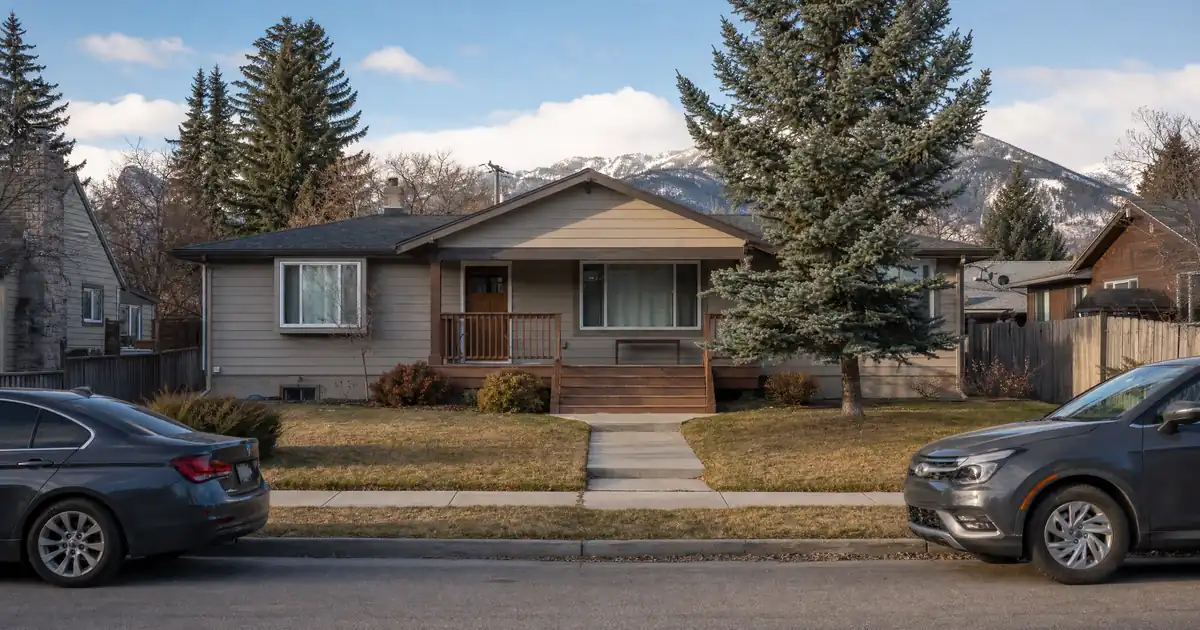
If you’re pricing a duplex near Montana State University or scouting a workforce rental out past the airport in Belgrade, investment property loans in Bozeman work differently than they did two years ago. Bozeman just absorbed roughly 1,900 new multifamily units between 2024 and mid-2025, and that supply wave has split the rental market into two very different worlds — one where older, stabilized buildings keep filling up, and one where brand-new Class A product is sitting empty and discounting hard to compete. That split is exactly what a lender pulls apart when scoring a rental property on the income it produces rather than the borrower’s paycheck.
TL;DR: An investment property loan in Bozeman, Montana is underwritten primarily on the rent a property generates measured against its full monthly obligation, not the borrower’s personal income, which lets an investor buying a duplex near Montana State University — enrollment hit a record 17,165 students this fall — qualify largely on the lease income itself.
DSCR Calculator
Run the numbers in your market
Rate source: Freddie Mac 30-yr average via FRED® — Federal Reserve Bank of St. Louis · effective Jul 30, 2026
Prefilled with starting assumptions — enter your own rent or nightly figures, taxes, insurance, and HOA for a more accurate picture.
Program parameters update from Lendmire’s centralized guideline source. Taxes and insurance are editable estimates.
As of Jul 30, 2026 · General Freddie Mac market benchmark, not a Lendmire loan offer. Rent, nightly rate, occupancy, taxes, and insurance are editable estimates. Short-term rental figures are estimates only and vary significantly by season, property type, management approach, and local short-term-rental rules — confirm local regulations before relying on them. Qualifying income for short-term rentals varies by program — some use appraisal market rent, others use documented STR history or projections — and is confirmed in underwriting. Not a Loan Estimate, approval, or commitment to lend. Program availability and eligibility are subject to lender guidelines, credit approval, property review, and underwriting.
- MSU enrolled a record 17,165 students this fall, up from the prior record of 17,144.
- Pre-2020 multifamily vacancy runs near 4.3%, versus 21.8% for units built since.
- Belgrade’s Q4 median sale price fell to $565,000, well below Bozeman’s core.
- Citywide average rent runs between roughly $1,923 and $2,129 a month, depending on the tracker.
- Purchase financing typically runs 75%–80% loan-to-value.
Bozeman Market Snapshot
A quick read on the Bozeman investor landscape — figures come from the cited sources below. Confirm current property-level numbers before underwriting.
| Metric | Detail |
|---|---|
| Home prices | $672K median sale price (Redfin Bozeman Housing Market) |
| Typical rents | $2,129 avg (RentCafe/Yardi Matrix Bozeman) |
| Cap rates | 5.8% cap rate (Bozeman Realty Group) |
| University enrollment | 17,165 students (Montana State University) |
| Employment | 2,900+ employees (Bozeman Health History) |
| Vacancy | 44.2% vs 9.2% (Bozeman Magazine) |
The Vacancy Split Every Bozeman DSCR File Should Account For
The headline vacancy number in Bozeman is misleading if applied to the wrong property. Sterling CRE Advisors found that apartments built before 2020 carry a vacancy rate of just 4.3%, while units built in the last few years are running 21.8% — a five-fold gap driven entirely by construction vintage, not location or tenant demand. A separate accounting from Bozeman Magazine, citing city-commissioned data, put newly built units at 44.2% vacancy against 9.2% for older stock — different measurement window, same conclusion.
The concession data makes the point sharper still. A Q1 2026 report cited by Bozeman Magazine put Bozeman’s renter concession rate at 86.6% — reportedly the highest in the country — meaning nearly nine in ten new-construction renters are getting free months, gift cards, or other incentives layered on top of the advertised rent. That matters directly for DSCR underwriting: an appraiser pulling comps from a two-year-old lease-up building is often pricing off gross asking rent, not the effective rent tenants are actually paying after concessions. A stabilized pre-2020 duplex or fourplex with a real trailing-twelve rent roll gives a cleaner, more defensible number.
Zoom out and the overall trajectory is improving, even if slowly. Montana Free Press reported that citywide vacancy peaked near 18%, has been dropping roughly a percentage point per quarter since, and sits closer to 12% now — with Sterling CRE projecting a slide to around 6% by the end of next year. That’s an absorption curve, not a permanent oversupply. Investors buying now on stabilized 2–4 unit product are, in effect, buying ahead of that curve rather than into a market in structural decline.
MSU-Adjacent Duplexes and Triplexes: The Core Income-Stacking Play
Montana State University enrolled a record 17,165 students this fall, up from last year’s record of 17,144, marking at least five straight years of growth — a detail that matters more to a DSCR file than almost any other single fact in this market. Growing enrollment means the tenant pool feeding South Side and College Street rentals is expanding, not stabilizing, which de-risks the assumption that today’s lease comps still hold a year from now.
The DSCR mechanics here run on income-stacking: multiple units, one loan, one appraisal, one closing. A renovated central Bozeman duplex — each unit roughly 1,198 square feet, separately metered with its own laundry — is currently listed near $795,000, per Bozeman Realty Group. Modeling that purchase at 75% loan-to-value, and assuming combined per-bedroom rent near $5,400 a month (reflecting the per-bedroom leasing structure common to MSU-adjacent product rather than a single family lease), full-PITIA coverage — principal, interest, an estimated property-tax escrow, and insurance — lands near 1.18x. That clears the 1.00x benchmark most standard DSCR programs are built around, with room to spare.
Larger multi-unit product supports the same thesis. A fully rented, historic triplex near Main Street and MSU recently listed at a 5.8% cap rate near $2,695,000, per Bozeman Realty Group — a real, on-market data point for what coverage-friendly pricing looks like on bigger buildings in this corridor today, not a modeled hypothetical.
Working DSCR brokers see a recurring pattern in university towns absorbing a supply wave like this one: files on stabilized, pre-2020 buildings tend to clear underwriting with far less friction than files on units delivered in the last year or two, because appraisers can pull real trailing rent rolls instead of asking-rent comps still working through lease-up concessions. The property that looks “boring” — the decade-old duplex with steady tenants — often produces the cleaner file.
Belgrade, Four Corners, and Elk Grove: Where the Basis Still Works
Belgrade is the cash-flow submarket in this metro, full stop. At the end of Q4 last year, the median sale price for Belgrade homes was $565,000, down 8.4% from the prior year’s $616,750, per Taunya Fagan Real Estate — a real price correction, not a hypothetical discount. Belgrade properties in the $350,000–$500,000 range command rents of $1,600–$2,200 a month, and the lower entry basis paired with airport proximity keeps drawing cost-conscious tenants who’ve been priced out of Bozeman proper.
Run the numbers on a $350,000 Belgrade single-family purchase at 75% LTV, with rent modeled near the top of that sourced range at $2,200 a month. Full-PITIA coverage comes out around 1.03x — a workable, if not exceptional, number, and one that clears the coverage threshold without leaning on a best-case rent assumption. Terms vary by lender guidelines, property type, leverage, credit profile, and full file review.
Elk Grove, just outside city limits toward Four Corners, offers roughly 300 single-family homes on larger-than-average lots, with more square footage for the money and pricing under $300 per square foot available on some inventory. Norton Ranch, on the west side, skews similarly affordable, with typical pricing under $400 per square foot on 3-bedroom, 2-bath homes under 2,000 square feet. Neither submarket has the enrollment-driven demand engine MSU-adjacent product enjoys, but both give an investor a lower basis to work with — which, on a rent-to-price basis, is often what makes the coverage ratio pencil in the first place.
North Side and Downtown: Betting on Equity, Not Day-One Coverage
Downtown and the North Side are a different trade entirely. Downtown Bozeman retains more than 100 shops and restaurants along Historic Main Street and pulls rental demand from MSU students, young professionals, and retirees alike; the North Side has evolved into a trendier, mixed-use corridor of breweries, co-working spaces, and new development aimed at the same young-professional renter. Neither is priced for day-one DSCR math the way Belgrade or an MSU-adjacent duplex is — this is appreciation-led territory.
That’s not incidental. Snowflake Inc., the NYSE-listed cloud data company, lists its SEC-required principal executive office in downtown Bozeman — the address, per the company’s own Snowflake contact page, sits blocks from a post office and a coffee shop, an unusual pairing of enterprise-software capital and small-town scale that no other Montana city can claim. Oracle maintains a Bozeman campus dating to its 2012 acquisition of RightNow Technologies. Layer that tech-employer base onto MSU and Bozeman Health, and the North Side and Downtown submarkets carry an income profile that supports higher rents over time, even if today’s coverage ratio on a purchase runs tighter than it would in Belgrade. The stronger play for pure cash flow probably still sits with the outer submarkets — though an investor buying for equity growth in a tight-supply, income-anchored core could reasonably argue the other way.
What Actually Qualifies as a DSCR File in Bozeman?
DSCR mortgage broker review here works the same way it does everywhere Lendmire operates: the lender looks at the rent the property generates relative to its full monthly obligation, rather than the borrower’s traditional personal-income documentation. Our guide to “What Is a DSCR Loan” covers the mechanics in more depth, but the short version is that a property clearing a 1.00x ratio is covering its own payment on paper — most standard programs are built around that benchmark, though some lenders will review files below it with stronger reserves, lower leverage, or additional compensating factors, subject to lender guidelines and program eligibility.
On purchase transactions in this market, typical loan-to-value runs 75%–80%, meaning roughly 20%–25% down, with select strong files eligible for up to 85% LTV where guidelines allow. Credit-tier overlays generally start around a 620 floor, with better pricing and leverage opening up in the 660–700+ range, and reserve requirements typically run about six months of PITIA — closer to nine months on loan amounts above $1.5 million, which matters in a market where the median home value in this metro runs meaningfully above the national figure. DSCR versus conventional financing comes down to that same distinction — property income instead of personal debt-to-income — which is part of why LLC-held rentals and multi-property portfolios lean toward the DSCR structure, subject to lender program eligibility.
Lendmire’s Montana DSCR platform works across this exact split — MSU-adjacent multi-unit, Belgrade and Four Corners workforce single-family, and appreciation-led core product — with review details subject to lender overlays and confirmed at the file level. Investors comparing structures across these submarkets can compare DSCR options or reach the team at 828-256-2183 to walk through a specific property.
Employment growth backs the broader thesis regardless of submarket. Bozeman-area employment grew 2.8% year-over-year, from 33.9k to 34.8k employees, per Data USA, with Educational Services, Health Care and Social Assistance, and Retail Trade as the three largest sectors. Bozeman Health, the region’s dominant private employer, runs more than 2,900 employees across a 125-bed Level III trauma center and a network reaching Big Sky and West Yellowstone — an anchor that keeps a durable renter base in the market independent of whatever the multifamily supply cycle is doing.
Frequently Asked Questions
How do you qualify for a DSCR loan in Bozeman, Montana?
Qualification centers on the property’s rent measured against its full monthly obligation rather than the borrower’s income documents. A file clearing 1.00x or better on that ratio is a straightforward fit for most standard programs; lower ratios can still be reviewed with stronger reserves or lower leverage, subject to lender guidelines and credit approval. Rent rolls, a lease or market-rent estimate, and property-level financials typically drive the review more than traditional personal-income documentation.
What are the requirements for an investment property loan in Bozeman, Montana?
Typical purchase transactions run 75%–80% loan-to-value, with credit generally starting around a 620 floor and stronger pricing available in the 660–700+ range. Reserve requirements usually run about six months of PITIA, rising to roughly nine months on loans above $1.5 million — figures that reflect general program guidelines rather than a guarantee for any individual file.
DSCR vs. conventional financing
Two common ways to finance an investment property in Bozeman, MT. They qualify you differently — here’s how investors weigh them.
Why investors choose it
- Qualifies on the property’s rental income — no personal tax returns, W-2s, or pay stubs needed to document income.
- No personal debt-to-income ceiling to clear, so existing mortgages and obligations don’t cap your borrowing the same way.
- Can be closed in an LLC, keeping the property inside a business entity.
- Built for scaling — not held to the limit on number of financed properties that conventional financing applies.
- Underwriting centers on the deal: generally qualifies when the rent covers the payment, a 1.00x coverage ratio being a common baseline (confirmed in underwriting).
- Designed specifically for investment property, including long-term and, where the program allows, short-term rentals.
Where it’s strong
- Often the lowest ongoing financing cost for a buyer who fully qualifies on personal income — a fit for a first property or a cost-first purchase.
Trade-offs for investors
- Requires full personal income documentation and must fit within a debt-to-income limit — salary, existing debts, and other mortgages all count.
- Typically held in your personal name rather than a business entity.
- Caps how many financed properties you can carry, which can become a ceiling as a portfolio grows.
- Evaluates you as a borrower as much as the property, which usually means more paperwork.
How investors usually choose: a first or single property often optimizes for the lowest financing cost; portfolio builders often optimize for leverage, vesting in an LLC, and scaling past conventional caps. The right answer depends on your goals, the property, and current guidelines — both paths run through select lenders in Lendmire’s wholesale network, with eligibility and terms confirmed in underwriting.
Does MSU’s academic calendar affect how lenders view Bozeman rental income?
Yes, in the sense that underwriting works best when it leans on academic-year lease comps rather than peak-summer or short-term rates, since student-driven demand near campus follows the school calendar rather than a tourist season. A file built around a signed academic-year lease or a comparable long-term rent estimate generally holds up better than one modeled on peak-season pricing.
Why do vacancy rates vary so much between new and older Bozeman apartment buildings?
Because the city absorbed a wave of new construction — roughly 1,900 multifamily units between 2024 and mid-2025 — that’s still working through lease-up. Older, pre-2020 buildings run vacancy near 4.3%, while units built in the last few years have run as high as 21.8%, per Sterling CRE Advisors, largely because new product is still competing on concessions rather than operating at stabilized occupancy.
Is Belgrade a better buy than core Bozeman for rental coverage?
For day-one cash flow, generally yes. Belgrade’s median sale price sits well below Bozeman’s core, and rents in the $1,600–$2,200 range on $350,000–$500,000 product produce stronger, more workable coverage math than luxury-skewed Bozeman-proper inventory. Core Bozeman’s case rests more on long-term equity growth, anchored by MSU, Bozeman Health, and the Snowflake and Oracle tech presence, than on immediate rent-to-price math.
What can limit DSCR cash-out proceeds in Bozeman?
Vacancy vintage is the biggest wildcard — an appraiser pricing off asking rents in a new-construction building rather than trailing collections can overstate the coverage number a cash-out refinance is built on. Lendmire arranges these loans through a network, and generally caps cash-out refinances at loan-to-value levels below what’s available on a purchase, which keeps proceeds tied to actual, defensible rent rather than optimistic comps.
Lendmire is a mortgage brokerage built around investor financing, arranging DSCR loans. Qualification runs primarily off the property’s rental income rather than personal income documentation, subject to lender guidelines, which is part of why the structure fits LLC-held rentals and investors scaling a portfolio rather than buying one house at a time.
So — is the property under consideration the stabilized pre-2020 duplex that already has a rent roll behind it, or the newer building still competing on concessions to fill its first year?
About Lendmire
Lendmire, NMLS# 2371349, is a mortgage brokerage focused on investor financing, arranging DSCR loans in 40 states plus Washington, D.C. — 41 markets total. Qualification is based on the property’s income rather than personal income documentation, subject to lender guidelines, making it a fit for LLC-held rentals and scaling portfolios. Scotsman Guide named Lendmire a Top Mortgage Workplace in both 2025 and 2026.
Get Started
Ready to find the right loan for you?
In about 30 seconds you can review financing options available for your investment property. No commitment required.
Informational only. Not a Loan Estimate, approval, or commitment to lend. Program availability and eligibility are subject to lender guidelines, credit approval, property review, and underwriting.
References
1. Redfin Bozeman Housing Market
2. RentCafe/Yardi Matrix Bozeman
9. Snowflake
10. Bozeman Health
11. recognized by Scotsman Guide as a 2026 Top Workplace
This article is part of Lendmire’s DSCR loan program — full qualification details, guidelines, and scenarios live on the program page.
Related reading: DSCR Loans Bozeman: Investor Financing for Montana State, Downtown, Bridger Bowl, Gallatin Valley & Real Estate Investors · Luxury Rental DSCR Loans In Bozeman: How STR Rents Are Read · Cash Out Refinance Investment Property in Huntersville, North Carolina
Guides: DSCR Loans in Bozeman, MT · DSCR Loans in Montana
Brandon Miller
Founder & CEO, Mortgage Loan Originator, Lendmire LLC
- Mortgage Loan Originator · NMLS# 1129696 · Verify on NMLS Consumer Access
- North Carolina Real Estate Broker · License# 343312 · Verify on NCREC
- North Carolina Insurance Producer · License# 19053198 · Property, Casualty, Life, Health · Verify on NAIC SBS
- Lendmire LLC · Firm NMLS# 2371349 · Verify firm licensure
Disclosure information. Lendmire is a state-licensed mortgage brokerage under NMLS# 2371349. Lendmire is not a depository institution, direct lender, or financial advisor — all loans referenced are placed through wholesale lender partners and are subject to each lender's underwriting standards. This article is provided for general informational purposes and is not a commitment to lend, nor does it constitute financial, legal, or tax advice. Loan programs, terms, rates, and qualification standards change without notice and depend on borrower profile, property type, and the state in which the subject property is located. Equal Housing Opportunity provider. NMLS Consumer Access: nmlsconsumeraccess.org.