
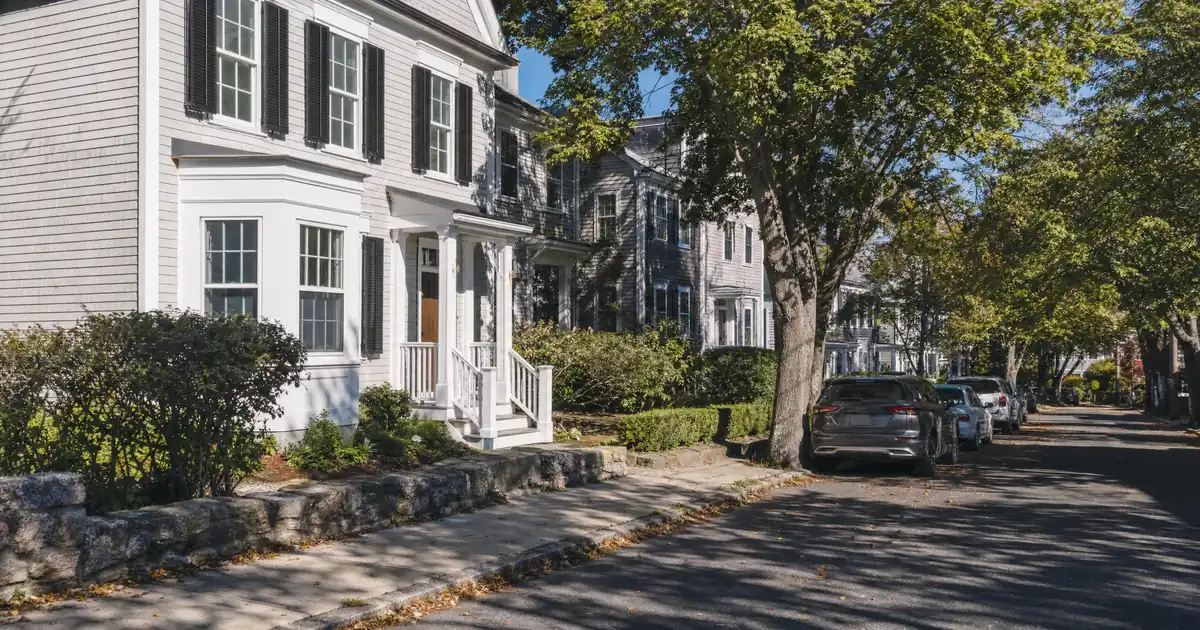
An investor scrolling listings from off-island — someone used to duplex math in Providence or coastal Connecticut — pulls up Edgartown and sees the harbor, the whaling-captain houses on Main Street, and a typical home value Zillow pegs at $1,755,429, up 2.0 percent over the past year (Zillow). The instinct is to assume the rental math scales with the price tag. It doesn’t, not on paper.
Key Takeaways: An investment property loan in Edgartown, Massachusetts is underwritten primarily on the rent a property can generate against its full monthly obligation rather than on the borrower’s personal income, with lenders reviewing local long-term rent data that runs from roughly $2,200 to $6,500 a month depending on the unit (WeNeedAVacation).
DSCR Calculator
Run the numbers in your market
Rate source: Freddie Mac 30-yr average via FRED® — Federal Reserve Bank of St. Louis · effective Jul 30, 2026
Prefilled with starting assumptions — enter your own rent or nightly figures, taxes, insurance, and HOA for a more accurate picture.
Program parameters update from Lendmire’s centralized guideline source. Taxes and insurance are editable estimates.
As of Jul 30, 2026 · General Freddie Mac market benchmark, not a Lendmire loan offer. Rent, nightly rate, occupancy, taxes, and insurance are editable estimates. Short-term rental figures are estimates only and vary significantly by season, property type, management approach, and local short-term-rental rules — confirm local regulations before relying on them. Qualifying income for short-term rentals varies by program — some use appraisal market rent, others use documented STR history or projections — and is confirmed in underwriting. Not a Loan Estimate, approval, or commitment to lend. Program availability and eligibility are subject to lender guidelines, credit approval, property review, and underwriting.
- Zillow’s typical home value sits at $1,755,429; Warren Group’s 2025 town-level median lands near $1,700,000.
- Village center median household income tops $250,001 versus $89,710 townwide — a genuine two-tier market.
- Only 38 percent of the island’s housing stock remains year-round, per Island Housing Trust.
- Edgartown alone carries 934 registered short-term rentals, thinning out true long-term rental comps.
- Standard files under $1.5 million in loan size hold roughly six months of PITIA in reserves above 70% LTV, and none are required at or below 70% LTV.
Edgartown Market Snapshot
A quick read on the Edgartown investor landscape — figures come from the cited sources below. Confirm current property-level numbers before underwriting.
| Metric | Detail |
|---|---|
| Home prices | $2.8M median sale price (Redfin) |
| Typical rents | $3,000 avg (Martha’s Vineyard Commission) |
| Population | 5,212 population (Census Reporter) |
| Employment | ~200 hospital employees (Oak Bluffs town government) |
A Two-Tier Town, Not a Typical Vineyard Market
Edgartown’s demographics split so sharply it almost reads like a typo. The compact village center — 904 people packed into 1.2 square miles — carries a median household income above $250,001 and a median age of 62.9, according to Census Reporter’s village profile. Step outside that historic core and the townwide population of 5,212 reports a median household income of just $89,710 (Census Bureau QuickFacts) — about 90 percent of the Dukes County figure.
That gap is the whole investment thesis in one sentence. The village and the waterfront trade like a private-wealth market. The rest of the town — where hospital staff, teachers, and marine-trades workers actually rent — behaves like a workforce housing market wedged inside one of the priciest zip codes in Massachusetts. A DSCR file here lives or dies on which side of that split the collateral sits on.
Worth flagging early: the headline appreciation numbers deserve skepticism. Redfin shows Edgartown’s median sale price at $2.8 million, up 16.4 percent year over year, but its price-per-square-foot figure actually fell 41.9 percent over the same period (Redfin) — a dead giveaway that a handful of Katama and waterfront closings are dragging the median around. Warren Group’s full-year 2025 town data, a steadier annual read, puts Edgartown’s median sale price at $1,700,000, which lines up much closer to Zillow’s index. Underwriting purchase decisions off the Redfin monthly headline instead of the broader value trend is how out-of-state buyers overpay for what they think is “the market.”
Where the Submarkets Actually Diverge
Edgartown Village, Katama, and Chappaquiddick are estate and second-home territory — not places to hunt for cash-flow rentals; the workforce-relevant inventory sits in the Upper Main Street/Triangle corridor and out toward Meshacket and State Road.
Edgartown Village is the postcard — a one-way Main Street lined with elms, inns, and a brick courthouse, protected by historic district rules that lock down exterior appearances on the residential streets. Active listings near the village run from roughly $945,000 for a small in-town home up to $19.9 million for a Katama oceanfront compound. This is second-home and boutique-STR territory. Skip it for long-term rental yield — the entry price doesn’t support workforce rents, full stop.
Katama is bigger lots, South Beach, the Katama Airfield, and increasingly estate-scale new construction, including the five-home Somerset enclave developed by the owners of the Winnetu Oceanside Resort. This is ultra-high-net-worth buyer territory. There’s a wrinkle worth tracking, though: Katama Meadows, a planned subdivision off Meeting House Way, is being designed with lots reserved for households earning between 80 and 250 percent of area median income (Vineyard Gazette). If that pipeline delivers, it could pull some of the teacher-and-tradesperson rental demand away from market-rate listings in that specific pocket — something to watch before assuming today’s tenant scarcity in Katama holds indefinitely.
Chappaquiddick gets a short dismissal, and it earns it: a three-car ferry is the only way on or off the island, there’s essentially no year-round rental stock, and buyers here are almost exclusively legacy-estate or premium-STR. It simply isn’t a DSCR long-term-rental market, so investors focused on that strategy are better served looking elsewhere on the island.
Upper Main Street and the Triangle — the corridor with Donaroma’s Nursery, Stop & Shop, the post office, and a run of restaurants and shops — is the closest thing Edgartown has to a workforce-adjacent zone. It’s still expensive and thin on inventory, but it’s where year-round service and retail employees actually want to live.
Meshacket and the State Road corridor, running toward the West Tisbury line, is where the modest-footprint, workforce-oriented single-family stock exists — larger rural lots, lower entry points relative to the historic core, still constrained by septic capacity and zoning. One recently buildable lot in this corridor got there specifically because of the Massachusetts Affordable Homes Act, which opened new development allowances statewide. This corridor and the Triangle are where an investor targeting rental coverage, not just appreciation, should be spending time.
Where Does the DSCR Math Actually Work in Edgartown?
Coverage ratios in Edgartown swing wide depending on which rent an investor actually lands, and that’s the honest answer — this isn’t a market with a tidy, repeatable number. Modeling a $945,000 in-town listing at 75 percent leverage, with taxes and insurance folded into the full monthly obligation, the ratio lands in the high-0.7x range if the unit leases near the bottom of Edgartown’s reported long-term rent band of roughly $2,200 to $6,500 a month (WeNeedAVacation), and climbs far higher if it leases at the top of that band.
That’s a real spread — not a rounding error. It means the underwriting question for an Edgartown purchase isn’t “does this qualify,” it’s “which rent is realistic for this specific unit, in this specific corridor.” A three-bedroom in the Meshacket corridor renting to a hospital family behaves nothing like a walk-to-harbor unit in the village competing for the same tenant pool as short-term guests. Lendmire’s primer on DSCR loans covers how the ratio itself gets calculated; the harder work in Edgartown is pinning down which rent belongs in that calculation.
Standard DSCR purchase files here typically run in the 75 to 80 percent LTV range, with the strongest files occasionally reaching higher leverage when credit and reserves support it, and lenders generally want around six months of PITIA in reserves on loans under $1.5 million (nine months above that threshold). A 1.00 baseline is common because it’s the point where rent covers the payment outright; sub-1.00 scenarios in a market like this one may still get reviewed, but usually with reduced leverage, stronger credit, or a larger down payment offsetting the gap. How DSCR stacks up against a conventional loan comes down to which of those levers an investor is willing to pull.
The Tenant Base Nobody Pitches: Hospital Staff and Ferry Crews
There’s no university on Martha’s Vineyard and none on the mainland close enough to matter for this rental pool — a structural difference from most DSCR markets Lendmire works in. The tenant base here isn’t students. It’s Martha’s Vineyard Hospital staff, teachers, town employees, and marine-trades workers, competing for a shrinking pool of year-round housing.
The hospital matters more than its size suggests. It’s a 25-bed critical access hospital affiliated with Mass General Brigham, and it describes itself as the largest employer on the island. Steamship Authority ferry operations add another durable, non-seasonal employer base. That combination — a recession-resistant hospital and a ferry system that runs every day of the year regardless of tourist season — is one of the few genuinely year-round tenant segments an investor can underwrite against on an island economy otherwise built on summer traffic.
The demand side of that trade is brutal, though, and it’s worth saying plainly: 53 percent of Vineyard renters and 39 percent of homeowners are cost-burdened, some severely, according to a Martha’s Vineyard Commission housing needs assessment reported by the Vineyard Times, and the average income needed to buy a home on the island is $431,700 against a median local income of $102,348. Only 38 percent of the island’s total housing stock remains year-round at this point — a historic low, with more than 600 year-round homes converted to seasonal or short-term use over the past decade, according to Island Housing Trust reporting.
Working DSCR brokers see a recurring pattern in island and resort-town markets like this one: purchase files come in priced off the luxury comps that make headlines, but the rent roll an underwriter actually uses is the workforce lease a nurse or ferry deckhand signs — not the seasonal weekly rate a listing agent quotes in July. The files that clear review cleanest are usually the ones where the acquisition price got anchored to that modest, year-round number from the start, rather than backing into a purchase price that only works with a summer short-term-rental assumption layered on top.
Guest Houses and ADUs (The Real Multi-Unit Play)
True duplexes and fourplexes barely exist in Edgartown, and that’s not a data gap — it’s the market. Historic district design controls, septic capacity, and standard lot sizes make conventional multi-unit construction rare inside town limits. The realistic path to income-stacking here is a main-house-and-guest-house parcel — brokers market these explicitly as investor-and-homeowner plays — or an accessory dwelling unit built under the 2024 Massachusetts Affordable Homes Act, which opened new statewide ADU allowances, including on the Vineyard (MV Times).
For an investor comparing single-family versus small multi-unit coverage math, the guest-house structure usually wins. A second rentable unit on the same lot spreads the fixed cost of land against two income streams instead of one, which is exactly the lever that pulls a marginal single-family coverage ratio up toward — or past — 1.00x without needing appreciation to do the work.
Registered short-term rentals in Edgartown number 934, more than any other Vineyard town, and roughly 63 percent of island residences are seasonal, per the Martha’s Vineyard Chamber of Commerce, cited in Vineyard Times reporting from 2022. That density cuts two ways for a long-term-rental buyer: there’s almost no market-rate LTR competition for tenants, since so few owners commit units to 12-month leases — but there are also thin comps to benchmark rent against, since so few properties operate as long-term rentals in the first place. An investor pricing a purchase off “what similar units rent for” will find the comp set smaller than expected.
Frequently Asked Questions
How do you qualify for a DSCR loan in Edgartown, Massachusetts?
Qualification runs primarily off the property’s projected rental income measured against its full monthly obligation, not the borrower’s traditional personal-income documentation. Given Edgartown’s wide rent band — roughly $2,200 to $6,500 a month depending on unit and location — lenders will want a supportable rent figure specific to the property, along with standard credit and reserve documentation. Review details are subject to lender overlays and property-level review.
DSCR vs. conventional financing
Two common ways to finance an investment property in Edgartown, MA. They qualify you differently — here’s how investors weigh them.
Why investors choose it
- Qualifies on the property’s rental income — no personal tax returns, W-2s, or pay stubs needed to document income.
- No personal debt-to-income ceiling to clear, so existing mortgages and obligations don’t cap your borrowing the same way.
- Can be closed in an LLC, keeping the property inside a business entity.
- Built for scaling — not held to the limit on number of financed properties that conventional financing applies.
- Underwriting centers on the deal: generally qualifies when the rent covers the payment, a 1.00x coverage ratio being a common baseline (confirmed in underwriting).
- Designed specifically for investment property, including long-term and, where the program allows, short-term rentals.
Where it’s strong
- Often the lowest ongoing financing cost for a buyer who fully qualifies on personal income — a fit for a first property or a cost-first purchase.
Trade-offs for investors
- Requires full personal income documentation and must fit within a debt-to-income limit — salary, existing debts, and other mortgages all count.
- Typically held in your personal name rather than a business entity.
- Caps how many financed properties you can carry, which can become a ceiling as a portfolio grows.
- Evaluates you as a borrower as much as the property, which usually means more paperwork.
How investors usually choose: a first or single property often optimizes for the lowest financing cost; portfolio builders often optimize for leverage, vesting in an LLC, and scaling past conventional caps. The right answer depends on your goals, the property, and current guidelines — both paths run through select lenders in Lendmire’s wholesale network, with eligibility and terms confirmed in underwriting.
What are the requirements for an investment property loan in Edgartown, Massachusetts?
Most standard purchase files run 75 to 80 percent LTV, with reserves near six months of PITIA on loans under $1.5 million and nine months above that threshold. Credit tiers generally start in the 620 range with better leverage available at higher scores, and files titled to an LLC are reviewed subject to program guidelines.
Why does Edgartown’s median sale price look so different depending on the source?
Transaction-based figures like Redfin’s $2.8 million median get pulled around by a handful of ultra-high-end Katama and waterfront closings in any given month, since Edgartown’s sales volume is thin. Broader value indices, like Zillow’s $1,755,429 figure, or full-year town-level data from the Warren Group at $1,700,000, give a steadier read on what a typical property is actually worth.
Can Chappaquiddick properties qualify for DSCR financing?
They’re reviewed on a case-by-case basis, but the ferry-access constraint and near-total absence of long-term rental stock make Chappaquiddick a weak fit for a rental-income-based loan. Files here typically come in as appreciation or premium short-term-rental plays rather than long-term coverage stories, and lenders will weigh that when reviewing the file.
What loan-amount ranges may DSCR lenders review for Edgartown rental properties?
Given Edgartown’s price points, most rental purchases here fall well within the standard program range lenders in Lendmire’s network review — up to $3,000,000 on typical files, with select lenders handling smaller balances. Lendmire arranges this financing, and its DSCR programs weigh property income over traditional personal-income documentation, which tends to suit owners of multiple financed properties.
Investors weighing an acquisition can see how the math pencils before writing an offer, or reach the team directly at 828-256-2183.
As a non-QM mortgage broker focused on rental-income underwriting, Lendmire places DSCR financing with wholesale lenders through programs detailed on Lendmire’s Massachusetts DSCR loan programs page. Lender review centers on what the property earns rather than what the borrower’s W-2 shows, a structure that tends to fit self-employed operators and investors holding portfolios beyond four financed properties.
Stack Edgartown against its up-island neighbors and the value case actually favors it, something most off-island buyers miss entirely. Chilmark’s 2025 median sale price landed at $2,512,500 and Aquinnah’s at $2,750,000, while Edgartown’s full-year figure came in near $1,700,000 (CBS News Boston) — meaningfully lower entry pricing for a town that comes with an actual hospital, a ferry terminal, a school district, and a commercial corridor, not just estate lots and privacy. It’s still not a cash-flow market by mainland standards. But of the three towns, Edgartown is the one where a dollar of purchase price buys the most livable, rentable, year-round square footage — and that’s the distinction worth underwriting toward.
About Lendmire
As a DSCR and non-QM mortgage broker, Lendmire — NMLS# 2371349 — connects investors with wholesale lending channels across 41 markets, including Washington, D.C. The property’s rental income, not the borrower’s tax returns, is central to lender review, an approach that suits self-employed operators and portfolios beyond four financed properties. Scotsman Guide named Lendmire a Top Mortgage Workplace in both 2025 and 2026.
Get Started
Ready to find the right loan for you?
In about 30 seconds you can review financing options available for your investment property. No commitment required.
Informational only. Not a Loan Estimate, approval, or commitment to lend. Program availability and eligibility are subject to lender guidelines, credit approval, property review, and underwriting.
References
1. Zillow Home Value Index — Edgartown
2. Redfin — Edgartown Housing Market
3. MV Times — Island Towns Redouble Housing Planning Effort
6. Census Reporter — Edgartown Town Profile
7. Vineyard Gazette — Housing Crisis Hits Middle-Income Earners
8. Martha’s Vineyard Hospital — Careers
9. Scotsman Guide — 2026 Top Workplace
10. CBS News Boston — Massachusetts Median Sale Price Data
This article is part of Lendmire’s DSCR loan program — full qualification details, guidelines, and scenarios live on the program page.
Related reading: DSCR Portfolio Loans In Connecticut: Several Rentals, One Note · Super Jumbo DSCR Loans In Connecticut: Complete Guide · Luxury Rental DSCR Loans In Martha’s Vineyard: How STR Rents Are Read
Guides: DSCR Loans in Massachusetts
Brandon Miller
Founder & CEO, Mortgage Loan Originator, Lendmire LLC
- Mortgage Loan Originator · NMLS# 1129696 · Verify on NMLS Consumer Access
- North Carolina Real Estate Broker · License# 343312 · Verify on NCREC
- North Carolina Insurance Producer · License# 19053198 · Property, Casualty, Life, Health · Verify on NAIC SBS
- Lendmire LLC · Firm NMLS# 2371349 · Verify firm licensure
Disclosures. The information presented in this article is general market commentary, not financial, legal, or tax advice. Lendmire is a mortgage brokerage (NMLS# 2371349) — not a direct lender or depository institution — and loan placement is subject to lender underwriting. Nothing in this content represents a commitment to lend. Loan terms, pricing, and program availability vary based on borrower qualifications, property characteristics, and state of subject property, and are subject to change at any time. Lendmire complies with Equal Housing Opportunity requirements. Consumer access: nmlsconsumeraccess.org.