
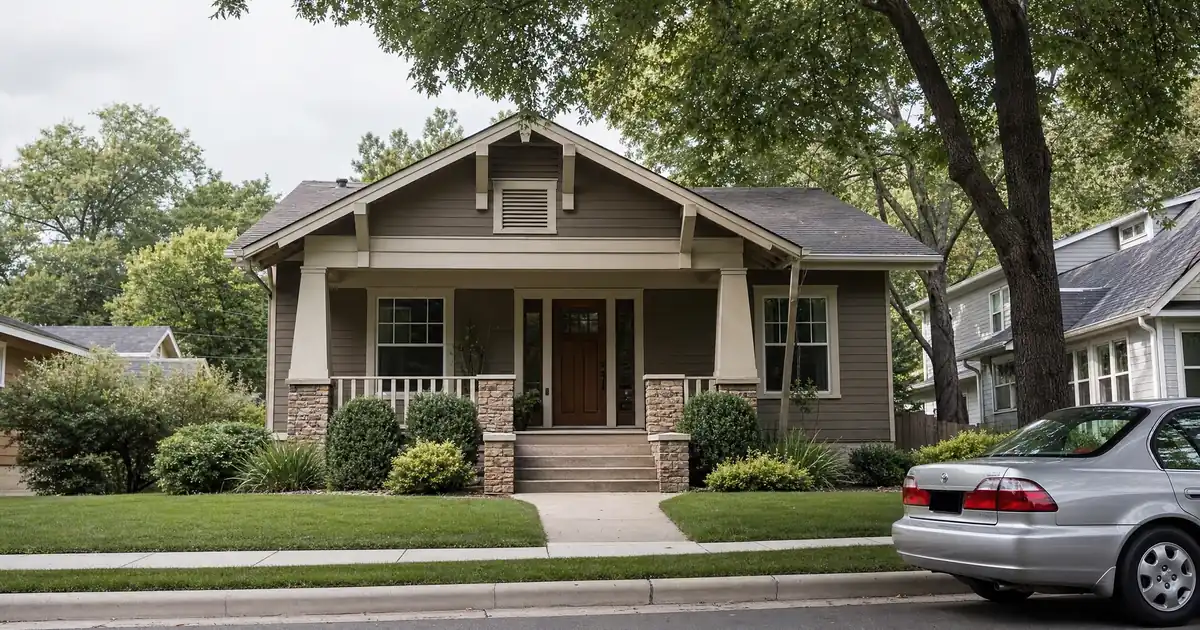
The Quick Read: FHA loans are not investment-property loans. The program requires you to move into the home soon after closing. You must live there as your primary residence. Pure rental purchases don’t qualify. There’s one real exception: a 2-4 unit property. You occupy one unit and rent out the rest. People call this house hacking. Once that occupancy period ends, most investors move the property — or their next purchase — into conventional or DSCR financing. DSCR loans qualify purely on the property’s rental income.
DSCR Calculator
Run the numbers in your market
Rate source: Freddie Mac 30-yr average via FRED® — Federal Reserve Bank of St. Louis · effective Jul 30, 2026
Prefilled with starting assumptions — enter your own rent or nightly figures, taxes, insurance, and HOA for a more accurate picture.
Program parameters update from Lendmire’s centralized guideline source. Taxes and insurance are editable estimates.
As of Jul 30, 2026 · General Freddie Mac market benchmark, not a Lendmire loan offer. Rent, nightly rate, occupancy, taxes, and insurance are editable estimates. Short-term rental figures are estimates only and vary significantly by season, property type, management approach, and local short-term-rental rules — confirm local regulations before relying on them. Qualifying income for short-term rentals varies by program — some use appraisal market rent, others use documented STR history or projections — and is confirmed in underwriting. Not a Loan Estimate, approval, or commitment to lend. Program availability and eligibility are subject to lender guidelines, credit approval, property review, and underwriting.
Key Terms Defined
DSCR stands for debt-service coverage ratio. It’s the property’s monthly rent divided by its full monthly housing payment. DSCR lenders use this number to decide if a rental property can carry itself.
LTV means loan-to-value. This is the loan amount as a percentage of the property’s appraised value or purchase price — whichever is lower.
PITIA (sometimes shortened to PITI) is the full monthly housing bill. It covers principal, interest, taxes, insurance, and association dues if the property has any.
The Self-Sufficiency Test is an FHA-specific underwriting check. It applies only to 3-4 unit purchases. It checks whether the appraiser’s projected rent — after a standard deduction — covers the full mortgage payment on its own.
Business-purpose loan describes financing for a property you don’t plan to live in. DSCR loans fall into this category. Lenders review them differently than an owner-occupied mortgage.
Can You Actually Use FHA for an Investment Property?
No — not for a straight rental purchase. FHA insurance is built around owner-occupancy. HUD’s Single Family Housing Policy Handbook 4000.1 governs every FHA-insured mortgage. It requires you to intend to occupy the property as your primary residence and move in soon after closing. Investment properties and vacation homes are excluded outright.
That’s the rule most first-time investors run into on a mortgage forum. They often never fully understand it. FHA financing was built for owner-occupants with lighter credit and smaller down payments. It wasn’t built for people trying to acquire a rental. There’s no version of FHA where you buy a single-family home, never move in, and rent it to a tenant on day one. That’s a violation of the occupancy certification you sign at closing. It’s not a gray area.
The Multi-Unit Exception (Where FHA Actually Gets Interesting)
The real opening is a 2-4 unit property. FHA insures loans on properties with up to four units. You can occupy one unit while renting the others. Investors call this structure house hacking. It’s the only legitimate path from FHA to real rental income. That’s why FHA comes up in investor conversations at all.
You have to move into one of the units soon after closing. You must stay at least a year before that unit can be vacated or rented out. FHA doesn’t dictate which unit you take. Plenty of buyers deliberately choose the smallest or least desirable unit for themselves. They rent the larger, more profitable units to tenants. It’s a completely legal move. It’s also the single most common tactic in FHA multi-unit deals.
Down payment and credit requirements follow FHA’s own program guidelines. These are generally more flexible than what’s available across Lendmire’s DSCR network. The network’s DSCR programs are built around a minimum down payment and a credit floor well above FHA’s owner-occupant minimums. If you’re weighing an FHA house-hack against DSCR financing, confirm current FHA down payment and credit-score minimums directly with a lender. The two programs are underwritten on entirely different bases. That flexibility on the FHA side is part of the appeal for a first small-multifamily purchase. Many investors roll into rental-specific financing later.
How Rental Income Actually Gets Counted
This is where duplexes and 3-4 unit properties split into two different rulebooks. It’s the detail most buyers get wrong.
Duplex purchases get a DTI credit, not a pass/fail test. Lenders typically count 75% of the projected rental income from the non-owner-occupied unit toward your qualifying income. This can meaningfully stretch what you can afford beyond your salary alone.
Triplex and fourplex purchases face something tougher: the Self-Sufficiency Test. FHA requires that the property’s Net Self-Sufficiency Rental Income cover 100% of the full monthly PITI payment. That figure comes from the appraiser’s fair-market rent from all units, including the one you’ll occupy, minus the greater of the appraiser’s vacancy/maintenance estimate or 25% of that rent, according to HUD’s own underwriting guidance. Miss that threshold, and the loan doesn’t work. This holds true no matter how strong your personal income looks.
Here’s how the logic plays out on a hypothetical fourplex. The appraiser pulls fair-market rent for all four units. Then he knocks 25% off for vacancy and maintenance — that’s the standard floor unless the appraiser’s own vacancy estimate is higher. Say that net figure lands at 92% of the projected PITI. The deal fails the test outright. Full stop. There’s no override for a borrower with excellent income or credit. This is a mechanical property test, not a personal qualification issue. It’s exactly why some triplex and fourplex listings that look great on paper never clear FHA underwriting. Two-unit purchases are exempt from this test entirely — it’s a 3-4 unit rule only.
FHA also requires three months of PITI in verified reserves specifically for 3-4 unit purchases. This is on top of whatever reserves a lender might separately require for your overall file.
How Big Can FHA Multi-Unit Loans Get?
FHA’s loan limits scale by unit count, and the ceilings are higher than most buyers expect. For case numbers assigned in 2026, high-cost-area ceilings run roughly $1,249,125 for a one-unit property, $1,599,375 for two units, $1,933,200 for three units, and $2,402,625 for four units. Scotsman Guide notes this gives small-multifamily buyers in expensive markets real leverage, since the four-unit ceiling now clears $2.4 million.
That range matters. It means FHA multi-unit financing isn’t a low-cost-market-only strategy. A fourplex in an expensive metro can still fit inside FHA’s ceiling. The real constraint is almost always the self-sufficiency math, not the loan limit itself.
The Edge Cases Investors Miss
One FHA loan at a time. Generally, you can only carry one FHA loan at a time. The program is built around primary residences, not a repeatable rental-acquisition strategy. HUD does recognize narrow exceptions. The most notable one: relocating for work more than 100 miles away. This lets you keep the departing home (renting it is optional) and take out a new FHA loan on your next primary residence. Shorter moves inside 100 miles can still qualify in limited cases — a household that’s genuinely outgrown its current home, a divorce splitting jointly-owned property, or a borrower who was only a non-occupant co-signer on the first loan. Even then, counting rental income from the departing home toward qualifying usually requires a documented market-rate lease. For in-area moves, you’ll also need at least 25% equity in that first property.
CAIVRS screening. Every FHA borrower gets run through the Credit Alert Verification Reporting System before approval. This checks for delinquent federal debt or an FHA insurance claim paid within the past three years. It’s a screening layer with no real equivalent in DSCR underwriting. DSCR lending leans on the property’s cash flow and your credit score instead of a federal-debt database.
Condo approval is its own track. Most condo projects need full HUD project approval. A Single-Unit Approval path does exist for individual units in projects that aren’t fully approved. That path requires the project to have at least five units and meet certain occupancy and financial thresholds.
Property condition standards can kill a deal a conventional appraisal wouldn’t flag. FHA appraisers evaluate safety, security, and soundness. They check whether the home is safe to occupy, protects the lender’s collateral, and will hold up structurally over time. Fail any of those checks, and repairs are required before the loan can close. Pre-1978 properties add lead-paint inspection requirements on top of that.
Rate environments quietly move the self-sufficiency math. As financing costs shift, the payment side of the self-sufficiency equation moves while the rent side doesn’t. A property that cleared the 100%-of-PITI bar at one point can fail it later — with no change to the actual rent roll at all. It’s a purely mechanical shift, not a policy one.
The Life Cycle: From FHA House Hack to a Real Rental Portfolio
Most investors who start with FHA follow a similar path. They buy the 2-4 unit property. They occupy one unit for the required year. They collect rent on the rest. Then they either convert the whole property to a rental once the occupancy window closes, or they refinance out of FHA entirely. Many plan the refinance once they’ve built 20-25% equity, since that step also eliminates FHA’s mortgage insurance. Unlike conventional PMI, FHA mortgage insurance generally doesn’t cancel on its own with a low down payment. It typically runs for the life of the loan unless you refinance.
That refinance is usually the point where FHA hands off to DSCR. FHA underwrites you — your personal DTI, credit score, and occupancy history. DSCR lenders review the property’s rental income instead — rent against the full monthly payment, full stop, with no personal income documentation involved. That’s a genuinely different qualification model, not just a different rate sheet. Lendmire covers this in more depth in its complete DSCR loans guide.
FHA vs. Conventional vs. DSCR vs. Commercial
| Factor | FHA House-Hack | Conventional Rental | DSCR | Commercial (5+ units) |
|---|---|---|---|---|
| Occupancy | One unit, 1+ year | Not required | Not required | Not required |
| Qualifying basis | Personal DTI + partial rent credit | Personal DTI | Property rent vs. full payment | Property income |
| Portfolio scale | One FHA loan at a time | Multiple, with lender-set caps | No cap on number of financed properties | Built for larger, income-producing holdings |
| Typical use | First small multifamily acquisition | Standard rental purchase | Ongoing portfolio growth | Apartment buildings above 4 units |
DSCR’s structural edge shows up in the second-to-last row. There’s no ceiling on how many rental properties you can finance through the program. That’s the exact constraint FHA’s one-loan-at-a-time rule puts on scaling.
Where DSCR Picks Up After FHA
Across select lenders in Lendmire’s wholesale network, purchase leverage on DSCR loans typically runs 75-80% LTV. A handful of stronger programs reach 85% for borrowers with roughly a 700+ credit score. That higher leverage can lower the required down payment for well-qualified files. Coverage requirements start at a 1.00 debt-service ratio on select programs — this is a floor, not a universal benchmark. Rent needs to at least equal the full monthly payment; stronger ratios open up better leverage and program tiers. Credit floors run as low as 620 in parts of the network, though most programs are built around 660. Reserve requirements generally sit near six months of PITIA, stepping up toward nine months on larger loan balances above roughly $1,500,000. Loan sizes on standard programs run up to about $3,000,000, with select lenders in the network handling smaller balances outside that range.
A larger down payment lowers your monthly obligation and can lift the coverage ratio. But it never substitutes for a credit floor, a reserve requirement, or property eligibility. The strongest DSCR files clear both tests at once: enough equity in the deal and enough rent to cover the payment. Keep in mind, clearing a 1.00 ratio isn’t the same as positive cash flow. Repairs, vacancy, management fees, utilities, and capital expenses all sit outside that calculation. Terms vary by lender guidelines, property type, leverage, credit profile, and full file review.
Some property types simply don’t fit DSCR programs in this network at all. Manufactured homes, log homes, and barndominiums fall outside eligibility, full stop, no matter how strong the rent looks.
Frequently Asked Questions
Can I get an investment property loan?
Yes, but FHA isn’t the vehicle for a pure rental purchase — it requires owner-occupancy. If you’re looking to finance a property you won’t live in, you’ll typically use conventional investment financing, DSCR loans, or commercial financing for larger buildings. All of these qualify on the property or your broader financial picture rather than FHA’s occupancy rule.
How do I get an investment property loan?
Start by deciding whether the property will cash flow on its own. That decision determines whether DSCR financing fits, since it qualifies almost entirely on rent versus the monthly payment rather than personal income documents. From there, a lender or broker reviews your credit, your reserves, and the appraisal’s rent figures to size the leverage and terms.
How do you qualify for a DSCR loan after outgrowing an FHA property?
Qualification shifts from your personal file to the property’s numbers. A lender reviews the projected or in-place rent against the full monthly payment, along with your credit, your reserves, and the appraisal. Traditional personal-income documentation and employment history don’t come into it.
What down payment and credit score do you need to qualify for a DSCR loan in Lendmire’s network?
Across the network, purchase leverage generally runs 75-80% LTV, with select stronger programs reaching 85% for well-qualified borrowers. The minimum credit score is typically 620. Exact terms depend on lender guidelines, property type, and full file review.
Can I use an FHA loan to buy a rental property outright?
No. FHA requires genuine owner-occupancy shortly after closing, and investment properties or vacation homes are explicitly excluded under HUD’s guidelines. The only workaround is a 2-4 unit property where you occupy one unit. That’s house hacking, not a pure rental purchase.
What happens if I move out of my FHA multi-unit property before a year is up?
It can violate the occupancy certification you signed at closing, unless your move fits one of FHA’s narrow documented exceptions — like relocating for work more than 100 miles away. Outside those exceptions, vacating early gets treated as a misrepresentation of occupancy intent. That carries real consequences under the loan agreement.
Can I have two FHA loans at the same time?
Generally, no. FHA is built around one loan at a time, because it’s designed for primary residences, not a repeatable acquisition tool. HUD allows a handful of documented exceptions, mostly tied to relocation, outgrowing a home, or divorce. But stacking FHA loans as a scaling strategy isn’t how the program works.
About Lendmire
Lendmire (NMLS# 2371349) is a mortgage broker, not a lender. It arranges DSCR investor financing through select lenders across a 41-market footprint covering 40 states plus Washington, D.C. It doesn’t approve or fund loans directly. Have you outgrown the FHA occupancy clock? Are you refinancing an existing rental to pull equity? Resources like investment property refinance guidance, a breakdown of how soon a rental can be refinanced after purchase, and a comparison of DSCR loans against jumbo financing all cover the next steps in more detail. Scotsman Guide named Lendmire a Top Mortgage Workplace in both 2025 and 2026.
Are you weighing whether to keep house-hacking under FHA or move straight to a DSCR purchase on your next property? Lendmire can help you compare the leverage, coverage, and credit tiers against the actual rent roll. Reach the team at 828-256-2183 or request a quote to see how a specific property pencils.
Tax treatment can depend on how you use the funds and how you hold the property. Keep clear records and speak with a qualified tax professional before relying on any deduction.
Loan approval is never guaranteed, and nothing here is a commitment to lend. Every scenario described here is subject to lender approval and to borrower, property, and program guidelines that can change. This article is general information, not financial, legal, or tax advice.
Get Started
Ready to find the right loan for you?
In about 30 seconds you can review financing options available for your investment property. No commitment required.
Informational only. Not a Loan Estimate, approval, or commitment to lend. Program availability and eligibility are subject to lender guidelines, credit approval, property review, and underwriting.
References
2. Scotsman Guide — HUD Hikes FHA and HECM Loan Limits for 2026
This article is part of Lendmire’s DSCR loan program — full qualification details, guidelines, and scenarios live on the program page.
Related reading: FHA House Hack Vs DSCR Rental Purchase · Can I Refinance A FHA Loan On Investment Property? · Can I Refinance And Take Money Out Of Rental Property?
Brandon Miller
Founder & CEO, Mortgage Loan Originator, Lendmire LLC
- Mortgage Loan Originator · NMLS# 1129696 · Verify on NMLS Consumer Access
- North Carolina Real Estate Broker · License# 343312 · Verify on NCREC
- North Carolina Insurance Producer · License# 19053198 · Property, Casualty, Life, Health · Verify on NAIC SBS
- Lendmire LLC · Firm NMLS# 2371349 · Verify firm licensure
Legal disclosures. Lendmire (NMLS# 2371349) is a state-licensed mortgage brokerage that arranges financing through wholesale lender relationships. Lendmire is not a direct lender, depository institution, or registered financial advisor. The discussion above is general informational content about real estate financing — it is not financial, legal, or tax advice, and readers should consult licensed professionals for guidance on their individual circumstances. Loan inquiries are subject to lender underwriting; this article does not represent a commitment to lend. Loan terms, rates, and qualification standards vary by borrower, property, and state, and are subject to change at any time. Equal Housing Opportunity. NMLS Consumer Access: nmlsconsumeraccess.org.