
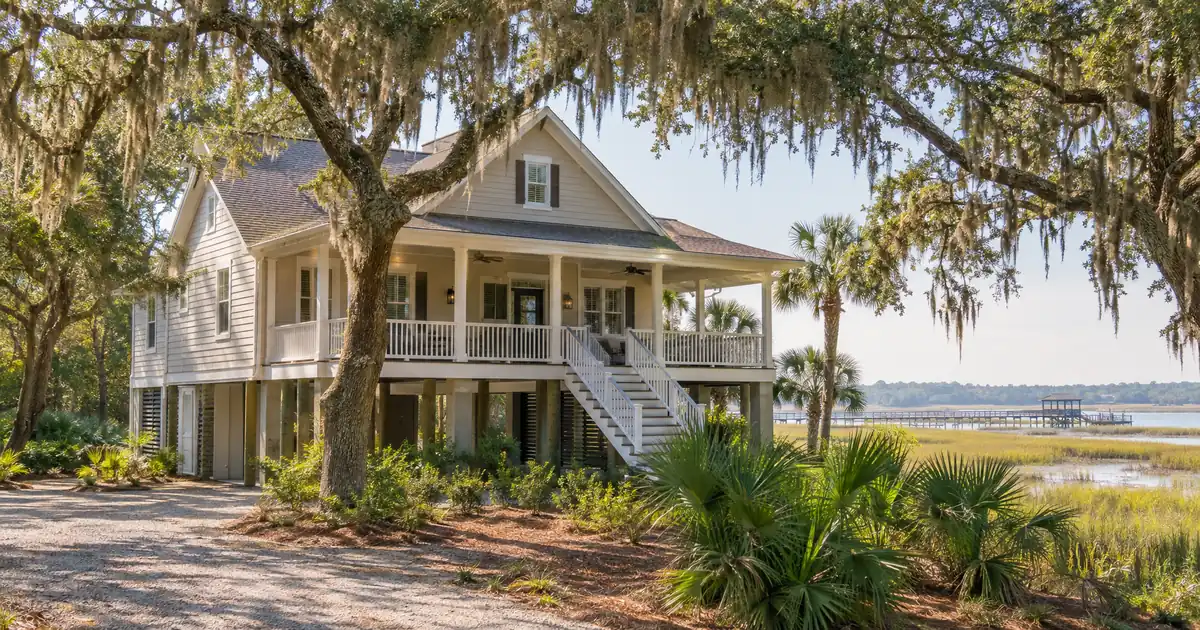
If you’re pricing out a duplex on Hilton Head Island, stop. It doesn’t exist as inventory here — not in any real quantity — and that single fact changes how a rental-income loan gets built on this island more than almost anything else.
The Short Version: On Hilton Head Island, South Carolina, a rental-income loan gets underwritten on the property’s rent measured against its full monthly carry — taxes, insurance and, where it applies, HOA/POA dues — which means older 1980s and 1990s condos and non-gated single-family homes clear the coverage math more cleanly than gated resort product.
DSCR Calculator
Run the numbers in your market
Rate source: Freddie Mac 30-yr average via FRED® — Federal Reserve Bank of St. Louis · effective Jul 30, 2026
Prefilled with starting assumptions — enter your own rent or nightly figures, taxes, insurance, and HOA for a more accurate picture.
Program parameters update from Lendmire’s centralized guideline source. Taxes and insurance are editable estimates.
As of Jul 30, 2026 · General Freddie Mac market benchmark, not a Lendmire loan offer. Rent, nightly rate, occupancy, taxes, and insurance are editable estimates. Short-term rental figures are estimates only and vary significantly by season, property type, management approach, and local short-term-rental rules — confirm local regulations before relying on them. Qualifying income for short-term rentals varies by program — some use appraisal market rent, others use documented STR history or projections — and is confirmed in underwriting. Not a Loan Estimate, approval, or commitment to lend. Program availability and eligibility are subject to lender guidelines, credit approval, property review, and underwriting.
- Town-wide median sale prices run well above the national norm, but it’s the older, non-luxury stock that clears coverage best.
- True duplex/triplex/fourplex inventory is scarce on the island — multi-unit stacking mostly lives across the bridge in Bluffton.
- HOA/POA dues in gated communities like Sea Pines or Hilton Head Plantation add real weight to the coverage denominator.
- The price-to-rent ratio here sits on the borderline of renter-favoring territory, not a landlord’s market.
- Average asking rents have softened year over year, so files shouldn’t lean on rent growth to make coverage work.
For real estate investors in Hilton Head Island, South Carolina, Lendmire (NMLS# 2371349) helps structure and place DSCR financing through wholesale lenders operating in 41 markets, including D.C. That footprint matters here specifically because this market doesn’t behave like a typical Southeastern coastal town, and a lender who’s only ever underwritten conventional multifamily elsewhere tends to stumble on the local housing stock.
Hilton Head Island Market Snapshot
A quick read on the Hilton Head Island investor landscape — figures come from the cited sources below. Confirm current property-level numbers before underwriting.
| Metric | Detail |
|---|---|
| Home prices | $803K median (Redfin) |
| Typical rents | $3,200 median (Zillow Rental Manager) |
| Recent appreciation | +10.0% yoy (Redfin) |
| University enrollment | 2,208 students (USC-Beaufort (regional campus)) |
| Employment | 1,100+ employees — SERG Restaurant Group (WSAV News) |
Why the Duplex Play Doesn’t Exist Here
Zillow’s own duplex and triplex search results for the island run to a handful of listings, total. The built environment is dominated instead by attached condo/villa product and detached single-family resort homes — condo and villa sales are the primary driver of activity in Folly Field, Forest Beach and Shipyard specifically. That’s not a data gap. It’s the actual shape of the market.
For an investor used to running rent-to-debt math on a fourplex in a landlocked Southern city, that’s a real adjustment. On Hilton Head Island proper, the DSCR conversation isn’t about stacking four rent rolls under one mortgage. It’s about finding the single unit — condo, villa or detached home — where rent covers the note without a luxury HOA line eating the cushion.
Where the Long-Term Rental Math Actually Clears
Older condo and villa stock built in the 1980s and 1990s is where DSCR coverage clears most reliably on the island itself — not the newer luxury product, and not the gated golf communities carrying the heaviest dues. That’s a function of basis, not charm.
Per Point2Homes rental-stock data, Hilton Head Island’s rental inventory skews older: 27% of units were built 1980-1989 and another 22% built 1990-1999 — nearly half the rental base. These units trade at a lower basis than newer construction, which is exactly what a rent-to-value calculation needs when the island’s price-to-rent ratio sits at 18.6, per Homes.com — a reading that generally favors renting over owning, and one that leaves less margin for a landlord’s coverage math than a lower ratio would.
Forest Beach and North Forest Beach carry the lowest entry point among the walkable, beach-adjacent submarkets, with condo-heavy inventory and steady occupancy. This is the pocket where a straight long-term-rental DSCR file has the best shot at clearing 1.00x without help from HOA-light structuring or blended income. Shipyard runs a similar profile — high attached-unit share, golf/resort adjacency — though its HOA structure runs closer to the gated-community end of the spectrum, worth checking unit by unit.
Spanish Wells is a different animal: established, less resort-branded, populated more by long-term owners than renters, with luxury product commonly clearing seven figures. It’s not a landlord-heavy submarket, and an investor chasing rental coverage should treat it as the exception rather than the target.
Skip the Gate If You’re Buying for Cash Flow
Gated resort communities on Hilton Head Island carry the heaviest HOA/POA drag on the island, and that drag lands directly in the DSCR denominator — which is why Sea Pines, Palmetto Dunes and Hilton Head Plantation often underperform on straight rental coverage relative to non-gated workforce housing, even with stronger name recognition.
HOA and POA dues in these communities commonly run from the low thousands to well into five figures annually, and every dollar of that goes into the same monthly obligation that rent has to cover. Higher dues mean a lower coverage ratio on the exact same rent roll — full stop. This isn’t a tax or insurance conversation; it’s structural to how the loan gets sized.
Sea Pines is the clearest example of the appreciation-versus-cash-flow split on this island. The average Sea Pines house price runs $1.24 million, up 10.0% over the past year according to Redfin’s neighborhood data — real appreciation, real brand value, and genuinely difficult coverage math for a straight long-term rental given the price point and the HOA structure. Hilton Head Plantation runs a median sale price near $862K with more modest 1.4% year-over-year growth, and carries its own flood-exposure profile worth reviewing with an insurance professional before committing — a detail an appraiser or local broker would flag without hesitation.
Here’s the honest tension: Sea Pines and similar gated product are the equity-growth play, better suited to a longer hold before any refinance conversation. Workforce and attached-condo submarkets with flatter appreciation are where the DSCR math has to work on rent alone at acquisition — no waiting on appreciation to bail out an aggressive purchase price.
Crossing the Bridge for Multi-Unit Stacking
Bluffton, not Hilton Head Island, is where multi-unit income stacking actually lives in this submarket — carriage-house and detached-suite configurations paired with a main house are the closest product to a duplex or triplex, and they’re concentrated on the mainland side of the bridge.
A representative example from current listings: a Bluffton property offering a 3BR/2.5BA main house, a 1BR/1BA suite and a detached 1BR/1.5BA carriage house — long-term tenants already in place across the configuration. That’s the de facto multifamily product for this metro, and it isn’t found on the island itself in any meaningful volume.
Bluffton’s fundamentals support the play. Median rent runs $2,050 a month against a median owner-occupied home value of $390,200 — both a lower basis and a lower rent than the island, but a rent-to-price relationship that can work harder for a multi-unit investor stacking several income streams under one loan. Local investment guides frame it plainly: Bluffton and Hilton Head Island work as long-term rental plays, while Old Town Bluffton and Bluffton Park carry the area’s short-term rental permitting. Investors who want the multi-unit income-stacking profile they’d find in Greenville or Aiken need to look here, or push further toward Okatie.
Who’s Actually Renting on This Island
The renter base on Hilton Head Island is smaller and more cost-sensitive than the resort image suggests — only 21% of households are renter-occupied against 79% owner-occupied, per Wikipedia’s Census-sourced figures, and nearly half of the island’s renters are already housing cost-burdened.
That second point matters more than it sounds. According to the Municipal Association of South Carolina, roughly 40% of all households on the island — including close to half of renters — spend 30% or more of monthly income on housing. That’s not a market clamoring for premium product. It’s a market where workforce-priced 1980s and 1990s inventory is the demand center, not luxury villas.
There’s also a structural commuter base that has nothing to do with tourism. More than 14,000 people commute onto the island for work each day, with roughly 17% traveling 50 miles or more one way, per the same MASC data. Workforce housing near the Highway 278 corridor captures that commuter pool directly — tenants who’d otherwise be renting in Bluffton or Hardeeville, and whose demand doesn’t swing with visitor season the way STR-adjacent product does.
The Town of Hilton Head Island is responding to this gap directly. Its Northpoint on Jarvis Creek project is slated to deliver 157 units across one-, two- and three-bedroom apartments, priced for households earning between 60% and 150% of area median income — roughly $59,520 to $148,800 for a family of three. That’s an institutional bet, built by the town itself, that attainable rental product is undersupplied on the island. Small private landlords holding workforce-tier units in that same income band are filling a gap the market has already identified, and doing it ahead of Northpoint’s lease-up.
Employment behind that renter base is broad but tourism-heavy at the top. SERG Restaurant Group runs 15 restaurants and employs more than 1,100 people, making it the island’s largest private employer, per WSAV News. Resort employers — The Sea Pines Resort, Westin Hilton Head, Marriott Vacations Worldwide, Sonesta — round out the top of the list, per the Hilton Head Island-Bluffton Chamber of Commerce. Healthcare adds a non-tourism anchor: Beaufort Memorial Hospital employs 1,900 people and recently opened a 70,000-square-foot Okatie Medical Pavilion to serve growth in southern Beaufort County, per Beaufort County. Thirty miles inland, the Marine Corps Air Station Beaufort and Marine Corps Recruit Depot Parris Island contribute $2.4 billion to the regional economy and employ nearly 20,000 people, according to the Beaufort Regional Chamber of Commerce — and every recruit graduation cycle feeds a recurring wave of family visitation and rental demand into the broader Beaufort-Hilton Head system, a driver no comparable non-military coastal town shares.
A Worked Purchase Scenario
Run the numbers on a modeled Forest Beach condo priced around $420,000 — below the town’s $803K median per Redfin, and representative of the older, lower-basis inventory that dominates this submarket. Financed at 75% LTV with 25% down, using a modeled rent assumption near $2,700 a month — close to RentCafe’s two-bedroom average of $2,757 — the coverage ratio lands in the low-1.1x range once taxes, insurance and standard debt service are factored in. That’s workable, not padded. Terms vary by lender guidelines, property type, leverage, credit profile, and full file review.
Run the same unit through a gated-resort HOA structure instead. Same price bracket, same rent, but the dues line adds real weight to the coverage denominator. Coverage can slide into the 0.90s — sub-1.00 territory. That doesn’t automatically kill a file, but it changes the conversation: sub-1.00 DSCR programs, interest-only structuring or blended short-term rental income all become the relevant paths a lender might review, subject to credit approval, reserves and program guidelines.
The stress test worth running before committing to either scenario: RentCafe’s data shows island-wide average rent fell 8.16% year over year, down to $2,642 from $2,877 — a real decline, not a rounding error. Zillow’s rental data lands higher, at a $3,200 median across all property types, which reflects a different mix and methodology rather than a contradiction. Either way, a file built on assumed rent growth is the wrong file for this market right now. One built on today’s rent, held flat, is the safer one.
Lendmire’s deal desk sees a consistent pattern on files from markets structured like this one — heavy second-home and HOA-governed inventory, thin true-multifamily stock, rents that don’t move in a straight line. The cleaner files tend to come in with the HOA questionnaire and master insurance documentation already complete, rather than requested mid-review, and with a rent figure the appraiser can support from comparable long-term leases rather than a nightly STR average dressed up as annual rent. The common friction point in markets like this is exactly the opposite — an incomplete HOA packet, or coverage math built on optimistic rent that the appraisal doesn’t back up.
What Actually Slows These Files Down
The HOA questionnaire is the first document to chase on any condo or villa purchase inside a gated Hilton Head community — incomplete questionnaires, missing master insurance certificates or unclear reserve-fund disclosures are a common reason a file sits in review longer than it needs to. Get that packet complete before submission, not after a request comes back.
Appraisal comp selection is the second friction point, and it’s specific to gated product. Appraisers working inside Sea Pines, Palmetto Dunes or Hilton Head Plantation are often restricted to comps within the same gated community, which can be a thin pool depending on recent sales activity. Broader market inventory has actually opened up — the wider Hilton Head area posted 1,793 active listings, up 11.3%, with 96 days on market and sellers still capturing 97.2% of list price, per SimplyGrand Properties — but that broader depth doesn’t help an appraiser confined to a single gated subdivision’s recent closings.
Entity documentation matters too. Investors purchasing under an LLC should have operating agreements and EIN documentation ready ahead of submission — loans to entity-titled borrowers are available depending on program guidelines, but incomplete entity paperwork is a routine, avoidable delay. And on any property near the marsh or waterfront, flood zone determination deserves an early look — Hilton Head Plantation in particular carries elevated flood exposure worth confirming with an insurance professional before locking in a purchase price, since flood coverage requirements can shift the file’s numbers after the fact if they’re addressed late.
None of this is exotic. It’s the same documentation discipline that clears files anywhere — it just shows up differently on a barrier island where condo/villa product and HOA governance dominate the housing stock alongside detached single-family resort homes.
DSCR vs. conventional financing
Two common ways to finance an investment property in Hilton Head Island, SC. They qualify you differently — here’s how investors weigh them.
Why investors choose it
- Qualifies on the property’s rental income — no personal tax returns, W-2s, or pay stubs needed to document income.
- No personal debt-to-income ceiling to clear, so existing mortgages and obligations don’t cap your borrowing the same way.
- Can be closed in an LLC, keeping the property inside a business entity.
- Built for scaling — not held to the limit on number of financed properties that conventional financing applies.
- Underwriting centers on the deal: generally qualifies when the rent covers the payment, a 1.00x coverage ratio being a common baseline (confirmed in underwriting).
- Designed specifically for investment property, including long-term and, where the program allows, short-term rentals.
Where it’s strong
- Often the lowest ongoing financing cost for a buyer who fully qualifies on personal income — a fit for a first property or a cost-first purchase.
Trade-offs for investors
- Requires full personal income documentation and must fit within a debt-to-income limit — salary, existing debts, and other mortgages all count.
- Typically held in your personal name rather than a business entity.
- Caps how many financed properties you can carry, which can become a ceiling as a portfolio grows.
- Evaluates you as a borrower as much as the property, which usually means more paperwork.
How investors usually choose: a first or single property often optimizes for the lowest financing cost; portfolio builders often optimize for leverage, vesting in an LLC, and scaling past conventional caps. The right answer depends on your goals, the property, and current guidelines — both paths run through select lenders in Lendmire’s wholesale network, with eligibility and terms confirmed in underwriting.
The DSCR review itself works the same way here as anywhere Lendmire places these loans: the rental-income review framework comes down to the property’s rent measured against its debt obligation rather than the borrower’s personal income documentation. Investors weighing this against a conventional purchase loan can see the guide to where DSCR and conventional financing diverge, and South Carolina investors working across multiple submarkets in the state can review Lendmire’s South Carolina DSCR loan programs for a broader look at how the state’s coastal and inland markets differ.
Frequently Asked Questions
Why is it so hard to find a duplex or triplex on Hilton Head Island itself?
The housing stock simply wasn’t built that way. Condo/villa and detached single-family resort product dominates the island, and true 2-4 unit properties are scarce enough that most investors looking for that configuration end up shopping in Bluffton instead, where carriage-house and detached-suite layouts fill the gap.
Does a high HOA fee actually change DSCR lender review?
Yes — HOA and POA dues get added into the monthly obligation the lender measures rent against, so a higher fee lowers the coverage ratio even if the rent and purchase price stay identical. That’s why non-gated or lower-due communities often clear coverage more easily than Sea Pines or Palmetto Dunes-style gated product, subject to lender guidelines on how dues are documented.
Is older condo inventory actually a better DSCR play than newer construction here?
Generally, yes, because of basis. Units built in the 1980s and 1990s make up close to half of the island’s rental stock and trade at a lower price point than newer luxury construction, which tends to produce a stronger rent-to-price relationship for coverage purposes — though condition, reserves and HOA structure still need review property by property.
How does the Marine Corps presence at Parris Island affect rental demand here?
It adds a recurring, non-tourism demand layer roughly 30 miles inland that ripples into the broader Beaufort-Hilton Head rental market — recruit graduation cycles bring waves of family visitors and BAH-backed housing demand that most comparable coastal resort towns simply don’t have.
Should an investor count on rent growth to make the DSCR math work on Hilton Head Island?
Not right now. Average asking rents fell 8.16% year over year according to RentCafe data, so a file built on assumed rent increases is taking on risk the current market doesn’t support. Underwriting off today’s rent, held flat, is the more conservative and more defensible approach.
Is Bluffton a better bet than Hilton Head Island proper for a first DSCR purchase?
It depends on the strategy. Bluffton offers a lower entry price, lower rent, and the multi-unit stacking product the island doesn’t have — a genuine option for an investor prioritizing income-stacking over island brand value. An investor set on Hilton Head Island itself is generally better served targeting older condo/villa stock in non-gated pockets rather than gated resort communities.
A DSCR-focused mortgage broker, Lendmire places investor financing — with eligibility generally reviewed by the lender on the property’s cash flow rather than the borrower’s traditional personal-income documentation, subject to lender guidelines and program eligibility. Investors weighing a purchase on this island can review the DSCR loan programs across the Lendmire platform, or call 828-256-2183 to talk through a specific property before writing an offer.
Anyone who’s underwritten a file on this island long enough will tell you the same thing an appraiser would: the HOA packet decides the timeline before the rent roll ever does, and the properties that clear coverage cleanest are rarely the ones with the ocean view.
About Lendmire
A DSCR-focused mortgage broker, Lendmire (NMLS# 2371349) places investor financing across 41 markets — 40 states plus Washington, D.C — with DSCR eligibility generally reviewed by the lender on property cash flow instead of tax returns, subject to lender guidelines. Scotsman Guide named Lendmire a Top Mortgage Workplace in 2025 and 2026.
Get Started
Ready to find the right loan for you?
In about 30 seconds you can review financing options available for your investment property. No commitment required.
Informational only. Not a Loan Estimate, approval, or commitment to lend. Program availability and eligibility are subject to lender guidelines, credit approval, property review, and underwriting.
References
1. Redfin — Hilton Head Island Housing Market
3. Redfin — Sea Pines Neighborhood Housing Market
4. USC-Beaufort (regional campus)
5. WSAV News
6. Point2Homes — Average Rent in Hilton Head Island
7. Homes.com — Hilton Head Island Homes for Rent
8. Municipal Association of South Carolina — Growth Drives Workforce Housing Demand
9. Town of Hilton Head Island — Northpoint on Jarvis Creek
10. Hilton Head Island-Bluffton Chamber of Commerce
11. Beaufort County SC — Beaufort Memorial Hospital
12. Beaufort Regional Chamber of Commerce
13. SimplyGrand Properties — Housing Market Outlook
14. a 2026 Scotsman Guide Top Mortgage Workplace
15. a 2025 Scotsman Guide Top Mortgage Workplace
This article is part of Lendmire’s DSCR loan program — full qualification details, guidelines, and scenarios live on the program page.
Related reading: Luxury Rental DSCR Loans In Hilton Head Island: How STR Rents Are Read · Cash Out Refinance Investment Property in Tega Cay, South Carolina · DSCR Loans Beaufort & Port Royal: Investor Financing for MCAS Beaufort, Parris Island, Hunting Island & Real Estate Investors
Guides: DSCR Loans in Hilton Head Island, SC · DSCR Loans in South Carolina
Brandon Miller
Founder & CEO, Mortgage Loan Originator, Lendmire LLC
- Mortgage Loan Originator · NMLS# 1129696 · Verify on NMLS Consumer Access
- North Carolina Real Estate Broker · License# 343312 · Verify on NCREC
- North Carolina Insurance Producer · License# 19053198 · Property, Casualty, Life, Health · Verify on NAIC SBS
- Lendmire LLC · Firm NMLS# 2371349 · Verify firm licensure
Disclosure information. Lendmire is a state-licensed mortgage brokerage under NMLS# 2371349. Lendmire is not a depository institution, direct lender, or financial advisor — all loans referenced are placed through wholesale lender partners and are subject to each lender's underwriting standards. This article is provided for general informational purposes and is not a commitment to lend, nor does it constitute financial, legal, or tax advice. Loan programs, terms, rates, and qualification standards change without notice and depend on borrower profile, property type, and the state in which the subject property is located. Equal Housing Opportunity provider. NMLS Consumer Access: nmlsconsumeraccess.org.