
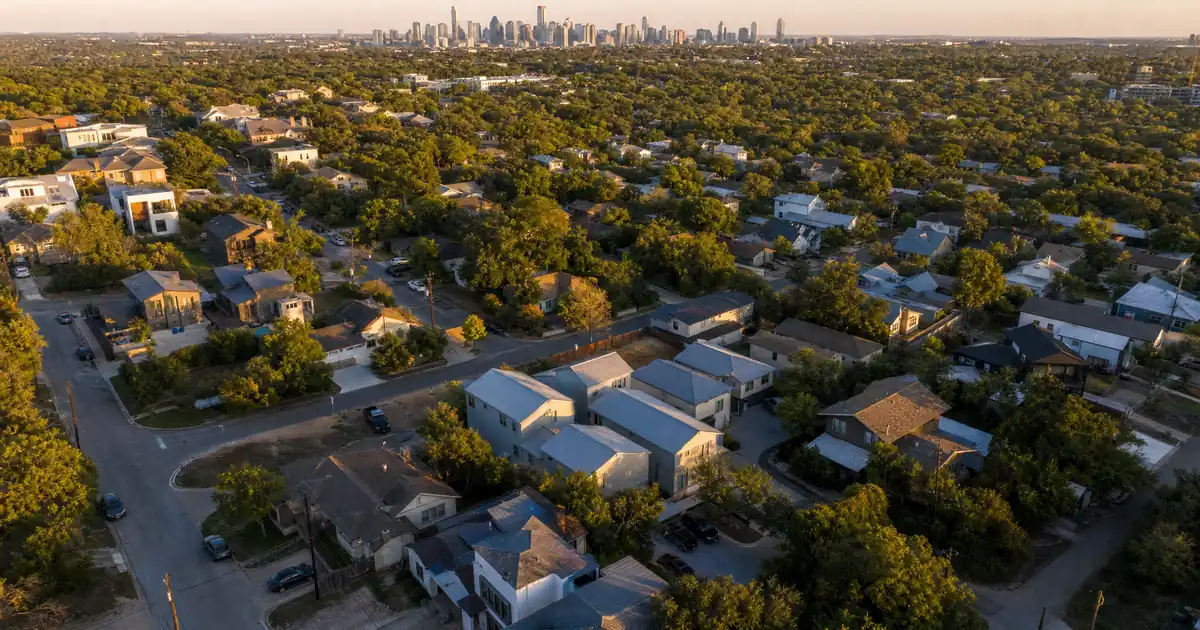
Most out-of-state buyers searching for investment property loans in Austin, Texas start their neighborhood list with South Congress, the Domain, or a lake-view lot in Westlake Hills. That instinct is understandable — those are the ZIPs that show up in every “hottest Austin neighborhoods” roundup — and for a DSCR investor specifically, it’s close to backwards. The cap rate data tells a blunter story: ZIP 78703 in Tarrytown and the Barton Creek-adjacent ZIPs of 78733 and 78735 were running below 1 percent in early 2025, while far-east ZIPs 78724 and 78725 were clearing 5.49 percent and 6.45 percent, respectively, according to Team Price’s cap rate analysis. For an investor whose loan is reviewed around the property’s own rent roll rather than a W-2, that gap is close to the whole ballgame.
The Quick Read: In Austin, Texas, a DSCR loan is underwritten primarily on the subject property’s rental income measured against its full monthly obligation, taxes and insurance included, and the spread between submarkets here is unusually wide — far-east ZIP 78724 clears a 5.49 percent cap rate on a $312,500 median sold price, while west-side ZIP 78703 sits under 1 percent (Team Price).
DSCR Calculator
Run the numbers in your market
Rate source: Freddie Mac 30-yr average via FRED® — Federal Reserve Bank of St. Louis · effective Jul 30, 2026
Prefilled with starting assumptions — enter your own rent or nightly figures, taxes, insurance, and HOA for a more accurate picture.
Program parameters update from Lendmire’s centralized guideline source. Taxes and insurance are editable estimates.
As of Jul 30, 2026 · General Freddie Mac market benchmark, not a Lendmire loan offer. Rent, nightly rate, occupancy, taxes, and insurance are editable estimates. Short-term rental figures are estimates only and vary significantly by season, property type, management approach, and local short-term-rental rules — confirm local regulations before relying on them. Qualifying income for short-term rentals varies by program — some use appraisal market rent, others use documented STR history or projections — and is confirmed in underwriting. Not a Loan Estimate, approval, or commitment to lend. Program availability and eligibility are subject to lender guidelines, credit approval, property review, and underwriting.
- ZIP 78724 posts a 5.49 percent cap rate on $25,368 in annual gross rent (Team Price)
- Duplex and fourplex inventory clusters in ZIPs 78753, 78758, 78741, and 78723 (LRG Realty)
- Metro apartment vacancy hit 10.01 percent in mid-2025 before absorption caught up (Team Price)
- Home prices sit 28 percent below the April 2022 peak and have flattened since (Team Price)
- Samsung’s Taylor fab is expected to bring roughly 3,000 workers northeast of the metro (market reporting)
Austin Market Snapshot
A quick read on the Austin investor landscape — figures come from the cited sources below. Confirm current property-level numbers before underwriting.
| Metric | Detail |
|---|---|
| Home prices | Metro median $440,000 (KXAN Austin Housing Market Data) |
| Typical rents | $1,726→$1,425 (Team Price) |
| Cap rates | 6.45% vs <1% cap rates (Team Price) |
| University enrollment | 55,000 total enrollment (UT Austin Facts & Figures) |
| Population | 1,002,632 population (City of Austin Demographics) |
| Vacancy | 10.01% (Team Price) |
The ZIP Everyone Skips: Far East Austin
Far east Austin — ZIPs 78724 and 78725 — currently produces the cleanest DSCR math in the metro, with cap rates of 5.49 percent and 6.45 percent, respectively, against a city where most of the well-known central neighborhoods run on appreciation, not rent. Modeled coverage on a median-priced 78724 purchase lands close to a 1.00x benchmark once taxes and insurance are folded in.
Run the numbers on a purchase in 78724 at the ZIP’s recent median sold price of $312,500 (Team Price), financed at a 75 percent loan-to-value ratio — inside Lendmire’s typical purchase range of 75 to 80 percent LTV on standard DSCR programs. Annual gross rent on the property runs around $25,368, or roughly $2,114 a month. Weighing that rent against a full monthly obligation that includes principal, interest, property tax, and insurance, using typical financing-cost assumptions and Central Texas tax and insurance averages, produces modeled coverage right around a 1.00x baseline — enough to clear the 1.00x qualifying threshold on standard programs, but short of the 1.25x coverage that counts as strong. That’s not a wide margin. It leaves little cushion for a rent dip, a vacancy month, or a tax reassessment, and it assumes the buyer isn’t reaching for a higher-leverage tier that would require stronger coverage elsewhere in the file.
78725, just north along the Manor and Elgin corridor, posted the highest cap rate in the city’s ZIP-level dataset at 6.45 percent (Team Price). Properties here run older and less renovated than the showcase listings in South Congress or Mueller, which is precisely why the yield runs better — the entry price sits lower relative to achievable rent. That’s the tradeoff worth naming honestly: less curb appeal, thinner exit liquidity if the eventual buyer is a retail homeowner rather than another investor, but a rent roll that covers its own debt from day one instead of depending on future appreciation to make the math work.
Why Westlake, Tarrytown, and Barton Creek Are a Different Bet
Cap rates in Westlake Hills, Tarrytown, and the Barton Creek-adjacent ZIPs run below 1 percent, per Team Price’s ZIP-level analysis — meaning a purchase-money DSCR file here will typically model well under a 1.00x ratio before any adjustment. These are appreciation neighborhoods, not cash-flow neighborhoods, and the loan structure needs to reflect that honestly rather than pretend otherwise.
West Austin’s draw is proximity to the Hill Country and an established address, not the rent roll. Zillow places the typical home value in 78746 (Westlake) at about $1.72 million — the highest of any Austin-area ZIP — while the least expensive ZIP in the same dataset lands closer to $191,000, a spread that captures just how bifurcated the price ladder has become across this one metro.
For a file that comes in under a 1.00x baseline in these ZIPs, the options aren’t off the table — they’re just different. Some lenders review sub-1.00 structures on select programs, typically paired with reduced leverage, stronger credit, or additional reserves, reviewed subject to lender guidelines, credit approval, and property review — not a guarantee of qualification. An investor buying in Westlake with a clear equity thesis and reserves to support a lower current yield is having a different conversation than an investor reaching for sub-1.00 because nothing else in their search radius pencils. The second scenario is usually a signal to widen the search radius, not to force the structure. Investors who buy here for the long game may eventually look at refinancing their investor property once equity builds — a separate calculation entirely from today’s purchase math.
Small Multifamily’s Home Turf
Duplex and fourplex inventory in Austin clusters in four ZIPs — 78753, 78758, 78741, and 78723 — where two-to-four-unit stacking often clears coverage more comfortably than a comparable single-family purchase, according to LRG Realty’s inventory data.
Austin’s duplex market currently runs 190 to 200 active listings with asking prices spanning roughly $500,000 to $900,000, while fourplexes, a much thinner slice of inventory, run from $800,000 to $1.2 million (LRG Realty). Outside those four ZIPs, comparable small multifamily stock thins out fast, and that matters for DSCR investors because appraisers need comps — comps get harder to source once a search moves outside the established multifamily corridors.
The math tends to favor this property type structurally: two or four rent rolls covering one loan payment gives a file more room than a single-family purchase depending on one tenant. Hyde Park and North Loop, both walkable to The University of Texas at Austin — which enrolled 55,000 students in fall 2025, the largest class in the university’s 142-year history, per UT Austin’s enrollment announcement — carry some of the city’s steadiest rental demand for exactly this reason: dense renter turnover near campus supports multiple units on one lot without relying on a single high-income tenant.
East Austin (Cesar Chavez, Govalle, Chestnut, Cherrywood) is worth separating from the far-east ZIPs above — it’s closer in, walkable, and landed a top-ten ranking on Forbes’ list of America’s hippest neighborhoods for its coffee shops, food trucks, and farmers’ markets. That cultural cachet has already priced into land values, though, so an investor chasing East Austin duplex inventory should expect a tighter cash-flow margin than the far-east single-family ZIPs, with more of the return riding on rent growth and eventual appreciation than on day-one coverage.
The Supply Wave Investors Need to Underwrite Around
Austin delivered a metro-record 30,002 multifamily units in a single recent year — equal to roughly 8.7 percent of existing apartment stock — and that supply wave is the single biggest reason a DSCR file built on stale rent comps gets re-priced during underwriting.
Metro apartment vacancy climbed to 10.01 percent by mid-2025, among the highest of any major metro nationally, with average rents falling from a 2022 peak of $1,726 to roughly $1,425, a 17.44 percent drop in under three years (Team Price). There’s a turning point worth noting, though: the third quarter of that year marked the first quarter in sixteen where net absorption outpaced new deliveries, with 16,017 units absorbed, according to MotionCRE’s multifamily development brief. That’s a turning point, not a full recovery — 22,602 units remain under construction — but it argues for underwriting to today’s rent roll rather than a peak-era pro forma, and for favoring submarkets furthest from the remaining pipeline.
That pipeline isn’t evenly distributed. Far North Austin is projected to see the largest share of new inventory growth at 15 percent, with the Hill Country corridor and downtown following at 14 percent and 13 percent, per MMG Real Estate Advisors’ 2025 Austin forecast — meaning those three areas carry more supply-side rent-growth risk over the coming underwriting cycle than the outer-ring and suburban ZIPs that saw less construction and are positioned to recover rent growth sooner.
There’s a quality-tier wrinkle here too, and it’s counterintuitive. Class C rents — the older, non-luxury stock that duplexes and small multifamily most often compete against — fell about 11 percent in a recent one-year stretch, versus just 2.6 percent for new Class A product, per Pew Charitable Trusts’ research on Austin’s construction boom. Newer, pricier units held rent better than older ones, likely because renters traded up while move-in incentives were on offer. That means an investor underwriting an older duplex in 78741 or 78723 should stress-test rent assumptions more conservatively than a comp pulled from a shiny new building down the street — and, as with any Texas purchase, should confirm current property tax and insurance costs with local professionals before locking in those rent-to-debt assumptions.
On the price side, the picture has stabilized in a way that helps purchase-side underwriting. Citywide price-per-square-foot data closed a recent year at $283, down 28 percent from the April 2022 peak but essentially flat across the full twelve months — a two-dollar move from January to November (Team Price). For a buyer today, that flatness is useful: the comps an appraiser pulls are unlikely to have moved meaningfully by closing, which removes one source of underwriting risk compared with the more volatile repricing window a couple of years prior.
The Employment Story Behind the Rent Roll
Austin’s tenant base rests on a combination no other Texas metro has assembled: a state capital’s government workforce, a flagship research university carrying 55,000 students, and Tesla’s global corporate headquarters — with a fourth leg, Samsung’s Taylor semiconductor fab, adding roughly 3,000 workers just northeast of the city.
Tesla’s Gigafactory Texas, a 2,500-acre campus with more than 10 million square feet of factory floor along the Colorado River, still functions as the company’s global headquarters. Its local workforce has contracted meaningfully, though — public reporting points to roughly 2,700 layoffs in 2024 and a total headcount decline near 22 percent by the end of a recent year. That’s a trend worth tracking for anyone underwriting rental demand tied to the southeast submarkets near the plant, since it cuts against the easy assumption that Tesla employment only moves in one direction.
Samsung’s fab in Taylor is the newer, less-priced-in story. A direct hire count of roughly 1,500 employees, plus another 1,500 supplier-side engineers from firms including ASML, Lam Research, and KLA Corporation, brings the total workforce to around 3,000 at a site less than 30 minutes from downtown Austin, according to market tracking coverage of the hiring ramp. That’s a near-term demand driver for the northeast Austin and Williamson County corridor feeding Taylor — worth weighting separately from the already-priced-in UT Austin and Tesla anchors.
Healthcare adds a leg that doesn’t move with tech hiring cycles. Ascension Seton operates Dell Seton Medical Center at The University of Texas, the region’s only Level I trauma center serving an 11-county area, within a broader system spanning more than 2,000 beds and 1,700 physicians. Mueller — the 700-acre former-airport redevelopment about three miles from downtown, home to roughly 10,000 residents across more than 4,900 homes — sits adjacent to Dell Children’s Medical Center and draws medical staff and young families who need housing near a hospital campus that isn’t moving regardless of what tech employment does.
What Actually Qualifies for a DSCR Purchase Here
DSCR investor financing for Austin, Texas is reviewed primarily around the subject property’s own rent roll rather than the borrower’s pay stubs or W-2 documentation — the DSCR lender review mechanics explain how that works structurally. Most standard programs look for modeled rent to cover the modeled monthly obligation, with a 1.00x breakeven point as the qualifying threshold; properties with stronger coverage generally have an easier path through underwriting, though credit profile, reserves, and property type all factor into the final review, subject to lender guidelines.
For a purchase in Austin, that translates to typical leverage in the 75 to 80 percent LTV range — meaning a 20 to 25 percent down payment — with a high-leverage ceiling up to 85 percent available on the strongest files when program guidelines allow. Credit tiers commonly referenced across the network run from a 620 floor up through 700, with the higher tiers unlocking the higher-leverage options. Reserve requirements typically run around six months of the property’s full monthly carrying cost, stepping up toward nine months on larger loan balances. Program details shift over time, so it’s worth confirming current parameters directly with Lendmire before finalizing an offer.
For an investor comparing this against a conventional loan, the tradeoff usually comes down to documentation and portfolio size — the conventional-vs-DSCR tradeoffs lay out where each lane tends to work better. Investors evaluating opportunities elsewhere in the state should also note that DSCR underwriting logic can shift across different Texas metros.
DSCR files coming out of Texas metros with this kind of ZIP-level dispersion tend to share a common friction point: the property tax line. Central Texas effective tax rates run high relative to national norms, and a file modeled on a stale tax bill from before a reassessment often shows a materially different coverage number once the current bill lands. The cleaner files, from a documentation standpoint, tend to pull a fresh tax certificate and current insurance quote before the coverage number gets locked in, rather than relying on the prior owner’s figures.
The Middle Ground: Domain, Circle C, and Riverside
Not every Austin investor wants the far-east cash-flow play or the Westlake appreciation bet. The Domain, in North Austin, functions as what locals call the city’s second downtown — a mixed-use node built around Class A office space that draws tech-company tenants into its surrounding luxury apartment and condo stock. That’s a renter pool with income stability, and newer-construction rents held up better, as discussed above (Class A rents fell just 2.6 percent versus 11 percent for Class C), but the entry price still cuts toward thinner margins than the far-east single-family plays.
Circle C Ranch and the broader Southwest Austin corridor lean suburban: single-family stock, family-oriented renters, and steadier long-term tenancy than the closer-in, campus-adjacent neighborhoods. North Central Austin — Allandale, Brentwood, Crestview — occupies a similar niche with easier highway access to the tech corridor. Neither submarket posts the cap rates of far-east Austin, but both tend to produce lower turnover, and that matters for an investor weighing gross yield against the cost of re-leasing a vacant unit.
Riverside, across Lady Bird Lake southeast of downtown, is the submarket to watch rather than the one to bank on today. It’s historically been one of the more affordable in-city options, with quick access to the airport and downtown, and it’s beginning to draw redevelopment attention. “Starting to draw attention” isn’t the same as an established rent-to-price case, though — an investor underwriting here should treat any near-term rent growth thesis as a bet on the next two to three years, not on today’s rent roll.
DSCR vs. conventional financing
Two common ways to finance an investment property in Austin, TX. They qualify you differently — here’s how investors weigh them.
Why investors choose it
- Qualifies on the property’s rental income — no personal tax returns, W-2s, or pay stubs needed to document income.
- No personal debt-to-income ceiling to clear, so existing mortgages and obligations don’t cap your borrowing the same way.
- Can be closed in an LLC, keeping the property inside a business entity.
- Built for scaling — not held to the limit on number of financed properties that conventional financing applies.
- Underwriting centers on the deal: generally qualifies when the rent covers the payment, a 1.00x coverage ratio being a common baseline (confirmed in underwriting).
- Designed specifically for investment property, including long-term and, where the program allows, short-term rentals.
Where it’s strong
- Often the lowest ongoing financing cost for a buyer who fully qualifies on personal income — a fit for a first property or a cost-first purchase.
Trade-offs for investors
- Requires full personal income documentation and must fit within a debt-to-income limit — salary, existing debts, and other mortgages all count.
- Typically held in your personal name rather than a business entity.
- Caps how many financed properties you can carry, which can become a ceiling as a portfolio grows.
- Evaluates you as a borrower as much as the property, which usually means more paperwork.
How investors usually choose: a first or single property often optimizes for the lowest financing cost; portfolio builders often optimize for leverage, vesting in an LLC, and scaling past conventional caps. The right answer depends on your goals, the property, and current guidelines — both paths run through select lenders in Lendmire’s wholesale network, with eligibility and terms confirmed in underwriting.
Frequently Asked Questions
How do you qualify for a DSCR loan in Austin, Texas?
Qualification runs primarily off the property’s own rent, weighed against its full monthly carrying cost, rather than off personal income documentation. Most standard programs look for that rent-to-debt figure to clear a 1.00x breakeven point. Credit score, reserves, and property type also factor into the final underwriting decision, subject to lender guidelines and program terms.
What are the requirements for an investment property loan in Austin, Texas?
Typical purchase leverage runs 75 to 80 percent LTV, meaning a 20 to 25 percent down payment, with select strong files reaching up to 85 percent when guidelines allow. Credit tiers referenced across the network commonly range from a 620 floor to 700, and reserves generally run around six months of carrying costs, stepping up on larger loan amounts.
Which Austin ZIP codes actually cash flow for a DSCR purchase?
Far-east ZIPs 78724 and 78725 currently post the strongest cap rates in the metro, at 5.49 percent and 6.45 percent, respectively. Central and west-side ZIPs like 78703, 78733, and 78735 run under 1 percent and function as appreciation plays rather than cash-flow purchases at current pricing.
Does Austin’s apartment oversupply affect DSCR lender review on a single-family rental?
Less directly than it affects large apartment buildings, but the effect is real through the comp set. Metro apartment vacancy near 10 percent and the sharper rent declines seen in older Class C stock mean single-family and small multifamily rent assumptions should be underwritten to current, post-correction rent rolls rather than 2022-era pro formas.
Can an LLC hold title on an Austin DSCR purchase?
Yes, in many cases, subject to program eligibility. DSCR loans are commonly structured for entity-held title, which is one reason they’re popular with investors scaling past a handful of financed properties where conventional lending options taper off.
Can Lendmire help structure DSCR financing for small multifamily investment properties in Austin?
Yes. Lendmire arranges DSCR financing for duplex, triplex, and fourplex purchases across its wholesale network with underwriting that treats combined rent rolls from multiple units as the qualifying income basis rather than requiring separate personal-income support for each unit.
Investors comparing a far-east purchase against a Westlake appreciation play, or a single-family deal against a fourplex in 78753, can run the numbers with Lendmire or call 828-256-2183 to talk through how a given property models before making an offer.
Three Things to Track Before Moving on Austin
- Net absorption versus delivery pace. With 22,602 units still under construction, watch whether the recent quarter’s absorption-over-deliveries trend holds or reverses — that single data point signals whether rent growth is genuinely recovering or just pausing.
- Samsung’s Taylor hiring ramp. The roughly 1,500 direct hires and 1,500 supplier-side engineers are still filling in; actual move-in activity will show up first in Williamson County rental demand before it registers in Austin proper.
- Price-per-square-foot stability. Citywide pricing held within a two-dollar band across a full year; a meaningful break outside that range, in either direction, would change the purchase-timing calculus for the far-east ZIPs that currently carry the best coverage math.
For broader investor-financing rules and property-type coverage across the state, see Texas DSCR loans.
About Lendmire
As a DSCR and non-QM mortgage broker, Lendmire — NMLS# 2371349 — connects investors with wholesale lending channels across 41 markets, including Austin, Texas. The property’s rental income, not the borrower’s tax returns, is central to lender review, an approach that suits self-employed operators and portfolios beyond four financed properties. Scotsman Guide named Lendmire a Top Mortgage Workplace in both 2025 and 2026.
Get Started
Ready to find the right loan for you?
In about 30 seconds you can review financing options available for your investment property. No commitment required.
Informational only. Not a Loan Estimate, approval, or commitment to lend. Program availability and eligibility are subject to lender guidelines, credit approval, property review, and underwriting.
References
1. Team Price — Cap Rate Trends
2. Team Price — High-Yield Deals
3. LRG Realty — Duplexes for Sale in Austin
4. Team Price — Vacancy and Rent Trends
5. Team Price — November Home Price Update
6. KXAN Austin Housing Market Data
7. The University of Texas at Austin — Facts and Figures
8. City of Austin Demographics
9. UT Austin News — Record Enrollment
10. MotionCRE — Multifamily Development Brief
11. MMG Real Estate Advisors — 2025 Austin Forecast
12. Pew Charitable Trusts — Austin Housing Construction and Rents
14. Ascension Seton — Dell Seton Medical Center
This article is part of Lendmire’s DSCR loan program — full qualification details, guidelines, and scenarios live on the program page.
Related reading: Investment Property Loans in San Antonio, TX: Will the Rent Cover the Payment Here? · Cash Out Refinance Investment Property in Sherman, Texas: SM1’s Operational Fab Changes the Equity Math · Investment Property Loans in Frisco, TX: Will Local Rents Cover the Mortgage?
Guides: DSCR Loans in Austin, TX · DSCR Loans in Texas
Brandon Miller
Founder & CEO, Mortgage Loan Originator, Lendmire LLC
- Mortgage Loan Originator · NMLS# 1129696 · Verify on NMLS Consumer Access
- North Carolina Real Estate Broker · License# 343312 · Verify on NCREC
- North Carolina Insurance Producer · License# 19053198 · Property, Casualty, Life, Health · Verify on NAIC SBS
- Lendmire LLC · Firm NMLS# 2371349 · Verify firm licensure
Disclosure information. Lendmire is a state-licensed mortgage brokerage under NMLS# 2371349. Lendmire is not a depository institution, direct lender, or financial advisor — all loans referenced are placed through wholesale lender partners and are subject to each lender's underwriting standards. This article is provided for general informational purposes and is not a commitment to lend, nor does it constitute financial, legal, or tax advice. Loan programs, terms, rates, and qualification standards change without notice and depend on borrower profile, property type, and the state in which the subject property is located. Equal Housing Opportunity provider. NMLS Consumer Access: nmlsconsumeraccess.org.