
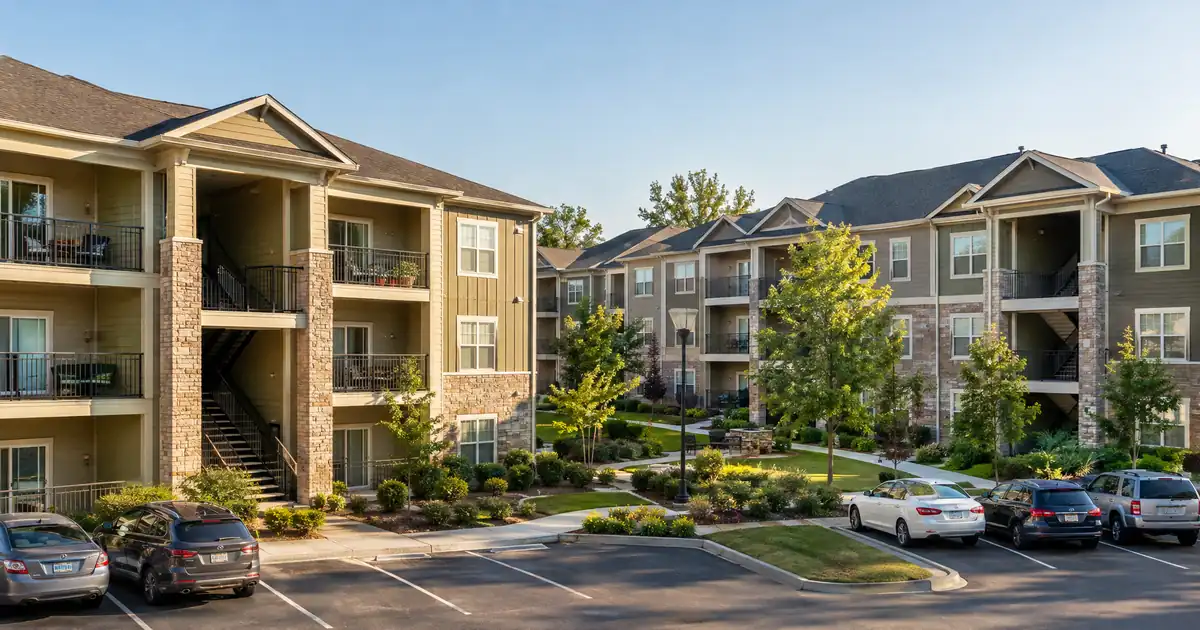
Apartment Investment Property Refinance Loan Financing — The Quick Read: Refinancing an apartment property splits into two different worlds. It depends on how many units the building has. A duplex, triplex, or fourplex refinances through residential-style DSCR or non-QM channels. It qualifies mainly on whether the rent covers the payment. A building with five or more units moves into commercial multifamily territory. This means HUD, agency, bank, or CMBS execution. Here, net operating income and debt yield replace a simple rent-to-payment ratio. Getting the lane wrong before shopping a refinance wastes time. You’ll end up with quotes that were never going to fit the property.
Key Takeaways
- Five units is the line. Below it, refinance through DSCR/non-QM. At or above it, the property is commercial multifamily.
- Rate-and-term and cash-out are treated differently. Cash-out refinances typically cap lower. They also carry seasoning expectations that rate-and-term deals don’t.
- DSCR of 1.00 is a floor, not a target. Select programs start there. Stronger coverage typically opens better leverage.
- Sub-1.00 and no-ratio paths exist through select lenders in the network. But they trade leverage or require specific borrower profiles. They aren’t the default path.
- Short-term rental income is documented differently than long-term rent. This applies on both the appraisal side and the qualifying-ratio side.
Which Lane Is Your Property In?
The unit count on the deed decides almost everything that happens next. It sets the appraisal type, the income documentation, and even which category of lender will look at the file. The U.S. Department of Housing and Urban Development defines its Section 207 mortgage insurance as covering detached, semidetached, row, walk-up, or elevator structures “with 5 or more units.” That same authority underpins HUD’s Section 223(f) program, the agency’s main tool for refinancing stabilized multifamily assets.
DSCR Calculator
Run the numbers in your market
Rate is an editable market assumption — the live benchmark loads when available.
Prefilled with local estimates — enter your own rent or nightly figures, taxes, insurance, and HOA for a more accurate picture.
Program parameters update from Lendmire’s centralized guideline source. Taxes and insurance are editable estimates.
Fallback assumption · General Freddie Mac market benchmark, not a Lendmire loan offer. Rent, nightly rate, occupancy, taxes, and insurance are editable estimates. Short-term rental figures are estimates only and vary significantly by season, property type, management approach, and local short-term-rental rules — confirm local regulations before relying on them. Qualifying income for short-term rentals varies by program — some use appraisal market rent, others use documented STR history or projections — and is confirmed in underwriting. Not a Loan Estimate, approval, or commitment to lend. Program availability and eligibility are subject to lender guidelines, credit approval, property review, and underwriting.
Anything under that five-unit line stays in the residential-style lane. That includes a single-family rental, duplex, triplex, or fourplex. These get financed through DSCR, non-QM, or conventional loans. Lenders document them with a comparable-rent appraisal instead of a full operating statement. Cross the five-unit line, and the property gets underwritten like a small commercial asset. Now trailing net operating income, expense ratios, and a debt-yield test drive the loan size. A simple rent-versus-payment calculation no longer applies.
This is the single most useful filter an apartment owner can apply before requesting a quote. A fourplex owner shopping a refinance and a 24-unit building owner shopping a refinance are not shopping for the same product. That’s true even though both might describe the deal the same way.
Key Terms Defined
DSCR (Debt Service Coverage Ratio): This is the ratio of gross rental income to the full monthly obligation. That obligation includes principal, interest, taxes, insurance, and HOA dues where they apply. A ratio above 1.00 means the rent covers the payment on paper.
NOI (Net Operating Income): This is rental income minus operating expenses, before debt service. It’s the figure that drives underwriting on 5+ unit commercial properties.
LTV (Loan-to-Value): This is the loan amount, shown as a percentage of the property’s appraised value. It sets the leverage ceiling on both purchases and refinances.
Rate-and-term refinance: This changes the loan’s structure or payoff without pulling cash out, beyond minor closing-cost adjustments.
Cash-out refinance: This pulls equity out of the property as loan proceeds. It’s typically capped at a lower LTV than a rate-and-term deal.
Seasoning: This is the minimum time you must own a property (or hold a prior loan) before a lender will consider it for a cash-out refinance.
No-ratio loan: This structure qualifies without measuring rent against the payment at all. It’s available only through select lenders, and it’s generally reserved for borrowers who already own a primary residence.
How Underwriting Actually Treats a 1-4 Unit Apartment Refinance
For properties under five units, the qualifying income comes from the same appraisal method conventional lenders have used for decades. This holds even though DSCR loans aren’t conventional products. Fannie Mae’s Selling Guide points to two forms for documenting market rent. Lenders use the Single-Family Comparable Rent Schedule (Form 1007) for one-unit properties. They use the Small Residential Income Property Appraisal Report (Form 1025) for two-to-four-unit properties. Most non-QM programs in the DSCR space mirror that same rent-schedule logic. They answer to their own overlays, not Fannie Mae’s — but the logic carries over.
Underwriting a DSCR refinance across the network generally runs through these steps:
1. Confirm the lane. Unit count, legal classification, and how the appraiser treats the property set the whole framework.
2. Order the appraisal. It establishes both value (for LTV) and the rent used for lender review, through the comparable-rent form.
3. Calculate the coverage ratio. Take gross rent and divide it by full PITIA. That’s the DSCR calculation the loan is qualified against.
4. Check credit and leverage tiers together. A 620 credit floor exists in parts of the network, but most programs want something closer to 660. A score of 700 or better typically unlocks the strongest leverage tiers.
5. Confirm reserves and seasoning. Reserve requirements vary by loan size and leverage. They commonly land around six months of PITIA. Conservative rate-and-term files at modest leverage under $1.5 million sometimes see reserves waived. Files above that size typically step up toward nine months.
A larger down payment (or, on a refinance, a smaller cash-out request) lowers the payment. It can also lift the DSCR. But it never overrides a credit floor, a leverage cap, or a property-type restriction. The strongest files clear both tests at once. They have enough equity and enough rental coverage.
DSCR loans are business-purpose products. They’re built for non-owner-occupied investment property. That’s why they get reviewed differently from a standard owner-occupied mortgage. It’s also why they generally fall outside TRID’s consumer-disclosure timeline. That’s a structural fact about the product, not a shortcut. Qualification still runs mainly on the property’s rental income covering the payment, subject to lender guidelines.
Rate-and-Term vs. Cash-Out: Two Different Leverage Ceilings
A rate-and-term refinance restructures the existing debt. A cash-out refinance pulls equity out as proceeds. The two get underwritten to different leverage ceilings. Across the network, cash-out refinances on 1-4 unit rental property generally top out around 75% LTV. Roughly six months of seasoning is the common expectation before a lender will even consider the file. Purchase transactions run more leverage. Most land at 75%-80% LTV, and select high-leverage programs reach 85% for borrowers with credit around 700 or better.
That gap matters if you’re planning a refinance strategy. Pulling maximum equity out of a property that’s appreciated is a very different conversation than simply restructuring an existing loan without taking cash out. The latter tends to have more room to work with on leverage and documentation.
| Factor | 1-4 Unit DSCR/Non-QM Refinance | 5+ Unit Commercial Refinance |
|---|---|---|
| Underwriting basis | Rent vs. full PITIA (DSCR) | NOI vs. debt service, debt yield |
| Appraisal type | Comparable-rent schedule | Income-capitalization / full NOI |
| Typical execution | Non-QM wholesale network | Bank, agency, HUD, or CMBS |
| Cash-out ceiling | Around 75% LTV, typical | Varies widely by program and stabilization |
Structures and Variations Worth Knowing
The 30-year fixed structure is the backbone of most DSCR refinance files. But it’s far from the only strong option out there. Extended-term structures (40-year amortization) and interest-only periods are available through select lenders in the network. Adjustable-rate structures also exist, for investors who specifically want them over a fixed payment.
Coverage below 1.00 is a real path, not a dead end. It’s available through select lenders in the network, with leverage and terms adjusted to offset the weaker ratio. No-ratio qualification is real too, but it’s narrower. It isn’t a blanket option open to any file.
Short-term rental refinances follow their own set of numbers. They don’t just borrow the long-term rent framework wholesale. Purchase transactions on STR properties top out around 75% LTV. Refinance and cash-out transactions on STR-generating property generally run closer to 70%. Expect credit floors starting around 640, and roughly 12 months of hosting history or an accepted market data report. The coverage floor sits at 1.00 on both the purchase and refinance side. Nightly-rate income also can’t just get multiplied by 30 to produce a monthly rent figure for appraisal purposes. Fannie Mae’s own appraiser guidance is clear on this: doing so ignores furnishings, services, vacancy, and business expenses baked into short-term rental economics. Most DSCR programs instead build separate income models — platform history or projected revenue — instead of forcing STR income through the standard rent-schedule form.
Investors sitting on paid-off or low-leverage rental portfolios sometimes look at a HELOC instead of a full refinance. Investment-property HELOC lines cap at $500,000 total across the network. There’s no larger tier above that. So an investor pulling significant equity out of a higher-value apartment property will generally end up back in cash-out refinance territory instead of a HELOC. For a deeper look at that comparison, Lendmire’s investment property refinance guide walks through when each structure fits.
Where the General Rule Breaks — Edge Cases
The 5-8 unit gray zone. A group of small-balance lenders exists specifically to serve buildings just above the four-unit line. These buildings are too small for efficient agency or CMBS execution, but too big for standard residential programs. These deals tend to price and underwrite more like small commercial loans than residential DSCR, even when marketed with DSCR language. An owner in this range should expect a genuinely different process than a fourplex refinance.
Mixed-use and legal-unit ambiguity. Whether a building counts as residential or commercial can hinge on legal unit count. It also depends on how much square footage is commercial versus residential — not just the number of doors on the building. A property that looks like a fourplex on paper but includes commercial space needs its classification confirmed first. Don’t assume standard DSCR treatment applies until that’s settled.
Entity and seasoning stacking. LLC-titled properties are common in this market, subject to program guidelines. But title in an entity doesn’t override the seasoning clock on a cash-out refinance. The roughly six-month expectation still generally applies, no matter how the property is titled.
State overlays. A handful of states carry their own leverage caps. Purchases in Connecticut, Florida, Illinois, and New Jersey generally cap near 75% LTV, even where other states might allow more. Overlay-state transactions overall tend to cap around $2 million in loan amount.
Property types that simply aren’t offered. Manufactured homes (both single- and double-wide), log homes, and barndominiums fall outside the network’s DSCR programs entirely. They’re not harder to finance — they’re just not offered.
A Worked Example (Ratios, Not Dollar Payments)
Consider a fourplex refinance where the appraisal comes in at $600,000. At a 75% cash-out LTV ceiling, the maximum loan amount is a percentage of that appraised value. The specific dollar figure depends on the file’s PITIA, closing costs, and existing balance, rather than a number quoted here. What decides the outcome is whether the resulting loan clears the coverage floor. Take gross rent, divide it by the new full PITIA, and see where it lands. A result around 1.05x to 1.15x sits in typical territory for standard programs. If that math comes in under 1.00, the conversation shifts. It moves toward a sub-1.00 structure with adjusted leverage, or toward reducing the requested cash-out amount to bring the ratio back up. Terms vary by lender guidelines, property type, leverage, credit profile, and full file review.
The stronger the DSCR, the more pricing and leverage flexibility tends to open up. But clearing 1.00 is not the same as positive cash flow. Repairs, vacancy, property management, utilities, and capital expenditures all sit outside the DSCR formula. A file that clears 1.05x on paper can still run tight once you factor those costs in separately.
Documentation an Apartment Refinance Typically Requires
- Current rent roll or lease documentation for each unit
- Recent mortgage statement showing existing balance and payment history
- Property tax and insurance information
- Entity documents if the property is titled in an LLC, subject to program guidelines
- A recent appraisal or willingness to order one as part of the transaction
- Reserve documentation (bank or brokerage statements) covering the applicable months of PITIA
What the Decision Looks Like in Practice
An investor scaling from a fourplex into a small apartment building shouldn’t expect a bigger version of the same DSCR loan. It’s a different transaction, with a different appraisal product and a different income analysis. That’s the single biggest planning mistake apartment owners make. They assume “apartment refinance” is one product with one set of rules — it isn’t.
The broader non-QM market has grown enough that this is no longer a niche corner of lending. DSCR and other investor products now make up roughly half of all non-QM collateral. Industry forecasts point toward continued growth in overall non-QM origination volume heading into next year. That kind of institutional interest has historically pushed lenders toward more product variety. Think interest-only options, entity-vesting flexibility, and varied structures, as lenders compete for volume. But every DSCR program sets its own overlays. So the same property can qualify very differently, depending on which lender’s grid it’s measured against. That’s the practical argument for shopping a file across a wholesale panel, rather than relying on a single lender’s page. This matters most on cash-out refinances, where leverage caps and seasoning windows vary the most between programs. For a full walkthrough of how the coverage ratio itself is built and applied, Lendmire’s complete DSCR loans guide covers the underlying mechanics in more depth. The apartment refinance financing overview breaks down program fit by property type.
Frequently Asked Questions
Can a five-unit or larger apartment building refinance through a DSCR loan?
Generally, no. Five or more units moves the property into commercial multifamily underwriting (bank, agency, HUD, or CMBS). There, net operating income and debt yield replace the standard DSCR calculation. Standard residential DSCR programs are built around 1-4 unit properties.
What credit score does a cash-out refinance on a rental property typically need?
A 620 floor exists in parts of the network, but most programs want something closer to 660. Scores of 700 or better typically unlock the strongest available leverage. Exact thresholds vary by lender, loan size, and property type.
Does a free-and-clear property refinance any differently?
Not owing money on the property doesn’t change the coverage math or the leverage ceiling. A cash-out refinance on a paid-off property still generally caps around 75% LTV. It’s measured against the same DSCR floor as a property with an existing mortgage.
What happens if the rent doesn’t cover the new payment?
Coverage below 1.00 is available through select lenders in the network. It typically comes with adjusted leverage or terms to offset the weaker ratio. The alternative is reducing the requested loan amount or cash-out proceeds, until the ratio clears a more typical range.
Can an LLC-titled apartment property refinance through this process?
Yes, subject to program guidelines. Entity ownership is common on DSCR files. But it doesn’t override seasoning requirements or reserve expectations. Those apply based on the transaction type and loan size, no matter how title is held.
About Lendmire
Lendmire (NMLS# 2371349) is a mortgage broker, not a lender. It arranges DSCR investor loans through select lenders across a wholesale network spanning 40 states plus Washington, D.C. — 41 markets total. Investors comparing refinance paths on a fourplex, triplex, or small apartment building can reach Lendmire at 828-256-2183. You can also request a quote to see how a specific property’s rent, credit profile, and leverage target line up against current program guidelines. Tax treatment of refinance proceeds can depend on how the funds are used and how the property is held. Investors should keep clear records and speak with a qualified tax professional before relying on any deduction. Scotsman Guide named Lendmire a Top Mortgage Workplace in both 2025 and 2026.
Loan approval is never guaranteed, and nothing here is a commitment to lend. Every scenario described here is general information, subject to lender approval and to the borrower’s, property’s, and program’s specific guidelines at the time of application. This article is for general informational purposes only and does not count as financial, legal, or tax advice.
Get Started
Ready to find the right loan for you?
In about 30 seconds you can review financing options available for your home or investment property. No commitment required.
Informational only. Not a Loan Estimate, approval, or commitment to lend. Program availability and eligibility are subject to lender guidelines, credit approval, property review, and underwriting.
References
1. HUD.gov — Descriptions of Multifamily Programs
2. Fannie Mae Selling Guide — Rental Income (B3-3.1-08)
This article is part of Lendmire’s DSCR loan program — full qualification details, guidelines, and scenarios live on the program page.
Related reading: Apartment Investment Property Refinance Mortgage · Multifamily Debt Refinance · Multifamily Cash Out Refinance
Brandon Miller
Founder & CEO, Mortgage Loan Originator, Lendmire LLC
- Mortgage Loan Originator · NMLS# 1129696 · Verify on NMLS Consumer Access
- North Carolina Real Estate Broker · License# 343312 · Verify on NCREC
- North Carolina Insurance Producer · License# 19053198 · Property, Casualty, Life, Health · Verify on NAIC SBS
- Lendmire LLC · Firm NMLS# 2371349 · Verify firm licensure
Compliance and disclosures. Lendmire (NMLS# 2371349) is a licensed mortgage broker and is not a direct lender, depository institution, financial advisor, or tax professional. Content in this article is general market analysis and educational information — not financial, legal, or tax advice for any specific situation. Lendmire does not guarantee loan approval; every transaction is subject to underwriting by the funding lender. Mortgage pricing and loan program guidelines are subject to change at any time without notice and vary by borrower characteristics, property type, and state regulations. Lendmire complies with Equal Housing Opportunity. Licensure verification: NMLS Consumer Access.