
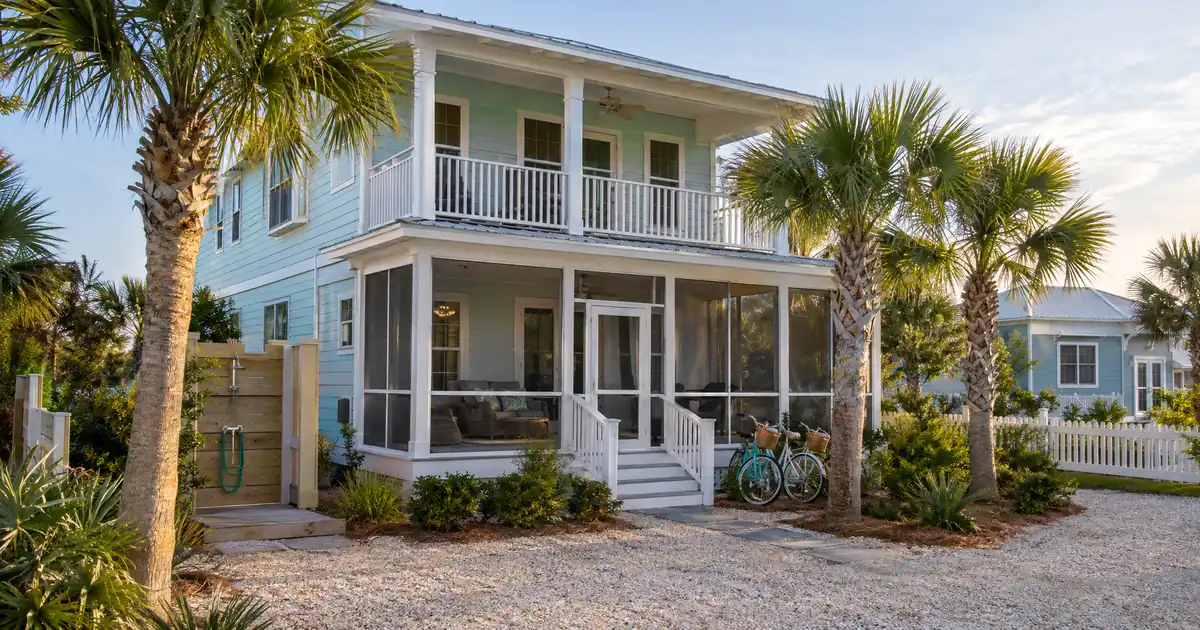
The Quick Read: Yes, but only if the property stops being a second home and is refinanced as a non-owner-occupied short-term rental, because a DSCR loan is an investment-property product that qualifies primarily on property-level rental income covering the payment, subject to lender guidelines. The cash-out pays off the old second-home mortgage, and what’s left is yours to deploy.
- Occupancy flips from second home to investment property at the refinance.
- Short-term-rental cash-out typically tops out at 70% LTV, with a 640 credit floor on most files.
- Lenders usually expect about 12 months of hosting history.
- Coverage is tested on the new, larger payment, so the DSCR often binds before equity does.
Here is how the conversion works, where it goes wrong, and when keeping the second home as it is makes more sense.
DSCR Cash-Out Calculator
Run the cash-out numbers in your market
Rate source: Freddie Mac 30-yr average via FRED® — Federal Reserve Bank of St. Louis · effective Oct 8, 2026
Prefilled with starting assumptions — enter your property’s value, balance, taxes, and insurance for a more accurate picture.
Program parameters update from Lendmire’s centralized guideline source. Taxes and insurance are editable estimates.
As of Oct 8, 2026 · General Freddie Mac market benchmark, not a Lendmire loan offer. Property value, balance, taxes, and insurance are editable estimates. Maximum loan-to-value varies by lender, program, property type, and seasoning. Not a Loan Estimate, approval, or commitment to lend. Program availability and eligibility are subject to lender guidelines, credit approval, property review, and underwriting.
Why a Second Home Doesn’t Qualify As-Is
A second home and a DSCR rental are opposite categories. A second home is a property you use yourself for part of the year, and the lender reviews your file on your income. A DSCR loan ignores your personal income and qualifies the property on its rent. You can’t be both borrower-occupant and rental landlord on the same file.
The agency definition makes the conflict plain. Fannie Mae’s Selling Guide describes a second home as a one-unit property the borrower occupies part of the year, with exclusive control, and not a rental. Even when rent exists, it can’t be used to qualify. That is a contrast, not a rule for DSCR files. It simply shows why a rent-based loan can’t sit on a second-home label.
DSCR loans are designed for non-owner-occupied investment properties. Because they are business-purpose investor loans, they are reviewed differently from a standard owner-occupied mortgage. Under Regulation Z’s commentary, a borrower who expects to occupy the home more than 14 days in the coming year can’t treat it as a clean non-owner-occupied rental. Programs in the network can be stricter than that. So the first question isn’t “what’s my DSCR?” It’s “am I really willing to run this as a rental?”
How the Conversion Works, Step by Step
The conversion happens at the refinance, not before. The borrower re-declares occupancy, documents the short-term-rental income, passes the coverage test on the new loan, and the proceeds pay off the second-home mortgage. Each step has its own failure point.
1. Re-declare occupancy. You sign a business-purpose and occupancy certification stating the property is non-owner-occupied. Misstating occupancy is a serious problem: it can put the loan at risk and expose the borrower legally. Don’t call it a second home to get friendlier terms.
2. Document the Airbnb income. For a refinance, programs typically want about 12 months of hosting history, shown through platform payout statements and bank deposits.
3. Order the appraisal. The appraiser sets value and supplies a rent schedule on Form 1007. That schedule is a long-term market rent, which often runs well below what a busy Airbnb earns.
4. Test coverage. Rent divided by PITIA (principal, interest, taxes, insurance, and any HOA dues) on the new, larger payment. For short-term rentals the refinance floor is 1.00 on the programs described here.
5. Pay off and vest. The new lender pays off the existing second-home loan. Many programs allow vesting in an LLC, subject to program terms, though individual title is also common.
Across a wholesale network, lenders treat short-term income differently. Some use trailing platform history, some use a data-service projection with an expense haircut, and some fall back to the 1007 long-term rent. The lender you’re matched with changes the income number more than almost any other variable, which is why file placement matters as much as the property.
What If You Have No Airbnb History?
A second home often has thin hosting history because the owner used it personally. That is the most common snag. Programs in the network typically look for about 12 months of landlord or host experience on short-term-rental files, so a property that’s only been lightly rented may not clear it.
Your options are roughly these:
| Income path | How it works | Tradeoff |
|---|---|---|
| Trailing history | Platform payouts and deposits | Strongest evidence, needs a track record |
| Projection | Data-service estimate, expense factor applied | Fewer lenders accept it |
| Long-term rent | Appraiser’s 1007 schedule | Widely accepted, often far lower |
If the history is short, running a season or two as a true rental before refinancing is usually cleaner than forcing a thin file. If you’d rather not wait, the long-term-rent path may still produce a workable number, particularly if the property would rent well on a standard lease. Whether any given path works depends on the lender, the property, and the appraisal.
Short-term rental rules can vary by city, county, HOA, and property type, so investors should confirm local rules before relying on projected rental income.
Equity Versus Coverage: Which Limit Binds First?
On most second-home cash-outs, coverage binds before equity does. Short-term-rental cash-out leverage is capped at 70% LTV on the programs described here, while standard long-term rentals reach 75%. But pulling cash raises the payment, and a bigger payment compresses the coverage ratio.
Picture an owner whose second home has 50% equity and strong Airbnb income. Leverage alone would permit a sizable cash-out. But if the new payment pushes coverage under 1.00, the loan size shrinks until the number clears. The same owner with softer income might find the DSCR test, not the LTV cap, sets the ceiling. A cash-out is limited by the lower of the two.
A few program ranges worth knowing, all subject to lender guidelines and varying by borrower and property:
| Factor | Short-term rental |
|---|---|
| Purchase LTV | Up to 75% |
| Cash-out / refinance LTV | Up to 70% |
| Minimum credit score | 640 |
| Coverage floor | 1.00 purchase, 1.00 refinance |
| Loan size | Up to $3,000,000 standard |
Stronger credit and stronger coverage generally open better pricing and leverage. Reserves vary by lender, leverage, and loan size, and are commonly around six months of PITIA on cash-out files. Loans above $2,500,000 generally stay in 30-year fixed structures, while extended terms and interest-only periods are available through select lenders.
Remember what the ratio does and doesn’t measure. DSCR compares rent to PITIA only. Clearing 1.00 is not the same as positive cash flow, because repairs, vacancy, management, utilities, and capex sit outside the calculation. Short-term rentals carry more of those costs than long-term ones, so a thin 1.00 on Airbnb income deserves a real stress test.
Many select programs start at 1.00, and some owners will ask about going lower. Coverage below 1.00 sits on a separate path through select lenders in the network, where leverage and terms are adjusted to match.
What Happens to Your Current Second-Home Loan?
The refinance replaces it. Your existing second-home mortgage is paid off at closing from the new loan, and the cash-out is what remains after payoff and costs. That’s simple on paper and expensive if you’re giving up favorable terms to get there.
Two things deserve attention. First, DSCR loans commonly carry a prepayment penalty, often structured over several years and sometimes reducible at added cost. If you plan to sell or refinance again soon, that penalty can erase the benefit. Second, if your current loan has terms you like, replacing it may not be the smartest move. A second lien or line of credit can leave the first mortgage untouched, though investment-property lines cap at $500,000 total, and a line on a second home sits under its own lender’s rules.
The investor profile decides this:
- You want to scale a portfolio. If you’re adding properties, you’ll eventually outgrow agency financing caps, and a DSCR file keeps working when personal debt-to-income would stall. Replacement usually makes sense.
- You want a modest amount of cash and love your current terms. A second lien may serve you better.
- You plan to sell within a few years. The prepayment penalty argues against it.
Common Mistakes on This Conversion
Most failed second-home conversions fail for the same few reasons. Avoiding them is half the work.
- Keeping personal use alive. Planning to stay there for weeks each year conflicts with non-owner-occupied business-purpose treatment. Choose a lane.
- Assuming the 1007 captures Airbnb income. It’s a long-term rent survey. Don’t build your cash-out math on it unless that’s the path you’ve chosen.
- Assuming every lender uses short-term projections. Only some do, and the differences between lenders are large.
- Ignoring local rules. Permits, zoning, and HOA restrictions can make the rental income unusable if the short-term use isn’t allowed.
- Skipping the insurance change. A second-home policy often doesn’t match rental or short-term-rental use, so coverage needs updating.
- Misusing the proceeds. Cash-out on a business-purpose loan should go to business purposes, such as the next rental or improvements.
Tax treatment can depend on how the funds are used and how the property is held; investors should keep clear records and speak with a qualified tax professional before relying on any deduction.
DSCR vs. conventional financing
There are two common ways to finance an investment property, and they qualify you differently — here’s how investors weigh them.
Why investors choose it
- Qualifies on the property’s rental income — no personal tax returns, W-2s, or pay stubs needed to document income.
- No personal debt-to-income ceiling to clear, so existing mortgages and obligations don’t cap your borrowing the same way.
- Can be closed in an LLC, keeping the property inside a business entity.
- Built for scaling — not held to the limit on number of financed properties that conventional financing applies.
- Underwriting centers on the deal: generally qualifies when the rent covers the payment, a 1.00x coverage ratio being a common baseline (confirmed in underwriting).
- Designed specifically for investment property, including long-term and, where the program allows, short-term rentals.
Where it’s strong
- Often the lowest ongoing financing cost for a buyer who fully qualifies on personal income — a fit for a first property or a cost-first purchase.
Trade-offs for investors
- Requires full personal income documentation and must fit within a debt-to-income limit — salary, existing debts, and other mortgages all count.
- Typically held in your personal name rather than a business entity.
- Caps how many financed properties you can carry, which can become a ceiling as a portfolio grows.
- Evaluates you as a borrower as much as the property, which usually means more paperwork.
How investors usually choose: a first or single property often optimizes for the lowest financing cost; portfolio builders often optimize for leverage, vesting in an LLC, and scaling past conventional caps. The right answer depends on your goals, the property, and current guidelines — both paths run through select lenders in Lendmire’s wholesale network, with eligibility and terms confirmed in underwriting.
Key Terms Defined
Second home: A property you occupy part of the year for personal use, financed on your own income.
Investment property: A property held primarily to earn rent, with no owner occupancy.
DSCR: Rent divided by the full monthly obligation (PITIA); the ratio the lender tests coverage with.
PITIA: Principal, interest, taxes, insurance, and any HOA dues.
Seasoning: How long you’ve held title or operated the property before a cash-out.
Form 1007: The appraiser’s rent schedule, usually a long-term market rent.
Should You Convert, or Leave the Second Home Alone?
Convert if the property already behaves like a rental and you want the cash for the next one. Leave it if you still use it heavily yourself, have no hosting record, or hold a loan you’d hate to lose.
If the property is a true lifestyle home that happens to rent a few weeks a year, converting forces you to give up personal use, accept investor-grade pricing, and likely wait for history. That’s a poor trade for most people in that spot. A bank-statement option can sometimes finance a genuine second home on documented income, which keeps the property a second home without forcing the rental conversion. Lendmire covers that route in Does a Second Home Qualify for a Bank Statement Cash-Out Refinance?.
On the other hand, if you’ve been hosting for a year, the numbers clear, and you want to redeploy equity, conversion is straightforward. The strongest files clear both tests: enough equity and enough rental coverage.
If the numbers don’t clear, the usual adjustments are a smaller cash-out, a rate-and-term refinance, more seasoning, or a different property type. The complete DSCR loans guide covers how the other levers fit together.
If you are buying or refinancing a rental property and want to see how the numbers work, Lendmire can help you compare DSCR loan options based on the property income, credit profile, leverage, and investor goals. Review details remain subject to lender guidelines, and none of this is a commitment to lend.
Frequently Asked Questions
Can I keep using my second home if I take a DSCR loan on it?
Not in any meaningful way. DSCR loans are non-owner-occupied investment products, and expecting to stay more than 14 days a year conflicts with the federal business-purpose occupancy test. Programs in the network can be stricter still. If personal use is central to why you own the place, this loan isn’t the right fit.
Does the appraiser’s rent schedule count my Airbnb income?
Usually not. The Form 1007 reflects long-term market rent, which often sits well below actual short-term income. Some lenders instead use trailing platform history or a data-service projection. Which one is accepted depends on the lender your file is placed with.
What leverage and credit score apply to a short-term-rental cash-out?
Typically up to 70% LTV on a short-term-rental cash-out, with a minimum score around 640 on most files. Stronger credit generally improves leverage and pricing. Everything is subject to lender guidelines, property review, and individual underwriting.
Do I need hosting history to refinance?
On most files, yes, about 12 months. Without it, the file may rely on a projection or the long-term rent schedule if the program allows it, usually with less favorable sizing. Building a season or two of real history first often produces a cleaner result.
Is the cash-out limited by equity or by coverage?
Often by coverage. A larger loan means a larger payment, which lowers the ratio. The binding limit is whichever is lower, the LTV cap or the loan size at which coverage still clears the program’s floor.
Investors focused on short-term rentals can review DSCR loans for Airbnb and short-term rentals.
For the mechanics of pulling equity out of a rental property, see Lendmire’s guide to cash-out refinance on an investment property.
About Lendmire
Lendmire — NMLS# 2371349 — is a mortgage brokerage specializing in DSCR investor loans, helping arrange financing across 41 markets, including Washington, D.C., through wholesale and investor-lending channels. The model centers on property-level rental income reviewed by the lender rather than W-2 documentation, subject to lender guidelines, suiting entity-owned and multi-property investors. Lendmire holds Scotsman Guide Top Mortgage Workplace recognition for 2025 and 2026.
Get Started
Ready to find the right loan for you?
In about 30 seconds you can review financing options available for your investment property. No commitment required.
Informational only. Not a Loan Estimate, approval, or commitment to lend. Program availability and eligibility are subject to lender guidelines, credit approval, property review, and underwriting.
References
1. Fannie Mae Selling Guide, Occupancy Types (B2-1.1-01)
2. CFPB, Regulation Z Official Interpretations for 1026.3
This article is part of Lendmire’s investment property cash-out refinance program — full qualification details, guidelines, and scenarios live on the program page.
Related reading: How to Move an Airbnb Off a Second-Home Mortgage Into a DSCR Cash-Out · Buying An Airbnb As Your First Investment Property · DSCR Cash-out Refinance For Airbnb Properties Explained
Brandon Miller
Founder & CEO, Mortgage Loan Originator, Lendmire LLC
- Mortgage Loan Originator · NMLS# 1129696 · Verify on NMLS Consumer Access
- North Carolina Real Estate Broker · License# 343312 · Verify on NCREC
- North Carolina Insurance Producer · License# 19053198 · Property, Casualty, Life, Health · Verify on NAIC SBS
- Lendmire LLC · Firm NMLS# 2371349 · Verify firm licensure
Compliance and disclosures. Lendmire (NMLS# 2371349) is a licensed mortgage broker and is not a direct lender, depository institution, financial advisor, or tax professional. Content in this article is general market analysis and educational information — not financial, legal, or tax advice for any specific situation. Lendmire does not guarantee loan approval; every transaction is subject to underwriting by the funding lender. Mortgage pricing and loan program guidelines are subject to change at any time without notice and vary by borrower characteristics, property type, and state regulations. Lendmire complies with Equal Housing Opportunity. Licensure verification: NMLS Consumer Access.