
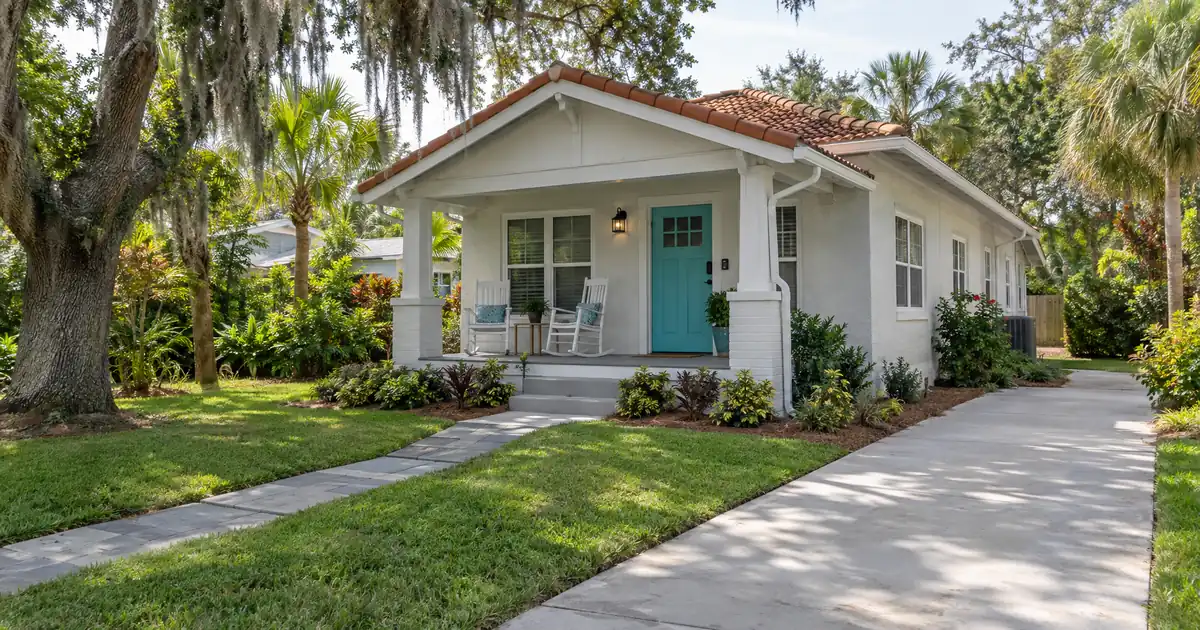
The Quick Read: A suburban Florida Airbnb is reviewed on a DSCR loan when its documented rental income covers the full monthly obligation, the home can legally operate as a short-term rental, and the borrower clears the credit and leverage tests. The file is built on property income, not personal income, subject to lender guidelines.
- Short-term rental purchases typically reach up to 75% LTV on the strongest files, and refinances and cash-outs up to 70%.
- Expect a 640 minimum score and about 12 months of host or landlord experience.
- Coverage starts at 1.00 on both purchases and refinances.
- Legal use is a gate. An HOA ban or an older local ordinance can end a deal no matter what the ratio says.
- Run the numbers on both short-term and long-term rent before making an offer.
Florida suburbs are a different underwriting problem than a beachfront condo or a resort-corridor villa. Comparable listings are thinner, seasonality is harder to read, and private covenants matter more than city hall. This piece walks through how a file gets built, step by step. For the broader program picture, see the complete DSCR loans guide.
Short-Term Rental Calculator
Run the STR numbers in Florida
Rate source: Freddie Mac 30-yr average via FRED® — Federal Reserve Bank of St. Louis · effective Oct 15, 2026
Prefilled with starting assumptions — enter your nightly rate, occupancy, taxes, and insurance for a more accurate picture.
Short-term rental income is documented with a 12-month history or a market data report. Program parameters update from Lendmire’s centralized guideline source.
As of Oct 15, 2026 · General Freddie Mac market benchmark, not a Lendmire loan offer. Nightly rate, occupancy, taxes, and insurance are editable estimates. Qualifying income for short-term rentals varies by program — some use appraisal market rent, others use documented STR history or projections — and is confirmed in underwriting. Not a Loan Estimate, approval, or commitment to lend. Program availability and eligibility are subject to lender guidelines, credit approval, property review, and underwriting.
What Does a DSCR Loan Actually Measure on an Airbnb?
It measures one thing: whether the property’s qualifying income covers its monthly obligation. That obligation is PITIA, meaning principal, interest, taxes, insurance, and any HOA dues. Divide qualifying monthly income by PITIA and you have the coverage number.
DSCR loans are designed for non-owner-occupied investment properties. Because they are business-purpose investor loans, they are reviewed differently from a standard owner-occupied mortgage. The file qualifies primarily on property-level rental income covering the payment, subject to lender guidelines.
Credit, reserves, and property eligibility still matter. Clearing 1.00 also does not mean the property cash flows. Repairs, vacancy, management, utilities, and capex all sit outside the formula.
Key Terms Defined
PITIA: Principal, interest, taxes, insurance, and HOA dues, the monthly obligation that sits under the ratio.
TTM income: Trailing-twelve-month booking income, the actual history of an operating rental.
Qualifying income: The income figure a lender accepts for the ratio, which is often lower than gross bookings.
Market projection: An analytics report that estimates a home’s likely short-term revenue from comparable listings.
Rent schedule: The appraiser’s estimate of market rent for the property, which serves as the long-term rent fallback when short-term income can’t be documented.
How Does Underwriting Treat the Income, Step by Step?
Underwriting follows a fixed order. The legal check comes first, then the income method, then any expense adjustment, then the ratio, then the rest of the file.
1. Confirm legal short-term rental use. Nothing else matters if the home can’t operate lawfully.
2. Pick the income method. An operating rental uses about 12 months of platform or deposit history. A purchase without history uses a projection or an appraiser’s analysis.
3. Apply the program’s expense factor. Gross bookings are rarely taken at face value. Many programs reduce gross income, and the haircut varies by lender.
4. Divide by PITIA. The result is the coverage ratio.
5. Clear the other file items. Those are the appraisal, title, insurance, entity documents, credit, and reserves.
Across the wholesale network, most programs want to see 1.00 or better on short-term rental files. Stronger ratios tend to open better pricing and leverage, subject to lender guidelines.
How Do You Prove Income on a Suburban Short-Term Rental?
There are three routes, and the right one depends on whether the home already has a booking record.
| Situation | Typical income evidence | Watch for |
|---|---|---|
| Operating Airbnb, refinance | About 12 months of platform or bank deposits | Gaps in the record |
| Purchase, no history | Market projection or appraiser STR analysis | Thin suburban comps |
| Purchase, weak projection | Long-term market rent from the appraisal | Lower qualifying income |
Actual history is the strongest evidence when it exists. A refinance of an operating rental generally needs those records, and holes in them can push the file back to long-term rent.
Purchases are harder in the suburbs. A projection is only as good as its comparable listings, and a quiet residential street may have few true comps. A report built on three or four loosely similar homes deserves less trust than one built on a dense resort corridor.
Is the Home Legal to Operate as an Airbnb?
Legality is a separate question from financing, and underwriters expect it answered. Short-term rental rules can vary by city, county, HOA, and property type, so investors should confirm local rules before relying on projected rental income.
Three layers matter in Florida:
- State licensing. The Florida DBPR licenses vacation rentals. Its guide notes that renting a single room rather than the whole unit is not a public lodging needing that license, and that local rules may still apply.
- State preemption. Per STR Law Map, state law bars local governments from banning vacation rentals or regulating their duration or frequency. That bar does not reach ordinances adopted on or before June 1, 2011. A suburb with an older rule can still enforce it.
- Private covenants. HOAs and deed restrictions sit outside state preemption entirely. In suburban neighborhoods they are the most common blocker.
Headlines have confused this topic. The Florida Phoenix reported that SB 280 passed both chambers, with a 60–51 House vote, before the governor vetoed it in late June 2024. The state did not take over short-term rental regulation. The veto left the existing framework in place, so local rules still matter.
Ask for the HOA documents before you offer. A minimum-stay rule or rental cap found after contract is an expensive discovery.
What Does the Payment Side Do to a Florida Suburban File?
It can swing the ratio more than the income does. Insurance and taxes sit in the denominator, and so do HOA dues. A suburban home with a modest HOA and a heavy insurance line can lose real coverage before a single booking is counted.
Get a fresh insurance quote before the file goes to a lender. A figure that worked months ago may not work now. Taxes can also reset after a sale, so model the post-purchase bill instead of the seller’s.
Insurance conditions in Florida suburbs shift often, and no single number fits every county. Stress-test the ratio with a higher insurance line and see whether it still clears.
Worked Example: Same House, Two Income Methods
Picture a three-bedroom suburban pool home listed in a planned community.
On the projection, after the program’s expense factor, the file clears roughly 1.15x. On long-term rent, the same house lands in borderline-to-slightly-below-1.00 territory. This example is illustrative, not market data.
The takeaway is practical. If only the short-term number works, the file depends on a projection in a market with thin comps. A sub-1.00 result isn’t a dead end. Select lenders in the network offer coverage below 1.00, with leverage and terms adjusted. A larger down payment can also lift the ratio by lowering the monthly obligation.
Now raise the insurance line meaningfully. The projection case may slip toward 1.00. A file that passes only at today’s quote is fragile.
DSCR files in markets with scattered suburban comps often come in with tight coverage on conservative assumptions. The stronger files usually run both income methods and the insurance sensitivity before an offer goes in, not after.
What Else Does the File Need?
Income is one test. Equity and credit are the other.
- Leverage: Up to 75% LTV on a short-term rental purchase, and up to 70% on a short-term rental refinance or cash-out, on the strongest files.
- Credit: A 640 minimum for short-term rental files. Stronger scores generally improve options.
- Experience: About 12 months of landlord or host experience is usually expected.
- Reserves: These vary by lender, leverage, loan size, and transaction type. Around 6 months of PITIA is common, and larger loans typically step up.
- Loan size: Up to $3,000,000 on standard programs. Smaller balances route through select lenders in the network.
- Entity: Closing in an LLC is common, subject to program terms.
Property type matters too. Manufactured homes, log homes, and barndominiums are not offered in these DSCR programs. Condos, townhomes, and 2–4 unit properties vary by program for short-term use.
DSCR vs. conventional financing
There are two common ways to finance an investment property, and they qualify you differently — here’s how investors weigh them.
Why investors choose it
- Qualifies on the property’s rental income — no personal tax returns, W-2s, or pay stubs needed to document income.
- No personal debt-to-income ceiling to clear, so existing mortgages and obligations don’t cap your borrowing the same way.
- Can be closed in an LLC, keeping the property inside a business entity.
- Built for scaling — not held to the limit on number of financed properties that conventional financing applies.
- Underwriting centers on the deal: generally qualifies when the rent covers the payment, a 1.00x coverage ratio being a common baseline (confirmed in underwriting).
- Designed specifically for investment property, including long-term and, where the program allows, short-term rentals.
Where it’s strong
- Often the lowest ongoing financing cost for a buyer who fully qualifies on personal income — a fit for a first property or a cost-first purchase.
Trade-offs for investors
- Requires full personal income documentation and must fit within a debt-to-income limit — salary, existing debts, and other mortgages all count.
- Typically held in your personal name rather than a business entity.
- Caps how many financed properties you can carry, which can become a ceiling as a portfolio grows.
- Evaluates you as a borrower as much as the property, which usually means more paperwork.
How investors usually choose: a first or single property often optimizes for the lowest financing cost; portfolio builders often optimize for leverage, vesting in an LLC, and scaling past conventional caps. The right answer depends on your goals, the property, and current guidelines — both paths run through select lenders in Lendmire’s wholesale network, with eligibility and terms confirmed in underwriting.
What If the Ratio Misses?
A miss usually has a fix. The levers, in rough order of use:
1. Put more down, which lowers the monthly obligation and can lift the ratio.
2. Shop insurance, since that line is often the most movable.
3. Compare the long-term rent route against the short-term one.
4. Move to a select-lender path with coverage below 1.00, with leverage and terms adjusted.
5. Pick a different property or a different submarket.
If the investor reaches for sub-1.00 only because nothing pencils anywhere, the problem is the target market, not the loan type. Equity alone won’t fix it either. A larger down payment never erases credit floors, reserve rules, or leverage caps. The strongest files clear both tests: enough equity and enough coverage.
Pre-Offer Checklist
1. Read the HOA and deed restrictions for rental terms and minimum stays.
2. Check city and county registration and zoning.
3. Confirm the state license path and sales tax registration.
4. Order a projection report, and note how many true comps it uses.
5. Get an insurance quote and the HOA dues in writing.
6. Run the ratio on both income methods.
7. Gather booking records if the home already operates.
8. Confirm credit, reserves, and entity documents.
Tax treatment can depend on how the funds are used and how the property is held. Investors should keep clear records and speak with a qualified tax professional before relying on any deduction.
If you are buying or refinancing a rental property and want to see how the numbers work, Lendmire can help you compare DSCR loan options based on the property income, credit profile, leverage, and investor goals. Reach the team at 828-256-2183 or request a quote.
Frequently Asked Questions
Can I use a DSCR loan on an Airbnb with no booking history?
Often yes, on a purchase. The file typically relies on a market projection, an appraiser’s short-term rental analysis, or long-term market rent as a fallback. A refinance of an operating rental generally needs about 12 months of records. Eligibility depends on the lender, the property, and the borrower.
Does a Florida vacation rental license mean I’m allowed to host?
No. The license is one layer. Local registration, zoning, and HOA rules apply separately, and the state’s own application materials tell applicants to check city and county requirements. An HOA ban can stop the rental even with a license in hand.
Why would a suburb still ban short-term rentals if Florida limits local bans?
The state limit does not reach local ordinances adopted on or before June 1, 2011. Those older rules remain enforceable. HOAs and deed restrictions are private and are not covered by the state limit at all.
What leverage can I expect on a suburban Florida short-term rental?
Purchases typically reach up to 75% LTV on the strongest files, and refinances and cash-outs up to 70%. Credit of 640 or higher is the usual floor. All figures are subject to lender guidelines and individual underwriting.
Does clearing 1.00 mean the Airbnb will cash flow?
No. The ratio compares qualifying income to PITIA only. Vacancy, repairs, utilities, management, and capital expenses fall outside it, so budget for them separately.
Investors focused on short-term rentals can review DSCR loans for Airbnb and short-term rentals.
About Lendmire
Lendmire (NMLS# 2371349) is a mortgage brokerage built around DSCR investor lending, with programs available in 41 markets, including Washington, D.C. DSCR lenders commonly evaluate rental-income coverage instead of personal income paperwork — a practical fit for LLC-owned and multi-property investors. Terms vary by lender, property, leverage, and program. Scotsman Guide named Lendmire a Top Mortgage Workplace in both 2025 and 2026.
Get Started
Ready to find the right loan for you?
In about 30 seconds you can review financing options available for your investment property. No commitment required.
Informational only. Not a Loan Estimate, approval, or commitment to lend. Program availability and eligibility are subject to lender guidelines, credit approval, property review, and underwriting.
References
1. Florida DBPR – Guide to Vacation Rentals
3. Florida Phoenix – SB 280 sponsor
This article is part of Lendmire’s short-term rental loan program — full qualification details, guidelines, and scenarios live on the program page.
Related reading: How to Qualify a Suburban Airbnb on DSCR With Mid-Term Comps · DSCR vs Conventional Airbnb Loan Requirements on a 2-4 Unit Property · How to Qualify for a DSCR Blanket Loan for LLC-Owned Properties
Guides: Short-Term Rental Loans in Florida
Brandon Miller
Founder & CEO, Mortgage Loan Originator, Lendmire LLC
- Mortgage Loan Originator · NMLS# 1129696 · Verify on NMLS Consumer Access
- North Carolina Real Estate Broker · License# 343312 · Verify on NCREC
- North Carolina Insurance Producer · License# 19053198 · Property, Casualty, Life, Health · Verify on NAIC SBS
- Lendmire LLC · Firm NMLS# 2371349 · Verify firm licensure
Disclosures. The information presented in this article is general market commentary, not financial, legal, or tax advice. Lendmire is a mortgage brokerage (NMLS# 2371349) — not a direct lender or depository institution — and loan placement is subject to lender underwriting. Nothing in this content represents a commitment to lend. Loan terms, pricing, and program availability vary based on borrower qualifications, property characteristics, and state of subject property, and are subject to change at any time. Lendmire complies with Equal Housing Opportunity requirements. Consumer access: nmlsconsumeraccess.org.