
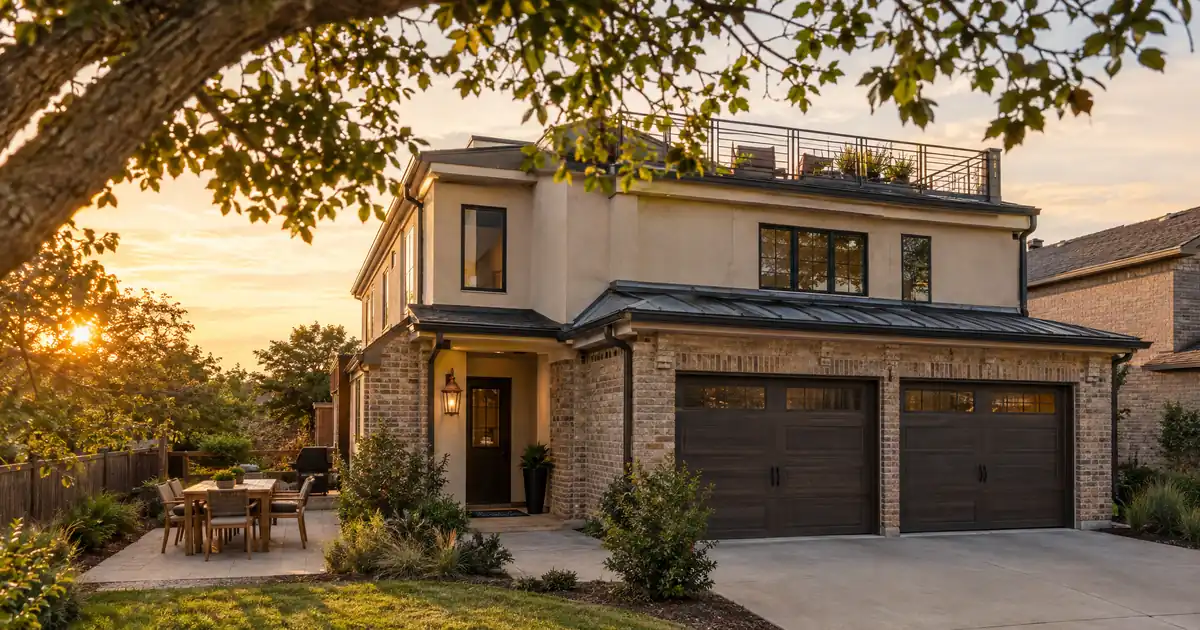
The Quick Read: A suburban short-term rental qualifies for a DSCR loan when two things hold: short-term use is legal at the address, and the lender accepts an income method that covers the full monthly housing payment. Gross booking revenue is not automatically the coverage figure. Lenders usually apply a haircut or use a different income source.
- Legal status comes first. A ban, a missing permit, or an HOA restriction can end the deal before any math starts.
- Programs accept different income evidence: hosting history, a third-party projection, or an appraiser’s rent schedule.
- Across most programs we place files with, short-term rental purchases reach up to 75% LTV, with a 640 credit score expected.
- A 1.00 coverage ratio is where select short-term rental programs start. It is not a promise of approval and not the same as positive cash flow.
DSCR stands for debt service coverage ratio. It compares a property’s rent to its monthly housing cost: principal, interest, taxes, insurance, and any HOA dues (together, PITIA). A DSCR loan is reviewed primarily on property-level rental income covering the payment, subject to lender guidelines. Your personal income is not the test. For the full picture, see Lendmire’s complete DSCR loans guide.
Short-Term Rental Calculator
Run the STR numbers in Texas
Rate source: Freddie Mac 30-yr average via FRED® — Federal Reserve Bank of St. Louis · effective Oct 15, 2026
Prefilled with starting assumptions — enter your nightly rate, occupancy, taxes, and insurance for a more accurate picture.
Short-term rental income is documented with a 12-month history or a market data report. Program parameters update from Lendmire’s centralized guideline source.
As of Oct 15, 2026 · General Freddie Mac market benchmark, not a Lendmire loan offer. Nightly rate, occupancy, taxes, and insurance are editable estimates. Qualifying income for short-term rentals varies by program — some use appraisal market rent, others use documented STR history or projections — and is confirmed in underwriting. Not a Loan Estimate, approval, or commitment to lend. Program availability and eligibility are subject to lender guidelines, credit approval, property review, and underwriting.
Is a Suburban Short-Term Rental Worth Underwriting?
Sometimes. Suburbs are not tourist districts, so demand is thinner and less predictable. Event traffic, sports tournaments, corporate relocations, and hospital or business travel can fill a suburban house. Pure leisure demand often does not.
Before you spend on an appraisal, test the demand honestly. Ask three questions:
- Who books this house, and why would they stay here instead of a hotel?
- How many comparable listings exist nearby? Suburbs often have very few.
- Does the income hold up in the slow months, or only in event weeks?
If the answers are vague, plan for a fallback. A rental with sound long-term rent coverage can still qualify even if nightly bookings disappoint. Many investors treat the short-term strategy as upside and the long-term rent as the floor.
Gate One: Is It Legal at This Address?
For a short-term rental file, legality comes before income. Short-term rental rules can vary by city, county, HOA, and property type, so investors should confirm local rules before relying on projected rental income. Texas has no statewide short-term rental license, which means the answer lives at the local level.
Suburbs next to each other can differ sharply. A Collin County guide from a host-tool publisher reports that Frisco and Allen require permits, McKinney requires a free registration, Plano bars new short-term rentals in residential districts, and Prosper prohibits them. It is a blog, so verify with each city. The City of Frisco confirms its registration requirement and a $300 annual fee. It also warns that unregistered rentals risk fines and a bar on future registration.
Plano shows why timing matters. Fox 4 reported that the council approved a ban on new short-term rentals in single-family residential areas. Rentals that existed before a cutoff date were grandfathered, according to a neighborhood coalition site. That means a grandfathered property may have underwritable income history, while a new purchase next door may not be legal to operate. State lawmakers have also discussed overriding city bans, so current law matters more than any old summary.
HOA and Deed Restrictions
Check these before you go under contract. In JBrice Holdings v. Wilcrest Walk Townhomes, the Texas Supreme Court held that the deed restrictions in that case did not prohibit short-term rentals. It also held that a state property code provision did not independently let the association ban them. The ruling turned on that subdivision’s covenants. An explicit minimum-lease-term covenant or a properly adopted amendment can still restrict short-term use. Read the actual documents.
Hotel Occupancy Tax
This is a compliance duty, not a loan test. The Texas Comptroller says the state hotel occupancy tax applies to houses rented for fewer than 30 consecutive days, at a 6 percent state rate. Platforms may collect it, but the owner stays responsible if they do not. Local hotel tax may need separate filing. Tax treatment can depend on how the funds are used and how the property is held; investors should keep clear records and speak with a qualified tax professional before relying on any deduction.
How Underwriting Treats Short-Term Rental Income, Step by Step
Here is the sequence a file follows through most programs in our wholesale network.
1. Legal status. The lender wants proof short-term use is allowed: permits, registrations, and HOA documents where they apply.
2. Income evidence. The file picks one of three paths, described below.
3. Haircut or factor. Many programs do not use the raw number. They apply an expense factor or a percentage of the projection. The factor varies by lender, so two programs can show two ratios for the same house.
4. Divide by PITIA. Qualifying income is divided by the full housing payment, HOA dues included.
5. Non-income gates. Credit score, leverage, reserves, vesting, and the appraisal still apply.
6. Insurance. Short-term rental coverage, often with rent-loss protection, is commonly required.
Reserves vary by lender, leverage, and loan size. Around six months of PITIA is common, and larger loans typically step up.
The Three Income Paths
| Path | Evidence | Best fit | Main risk |
|---|---|---|---|
| Hosting history | Platform payouts or twelve-month statement | Existing, operating rental | Seasonality shows in full |
| Third-party projection | Market report for the address | Purchase with no history | Property-level misses |
| Appraiser rent schedule | Form 1007 (single-family) or Form 1025 (2–4 units) | Conservative fallback | Long-term rent may be lower |
Not every program takes every path. Some products bar short-term income on the subject property and allow only long-term rent, so a file may need to move to a different program rather than get turned down. Lendmire’s piece Using A Market Data Report To Qualify A Short Term Rental covers the projection path in detail.
Be skeptical of projections in thin markets. Independent reviews from BNBCalc and VaultSTR both say property-level estimates can miss by roughly 15 to 30 percent. Market-level numbers tend to be stronger than address-level ones. Treat a projection as an estimate, and expect the lender to do the same.
A Worked Example
Run the numbers on a hypothetical suburban single-family house bought at 75% LTV, which is the ceiling for a short-term rental purchase. Coverage ratios below are modeled assumptions, not market data. Terms vary by lender guidelines, property type, leverage, credit profile, and full file review.
| Income path | Modeled DSCR | Reading |
|---|---|---|
| Hosting history, after factor | About 1.25x | Clears 1.00 with room |
| Projection, after haircut | About 1.05x | Clears, barely |
| Appraiser long-term rent | About 0.90x | Below 1.00 |
The same house produces three answers. At about 0.90x, the file is not dead, but it leaves the standard 1.00 programs. A separate path through select lenders in the network takes coverage below 1.00, with leverage and terms adjusted. Qualification stays subject to lender guidelines, credit approval, and property review.
Stress-Test Before You Offer
Suburban deals need more cushion than destination deals. Three tests:
- Haircut test. Cut the projected income by the 15 to 30 percent miss range above. Does the ratio still clear 1.00?
- Occupancy test. Lower occupancy by a meaningful margin. Does the house still cover its payment?
- Fallback test. If the lender uses only long-term rent, can you live with that ratio and leverage?
Texas taxes and HOA dues sit in the denominator. In many suburbs they can sink a ratio that looks fine on gross revenue. Budget for them, since they vary by county and neighborhood.
Here is the honest limit of the whole exercise. DSCR compares rent to PITIA only. Repairs, vacancy, management, cleaning, utilities, furnishing, and capital expenses sit outside it. A 1.00 or better does not mean positive cash flow. Short-term rentals carry heavier operating costs than long-term ones, so the real margin is thinner than the ratio suggests.
If the numbers fail, consider a mid-term or long-term strategy. A house that works as a conventional rental can still be a sound DSCR file.
What the Non-Income Gates Look Like
Across most programs we place short-term rental files with, a 640 credit score is the floor, and stronger scores open better leverage. Purchases reach up to 75% LTV on the strongest files. Refinances land around 70%, and short-term rental cash-out tops out at 70%, while a standard long-term rental cash-out can reach 75%. Lenders usually expect about twelve months of hosting experience. Coverage of 1.00 is where the standard short-term rental programs start, on purchases and refinances alike. The below-1.00 path described earlier is a separate select-lender route with adjusted leverage and terms. Loan sizes run up to $3,000,000 on standard programs.
A bigger down payment lowers the payment and can lift the ratio. It does not erase leverage caps, credit floors, reserve rules, or property eligibility. The strongest files clear both tests: enough equity and enough rental coverage. Entity vesting matters too, and an LLC borrower can work subject to lender program eligibility. Manufactured homes, log homes, and barndominiums are not offered in these programs.
DSCR vs. conventional financing
There are two common ways to finance an investment property, and they qualify you differently — here’s how investors weigh them.
Why investors choose it
- Qualifies on the property’s rental income — no personal tax returns, W-2s, or pay stubs needed to document income.
- No personal debt-to-income ceiling to clear, so existing mortgages and obligations don’t cap your borrowing the same way.
- Can be closed in an LLC, keeping the property inside a business entity.
- Built for scaling — not held to the limit on number of financed properties that conventional financing applies.
- Underwriting centers on the deal: generally qualifies when the rent covers the payment, a 1.00x coverage ratio being a common baseline (confirmed in underwriting).
- Designed specifically for investment property, including long-term and, where the program allows, short-term rentals.
Where it’s strong
- Often the lowest ongoing financing cost for a buyer who fully qualifies on personal income — a fit for a first property or a cost-first purchase.
Trade-offs for investors
- Requires full personal income documentation and must fit within a debt-to-income limit — salary, existing debts, and other mortgages all count.
- Typically held in your personal name rather than a business entity.
- Caps how many financed properties you can carry, which can become a ceiling as a portfolio grows.
- Evaluates you as a borrower as much as the property, which usually means more paperwork.
How investors usually choose: a first or single property often optimizes for the lowest financing cost; portfolio builders often optimize for leverage, vesting in an LLC, and scaling past conventional caps. The right answer depends on your goals, the property, and current guidelines — both paths run through select lenders in Lendmire’s wholesale network, with eligibility and terms confirmed in underwriting.
Documentation Checklist
- Proof of legal short-term use: permit, registration, or city confirmation
- HOA documents and recorded deed restrictions
- Hosting statements or platform payouts, if the rental already operates
- A market projection or appraiser rent analysis, if it does not
- Short-term rental insurance with rent-loss coverage
- Entity documents, assets, and credit information
Mistakes That Cost Deals
- Using gross bookings as qualifying income
- Skipping the HOA and deed review
- Assuming a nearby city’s rules apply in the next one
- Buying in a ban zone without grandfathering
- Trusting a projection in a market with few comparables
- Confusing a 1.00 ratio with profit
Key Terms Defined
DSCR: the ratio of a property’s qualifying income to its monthly housing payment.
PITIA: principal, interest, taxes, insurance, and association dues, the full monthly housing cost.
LTV: loan-to-value, the loan amount as a share of the property’s value.
Form 1007 / Form 1025: appraiser forms that estimate market rent for single-family homes and 2–4 unit properties.
Haircut: a reduction a lender applies to projected income before dividing by PITIA.
Grandfathering: a rule that lets an existing use continue after a new ban takes effect.
Frequently Asked Questions
Can a suburban short-term rental qualify for a DSCR loan?
Yes, when it is legal to operate and a program accepts its income method. Hosting history, a projection, or appraiser rent can support the file. Qualification stays subject to lender guidelines.
Does Texas have a statewide short-term rental license?
No. Cities decide whether short-term rentals are allowed, so rules differ between neighboring suburbs. The state does require hotel occupancy tax on stays under 30 days.
Can an HOA stop me from renting short-term?
It can, if the restriction is explicit and properly adopted. A bare residential-use clause is weaker. Read the recorded documents before you buy.
What if the property has no hosting history?
A third-party projection or an appraiser’s rent analysis can stand in, often with a haircut. Some programs use only long-term rent for that property.
Is a 1.00 coverage ratio enough to get approved?
No. Credit, leverage, reserves, and property condition still count. A ratio of 1.00 is where select programs start, not a guarantee.
If you are buying or refinancing a rental property and want to see how the numbers work, Lendmire, a broker arranging DSCR financing through select lenders in its wholesale network across 41 markets including Washington, D.C., can help you compare DSCR loan options based on the property income, credit profile, leverage, and investor goals. Call 828-256-2183 or request a quote.
For current guidelines and terms, see Lendmire’s DSCR loan programs page.
About Lendmire
Lendmire, NMLS# 2371349, is a non-QM mortgage broker serving real estate investors in 41 markets, including Washington, D.C., through DSCR investor loan programs. Qualification is generally reviewed around the subject property’s rental income, not the borrower’s W-2 history — a practical fit for LLC-titled portfolios and self-employed investors. All scenarios remain subject to lender review and program guidelines. Two consecutive Scotsman Guide Top Mortgage Workplace recognitions (2025, 2026).
Get Started
Ready to find the right loan for you?
In about 30 seconds you can review financing options available for your investment property. No commitment required.
Informational only. Not a Loan Estimate, approval, or commitment to lend. Program availability and eligibility are subject to lender guidelines, credit approval, property review, and underwriting.
References
1. BNBCalc – Collin County short-term rental guide
2. City of Frisco – Short-Term Rentals
3. Fox 4 News – Plano short-term rental ban
4. Texas Neighborhood Coalition Plano
5. Texas Supreme Court – JBrice Holdings v. Wilcrest Walk Townhomes
This article is part of Lendmire’s short-term rental loan program — full qualification details, guidelines, and scenarios live on the program page.
Related reading: How to Buy a Short-Term Rental When the Permit Does Not Transfer · Putting 15% Down vs. 25% Down on a Short-Term Rental DSCR Loan · How to Refinance a DSCR Loan When Moving a Mid-Term Rental to Airbnb
Guides: Short-Term Rental Loans in Texas
Brandon Miller
Founder & CEO, Mortgage Loan Originator, Lendmire LLC
- Mortgage Loan Originator · NMLS# 1129696 · Verify on NMLS Consumer Access
- North Carolina Real Estate Broker · License# 343312 · Verify on NCREC
- North Carolina Insurance Producer · License# 19053198 · Property, Casualty, Life, Health · Verify on NAIC SBS
- Lendmire LLC · Firm NMLS# 2371349 · Verify firm licensure
Required disclosures. Lendmire (NMLS# 2371349) operates as a licensed mortgage broker, not a direct lender or depository. The discussion in this article is general in nature and should not be relied upon as financial, legal, or tax advice — every investment scenario is unique and should be reviewed by a qualified professional. Any loan inquiry is subject to lender underwriting, and this article is not a commitment to lend or a guarantee of approval. Mortgage rates, loan terms, and program guidelines vary by borrower, property, and state, and may change without notice. Equal Housing Opportunity. Verify licensure at NMLS Consumer Access.