
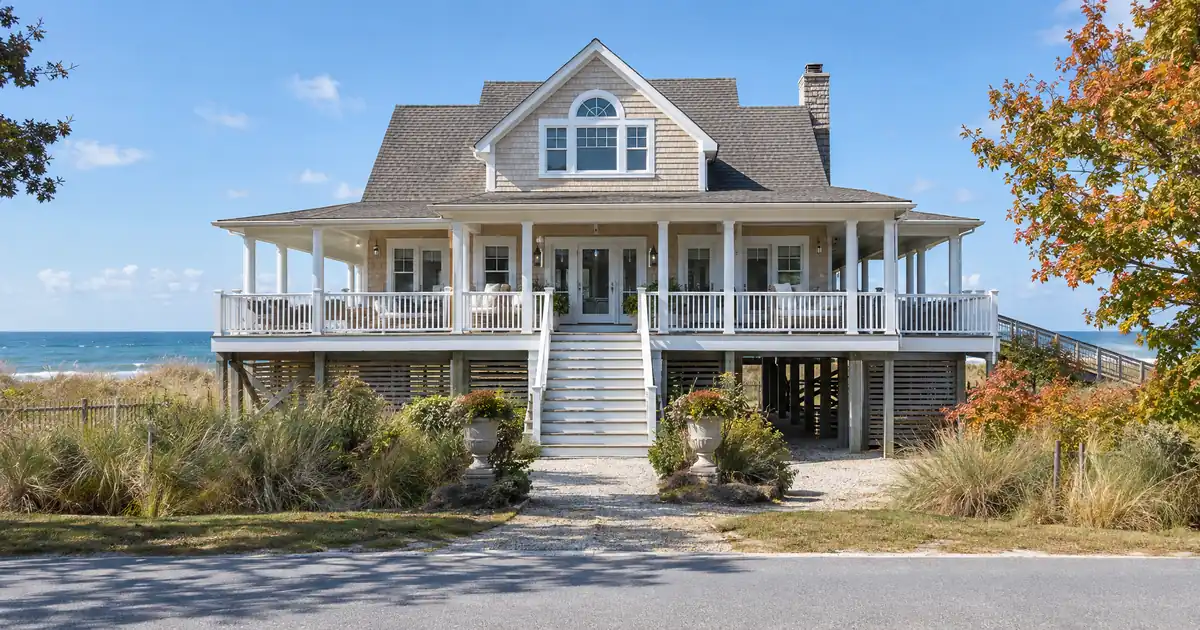
The Quick Read: You qualify for a short-term rental DSCR loan on a new build by using a program that accepts projected income, from an appraiser’s short-term-rental analysis or a third-party market report, in place of past bookings. The finished home, local rules, credit, and reserves must also check out, subject to lender guidelines. Coverage is still projected rent divided by the full monthly housing obligation, so the income method matters as much as the property itself.
- Projected income stands in for history. The appraiser’s analysis and the third-party report can produce very different coverage numbers on the same house.
- The home must be finished, with a certificate of occupancy, before permanent financing funds. A DSCR loan is not construction money.
- Across the wholesale network, short-term-rental purchases typically reach up to 75% LTV, and the typical minimum credit score is 640.
- Local rental rules and HOA covenants can erase the projection, even on a brand-new house.
- Clearing the coverage ratio does not mean the property makes money. Vacancy, repairs, and management sit outside the calculation.
What Is a Short-Term Rental DSCR Loan on a New Build?
It is permanent financing on a finished home that will rent by the night, underwritten mainly on what the property is expected to earn. DSCR stands for debt service coverage ratio. It divides the property’s monthly income by its monthly obligation, which lenders call PITIA: principal, interest, taxes, insurance, and any HOA dues.
Short-Term Rental Calculator
Run the STR numbers in your market
Rate source: Freddie Mac 30-yr average via FRED® — Federal Reserve Bank of St. Louis · effective Oct 15, 2026
Prefilled with starting assumptions — enter your nightly rate, occupancy, taxes, and insurance for a more accurate picture.
Short-term rental income is documented with a 12-month history or a market data report. Program parameters update from Lendmire’s centralized guideline source.
As of Oct 15, 2026 · General Freddie Mac market benchmark, not a Lendmire loan offer. Nightly rate, occupancy, taxes, and insurance are editable estimates. Qualifying income for short-term rentals varies by program — some use appraisal market rent, others use documented STR history or projections — and is confirmed in underwriting. Not a Loan Estimate, approval, or commitment to lend. Program availability and eligibility are subject to lender guidelines, credit approval, property review, and underwriting.
DSCR loans are designed for non-owner-occupied investment properties. Because they are business-purpose investor loans, they are reviewed differently from a standard owner-occupied mortgage.
A DSCR loan is reviewed primarily on property-level rental income covering the payment, subject to lender guidelines. That is why a new build works at all. There are no bookings to document, so the lender needs a credible stand-in for them.
Two things separate this file from an ordinary rental purchase. The home has never been rented, so income is a projection. The home also may have been finished weeks ago or may still be a framed shell. Lendmire’s complete DSCR loans guide covers the basics.
Lendmire’s piece Can a New Short-Term Rental Qualify for a DSCR Loan Without History? covers the short answer. What follows is the step-by-step mechanics.
Key Terms Defined
DSCR (debt service coverage ratio): The property’s monthly income divided by its monthly PITIA. A result of 1.00 means income equals the obligation.
PITIA: Principal, interest, taxes, insurance, and HOA dues. It is the full monthly housing obligation the ratio is measured against.
Certificate of occupancy (CO): The local building authority’s sign-off that a finished home can legally be occupied.
Form 1007: An appraisal form that estimates what a home would rent for on a monthly lease. It is built for long-term rentals, not nightly stays.
Rentalizer: A third-party tool from the data company AirDNA that projects short-term-rental revenue from comparable listings.
LTV (loan-to-value): The loan amount divided by the property’s value. Lower LTV means more of your own money in the deal.
Reserves: Liquid funds you hold after closing, usually counted in months of PITIA.
Ramp-up: The period when a new listing has few reviews and earns less than established comparable listings.
How Does a Lender Set Income When There Is No History?
The lender picks one of three methods, and each can produce a different coverage number on the same property. Know which method a lender uses before you compare offers.
| Method | Who produces it | Main strength | Main weakness |
|---|---|---|---|
| Appraiser’s STR analysis | Appraiser | Tied to the appraisal | Quality depends on comps |
| Third-party projection | Data vendor | Built for nightly rentals | Estimate, not a guarantee |
| Long-term rent schedule | Appraiser | Conservative | Mismatched to nightly income |
The appraiser’s analysis. Some programs ask the appraiser to analyze comparable short-term rentals and report an income figure alongside the value opinion. This ties the income to the same visit and the same comp set as the value.
The third-party report. AirDNA’s Rentalizer, as AirDNA describes its method, finds comparable short-term rentals within a 10-mile radius. It matches them on bedrooms, bathrooms, and guest count, then weights each comp by similarity. The result is adjusted for seasonality, demand, and revenue growth. A Comp Set Strength score shows how consistent the comps are. A weak score on your report is a warning sign worth taking seriously.
The long-term rent schedule. This is where many new-build files get hurt. Fannie Mae’s appraiser guidance says the Form 1007 rent schedule was not designed for single-family homes used as short-term rentals. It calls for market rent from monthly leases. The same guidance says it is incorrect to take nightly comps and multiply by 30.
Fannie Mae owns the form, and DSCR loans are not agency products. The form’s role is defined in the Selling Guide’s appraisal forms section as the single-family comparable rent schedule. DSCR programs borrow the form without following the agency rulebook.
Class Valuation, an appraisal-industry firm, argues the 1007 is incompatible with short-term-rental income and often produces an artificially low ratio when used for DSCR. That matches what a broker sees: a 1007-only program can understate a house that would work well as a nightly rental.
Worked Example: Three Methods, One House
Run the numbers on a modeled new build. These ratios are assumptions for illustration, not market data.
Say the appraiser’s short-term-rental analysis supports coverage near 1.25x. A third-party report on the same house lands near 1.15x. The long-term rent schedule shows roughly 0.85x.
The same house clears a 1.00 floor on two methods and misses on the third. Nothing about the property changed. Only the income method did.
Now stress the best case. Practitioner reviews of third-party projections, BnBCalc among them, report swings of roughly 15% to 30% in thin markets, and these are operator opinions rather than audited accuracy data. Cut the 1.25x case by 30% and coverage falls to about 0.88x.
At 0.88x, there are options a lender may review. Select lenders in the network offer coverage below 1.00 with leverage and terms adjusted. Others may look at an interest-only period or blended income. A larger down payment lowers the monthly obligation and can lift the ratio. It never erases leverage caps, credit floors, or reserve rules. Eligibility depends on lender guidelines, credit approval, and property review.
Many programs in the network start at 1.00. That is a floor for specific programs, never a universal standard. Stronger ratios open better pricing and leverage.
Step-by-Step Qualification Roadmap
1. Confirm the rental is allowed. Short-term rental rules can vary by city, county, HOA, and property type, so investors should confirm local rules before relying on projected rental income. New builds in planned communities often carry rental restrictions in their covenants.
2. Choose the program by income method. Ask which method the lender uses: appraiser analysis, third-party report, or the long-term schedule. Ask what happens if the appraiser’s number disagrees with your pro forma.
3. Plan the two-loan sequence if you are building. Ground-up construction uses construction debt first. The DSCR loan is the takeout once the home is finished. Start the conversation before the build completes so the file is ready.
4. Finish the home and obtain the certificate of occupancy. A CO is a local milestone, not a lender approval. The permanent lender still confirms value, rent, condition, title, and documentation.
5. Order the appraisal and the income report. The appraisal covers the finished home. The income report is the appraiser’s analysis, the third-party projection, or both.
6. Assemble the file. Typical items are the appraisal, the CO or local equivalent, final inspection, lien releases from the builder, insurance, entity documents, and proof of reserves.
7. Review the coverage number against your own stress test. If it falls short, restructure before the file goes in, not after.
DSCR vs. conventional financing
There are two common ways to finance an investment property, and they qualify you differently — here’s how investors weigh them.
Why investors choose it
- Qualifies on the property’s rental income — no personal tax returns, W-2s, or pay stubs needed to document income.
- No personal debt-to-income ceiling to clear, so existing mortgages and obligations don’t cap your borrowing the same way.
- Can be closed in an LLC, keeping the property inside a business entity.
- Built for scaling — not held to the limit on number of financed properties that conventional financing applies.
- Underwriting centers on the deal: generally qualifies when the rent covers the payment, a 1.00x coverage ratio being a common baseline (confirmed in underwriting).
- Designed specifically for investment property, including long-term and, where the program allows, short-term rentals.
Where it’s strong
- Often the lowest ongoing financing cost for a buyer who fully qualifies on personal income — a fit for a first property or a cost-first purchase.
Trade-offs for investors
- Requires full personal income documentation and must fit within a debt-to-income limit — salary, existing debts, and other mortgages all count.
- Typically held in your personal name rather than a business entity.
- Caps how many financed properties you can carry, which can become a ceiling as a portfolio grows.
- Evaluates you as a borrower as much as the property, which usually means more paperwork.
How investors usually choose: a first or single property often optimizes for the lowest financing cost; portfolio builders often optimize for leverage, vesting in an LLC, and scaling past conventional caps. The right answer depends on your goals, the property, and current guidelines — both paths run through select lenders in Lendmire’s wholesale network, with eligibility and terms confirmed in underwriting.
What the Network Typically Expects From You
Across the wholesale network, the typical short-term-rental ranges look like this. Each figure is guidance, not a guarantee, and every file is underwritten individually.
| Item | Typical range |
|---|---|
| Purchase LTV, STR | Up to 75% on the strongest files |
| Refinance or cash-out LTV, STR | Up to 70% |
| Minimum credit score | 640 |
| Coverage floor, purchase | 1.00 |
| Coverage floor, refinance | 1.00 |
| Loan size | Up to $3,000,000 on standard programs |
On a standard long-term rental, cash-out tops out around 75% LTV. Short-term-rental collateral is held to 70%, so that gap matters if you plan to refinance later. Leverage, reserves, and pricing vary by lender and program; the final terms follow the full file review.
Reserves vary by lender, leverage, loan size, and transaction type. Around 6 months of PITIA is common, and larger loans typically step up from there.
Short-term-rental files usually expect about 12 months of landlord or host experience from the borrower. The property has no history, but you may. Some programs treat first-time hosts more strictly than others, so raise this early. Vesting title in an LLC is possible on many files, subject to program terms.
Where the General Rule Breaks
1007-only programs. A new build can fall short on a lender that accepts only the long-term rent schedule, even when the house would perform as a nightly rental. This is a common reason a good property misses.
Thin or rural markets. Few comps mean wider projection error, and the error runs both ways. Reviews like 10xBnB’s AirDNA review describe drift in thin markets in the same 15% to 30% neighborhood.
Ramp-up. A listing with no reviews rarely earns comp-level income in month one. Lenders that accept projections generally price in a model, not your first-month calendar. Your own pro forma should plan for a slower start.
Multi-unit new builds. A two- to four-unit property may need the multi-unit appraisal form and possibly a per-unit income report. Expect more documentation.
Property type. Some new builds are barndominiums, log homes, or manufactured homes. These are not offered in the network’s DSCR programs, however new or well built they are.
Delayed completion. A late CO can stall funding, and temporary COs can expire. Build slack into the sequence.
Appraiser disputes. Some programs allow a reconsideration of value with supporting comps. Others take only the appraisal number. Ask before you order.
What Can Go Wrong, and What to Do About It
| Problem | Mitigation |
|---|---|
| Low appraisal or income | Gather better comps; ask about reconsideration |
| Projection below pro forma | Test coverage at a lower income case |
| CO delayed | Keep the builder timeline realistic |
| Local rule or HOA ban | Verify rules before contract |
| 1007-only lender | Choose a program that accepts projections |
Pre-Application Checklist
- Written confirmation that short-term rental is allowed by the local authority and the HOA or covenants.
- A third-party income report with a strong comp set, plus a realistic ramp-up assumption of your own.
- Insurance quote for a short-term-rental use, not a standard homeowner policy.
- Reserve funds documented and seasoned.
- A fallback case: what coverage looks like if the property rents monthly instead.
- A plan for furnishings and a manager, since the projection assumes a professionally operated listing.
On the fallback, remember what DSCR does and does not measure. It compares rent to PITIA only. Clearing 1.00 is not the same as positive cash flow, because repairs, vacancy, management, utilities, and capex sit outside the calculation. Tax treatment can depend on how the funds are used and how the property is held; investors should keep clear records and speak with a qualified tax professional before relying on any deduction.
Frequently Asked Questions
Can I qualify if I have never hosted a short-term rental?
It depends on the program. Short-term-rental files in the network usually expect about 12 months of landlord or host experience, but select lenders vary. A first-time host should talk to a broker before contract, because experience can matter as much as the property.
Does a certificate of occupancy mean I am approved?
No. The CO proves the home can legally be occupied. The permanent lender still reviews value, rent, condition, title, and your credit and reserves.
Can a DSCR loan pay for the construction itself?
No. A DSCR loan is permanent financing on a completed property. Ground-up builds typically use construction debt first and a DSCR loan afterward as the takeout.
What happens if the appraisal or projection comes in low?
First, check whether the program allows a reconsideration with better comps. Then run coverage at the lower figure. Select lenders in the network offer coverage below 1.00 with leverage and terms adjusted, and a larger down payment can lift the ratio, subject to lender guidelines.
Can I refinance later using my actual bookings?
Yes, that is a common path. Once the property has a booking record, a refinance can be underwritten on actual results. Short-term-rental refinances typically reach up to 70% LTV, and a cash-out on short-term-rental collateral is held to the same 70%.
Next Step
If you are buying or refinancing a rental property and want to see how the numbers work, Lendmire can help you compare DSCR loan options based on the property income, credit profile, leverage, and investor goals. Lendmire is a mortgage broker arranging DSCR financing through select lenders in its wholesale network across 41 markets, including Washington, D.C., and the team can be reached at 828-256-2183.
For the booking-record side of the problem, see Lendmire’s guide How to Finance a New Short-Term Rental With No Booking History. A new build is a timing puzzle first and a coverage puzzle second, and investors who solve the sequence early tend to have the easier file.
About Lendmire
Lendmire (NMLS# 2371349) is a mortgage brokerage built around DSCR investor lending, with programs available in 41 markets, including Washington, D.C. DSCR lenders commonly evaluate rental-income coverage instead of personal income paperwork, a practical fit for LLC-owned and multi-property investors. Terms vary by lender, property, leverage, and program. Scotsman Guide named Lendmire a Top Mortgage Workplace in both 2025 and 2026.
Get Started
Ready to find the right loan for you?
In about 30 seconds you can review financing options available for your investment property. No commitment required.
Informational only. Not a Loan Estimate, approval, or commitment to lend. Program availability and eligibility are subject to lender guidelines, credit approval, property review, and underwriting.
References
1. AirDNA Airbnb calculator method description
2. Fannie Mae appraiser update on short-term rentals and the rent schedule
3. Selling Guide’s appraisal forms section
4. Class Valuation on why Form 1007 does not fit short-term rentals
5. BnBCalc review of AirDNA projections
6. 10xBnB review of AirDNA projections
This article is part of Lendmire’s short-term rental loan program — full qualification details, guidelines, and scenarios live on the program page.
Related reading: How Much Is the Minimum Short-Term Rental DSCR Loan for Cabin and Rural Properties? · How to Qualify for a DSCR Cash-Out After an Airbnb Becomes a Mid-Term Rental · How to Qualify for a Super Jumbo DSCR Loan in Alaska
Brandon Miller
Founder & CEO, Mortgage Loan Originator, Lendmire LLC
- Mortgage Loan Originator · NMLS# 1129696 · Verify on NMLS Consumer Access
- North Carolina Real Estate Broker · License# 343312 · Verify on NCREC
- North Carolina Insurance Producer · License# 19053198 · Property, Casualty, Life, Health · Verify on NAIC SBS
- Lendmire LLC · Firm NMLS# 2371349 · Verify firm licensure
Important disclosures. Lendmire (NMLS# 2371349) is a licensed mortgage brokerage. Lendmire is not a direct lender, depository institution, or financial advisor. All loan inquiries are subject to lender underwriting; this article does not constitute a commitment to lend. Rates, terms, and program guidelines are subject to change without notice and vary by borrower profile, property type, and state. Information in this article is general in nature and is not financial, legal, or tax advice. Equal Housing Opportunity. NMLS Consumer Access: nmlsconsumeraccess.org.