
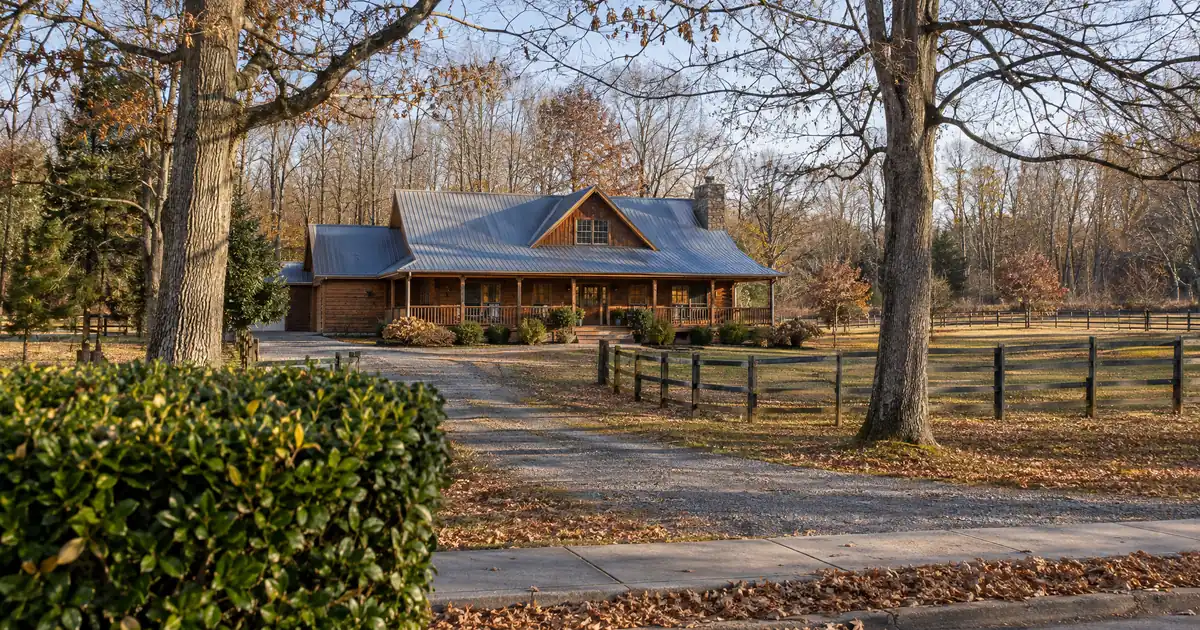
The Quick Read: On a rural cabin used as a short-term rental, the appraisal is usually the step that decides how much a lender will actually advance, because leverage is measured against the lower of the purchase price or the appraised value, and strong booking income does not raise that value.
- STR purchases typically reach up to 75% LTV on the strongest files; STR refinances and cash-outs top out around 70%.
- Most STR programs expect a 640+ score, about 12 months of hosting history, and a 1.00 coverage floor, subject to lender guidelines.
- Log homes, manufactured homes, and barndominiums are not offered in these programs.
- A low rural appraisal turns directly into more cash needed from the buyer.
- Clearing 1.00 coverage is not the same as positive cash flow.
Rural cabins break the usual DSCR script. Comparable sales are thin, land is hard to value, and nightly income does not fit the rent forms most appraisers use. This guide walks the chain from price to loan amount, then shows where it snaps. For the full program picture, see the complete DSCR loans guide.
Short-Term Rental Calculator
Run the STR numbers in your market
Rate source: Freddie Mac 30-yr average via FRED® — Federal Reserve Bank of St. Louis · effective Oct 15, 2026
Prefilled with starting assumptions — enter your nightly rate, occupancy, taxes, and insurance for a more accurate picture.
Short-term rental income is documented with a 12-month history or a market data report. Program parameters update from Lendmire’s centralized guideline source.
As of Oct 15, 2026 · General Freddie Mac market benchmark, not a Lendmire loan offer. Nightly rate, occupancy, taxes, and insurance are editable estimates. Qualifying income for short-term rentals varies by program — some use appraisal market rent, others use documented STR history or projections — and is confirmed in underwriting. Not a Loan Estimate, approval, or commitment to lend. Program availability and eligibility are subject to lender guidelines, credit approval, property review, and underwriting.
How Is LTV Set on a DSCR Loan?
LTV is the loan amount divided by the lower of the purchase price or the appraised value. The contract price does not override the appraisal. If a cabin is under contract above what the appraiser supports, the lender sizes the loan off the smaller number.
That is why the appraisal does two jobs on a DSCR file. It sets the value that leverage is measured against. It also feeds the rent or income figure used for the coverage test. DSCR compares rent to the full monthly obligation: principal, interest, taxes, insurance, and any association dues. Both tests must clear. Equity alone does not rescue thin coverage, and strong coverage does not rescue a value shortfall.
What Leverage Limits Apply to a Rural STR Cabin?
Across the wholesale network, short-term rental collateral carries tighter ceilings than a standard long-term rental. Subject to lender guidelines, the typical ranges look like this:
| Transaction | Typical STR ceiling | Other expectations |
|---|---|---|
| Purchase | Up to 75% LTV | 640+ score, 1.00 coverage |
| Refinance | Around 70% LTV | 1.00 coverage |
| Cash-out | Up to 70% LTV | Hosting history on file |
Most files also expect about 12 months of hosting experience, and standard loan sizes run up to $3,000,000. Pay attention to how the 70% figure is scoped. A standard long-term rental cash-out tops out around 75%, and that number should never be applied to a cabin run as an Airbnb.
Rural status layers on top. Some lenders in the network apply acreage and rural overlays, with the strongest rural treatment generally reserved for smaller parcels of about five acres or less. Whether the STR ceiling and a rural overlay stack, or the stricter one simply wins, depends on the lender. Ask before you pick a program, not after the appraisal is ordered.
Market surveys sometimes report that rural programs elsewhere cap leverage lower, in the 65% to 70% range, against 75% to 80% on standard properties. That is a market-wide observation, not a network ceiling. The network figures above are the ones that apply here.
What Makes a Cabin Rural to a Lender?
There is no single definition. Lenders look at several tests, and no one flag is automatically fatal. The usual signals:
| Flag | Why it matters | What it can do |
|---|---|---|
| Few nearby comparable sales | Value is hard to support | Lower or wider-radius value |
| Unpaved or shared road | Access and marketability | Added review, possible exclusion |
| Large parcel | Land is hard to value | Excess acreage carved out of value |
| Agricultural or vacant surroundings | Not a built-up neighborhood | Rural classification |
| Well and septic | Utility review | Condition requirements |
| Remote location | Fewer appraisers willing to travel | Longer, costlier appraisal |
Appraiser availability works as an informal ceiling. If nobody local will take the assignment, the lender has to bring someone in, and that can complicate the file.
Which Cabins Never Get to the Appraisal?
Property type screens come first. The cabin must be conventional and capable of year-round use. Log homes, manufactured homes (single- and double-wide), and barndominiums are not offered in the network’s DSCR programs. A true log cabin, however charming, falls outside these programs. A frame-built cabin with a log-style exterior is a different question, and the lender will review how it is classified.
Wells, septic systems, and private road access get reviewed at the property level. A cabin that cannot be used all year, or has unresolved access or utility issues, can stall before value even comes up. The cabin also needs to be legal as a short-term rental at its address. Short-term rental rules can vary by city, county, HOA, and property type, so investors should confirm local rules before relying on projected rental income. Lendmire’s piece How to Underwrite STR Permit Risk Before Buying a Rural Cabin covers that diligence in depth.
Why Doesn’t Airbnb Income Raise the Appraisal?
Short-term rental use does not change what the real property is worth. Per McKissock’s explanation of Form 1007 and short-term rental appraisals, appraisers value the real estate only. Furniture, fixtures, equipment, and business income are excluded, and a property used as an STR carries the same value as one that is not. Fannie Mae’s appraiser guidance says the same: only the real property belongs in the value.
Those are agency sources, and agency rules do not govern DSCR loans. The form names carry over; the rules do not. The practical lesson still holds. A cabin that books beautifully can still appraise low if the comps are weak. Bookings prove income. They do not prove value.
Why Does the Rent Form Misfit Nightly Rentals?
Form 1007 is the single-family comparable rent schedule. It documents monthly market rent on a one-unit investment property. Fannie Mae notes that short-term rentals are typically booked nightly, like a hotel, involve furnishings, run on terms and conditions rather than a lease, and may include services like housekeeping. McKissock adds that an appraiser cannot multiply a nightly rate by 30, and cannot do that and then subtract expenses either.
HousingWire reports that forcing STR income into the 1007 tends to produce artificially low coverage, and that appraisers are encouraged to decline assignments that ask them to contort the form. Competent STR appraisers instead attach a labeled narrative projected-income analysis.
| Approach | What it produces | Limitation |
|---|---|---|
| Form 1007 | Monthly long-term market rent | Understates nightly income |
| Narrative STR analysis | Projected nightly income | Lender must accept it |
| Booking records | Actual trailing income | Needs hosting history |
Form 1025 is for two- to four-unit properties. A single cabin gets a 1007 or a full appraisal, not a 1025.
How Is STR Income Actually Proven?
The lender chooses the method, and the appraiser does not decide income. Across the network, the options include an appraiser’s STR income analysis, 12 months of property-manager or platform statements, 12 months of bank statements showing booking deposits, or a market projection report on a purchase with no history.
Many lenders then haircut the revenue before testing it. Coverage is the adjusted income divided by full PITIA, and it uses full-year income. A cabin that earns most of its money in two peak seasons still gets measured against twelve months. Slow winters count against the file.
On rural STR files, the weakest plausible income number tends to decide the outcome. That might be the long-term rent fallback, a discounted projection, or the full-year figure with a soft winter. Run all three before making an offer. If the file only works on peak-season math, it does not work.
What Happens When Comps Are Thin?
A rural appraiser typically widens the search radius, reaches back to older sales, and makes larger adjustments. Each of those makes the value opinion less certain, and uncertainty tends to land on the conservative side.
You can help. Package the listing history, seller operating records, a feature sheet covering the well, septic, road, and finishes, and any recent nearby sales you know about. Recreation or view premiums are especially hard to support from comps, so do not count on them.
Thin markets cut the other way on income. If the area has too few long-term rentals, the rent fallback can land under 1.00 even when bookings are strong. One illustrative file shows roughly 0.90x on long-term rent against about 1.25x with appraisal-supported nightly income. That gap is why the income method matters so much. If your coverage falls under 1.00 on the fallback, 1.00 is where many select programs start, while a separate select-lender path takes coverage below 1.00 with leverage and terms adjusted. Qualification stays subject to lender guidelines, credit approval, and property review.
How Does Excess Acreage Change the Math?
Programs limit land because acreage is hard to compare and can shade toward agricultural classification. When a parcel exceeds a program’s limit, the excess is typically left out of the appraised value, so the property can appraise below its full market worth. Some lenders want the extra land split off as a separate parcel. The effective area, meaning the usable portion the appraiser actually credits, drives the number.
Consider an illustrative round-number case, not a market figure. A cabin is under contract at $400,000. The appraiser supports the house and a program-eligible portion of land at $360,000 after excluding the excess. On a purchase at 75% LTV, leverage is measured against $360,000, not $400,000. The loan is sized off the lower value, so the buyer’s cash to close rises by the difference between the loan on $400,000 and the loan on $360,000, which is 75% of the $40,000 gap. The buyer also absorbs the rest of the shortfall if the seller will not renegotiate. That is the real cost of an appraisal hurdle. These specifics are subject to lender guidelines and a full review of property, leverage, and credit.
Worked Chain: From Price to Loan Amount
| Step | Pass case | Shortfall case |
|---|---|---|
| Contract price | Equals appraisal | Above appraisal |
| Value used for LTV | Price | Appraised value |
| Leverage test | 75% on purchase | 75% on lower value |
| Coverage test | 1.00 or better | Under 1.00 on fallback rent |
| Result | Loan as planned | More cash in, or restructure |
Both columns also need credit at or above the program floor, reserves, and a legal STR. Reserves vary by lender, leverage, loan size, and transaction type, and commonly run around six months of PITIA.
What If the Appraisal Comes in Low?
You have options, and most investors use more than one:
1. Ask for a reconsideration of value with added comps the appraiser may have missed.
2. Renegotiate the price with the seller using the appraisal as evidence.
3. Bring more cash to close to cover the gap.
4. Move to a different program in the network with different rural or acreage treatment.
5. Walk away if the cabin only works at the contract price.
A larger down payment lowers the payment and can lift coverage, but it does not erase leverage caps, credit floors, reserve rules, or property eligibility.
DSCR vs. conventional financing
There are two common ways to finance an investment property, and they qualify you differently — here’s how investors weigh them.
Why investors choose it
- Qualifies on the property’s rental income — no personal tax returns, W-2s, or pay stubs needed to document income.
- No personal debt-to-income ceiling to clear, so existing mortgages and obligations don’t cap your borrowing the same way.
- Can be closed in an LLC, keeping the property inside a business entity.
- Built for scaling — not held to the limit on number of financed properties that conventional financing applies.
- Underwriting centers on the deal: generally qualifies when the rent covers the payment, a 1.00x coverage ratio being a common baseline (confirmed in underwriting).
- Designed specifically for investment property, including long-term and, where the program allows, short-term rentals.
Where it’s strong
- Often the lowest ongoing financing cost for a buyer who fully qualifies on personal income — a fit for a first property or a cost-first purchase.
Trade-offs for investors
- Requires full personal income documentation and must fit within a debt-to-income limit — salary, existing debts, and other mortgages all count.
- Typically held in your personal name rather than a business entity.
- Caps how many financed properties you can carry, which can become a ceiling as a portfolio grows.
- Evaluates you as a borrower as much as the property, which usually means more paperwork.
How investors usually choose: a first or single property often optimizes for the lowest financing cost; portfolio builders often optimize for leverage, vesting in an LLC, and scaling past conventional caps. The right answer depends on your goals, the property, and current guidelines — both paths run through select lenders in Lendmire’s wholesale network, with eligibility and terms confirmed in underwriting.
Purchase, Refinance, or Cash-Out?
On a purchase with no hosting history, the lender relies on a projection or the appraiser’s analysis. On a refinance, actual booking records carry the income. That is why buying and building a track record first can open refinance options later. Bookings, not the appraisal, prove the income. STR refinance and cash-out run lower on leverage, around 70%, so pulling equity out of a cabin yields less than the same move on a standard long-term rental.
Two more edge cases. New builds generally move into permanent DSCR financing only after the certificate of occupancy, and the appraiser’s market rent counts rather than your pro forma. And on a second-home loan, the cabin’s rental income generally cannot help the borrower qualify. That is a different product from a DSCR investor loan.
Key Terms Defined
LTV: The loan amount divided by the lower of purchase price or appraised value.
DSCR: Monthly rental income divided by the full monthly obligation, which includes principal, interest, taxes, insurance, and dues.
PITIA: Principal, interest, taxes, insurance, and association dues, the full monthly housing obligation.
Comps: Recent nearby sales an appraiser uses to support value.
STR projected income analysis: A narrative addendum estimating nightly rental income.
Form 1007: The appraisal form that documents monthly market rent on a one-unit property.
Excess acreage: Land beyond a program’s limit, usually left out of appraised value.
Overlay: An extra lender restriction layered on top of base program rules.
Pre-Offer Checklist
1. Pick the program first, including how it treats rural and acreage.
2. Confirm the construction type is eligible. Log, manufactured, and barndominium are out.
3. Check acreage against the program limit.
4. Confirm well, septic, road access, and year-round habitability.
5. Confirm short-term rental legality at the address.
6. Run coverage on the weakest income number.
7. Then order the appraisal.
Clearing 1.00 coverage only means income equals PITIA. Repairs, vacancy, management, utilities, and capital costs sit outside that ratio. Tax treatment varies; consult a qualified professional.
Frequently Asked Questions
Can a rural cabin be financed with a DSCR loan?
Often yes, if it is a conventional, year-round-capable structure with a legal STR use. Purchases typically reach up to 75% LTV on the strongest files, subject to lender guidelines, credit approval, and property review.
Does acreage reduce my loan amount?
It can. Acreage beyond a program’s limit is typically excluded from appraised value, and LTV is measured against that lower figure. The shortfall becomes cash you bring to the table.
Can the appraiser use Airbnb income to value the cabin?
No. Value covers the real property only, and income is excluded. The lender decides how STR income is documented and counted for coverage.
What if there are no STR comps nearby?
The lender may fall back on long-term market rent, which can drag coverage below 1.00. A projection report or appraiser analysis may help on a purchase, and a refinance leans on actual booking records.
Does a low appraisal change my down payment?
Yes. Leverage is set against the lower of price or appraised value, so a low appraisal increases the cash you need at purchase.
About Lendmire
Lendmire, NMLS# 2371349, is a mortgage brokerage focused on investor financing, arranging DSCR loans in 40 states plus Washington, D.C. — 41 markets total. Qualification is based on the property’s income rather than personal income documentation, subject to lender guidelines, making it a fit for LLC-held rentals and scaling portfolios. Scotsman Guide named Lendmire a Top Mortgage Workplace in both 2025 and 2026.
Investors focused on short-term rentals can review DSCR loans for Airbnb and short-term rentals.
Get Started
Ready to find the right loan for you?
In about 30 seconds you can review financing options available for your investment property. No commitment required.
Informational only. Not a Loan Estimate, approval, or commitment to lend. Program availability and eligibility are subject to lender guidelines, credit approval, property review, and underwriting.
References
1. McKissock: Form 1007 and Short-Term Rental Appraisals
2. Fannie Mae Appraiser Update
3. HousingWire: Short-Term Rentals Are Breaking the Appraisal Playbook
This article is part of Lendmire’s short-term rental loan program — full qualification details, guidelines, and scenarios live on the program page.
Related reading: Can You Get a DSCR Loan on an Out-of-State Rural Cabin Airbnb? · How Cross-Collateral DSCR LTV Rules Work for Family Offices and Trusts · How the DSCR Cross-Collateral Loan LTV Ceiling and Lender Requirements Work
Brandon Miller
Founder & CEO, Mortgage Loan Originator, Lendmire LLC
- Mortgage Loan Originator · NMLS# 1129696 · Verify on NMLS Consumer Access
- North Carolina Real Estate Broker · License# 343312 · Verify on NCREC
- North Carolina Insurance Producer · License# 19053198 · Property, Casualty, Life, Health · Verify on NAIC SBS
- Lendmire LLC · Firm NMLS# 2371349 · Verify firm licensure
Legal disclosures. Lendmire (NMLS# 2371349) is a state-licensed mortgage brokerage that arranges financing through wholesale lender relationships. Lendmire is not a direct lender, depository institution, or registered financial advisor. The discussion above is general informational content about real estate financing — it is not financial, legal, or tax advice, and readers should consult licensed professionals for guidance on their individual circumstances. Loan inquiries are subject to lender underwriting; this article does not represent a commitment to lend. Loan terms, rates, and qualification standards vary by borrower, property, and state, and are subject to change at any time. Equal Housing Opportunity. NMLS Consumer Access: nmlsconsumeraccess.org.