
The Quick Read: Houses and two-unit buildings can sit under one note, because both are standard one-to-four-unit rentals. The lender tests the pool’s combined rent against its combined payments instead of judging each property alone. Every property still gets its own appraisal and its own rent opinion, so the pool is not a shortcut around underwriting.
- Both houses and duplexes fit one pool, and so do condos and townhomes, subject to lender guidelines.
- Coverage is measured on the whole pool, so stronger rentals can offset weaker ones.
- Each property is cross-collateralized, which means each one backs the entire loan.
- The release terms, meaning what it costs to sell one property out, matter as much as the coverage ratio.
- Screen the pool before you apply. The weakest asset sets the pace for every later sale or refinance.
What Does One Portfolio DSCR Loan Mean?
It means one note secured by several rental properties, qualified mainly on rental income. A DSCR (debt service coverage ratio) loan checks whether rent covers the property’s monthly payment. A blanket or portfolio structure describes how the collateral is arranged. The two ideas combine here.
Many investors treat “DSCR” and “blanket” as the same thing. They are not. DSCR describes how income is tested. Blanket describes how many properties secure the loan. You can have one without the other.
Our broader complete DSCR loans guide covers the single-property basics. This article covers what changes when you pool houses and duplexes.
DSCR loans are designed for non-owner-occupied investment properties. Because they are business-purpose investor loans, they are reviewed differently from a standard owner-occupied mortgage. The loan is reviewed primarily on property-level rental income covering the payment, subject to lender guidelines. These are non-QM loans, which are loans that sit outside the standard mortgage rulebook and trade flexible income documentation for different cost and down-payment terms.
Can Houses and Duplexes Go in the Same Pool?
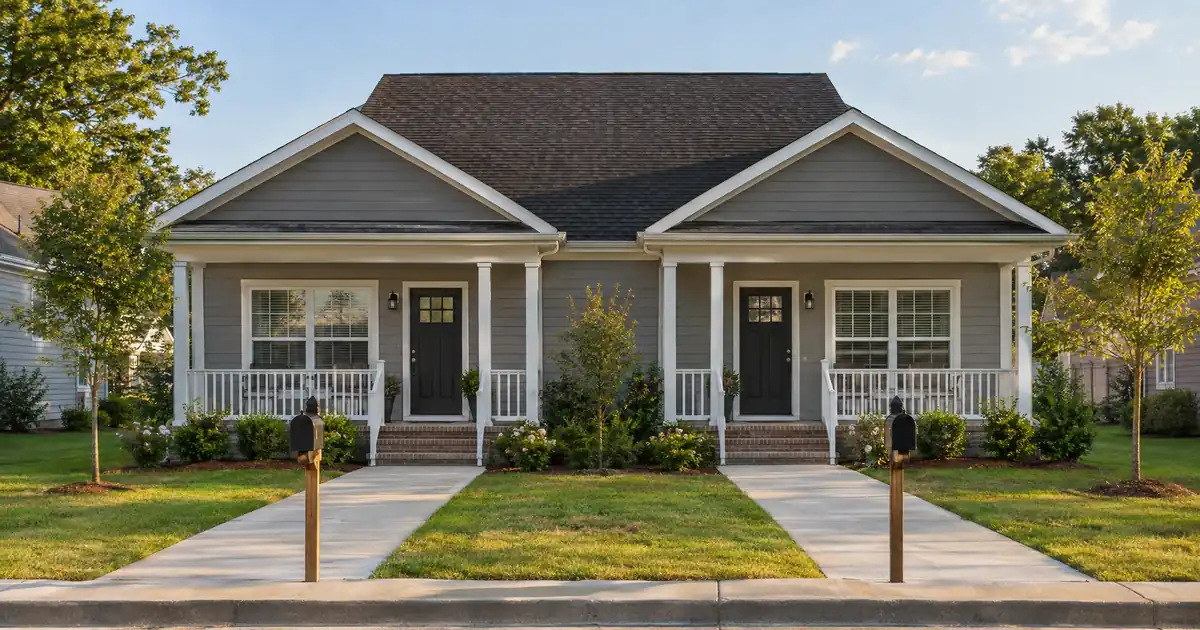
Yes. Across our wholesale network, portfolio programs accept single-family homes, two-to-four-unit buildings, condos and townhomes. A duplex is simply a two-unit rental, and the lender treats it as one property in the pool.
The edges matter. These properties are not offered in the pool:
- Owner-occupied property
- Co-ops
- Mixed-use or commercial buildings
- Mobile homes
- Manufactured homes (single- and double-wide)
- Log homes
- Barndominiums
A duplex with a storefront below is a mixed-use building, so it falls outside the pool. A plain side-by-side or stacked duplex does not.
The unit count also draws a line. Two-to-four-unit buildings are underwritten like residential rentals. Larger buildings move toward commercial-style review and need a different program.
One contrast helps if you have used other loan types. Under conventional rules, a two-unit building still counts as a single financed property, per Fannie Mae’s Selling Guide on multiple financed properties. Those rules do not govern DSCR loans. Our network’s pool limits come from the program guidelines below.
How Does the Lender Blend the Numbers?
The lender adds up the rent on every property and divides it by the combined PITIA. PITIA is principal, interest, taxes, insurance and any association dues. The result is one pooled coverage ratio. Where a single-property test would fail a weak rental, the pool lets a stronger one cover the gap.
For houses, the appraiser supplies a market-rent opinion on the 1007 rent schedule form. For duplexes, the 1025 form captures income by unit. The lender uses leases or the appraiser’s supported rent, depending on the program.
Here is an illustration. The ratios below are modeled assumptions, not market data, and they assume equal payments on all four properties so the blend is a simple average.
| Property | Own coverage | Role in the pool |
|---|---|---|
| House A | 1.30x | Strong carrier |
| House B | 0.95x | Weak link |
| Duplex C | 1.20x | Steady |
| Duplex D | 1.10x | Steady |
| Pooled result | About 1.14x | Clears 1.00 |
House B would struggle on its own. Inside the pool, its shortfall is offset by the stronger properties, so underwriting tests the pooled coverage, the leverage and the terms rather than House B alone. The blend only holds the average when payments are similar. If House B carries the largest payment, it pulls the pool down more than a simple average suggests.
Clearing 1.00 is also not the same as positive cash flow. DSCR compares rent to PITIA only. Repairs, vacancy, management and utilities sit outside the calculation.
Pool Everything, Pool Some, or Keep Separate Loans?
The right choice depends on how long you plan to hold. Three structures are common.
| Structure | Best when | Main drawback |
|---|---|---|
| Full pool | You hold stabilized rentals long term | Selling one needs a release |
| Partial pool | Most properties are strong, a few are in flux | Leftover loans to manage |
| Separate loans, closed together | You may sell or refinance one soon | More closings and payments |
Partial pooling is the most overlooked option. Leave out any property that needs work, may be sold within a few years or runs thin on coverage. A pool works best when every asset is a long-term hold.
Parallel individual loans cost you the single payment. They keep each property independent, which is cleaner for a sale or a tax-deferred exchange later. Tax treatment varies; consult a qualified professional.
Step-by-Step: Moving Existing Properties Onto One Loan
1. Inventory the properties. List each house and duplex with its current loan, lien position and ownership entity.
2. Screen the candidates. Keep stabilized, long-term holds. Drop anything vacant, under renovation or likely to be sold.
3. Gather per-property documents. Collect leases for each unit, insurance declarations, entity papers and recent rent history.
4. Align the titling. Properties held in different LLCs need a plan, because the lender may require a single special-purpose entity on some structures, per lender program requirements.
5. Order appraisals. Each property gets its own appraisal and rent opinion. A shortfall on one affects the pool.
6. Review the allocation. The loan documents assign an allocated amount to each property, and every later release price builds on it.
7. Read the release language. Get the sale terms in writing before you sign.
8. Pay off the old loans. The new note pays off the existing mortgages at closing.
Expect your credit score to matter alongside the rent. The credit floor on the 30-year portfolio program is typically 640, and some portfolio structures ask for 680 or 720.
What Can Go Wrong in a Pool?
Cross-collateralization is the main risk. Nav’s explanation of cross-collateralization covers the idea: each property backs the whole loan. If you default, the lender can pursue every property in the pool, not just one.
Here are the other risks, with a way to handle each.
- One vacancy. A long vacancy dents pooled coverage. Hold reserves and stress-test the pool with your weakest unit empty.
- A weak asset. A property that barely covers its own payment can block a later release or refinance, because the remaining portfolio must still cover its debt service.
- An appraisal shortfall. A low value on one property can change the leverage on the whole pool. Run the numbers on the downside before ordering.
- Entity mismatch. A personal guaranty can stay in place after a property leaves the lien. Mixing series LLCs under one lien needs a lender’s approval first.
A practical pattern we see: borrowers focus on the blended ratio and skip the question of which property they might sell first. Sketch the exit order before you apply, because that sequence drives the allocation.
Selling One Property Later: Release Terms
A release provision lets you sell one property and pay down part of the loan instead of the whole balance. It exists only if it is written into the note. No clause means no right, because the contract controls.
Here is what to ask for in writing:
- The release price for each property. It typically runs above that property’s allocated balance, so ask for the exact formula.
- Whether the remaining properties are retested for coverage or leverage after each sale.
- How sale proceeds reach the lender and how the lien release gets recorded.
- Whether a substitution, swapping one property for another, is allowed.
Partial releases, substitutions and sales follow the loan documents and the lender’s release terms. Programs differ here more than anywhere else.
Purchase, Rate-and-Term, or Cash-Out: Which Fits?
| Goal | Typical fit | Leverage ceiling |
|---|---|---|
| Buy a bundle at once | Purchase | Up to 80% |
| Consolidate loans | Rate-and-term | Up to 80% |
| Pull equity | Cash-out | Up to 75% |
Leverage figures are for the 30-year portfolio structure on investment property, measured against the pool’s combined value. On a cash-out, 75% of pooled value is the ceiling, and cash-out inside the first six months of ownership is capped by the seasoning rule. A larger down payment can lift coverage, but it does not erase credit floors, reserve rules or property eligibility.
For a larger holding of five or more rentals, a different structure may fit. Lendmire’s piece Is One Portfolio Cash-Out Refinance Worth It for Five or More Rentals? covers that decision. If some of your properties are short-term rentals, see how several short-term rentals can sit under one blanket DSCR loan. Short-term rental rules can vary by city, county, HOA, and property type, so investors should confirm local rules before relying on projected rental income.
Program Parameters for the Pool
These are typical ranges from select lenders in our wholesale network, not quotes. Every file is underwritten individually, and nothing here is a commitment to lend.
Structure A: the 30-year portfolio loan.
- Two to twenty properties under one note
- Loan sizes typically from $300,000 to $5,000,000, with larger balances reviewed case by case
- Leverage up to 80% on a purchase or rate-and-term refinance
- Coverage floor of 1.00 measured on the pooled rent
- Fixed or adjustable rates, with an interest-only period available
- Credit floor typically 640, higher on some structures
- Reserves around 6 months of PITIA, stepping up to about 9 months above $1,500,000
Structure B: the rental portfolio term loan.
- Five or more rental properties or units under one loan
- Loan sizes from $500,000, with leverage up to 75%
- Fixed terms of 3, 5, 7 or 10 years with a balloon at maturity
- Recourse and non-recourse options (non-recourse looks to the real estate, with carve-outs such as fraud and bankruptcy)
- Properties in several markets can sit under one loan. Every figure here varies by lender and program — guidelines, property type, leverage, and credit profile all apply.
For comparison, a loan on one rental typically runs 75%–80% on a purchase, with a 1.00 floor on select programs. The pool’s figures above apply only when several properties share one note.
Decision in Three Questions
1. Will you hold every property in the pool for the long term?
2. Does the pooled coverage hold up with your weakest unit vacant?
3. Can you read and accept the release terms before signing?
If the answer to all three is yes, a pool deserves a quote. If any answer is no, consider a partial pool or parallel loans.
Key Terms Defined
PITIA: Principal, interest, taxes, insurance and association dues, the monthly obligation that rent is measured against.
Cross-collateralization: Each property in the pool secures the whole loan, not just its own share.
Release provision: A clause in the note that lets you sell one property by paying a set amount instead of the whole balance.
Blended ratio: Total pooled rent divided by total pooled PITIA.
Allocated amount: The share of the loan assigned to each property, which sets its release price.
Frequently Asked Questions
Can I mix houses and duplexes in one DSCR loan?
Yes, subject to lender guidelines. Single-family homes, two-to-four-unit buildings, condos and townhomes can share a pool. Owner-occupied property and mixed-use buildings cannot.
Can a strong property cover a weak one?
Within limits. Coverage is measured on the pool, so strong rent can offset a thin property. The pooled coverage, the leverage and the terms are still what underwriting tests, and a weak asset can block later releases.
Do I need a separate appraisal for each property?
Yes. Each property gets its own appraisal and rent opinion, which is how the lender values and allocates the pool.
Can I put the properties in an LLC?
Often, subject to program terms. Some structures require a special-purpose entity. A personal guaranty can remain after a property is released, and series LLCs need lender approval first.
How many properties can one loan hold?
The 30-year portfolio program typically covers two to twenty. The rental portfolio term loan is built for five or more properties or units.
Next Step
If you are buying or refinancing a rental property and want to see how the numbers work, Lendmire can help you compare DSCR loan options based on the property income, credit profile, leverage, and investor goals.
About Lendmire
Lendmire (NMLS# 2371349) is a DSCR-focused mortgage broker that arranges investor financing through select lenders in its wholesale network, across 41 markets including Washington, D.C. It is not a lender, and all loans are subject to lender underwriting and approval. Scotsman Guide named Lendmire a Top Mortgage Workplace in both 2025 and 2026.
Get Started
Ready to find the right loan for you?
In about 30 seconds you can review financing options available for your investment property. No commitment required.
Informational only. Not a Loan Estimate, approval, or commitment to lend. Program availability and eligibility are subject to lender guidelines, credit approval, property review, and underwriting.
References
1. Fannie Mae Selling Guide B2-2-03: Multiple Financed Properties Same Borrower
2. Nav: Cross Collateralization
This article is part of Lendmire’s DSCR loan program — full qualification details, guidelines, and scenarios live on the program page.
Related reading: How to Handle Vacancies Before a DSCR Portfolio Loan · Can You Swap One Rental for Another in a Portfolio DSCR Loan? · How to Document a Portfolio DSCR Loan Without Personal Income
Brandon Miller
Founder & CEO, Mortgage Loan Originator, Lendmire LLC
- Mortgage Loan Originator · NMLS# 1129696 · Verify on NMLS Consumer Access
- North Carolina Real Estate Broker · License# 343312 · Verify on NCREC
- North Carolina Insurance Producer · License# 19053198 · Property, Casualty, Life, Health · Verify on NAIC SBS
- Lendmire LLC · Firm NMLS# 2371349 · Verify firm licensure
Required disclosures. Lendmire (NMLS# 2371349) operates as a licensed mortgage broker, not a direct lender or depository. The discussion in this article is general in nature and should not be relied upon as financial, legal, or tax advice — every investment scenario is unique and should be reviewed by a qualified professional. Any loan inquiry is subject to lender underwriting, and this article is not a commitment to lend or a guarantee of approval. Mortgage rates, loan terms, and program guidelines vary by borrower, property, and state, and may change without notice. Equal Housing Opportunity. Verify licensure at NMLS Consumer Access.