
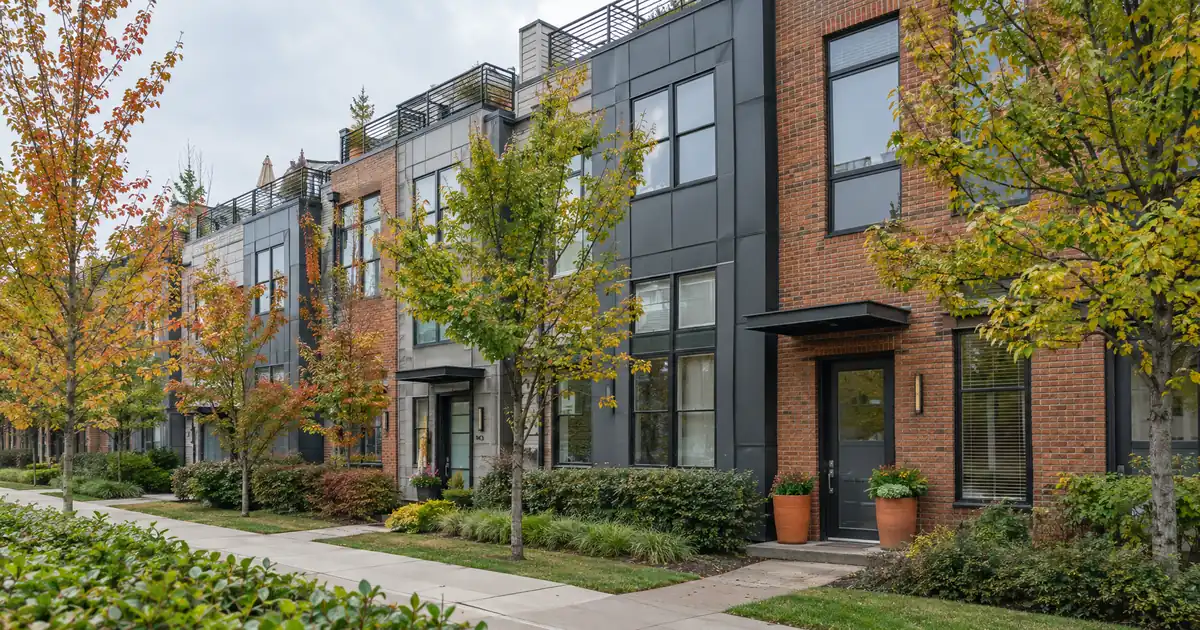
The Quick Read: It depends on three things: whether the lender’s portfolio program accepts condo units, whether the building passes the lender’s own project review, and whether the combined rent from all the units in the pool covers their combined monthly housing payments, including association dues. When all three line up, units in the same building can sit under one note. When they do not, separate loans on each unit are the usual fallback.
- Condo units are an eligible property type in the portfolio programs we place files with, but each building still gets reviewed.
- Coverage is tested on the pool, so a strong unit can offset a weak one.
- Owning many units in one building concentrates your risk in a single association.
- A blanket loan ties every unit to the whole balance, so one problem can reach all of them.
- Qualification is subject to lender guidelines, credit approval, and property review.
Can Several Condos in One Building Be Financed Under One DSCR Portfolio Loan?
Yes, in many cases, but the building is the variable. A portfolio loan (also called a blanket loan) is one note secured by two or more properties. Across the wholesale network Lendmire works with, condos are an accepted property type in these programs, alongside single-family homes, townhomes, and 2-4 unit buildings.
Two portfolio structures matter here.
The first is a 30-year portfolio DSCR loan. It covers 2 to 20 properties under one note, with loan sizes from $300,000 to $5,000,000 (larger balances on review). Leverage runs up to 80% of value on a purchase or a rate-and-term refinance. It offers fixed or adjustable rates and an interest-only period. Final terms depend on lender guidelines, property type, leverage, and the borrower’s complete credit picture.
The second is a rental portfolio term loan, built for five or more rental properties or units. Loan sizes run from $500,000 to $50,000,000, with leverage up to 75% of value. Terms are 3, 5, 7, or 10 years with a balloon payment at maturity, and both recourse and non-recourse versions exist. A non-recourse loan looks to the real estate, with recourse limited to carve-outs such as fraud and bankruptcy. These specifics are subject to lender guidelines and a full review of property, leverage, and credit.
These are program ceilings, not quotes. Every file is underwritten individually. For the basics behind all of this, see the complete DSCR loans guide.
Notice what the programs do not say. They do not say the building gets a pass. Each building still goes through the lender’s project review, which looks at the association’s budget and reserves, litigation, the share of units owned by investors, commercial space, and any hotel-style use.
How Does a Blended DSCR Work With Association Dues?
The lender adds up the monthly rent from every unit and divides it by the total monthly payment on every unit. That payment is principal, interest, taxes, insurance, and association dues. Dues matter more on condos than on almost any other property type, because they sit in the denominator every month.
Picture a pool of two units. One covers its payment at about 1.6x on its own. The other covers at about 1.0x. Tested together, the pool lands near 1.3x. The stronger unit lifts the weaker one, which is the whole appeal of testing the pool.
The pooled floor on the 30-year portfolio structure is 1.00. That is a floor for that program, not a promise that anything above it qualifies. A unit that falls below 1.00 can sometimes sit inside a pool, but in that case pooled coverage, leverage, and terms are what underwriting tests, subject to underwriting.
Some mechanics to know:
- Every unit still needs a lease or an appraiser-supported market rent.
- A vacant unit counts at the market rent the appraiser documents, not at zero.
- Appraisers document that rent on the 1007 rent schedule for single-unit properties, or the 1025 for small income properties.
- Each unit gets its own appraisal, and then the rents are pooled.
One caution. Clearing 1.00 on the pool does not mean the units make money. DSCR compares rent to the housing payment only. Repairs, vacancy, management, utilities, and special assessments sit outside the calculation, and in a condo building a special assessment can arrive for every unit at once.
Why Does Owning Several Units in One Building Raise a Flag?
Because one owner holding a large share of a building concentrates risk for the lender, the other owners, and you. If that owner has trouble paying dues, the association’s budget suffers. If the building has a problem, every unit you own is hit at the same time.
Lenders look at this from two angles. The first is how much of the building you own, and how much is owned by investors overall. The second is what happens when you sell. A future buyer who needs financing may struggle to get it if one owner controls a large slice of the building.
The thresholds differ by lender and change over time, so no single number is safe to rely on. Ask the lender for the current rule on the exact building before you make an offer.
Owning many units gives you more voting weight. How much that matters depends on the bylaws, including any rules on renting units short-term. Short-term rental rules can vary by city, county, HOA, and property type, so investors should confirm local rules before relying on projected rental income. If a building leans on short-term rentals, Lendmire’s piece Can Several Short-Term Rentals Sit on One Blanket DSCR Portfolio Loan? covers the separate qualification rules for that income.
Holding the units through one LLC or several does not make the concentration disappear. The lender looks at who ultimately owns the units. Some structures also require a special-purpose entity, typically an LLC, depending on program guidelines.
Does Non-Warrantable Mean Unfinanceable?
No. A non-warrantable building is one that fails the tests set for agency-style loans, which are the loans designed to be resold on the secondary market. DSCR loans are not bound by those tests. Lenders in our network review the building on their own terms, and a building that fails the agency tests can still be reviewed, usually with adjusted leverage or added conditions.
The agency view is still useful as a contrast. Fannie Mae’s guide on waiver of project review shows that project review is its own layer of underwriting, separate from your qualification as a borrower. Its list of ineligible projects includes condo hotels and timeshare or segmented ownership. Those rules govern agency loans only. For a DSCR file, a hotel-style building is a case-by-case question for the lender.
What does not change is the property list. Owner-occupied homes, mobile homes, co-ops, mixed-use property, and commercial property are not eligible inside the pool. Manufactured homes, log homes, and barndominiums are not offered in these programs at all.
One Blanket Loan or Separate Loans?
Neither is better in general. A blanket loan trades flexibility for convenience, and separate loans trade convenience for isolation.
| Factor | Blanket (portfolio) loan | Separate loans |
|---|---|---|
| Qualification | Pooled coverage | Each unit alone |
| Weak unit | Can hide in the blend | Stands on its own |
| Cross-default | Every unit secures the whole | Risk stays isolated |
| Selling one unit | Release terms apply | Pay off that loan only |
| Paperwork | One note, one servicer | More servicers, more files |
| Best fit | Several units, strong pool | Mixed quality, flexible exits |
Here is the practical version. Say you own three units in one building. Two cover well and one is weak, and you plan to sell the weak one within a few years. Separate loans keep that sale simple. A blanket loan makes sense if you plan to hold all three and want a single note.
Size also decides things. The 30-year portfolio structure starts at $300,000 in loan size and the term loan at $500,000. A small group of units may fall below those floors. In that case separate DSCR loans, which smaller balances route through select lenders in the network, fill the gap.
How Much Cash Do Multiple Closings Take?
More than most investors budget for, because each unit needs its own cash. On a purchase, leverage on the 30-year portfolio structure runs up to 80% of value, which means roughly 20% down on each unit at the top of the range. Closing costs come on top, and so do reserves. Terms depend on the lender’s guidelines, the property type, the leverage, and a full review of the credit profile.
Reserves vary by lender, leverage, loan size, and structure. On standard DSCR files they commonly run around six months of the full monthly payment, stepping up to about nine months on larger balances above $1,500,000. On the term loan, reserves are held for taxes, insurance, and capital expenditures. Ask for the exact reserve rule for the structure you are using.
Credit matters too. The pooled programs commonly look for a score of 640 or higher, and some structures want 680 or 720. A larger down payment can lift coverage by shrinking the payment, but it does not erase leverage caps, credit floors, or reserve rules. The strongest files pass both tests: enough equity and enough rental coverage.
If you are refinancing and pulling cash out, the ceiling is 75% of the pooled value, never more. Inside the first six months of ownership, the seasoning rule limits the cash-out amount.
What to Request From the Association Before You Buy
Ask before you offer, not after. For each building, request:
- The current budget and the most recent financial statement.
- The reserve study or reserve balance.
- The master insurance policy, plus what your own unit policy needs to cover.
- A list of pending or recent litigation.
- The count of owner-occupied versus investor-owned units, and how many belong to any single owner.
- Any special assessments planned or already approved.
- The rental rules in the bylaws, including minimum lease length.
- The percentage of space used for commercial purposes.
Your own file needs a schedule of real estate owned, leases or appraiser-supported rents, entity documents if you hold the units in an LLC, and title for each unit. A release schedule with allocated loan amounts matters if you use a blanket.
Selling One Unit Later: Release and Exit Planning
A release clause lets you sell one unit out of the pool without paying off the whole loan. The details live in the loan documents. The release price runs above the property’s allocated balance, and the remaining properties must still cover their combined debt service afterward. That second condition catches people. If you sell the strongest unit, the remaining pool can fall short.
Term loans add another layer. They carry prepayment terms, so check how a sale or early payoff is treated before you sign.
Concentration works against you at exit. Buyers who need financing may find it harder to qualify in a building where one owner holds a large share. A practical approach is to decide up front which unit you intend to keep and which you could sell, then check that the release terms allow the sale and the remaining pool still covers. Tax treatment can depend on how the funds are used and how the property is held; investors should keep clear records and speak with a qualified tax professional before relying on any deduction.
Which Building Problems Matter Most?
| Trigger | Usually fixable? | Concern level |
|---|---|---|
| High investor share | Sometimes | Moderate for DSCR, higher for agency |
| One owner holds many units | Rarely | Moderate; affects exit |
| Thin association reserves | Sometimes | Moderate |
| Active structural litigation | Rarely | High |
| Insurance gaps on master policy | Sometimes | High until resolved |
| Heavy commercial space | Rarely | Moderate to high |
| Hotel-style operation | Rarely | Case by case |
Some of these can shift between contract and closing, such as a new assessment or an insurance change. Check them again before you close.
Decision Checklist: Which Path Fits?
Run through these questions in order:
1. Are the units in one building? If so, concentration is the first question to ask.
2. Do you have enough units and enough combined loan size for a portfolio program?
3. Does the pooled coverage clear, or does one weak unit carry the blend?
4. Do you plan to hold every unit, or sell one soon?
5. Does the building pass the lender’s project review?
6. Can you fund each unit’s down payment, closing costs, and reserves at the same time?
If most answers are yes, a blanket loan is worth pricing. If the answers are mixed, separate loans, or waiting, usually protect you better.
Key Terms Defined
DSCR (debt service coverage ratio): The property’s rent divided by its monthly housing payment, used to judge whether the rent covers the loan.
PITIA: Principal, interest, taxes, insurance, and association dues, the full monthly housing payment.
Portfolio (blanket) loan: One loan secured by two or more properties.
Cross-collateralization: Each property secures the whole balance, not just its own share.
Release clause: The loan term that lets you sell one property out of the pool and keep the loan on the rest.
Project review: The lender’s check of the condo building itself, separate from your own qualification.
Non-warrantable: A condo building that fails agency-style tests, though it may still be reviewed by DSCR lenders.
LTV (loan-to-value): The loan balance as a percentage of the property’s value.
Frequently Asked Questions
Does a blanket loan make condo approval easier?
No. The building still goes through project review, and the pool still has to clear coverage. What a blanket changes is how the units are tested, as a group instead of one at a time.
Can one weak unit sink the whole loan?
Not by itself, because coverage is tested on the pool. But a weak unit lowers the blend, and the lender also looks at leverage and terms. Because every property secures the whole balance, a problem with one unit can reach the others.
Does a blanket loan change how many financed properties I own?
No. A blanket loan is one note, but the lender still sees each property as a financed property. Plan your borrowing capacity on that basis.
Can I include a vacant unit in the pool?
Yes, in many cases. A vacant unit is counted at the market rent the appraiser documents. Pooled coverage, leverage, and terms are still what underwriting tests, subject to lender guidelines.
Does an LLC change how the building sees my ownership?
Generally not. Lenders look through the entity to the people behind it, so holding units in one or several LLCs does not remove concentration. Entity requirements vary by program.
Next Step
If you are buying or refinancing a rental property and want to see how the numbers work, Lendmire can help you compare DSCR loan options based on the property income, credit profile, leverage, and investor goals. Reach the team at 828-256-2183, or request a quote on the site. Whether the pool or the single note wins usually comes down to one building’s association, not the loan program.
About Lendmire
Lendmire — NMLS# 2371349 — is a DSCR and non-QM mortgage brokerage with investor loan programs in 41 markets, including Washington, D.C. DSCR eligibility is commonly reviewed by the lender around property-level rent rather than personal income documentation, subject to lender guidelines, and the brokerage helps arrange financing for LLC-owned portfolios beyond conventional financed-property limits. Recognized by Scotsman Guide as a Top Mortgage Workplace in 2025 and 2026.
Get Started
Ready to find the right loan for you?
In about 30 seconds you can review financing options available for your investment property. No commitment required.
Informational only. Not a Loan Estimate, approval, or commitment to lend. Program availability and eligibility are subject to lender guidelines, credit approval, property review, and underwriting.
References
1. Fannie Mae Selling Guide: Waiver of Project Review
2. Fannie Mae Selling Guide: Ineligible Projects
This article is part of Lendmire’s DSCR loan program — full qualification details, guidelines, and scenarios live on the program page.
Related reading: How to Raise Pooled DSCR Coverage Before a Portfolio Loan · How a Portfolio DSCR Loan Moves From Application to Closing · Can Vacant Rentals Be Included in a Portfolio DSCR Loan?
Brandon Miller
Founder & CEO, Mortgage Loan Originator, Lendmire LLC
- Mortgage Loan Originator · NMLS# 1129696 · Verify on NMLS Consumer Access
- North Carolina Real Estate Broker · License# 343312 · Verify on NCREC
- North Carolina Insurance Producer · License# 19053198 · Property, Casualty, Life, Health · Verify on NAIC SBS
- Lendmire LLC · Firm NMLS# 2371349 · Verify firm licensure
Legal disclosures. Lendmire (NMLS# 2371349) is a state-licensed mortgage brokerage that arranges financing through wholesale lender relationships. Lendmire is not a direct lender, depository institution, or registered financial advisor. The discussion above is general informational content about real estate financing — it is not financial, legal, or tax advice, and readers should consult licensed professionals for guidance on their individual circumstances. Loan inquiries are subject to lender underwriting; this article does not represent a commitment to lend. Loan terms, rates, and qualification standards vary by borrower, property, and state, and are subject to change at any time. Equal Housing Opportunity. NMLS Consumer Access: nmlsconsumeraccess.org.