
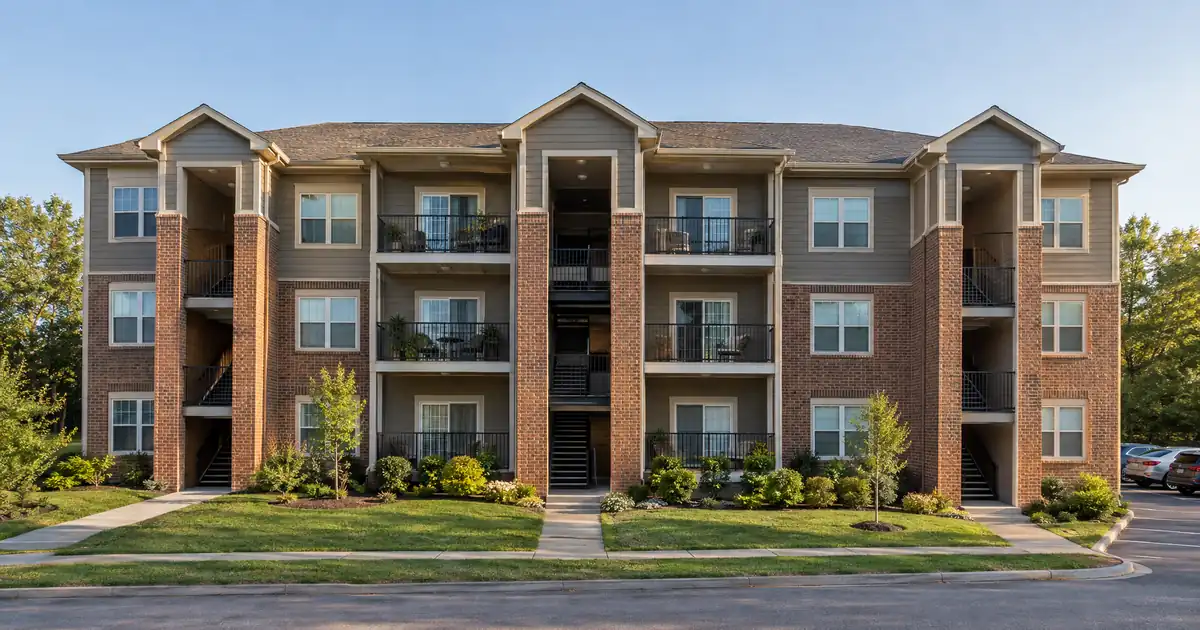
The Quick Read: The two fourplexes and the six-unit usually land in different loan categories, because unit count per building sets the product, not the total door count. A DSCR loan (one that qualifies primarily on property-level rental income covering the payment, subject to lender guidelines) is the natural fit for each fourplex. A commercial multifamily loan, which looks at the building’s net operating income, is the usual fit for the six-unit.
- Each fourplex is a 1-4 unit asset. The six-unit is a 5+ unit asset.
- DSCR compares rent to the full monthly payment. Commercial loans compare income after operating expenses.
- You have three structuring paths: separate loans, one blanket loan, or one commercial loan on all three.
- Many investors split the deal: DSCR on the fourplexes, a 5+ unit loan on the six-unit.
- Leverage, reserves and eligibility vary by lender, and every file is underwritten individually.
Picture an investor with two four-unit buildings under contract and a six-unit down the road. The first question is not “which loan is better?” It is “which loan fits each building?” The honest answer is that DSCR is built for the smaller buildings, and commercial multifamily is built for the larger one. A blanket loan is a third option that ties them together, with trade-offs covered below.
Key Terms Defined
DSCR (debt service coverage ratio): Monthly rent divided by the monthly housing obligation, meaning principal, interest, taxes, insurance and any HOA dues (PITIA).
NOI (net operating income): A building’s income after operating expenses, used to size commercial multifamily loans.
Blanket loan: One loan secured by several properties, so all of them back a single note.
Cross-collateralization: Pledging more than one property against the same debt, so trouble on one can put the others at risk.
Release clause: A loan term that lets you sell or refinance one property without paying off the whole loan, if the lender’s conditions are met.
Recourse: A loan where the signer is personally liable for the debt if the property does not cover it.
Side-by-Side
The column on the right shows published industry norms for commercial multifamily. Lendmire’s wholesale network places both kinds of loans, and terms vary by lender.
| Factor | DSCR Loan (1-4 units) | Commercial Multifamily (5+ units) |
|---|---|---|
| Review basis | Property rent vs. PITIA | NOI, debt yield, sponsor strength |
| Documentation | Leases, rent schedule, entity papers | Rent roll, operating statements, more financials |
| Property types | Fourplex and smaller | Five units and up |
| Entity vesting | Individual or LLC, per program terms | LLC common; personal guarantee often required |
| Appraisal | Small residential income report | Commercial income-approach report |
| Timeline | Generally shorter file | Generally longer, more diligence |
| Reserves | Often around 6 months of PITIA | Set by lender; often liquidity tests |
| Loan structure | Fully amortizing 30-year fixed is the spine | Shorter terms with balloon common |
How the Loan Category Gets Decided
Unit count per building draws the line. Fannie Mae’s appraisal guidance assigns Form 1025, the small residential income report, to two- to four-unit properties. Agency rules do not govern DSCR loans, but the form name shows where the market draws the boundary. A six-unit falls outside that form and needs a commercial-style appraisal built on income and cap-rate analysis.
So eight fourplex doors do not make you a commercial borrower. The four-unit line applies building by building. How a blanket loan treats a mix of 1-4 unit and 5+ unit collateral is lender-specific, and it is a question for the program guidelines, not a general rule.
One more point on classification. DSCR loans are designed for non-owner-occupied investment properties. Because they are business-purpose investor loans, they are reviewed differently from a standard owner-occupied mortgage. Federal rules exempt credit extended primarily for a business or commercial purpose, and a commercial multifamily loan sits in that same bucket. Tax treatment varies; consult a qualified professional.
Why the Math Is Different
The same rent can produce a different coverage number under each test. Residential-style DSCR divides rent by PITIA. It does not subtract management, maintenance or reserves from the ratio. Commercial underwriting starts with NOI, which deducts operating expenses, vacancy and replacement reserves before the lender sizes the debt.
That means a six-unit can show a thinner ratio under commercial math than a similar-rent fourplex does under DSCR math. Neither number is wrong. They measure different things.
Clearing 1.00 on a DSCR file is not the same as positive cash flow, either. Repairs, vacancy, management, utilities and capex all sit outside the calculation. A fourplex that covers its payment can still lose money in a bad year.
Three Ways to Structure This Portfolio
Path A: separate loans. Each fourplex gets its own DSCR loan, with its own note, appraisal, title and closing. The six-unit goes to a 5+ unit program or a commercial lender. You get three closings. You also isolate risk, so a problem at the six-unit does not drag the fourplexes into it.
Path B: one blanket loan. One note secures all three buildings, and the lender looks at the portfolio as a whole. You get one closing and one servicer. The cost is pooled risk. Cross-collateralization means a default can put every property at risk, and release clauses are common but not guaranteed. Because the six-unit is commercial, a blanket across all three usually lands in a portfolio or commercial structure. Whether a given non-QM program will blanket 1-4 unit and 5+ unit buildings together depends on the program.
Path C: a commercial or bank loan on all three. This works if you have a strong local banking relationship. Recourse is typical, meaning you sign personally even when an LLC holds title. Commercial multifamily also commonly carries shorter terms with a balloon payment, which creates refinance risk on a schedule you do not control. A fully amortizing 30-year DSCR structure on the fourplexes avoids that.
Here is a worked comparison using ratios only. Say fourplex one clears roughly 1.25x, fourplex two clears about 1.15x, and the six-unit shows about 1.05x under commercial NOI math. In a blanket, the blended picture could look healthy at around 1.15x. That blend can hide the weaker building. Separate loans show each asset on its own merits. These are modeled assumptions, not market data.
When a DSCR Loan Is the Better Fit
DSCR wins on the two fourplexes. Each is a 1-4 unit rental, and the loan is reviewed primarily on property-level rental income covering the payment, subject to lender guidelines. You are not handing over personal income documents as the main test.
Across Lendmire’s wholesale network, most purchase files land at 75%-80% LTV (20%-25% down) on an investment property. Select high-leverage programs reach 85% LTV with roughly a 700+ score. Coverage of 1.00 is where select programs start, and stronger ratios open better leverage. Credit floors start at 620 in parts of the network, and most programs want around 660 or higher.
Loan sizes reach up to $3,000,000 on standard programs, with smaller balances available through select lenders on standard programs. Reserves commonly run around 6 months of PITIA, stepping up to about 9 months on loans above $1,500,000. Terms are flexible: the 30-year fixed is the spine, while 40-year terms and interest-only periods are available through select lenders.
DSCR also fits if you want a fully amortizing structure with no balloon, and if you plan to hold in an LLC, subject to lender program eligibility. For deeper detail on how these loans work, see the complete DSCR loans guide.
When a Multifamily Loan Is the Better Fit
A commercial multifamily loan wins on the six-unit. It is the product built for five or more units, and its underwriting matches how larger buildings are valued.
It also fits when a building carries real operating history. A stabilized, fully leased six-unit with clean operating statements can make a strong NOI case. Commercial lenders may also measure a global DSCR, which pools income and debt service across all of a borrower’s properties, so strong fourplexes can offset a weaker building. That is not how standalone DSCR works on each fourplex.
Expect more paperwork and more diligence on the commercial side: a rent roll, operating statements, and often environmental review and property condition assessments. Some lenders also require a single-purpose entity. For a closer look at how the 5+ unit side differs, Lendmire’s piece Multifamily DSCR vs Bank Loan Terms for a W-2 Investor on a 5-Plus Unit covers the trade-offs.
Some non-QM lenders stretch DSCR-style underwriting to small 5+ unit buildings. Availability is program-specific, so confirm which formula applies to the six-unit before you assume either path.
Mistakes to Avoid
- Assuming all three buildings use one loan type. Unit count per building decides it.
- Treating a ratio above 1.00 as profit. DSCR leaves out repairs, vacancy and management.
- Assuming an LLC erases personal liability. On commercial loans, a personal guarantee often follows the signer.
- Ignoring blanket release terms. Without a release clause, selling one building may require lender approval or restructuring.
- Skipping the equity test. A bigger down payment can lift coverage, but it never erases leverage caps, credit floors, reserve rules or property eligibility. Strong files clear both equity and coverage.
The Verdict
If you want the cleanest answer, split the deal. Use DSCR on the two fourplexes and a 5+ unit or commercial loan on the six-unit. Each building gets the structure built for it, and no weak asset masks a strong one.
Choose a blanket if one closing and one servicer matter more to you than flexibility, and if you are comfortable with pooled risk. Choose a commercial loan on all three if you have a bank relationship and accept recourse and shorter terms. It is a genuine toss-up between Path A and Path B for some investors, and the deciding factor is usually how much you value being able to sell one building cleanly.
If you are buying or refinancing rental property and want to see how the numbers work, Lendmire can help you compare DSCR loan options based on the property income, credit profile, leverage, and investor goals. Lendmire is a broker arranging financing through select lenders in its wholesale network, with investor loan programs across 41 markets, including Washington, D.C. Not a commitment to lend.
Frequently Asked Questions
Does a six-unit building count as commercial?
Yes, in most lending. Five or more units generally moves a building into commercial multifamily underwriting, with NOI-based sizing and a commercial-style appraisal. Some select programs reach into small 5+ unit buildings, but availability depends on the lender.
Can I put two fourplexes and a six-unit under one loan?
Sometimes, through a blanket or portfolio structure. Whether a program will combine 1-4 unit and 5+ unit collateral depends entirely on that program’s guidelines. Many investors avoid the question by using separate loans.
Can an LLC borrow on these loans?
Often, subject to lender program eligibility. DSCR programs commonly allow individual or LLC vesting. Commercial lenders also lend to LLCs but frequently require a personal guarantee from the principal.
Does a strong DSCR mean the property will cash flow?
No. DSCR compares rent to PITIA only. Repairs, vacancy, management, utilities and capex sit outside the ratio, so budget for them separately.
What does a bigger down payment change?
It lowers the payment and can lift the coverage ratio. It does not override leverage caps, credit floors, reserve rules or property eligibility. Lenders check equity and rental coverage as two separate tests.
About Lendmire
As a DSCR and non-QM mortgage broker, Lendmire — NMLS# 2371349 — connects investors with wholesale lending channels across 41 markets, including Washington, D.C. The property’s rental income, not the borrower’s traditional personal-income documentation, is central to lender review, which works for self-employed operators and portfolios beyond four financed properties. Scotsman Guide named Lendmire a Top Mortgage Workplace in both 2025 and 2026.
Get Started
Ready to find the right loan for you?
In about 30 seconds you can review financing options available for your investment property. No commitment required.
Informational only. Not a Loan Estimate, approval, or commitment to lend. Program availability and eligibility are subject to lender guidelines, credit approval, property review, and underwriting.
References
1. Fannie Mae Selling Guide B4-1.2-01
2. Cornell Law School: 12 CFR 1026.3 Exempt Transactions
3. Goliath Data: Beginner’s Guide to Blanket Mortgages
4. Multifamily-USA: What Is US Multifamily 5+
This article is part of Lendmire’s DSCR loan program — full qualification details, guidelines, and scenarios live on the program page.
Related reading: Can a Landlord Replace a Maturing Blanket Loan With a DSCR Loan? · How to Count Three Fourplexes Toward a DSCR Portfolio Loan · How a DSCR Portfolio Loan Works When You Sell the Pool
Brandon Miller
Founder & CEO, Mortgage Loan Originator, Lendmire LLC
- Mortgage Loan Originator · NMLS# 1129696 · Verify on NMLS Consumer Access
- North Carolina Real Estate Broker · License# 343312 · Verify on NCREC
- North Carolina Insurance Producer · License# 19053198 · Property, Casualty, Life, Health · Verify on NAIC SBS
- Lendmire LLC · Firm NMLS# 2371349 · Verify firm licensure
Disclosure information. Lendmire is a state-licensed mortgage brokerage under NMLS# 2371349. Lendmire is not a depository institution, direct lender, or financial advisor — all loans referenced are placed through wholesale lender partners and are subject to each lender's underwriting standards. This article is provided for general informational purposes and is not a commitment to lend, nor does it constitute financial, legal, or tax advice. Loan programs, terms, rates, and qualification standards change without notice and depend on borrower profile, property type, and the state in which the subject property is located. Equal Housing Opportunity provider. NMLS Consumer Access: nmlsconsumeraccess.org.