
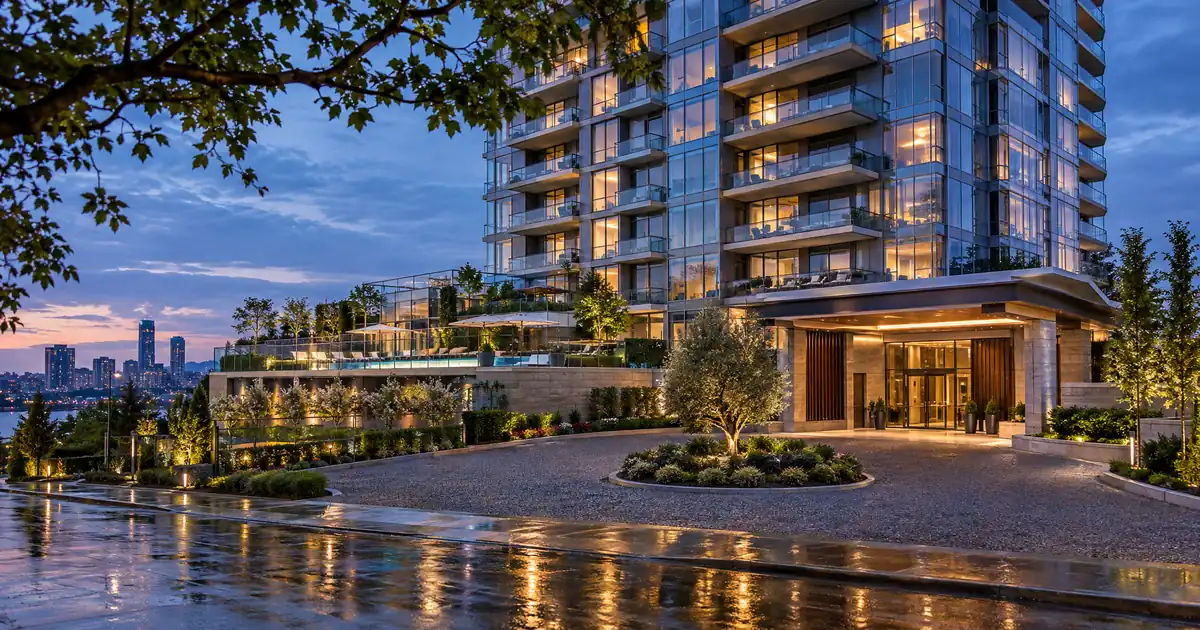
The Quick Read: It depends on the building before it depends on the loan size. A luxury tower unit can reach the super jumbo tier above $3,000,000 when the project is warrantable and its rental rules are open. A non-warrantable tower stops at $1,500,000, and a condotel or mandatory rental-pool tower is reviewed case by case, subject to underwriting.
- The lender screens the building first, then the rent coverage, then the borrower.
- Non-warrantable towers are reviewable through select programs, but only to a lower loan cap and lower leverage.
- An HOA rental ban cannot be fixed by any loan structure.
- Luxury rents rarely scale with price or dues, so the coverage number is usually the second gate to fail.
What “Pool” Means Here
“Pool” can mean three things, and only two matter for financing. The amenity pool matters not at all. An appraiser lists it as a building feature, and no underwriter prices it.
The first meaning is a rental pool, where owners share revenue from a hotel-style operation. That is a condotel, covered below. The second meaning is a pool of units: one investor buying or refinancing several units in the same tower. That is the version this article spends the most time on.
Financing several units can take two forms. You can place a separate loan on each unit. Or you can place one note secured by several rentals, which brokers call a portfolio loan, a blanket loan or a cross-collateralized loan. All three names mean the same thing. (A bank’s “portfolio loan,” meaning a loan the bank keeps on its own books, is a different idea entirely.)
Key Terms Defined
Super jumbo: A lender label, not an official category, for balances above the standard program cap. On Lendmire’s network the standard DSCR program stops at $3,000,000, and the super jumbo ladder runs above it to $10,000,000.
DSCR (debt service coverage ratio): Monthly rent divided by the full monthly obligation: principal, interest, taxes, insurance and association dues. Dues sit in the denominator. They are not subtracted from rent first.
Warrantable condo: A building that meets the project-eligibility tests agencies use for their own loan purchases. DSCR loans are not agency products, so those tests do not govern them.
Non-warrantable condo: A building that fails one or more of those tests. The cause matters more than the label.
Condotel: A condo tower run partly like a hotel, with a rental pool, front-desk rental services or revenue sharing.
Project review: The lender’s study of the building itself, built around a condo questionnaire the association completes.
Why the Building Gets Screened First
The tower is part of the collateral. A strong unit in a weak building is still a weak loan.
Agency rules are a useful contrast, though they do not decide a DSCR file. Freddie Mac’s Seller/Servicer Guide lists projects it will not buy, including condo hotels and transient housing, projects with critical repairs, and projects with excessive single-investor concentration. For projects of 21 or more units, its single-investor test is 25% of units. Fannie Mae’s condo Q&A defines a primarily transient project by how the units are rented, looking at whether most are rented on a short-term basis. Owners who live in a unit much of the year and rent it seasonally do not meet that definition.
Those are agency screens. Across the wholesale network, DSCR lenders write their own overlays. Some treat investor concentration, a special assessment or litigation as a pricing and leverage issue. Others treat it as a decline. That spread is why one tower can work with one lender and fail with another.
As homebuyer.com’s non-warrantable guide explains, non-warrantable is defined by exclusion. A building lands there for specific, nameable reasons. Common ones:
- high investor concentration or one owner holding many units
- delinquent dues
- pending litigation
- commercial space in the building
- short-term rental activity
- thin reserves or deferred maintenance
Two cautions follow. First, the HOA often cannot tell you whether the building is warrantable. The lender’s questionnaire answers that, so order it before you make an offer. Second, structural or safety litigation is a different animal from routine HOA disputes. It can end a file even in non-QM.
A rental ban in the declaration is the hard stop. Warrantable status is a financing test. Rental permission comes from the HOA documents, and a city permit does not override an HOA prohibition. Short-term rental rules also vary by city, county, HOA and property type. Confirm them for the specific property before relying on projected income.
The Gate Order
Files tend to fail in a predictable sequence. This table shows it.
| Gate | What the lender checks | Common failure in a tower |
|---|---|---|
| Project | Questionnaire, rental rules, insurance | Rental ban, litigation, concentration |
| Coverage | Rent against full obligation | Dues too high for the rent |
| Appraisal | Value and market rent opinion | Thin luxury comps |
| Credit and reserves | Score, subject-property reserves | Reserves funded by cash-out |
| Borrower and entity | Vesting, citizenship tier | Status limits above $3,000,000 |
Where the Coverage Number Breaks in a Tower
Luxury buildings pair high prices and high dues with rents that rise more slowly than either. The coverage ratio is the binding constraint, so run it before the offer.
The formula is simple. Rent is the numerator. Principal, interest, taxes, insurance and dues are the denominator. Raise dues and the ratio falls. Lose rent and it falls again. A special assessment or a master-policy insurance increase pushes the denominator up through dues.
| Change | Effect on coverage |
|---|---|
| Dues rise | Falls steadily |
| Rent comes in under projection | Falls steadily |
| Both at once | Falls sharply |
| Interest-only period elected | Improves, qualified on interest, taxes, insurance |
Some states now require structural reserve studies and milestone inspections on older, taller condos. An unfinished study can mean higher dues or special assessments, and both lower coverage. Treat any such regime as a diligence item, not a footnote.
If a unit lands below 1.00 on long-term rent, there are options. Select programs in the network will review coverage below 1.00 at reduced leverage, with LTV and terms adjusting, subject to underwriting. An interest-only period of up to 120 months is available to a 75% maximum. Short-term rental income is an option only where the HOA and the municipality both permit it for that property. On those files, the income counted is 80% of gross, loans run to $2,000,000, and the investor must be experienced.
A caution on the sub-1.00 route. Reduced leverage and a thinner cushion are real costs. If a tower reaches 1.00 only on aggressive rent assumptions, the stronger move is often a different building rather than a more flexible structure.
The Size Ladder
Leverage steps down as the loan amount rises. Read the bands as loan amounts, not purchase prices. Multiply price by leverage first, then find the band. All figures are ceilings through select wholesale programs, subject to underwriting.
| Loan band | Purchase | Rate-and-term | Cash-out |
|---|---|---|---|
| $150K–$1M | 80% | 80% | 75% |
| $1M–$1.5M | 75% | 75% | 70% |
| $1.5M–$2M | 75% | 75% | 60% |
| $2M–$3M | 75% | 75% | 60% |
| $3M–$4M | 65% | 65% | — |
| $4M–$6M | 60% on review | 60% on review | — |
| $6M–$10M | 60% on review | 60% on review | — |
The score needed for the top cell rises with size. About 660 does it in the first band, 700 or higher through the middle bands, and 720 or higher at $1.5M to $3M, where cash-out and top leverage sit. The program floor is 660 on loans to $3,000,000 and 700 above it. A lower score takes a lower leverage cell in the same band.
Above $3,000,000 the overlay adds more. Borrowers must be citizens or permanent residents, with a clean housing history, no rural property, and no more than ten acres on a non-rural one. Cash-out proceeds cannot satisfy reserves. Two appraisals are required above $2,000,000, which matters in a tower where the pool of comparable luxury rentals is thin. Reserves are typically six months on the subject property, or twelve for a first-time investor.
Now apply the building status to the ladder. On Lendmire’s network, a non-warrantable condo carries a ceiling of 75% and $1,500,000. A condotel carries 75% on a purchase and 65% on a refinance, also to $1,500,000, with $250,000 cash-in-hand. Neither reaches the $3,000,000-plus tier. For a non-warrantable unit that needs more than $1,500,000, the conversation moves outside the DSCR network, to a bank or a different structure.
Lendmire’s super jumbo DSCR requirements guide covers the full qualification stack for these units.
Buying Several Units in One Tower
The pooled version of the question has its own problems.
Concentration builds as you buy. Each additional unit raises your share of the building, which can push investor concentration toward a lender’s limit, and in some cases flip the building to non-warrantable between contract and closing. Lenders also cap their own exposure per building, so a large position in one tower often means spreading units across lenders.
There is a structural alternative. A 30-year portfolio DSCR loan places two to twenty properties under one note. Loan sizes run from $300,000 to $5,000,000, with larger balances reviewed individually, and leverage reaches up to 80% on a purchase or rate-and-term refinance. The coverage floor of 1.00 is measured on the pool, so rent across all units is tested against debt service across all units. Condos are an eligible property type. Credit typically starts at 640, subject to lender guidelines.
A rental portfolio term loan is a second option. Terms are fixed at three to ten years with a balloon at maturity, and a special-purpose entity may be required.
Pooling has tradeoffs. A strong unit can offset a weak one, but a rental below 1.00 inside a pool still gets tested: underwriting reviews the pooled coverage, the leverage and the terms. Selling one unit follows the loan documents and release terms, and the remaining pool must still cover its debt service. Every unit also needs a lease or an appraiser-supported market rent.
For separate loans, the reverse applies. Each unit stands on its own, and the single-property ladder above governs. That gives cleaner exits but no cross-support. For several towers or a mixed holding, the pool structure often works better. For several units in one building, separate loans may be the better fit, because a pool does nothing about the building’s own review.
Entity vesting is welcome, with no layered entities, subject to lender program requirements. LLC vesting is common for business-purpose rentals, with a personal guarantee on recourse structures. Prepare the entity documents once and the unit documents per unit.
When the Building Fails
Walk through the decision in order.
1. Find out why it failed. A fixable cause, such as delinquent dues or an unfinished repair, differs from a ban on rentals. Status can change when the HOA fixes the issue, and the building can then be reviewed again.
2. Check whether the tower is now agency-eligible. Agency rules change. A building flagged only for investor mix may qualify more easily than before, and a conventional loan can be cheaper where it applies. Confirm before assuming non-QM.
3. Drop to a lower-leverage lane. A non-warrantable unit works only if the loan fits inside $1,500,000 at up to 75%.
4. Reduce the balance. More cash down can move a file into a lower band with better terms.
5. Switch buildings. If both the project and the coverage number are borderline, a different tower often beats a heroic structure.
Who Does Not Fit
A tower with a rental ban does not fit. A condotel with a mandatory pool and owner-use limits is reviewed case by case and may be a flat decline. Gross bookings overstate income there, because the net-of-operator figure is the one that counts.
An owner-occupant does not fit either. These are business-purpose loans for investment property, so a primary residence belongs in a different program. An investor who needs a non-warrantable unit above $1,500,000 also falls outside this network. And a high-income W-2 borrower with one rental may find that conventional financing costs less, if the building qualifies.
DSCR loans are designed for non-owner-occupied investment properties. Because they are business-purpose investor loans, they are reviewed differently from a standard owner-occupied mortgage.
Pre-Application Checklist
Gather these before an offer or contract:
- the condo questionnaire, declaration, bylaws and amendments
- master insurance evidence
- the HOA budget, financials and reserve study
- delinquency and special-assessment details
- inspection or engineering reports and litigation disclosures
- ownership concentration and commercial-space data
- a lease or market-rent support for each unit
- entity documents and vesting details
The complete DSCR loans guide walks through the loan itself, and the checklist above covers the building.
Frequently Asked Questions
Does the building’s amenity pool affect the loan?
No. The pool, gym and concierge are amenities the appraiser notes. What the underwriter reviews is the project’s rental rules, insurance, reserves, litigation and ownership mix.
Can I get a super jumbo DSCR loan on a non-warrantable tower unit?
Only up to a point. On Lendmire’s network, non-warrantable condos reach 75% and $1,500,000, so a unit needing a larger balance falls outside that lane. The super jumbo tier above $3,000,000 is realistic mainly for warrantable-status towers with open rental rules, subject to underwriting.
Is a warrantable building automatically open to Airbnb?
No. Warrantable status says nothing about rental permission. The HOA documents and the municipality both have to clear short-term use for that specific property. Short-term rental files also require experienced investors and carry a loan cap of $2,000,000.
Can rent from several units cover one pooled loan?
Yes, on a portfolio structure where coverage is measured on the pooled rent against pooled debt service. A weaker unit can sit beside a stronger one, but underwriting still tests the pooled coverage, leverage and terms. Building concentration and lender exposure limits still apply.
Why can DSCR lenders finance buildings that conventional lenders will not?
DSCR loans are not sold to the agencies, so agency project rules do not bind them. Each lender sets its own overlays, and risk is reflected in leverage and loan caps instead of an automatic decline.
Next Step
If you are buying or refinancing a high-balance rental property and want to see how the numbers work, Lendmire can help you compare super jumbo DSCR loan options based on the property income, the loan balance, credit profile, leverage and investor goals. Lendmire is a broker arranging business-purpose financing across 41 markets, including Washington, D.C., through select lenders in its wholesale network. Program figures are ceilings, subject to underwriting, and nothing here is a commitment to lend. Call 828-256-2183 or request a quote.
In a luxury tower, the building decides the lane long before the loan amount does.
For current guidelines and terms, see Lendmire’s super jumbo DSCR loan programs page.
Lendmire’s self-employed mortgages page presents both super jumbo programs, bank statement and DSCR, side by side.
About Lendmire
Lendmire (NMLS# 2371349), a non-QM mortgage broker serving investors in 41 markets including Washington, D.C., helps structure DSCR scenarios commonly evaluated around a property’s rental income rather than personal income paperwork, subject to lender guidelines. A Scotsman Guide Top Mortgage Workplace in 2025 and 2026, Lendmire places loans through wholesale investor lenders and is not a direct lender.
Get Started
Ready to find the right loan for you?
In about 30 seconds you can review financing options available for your investment property. No commitment required.
Informational only. Not a Loan Estimate, approval, or commitment to lend. Program availability and eligibility are subject to lender guidelines, credit approval, property review, and underwriting.
References
1. Freddie Mac Seller/Servicer Guide, Section 5701.3
3. homebuyer.com, Non-Warrantable Condominium Guide
This article is part of Lendmire’s super jumbo DSCR loan program — full qualification details, guidelines, and scenarios live on the program page.
Related reading: How a Founder Closes a Super Jumbo DSCR Loan on a Non-Warrantable Tower · How to Qualify for a 40-Year Super Jumbo DSCR Loan · Can a Retiree With a Large Portfolio Qualify for a Super Jumbo DSCR Loan?
Brandon Miller
Founder & CEO, Mortgage Loan Originator, Lendmire LLC
- Mortgage Loan Originator · NMLS# 1129696 · Verify on NMLS Consumer Access
- North Carolina Real Estate Broker · License# 343312 · Verify on NCREC
- North Carolina Insurance Producer · License# 19053198 · Property, Casualty, Life, Health · Verify on NAIC SBS
- Lendmire LLC · Firm NMLS# 2371349 · Verify firm licensure
Legal disclosures. Lendmire (NMLS# 2371349) is a state-licensed mortgage brokerage that arranges financing through wholesale lender relationships. Lendmire is not a direct lender, depository institution, or registered financial advisor. The discussion above is general informational content about real estate financing — it is not financial, legal, or tax advice, and readers should consult licensed professionals for guidance on their individual circumstances. Loan inquiries are subject to lender underwriting; this article does not represent a commitment to lend. Loan terms, rates, and qualification standards vary by borrower, property, and state, and are subject to change at any time. Equal Housing Opportunity. NMLS Consumer Access: nmlsconsumeraccess.org.