
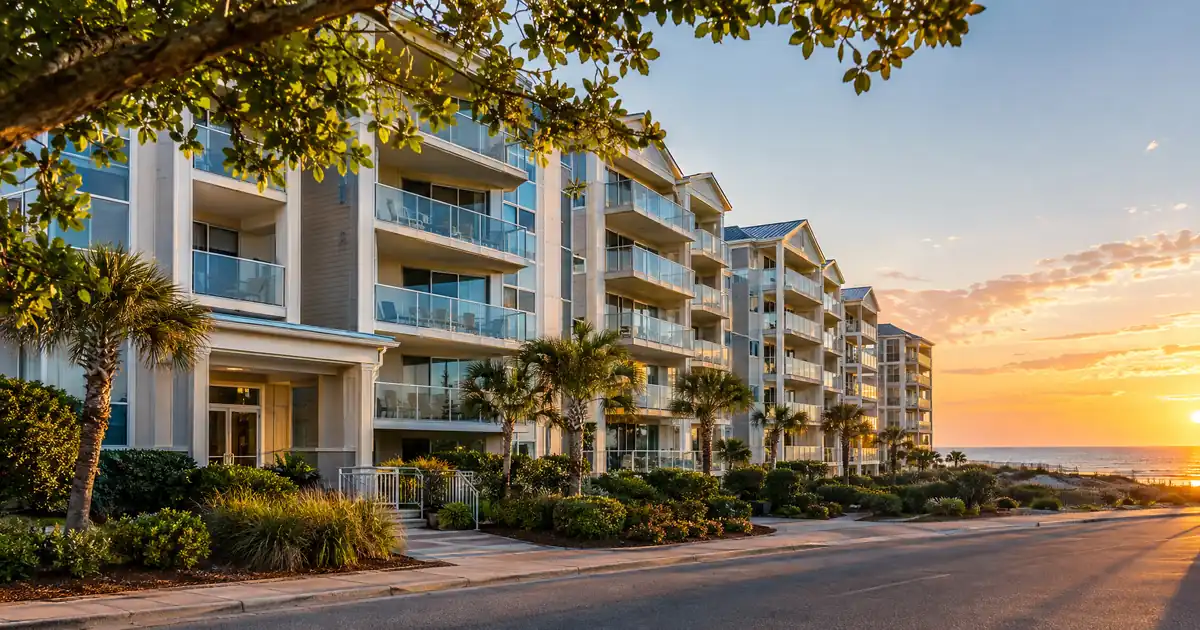
The Quick Read: You can cash out several beach condos in one project, either as separate cash-out loans run side by side or as one blanket loan secured by all the units, but each condo is still tested on its own building, its own income history, and its own equity, subject to lender guidelines. The building review usually decides the outcome before your credit or your rents come into play. The structure you pick decides how much flexibility you keep afterward.
- Separate loans keep each condo independent. A blanket loan gives you one closing and one servicer, but ties the units together.
- Income comes from documented hosting history or an appraiser’s short-term rental analysis, not from a lease.
- Single-property cash-out against short-term-rental collateral typically tops out around 70% of value, and a portfolio cash-out never exceeds 75% of pooled value.
- Clearing the coverage test does not mean the condo makes money. Costs sit outside the ratio.
How Do You Structure a Multi-Condo Cash-Out?
Two structures exist. You can run one cash-out refinance per condo in parallel, or you can place one blanket loan over several units. Separate loans suit condos with different ownership dates or different buildings. A blanket suits seasoned, similar units you plan to hold together.
Separate loans need no special product. Each condo gets its own appraisal, its own note, and its own closing. You can sell or refinance one without touching the others. The cost is paperwork multiplied by the number of units.
A blanket loan is one note secured by several properties. Some people call it a portfolio loan or a cross-collateralized loan. They all mean the same thing here. Two blanket structures run through our wholesale network, and they differ in size and term.
| Factor | Separate loans | 30-year portfolio DSCR loan | Rental portfolio term loan |
|---|---|---|---|
| Properties | One per note | 2 to 20 under one note | 5 or more under one loan |
| Loan size | Up to $3,000,000 each | $300,000 to $5,000,000 | $500,000 to $50,000,000 |
| Coverage test | Each unit alone | Pooled rent vs pooled debt | Pooled |
| Term | 30-year fixed spine | 30-year, interest-only available | 3, 5, 7, 10-year, balloon |
| Selling one unit | Independent | Follows release terms | Follows release terms |
All figures are program ceilings or ranges, not quotes, and every file is underwritten individually. On the 30-year portfolio loan, leverage runs up to 80% of value on a purchase or rate-and-term refinance. Small multifamily of five or more units is eligible only inside the rental portfolio term loan. The 30-year structure takes single-family, 2-4 unit, condo, and townhome properties.
Honestly, two or three condos often gain little from pooling. The savings come with scale, and the cross-default risk comes with the first property.
Key Terms Defined
Cash-out refinance: A new loan on a property you already own, sized above the old payoff, so you receive the difference as cash.
DSCR (debt service coverage ratio): Monthly rental income divided by the full monthly housing obligation. The loan is reviewed primarily on property-level rental income covering the payment, subject to lender guidelines.
PITIA: Principal, interest, taxes, insurance, and association dues. Beach condo dues sit inside this number and count against the ratio.
Seasoning: The time you must own a property before a lender sizes a cash-out off its appraised value.
Blanket loan: One note secured by several properties. A bank’s own portfolio loan, meaning a loan the bank keeps on its books, is a different use of the word.
Release clause: A term in the note that lets one property leave the pool when you pay a release price above that property’s allocated balance. It exists only if it is written into your documents.
Non-warrantable condo: A condo building that falls outside agency-style project standards. The label describes the building, not your credit.
Cross-default: Language that treats a default on one note as a default on the others.
How Do Lenders Count Short-Term Rental Income on Each Condo?
A short-term rental has no lease, so the lender builds the income number from evidence. The usual options are an appraiser’s short-term rental analysis, a 12-month management statement, or 12 months of bank statements showing platform payouts. On a purchase, a market-data report can also support the number. Expect about 12 months of hosting experience on short-term-rental files.
The source changes the result. Actual operating history is treated more favorably than a projection. A lender that works from a projection may also apply a haircut, and the size varies by program.
Appraisal form choice matters here. Form 1007 is the single-family rent schedule, and Form 1025 covers small residential income properties. Both are built for long-term market rent. HousingWire reports that Form 1007 cannot develop nightly-rate, seasonal, or event-driven income, and that forcing short-term income into it can produce artificially low coverage. Appraisers handle this with a narrative short-term rental income analysis instead.
Beach condos are peaky. Summer carries the year, and shoulder months look thin. Lenders generally average the full twelve months rather than underwrite to peak. A condo you converted to short-term use recently may be underwritten on long-term market rent until you have operating history.
Short-term rental rules can vary by city, county, HOA, and property type, so investors should confirm local rules before relying on projected rental income. Permission to host is a separate question from financing, and it needs documenting for each unit.
What Each Condo Must Pass Alone and What the Batch Shares
Every condo faces its own tests. The batch shares only a few things, and those few can sink the whole run.
| Tested per condo | Shared across the batch |
|---|---|
| Building and HOA review | Your credit score |
| Appraised value and equity | Your liquidity and reserves |
| Income evidence | Entity documents, if an LLC holds title |
| Hosting permission | Pooled coverage, on a blanket |
Credit on the portfolio programs starts at a 640 floor, with 680 or 720 on some structures. A special-purpose entity, typically an LLC, is required on some structures, per program terms. Reserves vary by lender, leverage, loan size, and transaction type. They commonly run around six months of PITIA, and larger loans step up. Plan liquidity for the whole batch, not for one file.
Which Building Problems Stall a Beach Condo Cash-Out?
The building is tested before you are. Lenders look at the HOA budget and reserves, the master insurance policy, litigation, special assessments, structural reports, how concentrated unit ownership is, and how much commercial space the project holds. They also ask whether the project operates like a hotel.
Realty Times lists daily or weekly rentals, compulsory leasing programs, and resort-style operation as common triggers for non-warrantable status. Mandatory rental pooling, front-desk or daily cleaning services, central key systems, revenue-sharing with an operator, and owner blackout dates all point the same way. A unit in that kind of building sits in a narrower lender pool, with tighter leverage, and some buildings may not be eligible at all.
Some short-term activity does not automatically sink a project. Condo-Approval says the real question is whether the building functions as housing or as transient lodging. It also notes resale friction: a non-warrantable building limits your future buyers’ financing options, which matters when you plan an exit. Because lenders draw that line differently, ask for the building’s rental rules and confirm its status before you commit.
Coastal insurance deserves its own line on your checklist. Wind and named-storm deductibles on a master policy are usually percentage-based on insured value, not flat dollars. Flood is typically excluded from master policies and bought separately. Wherever those costs land in your payment, they count against coverage. Association dues, special assessments, and insurance changes can shrink a ratio that looked comfortable on last year’s numbers.
One pattern shows up on these files repeatedly. Investors who own several units in the same building often assume one approval covers them all. The building review is shared, but the appraisals, income, and equity are not, so a single weak unit can still reshape the plan. Pulling the HOA questionnaire for every building before the application is a more affordable protection against a late surprise.
A Three-Condo Walkthrough
Picture an investor with three beach condos. The numbers below are hypothetical, built for illustration only, and show coverage ratios and loan-to-value, never dollars.
| Condo | Current loan-to-value | Coverage | Room under a 70% single-property cash-out |
|---|---|---|---|
| A | 45% | 1.25x | 25 points |
| B | 55% | 1.10x | 15 points |
| C | 65% | 0.90x | 5 points |
As separate loans, A and B clear a 1.00 floor with room to spare. C falls below 1.00. A sub-1.00 path is available through select lenders in the network, with leverage and terms adjusted, so C’s cash-out shrinks or its terms change. A and B are not affected.
As a pool, if the three carry similar payments, the pooled coverage lands near 1.08x. C can sit inside the pool because underwriting tests the pooled coverage, the leverage, and the terms. That is the benefit: stronger units carry the weak one. It is also the risk, because a weak unit can drag a strong pool down. On a pooled cash-out, proceeds never exceed 75% of pooled value, and short-term-rental collateral sits at the lower 70% single-property ceiling, so plan around the lower figure until a lender confirms how it treats a pool of short-term condos.
Here is the part people skip. Equity is spread unevenly, so one condo’s 5 points of room does not become 25 just because it sits in a pool with A. Check each unit’s own value first.
Parallel or Staggered? How to Sequence the Run
Run the weakest building review first. If one HOA questionnaire raises a problem, you learn it before spending on appraisals for the rest. Then order the others by seasoning and documentation strength.
Closing all files in parallel works when every unit has clean paperwork and long ownership. Staggering works when one unit is inside its first year. There, the cost-basis rule applies: inside the first six months the loan is also capped at 90% of total cost (purchase price plus documented improvements), and 100% of total cost from six to twelve months. The leverage ceiling still applies, and the loan is the lower of the two. After twelve months the appraised value alone is the basis. A rate-and-term refinance is not subject to the cost-basis cap.
A low appraisal on one file does not change the others, if they are separate loans. On a blanket, a low value on one unit lowers the pooled value, so the total proceeds shrink.
Separate Loans or a Blanket? Matching Structure to Your Exit
Choose by what you plan to sell. If you might sell one condo within a few years, separate loans keep that exit clean. If you plan to hold all of them and want one servicer, a blanket fits.
The fine print matters more than the headline terms. A release clause exists only if it is written into the note, and the release price runs above the property’s allocated balance. After a release, the remaining properties must still cover their debt service, and the lender may retest them. Cross-default language ties the notes together, so one default can reach every unit.
An investor discussion on BiggerPockets about a ten-property blanket raises two points worth checking against your own documents: a lender may block a sale to satisfy a default, and blankets may carry tighter coverage requirements than separate loans. That is one borrower’s anecdote, not a rule, but it names the right questions to ask.
On the rental portfolio term loan, you also choose recourse or non-recourse. A recourse loan carries a personal guarantee. A non-recourse loan looks to the real estate, with recourse limited to carve-outs such as fraud and bankruptcy. Prepayment on that structure runs through yield maintenance, and reserves are held for taxes, insurance, and capital expenditures.
Pooling does not change how many properties you finance. Four condos under one note are still four financed properties. Agency programs cap how many financed properties an investor can hold, and Scotsman Guide notes that investors adding rental condos often turn to DSCR loans for non-warrantable units and to get around that limit. Network programs set their own property counts and loan-size ceilings, so unlimited is never the answer.
What Does the Cash Do to Your Cash Flow?
A larger loan means a larger obligation, and the cash you pull has to earn more than it costs. If you plan to use proceeds for the next purchase, size the next property’s coverage too. Over-leveraging three condos to buy a fourth is how a good season turns into a thin one.
Coverage is not cash flow. A ratio above 1.00 means the rent covers the full housing payment. Repairs, vacancy, management, cleaning, platform fees, and utilities sit outside the calculation. On short-term rentals that gap is wider than on a long-term lease, so keep a cushion beyond what the lender requires.
If cash-out does not fit, the alternatives are selling one condo to fund the rest, or refinancing only the strongest unit. Both give up something, and neither beats the other for every owner.
Tax treatment varies; consult a qualified professional before relying on any deduction.
DSCR loans are designed for non-owner-occupied investment properties. Because they are business-purpose investor loans, they are reviewed differently from a standard owner-occupied mortgage. Owner-occupied property, co-ops, mixed-use property, and commercial property are ineligible in the pool.
Pre-Application Checklist
Gather these before you apply, for each unit and for you:
- Operating records or a management statement covering 12 months, plus platform payouts or bank statements.
- The HOA condo questionnaire, budget and reserves, insurance documents, litigation disclosures, rental restrictions, owner-occupancy ratios, and special-assessment information.
- Proof that each unit may operate as a short-term rental.
- Entity documents, if an LLC holds title, subject to program terms.
- Reserve statements sized for the whole batch.
- Your purchase or improvement records for any unit inside its first year.
For the broader program picture, the complete DSCR loans guide covers the basics.
Frequently Asked Questions
Can I close cash-outs on several condos at the same time?
Yes, as separate loans run in parallel or as one blanket loan, subject to lender guidelines. Each condo still gets its own appraisal and its own building review. A problem in one building does not stop the others when the loans are separate.
Do I need to show personal income?
The loans qualify primarily on property-level rental income covering the payment, subject to lender guidelines. Lenders still review your credit and reserves. The income evidence that matters most is the hosting history for each unit.
How long must I own a condo before cashing out?
About six months is the common expectation. Inside the first year, the cost-basis cap can reduce the loan amount. After twelve months, the appraised value alone is the basis.
Which is better if I might sell one condo later?
Separate loans, in most cases. A blanket allows a release only if the clause is written into the note, and the remaining units may be retested afterward. Read the release terms before you sign.
Does clearing 1.00 mean the condo makes money?
No. The ratio compares rent to the full payment and nothing else. Management, cleaning, vacancy, repairs, and utilities fall outside it, and beach condos tend to carry heavy versions of each.
If you are buying or refinancing a rental property and want to see how the numbers work, Lendmire can help you compare DSCR loan options based on the property income, credit profile, leverage, and investor goals. As a broker, it arranges these loans through select lenders across 41 markets, including Washington, D.C. Every approval depends on the building, not only the borrower, and coastal condos tend to reward the investor who vets the HOA before the appraisal.
For how equity extraction works on an investment property, see Lendmire’s guide to cash-out refinance on an investment property.
About Lendmire
As a non-QM mortgage broker (NMLS# 2371349), Lendmire facilitates DSCR investor loans across 41 markets, including Washington, D.C. DSCR eligibility is generally reviewed around property-level rental income instead of personal income documentation, subject to lender guidelines, serving LLC-structured portfolios and self-employed borrowers who don’t fit conventional boxes. A two-time Scotsman Guide Top Mortgage Workplace (2025, 2026).
Get Started
Ready to find the right loan for you?
In about 30 seconds you can review financing options available for your investment property. No commitment required.
Informational only. Not a Loan Estimate, approval, or commitment to lend. Program availability and eligibility are subject to lender guidelines, credit approval, property review, and underwriting.
References
1. HousingWire
2. Realty Times
This article is part of Lendmire’s investment property cash-out refinance program — full qualification details, guidelines, and scenarios live on the program page.
Related reading: How to Document Furnished Rentals in a Portfolio DSCR Loan · How to Consolidate Rental Loans Into One DSCR Loan Without Cash Out · How to Consolidate 5 to 20 Rentals Into a Non-Recourse DSCR Loan
Brandon Miller
Founder & CEO, Mortgage Loan Originator, Lendmire LLC
- Mortgage Loan Originator · NMLS# 1129696 · Verify on NMLS Consumer Access
- North Carolina Real Estate Broker · License# 343312 · Verify on NCREC
- North Carolina Insurance Producer · License# 19053198 · Property, Casualty, Life, Health · Verify on NAIC SBS
- Lendmire LLC · Firm NMLS# 2371349 · Verify firm licensure
Disclosure information. Lendmire is a state-licensed mortgage brokerage under NMLS# 2371349. Lendmire is not a depository institution, direct lender, or financial advisor — all loans referenced are placed through wholesale lender partners and are subject to each lender's underwriting standards. This article is provided for general informational purposes and is not a commitment to lend, nor does it constitute financial, legal, or tax advice. Loan programs, terms, rates, and qualification standards change without notice and depend on borrower profile, property type, and the state in which the subject property is located. Equal Housing Opportunity provider. NMLS Consumer Access: nmlsconsumeraccess.org.