
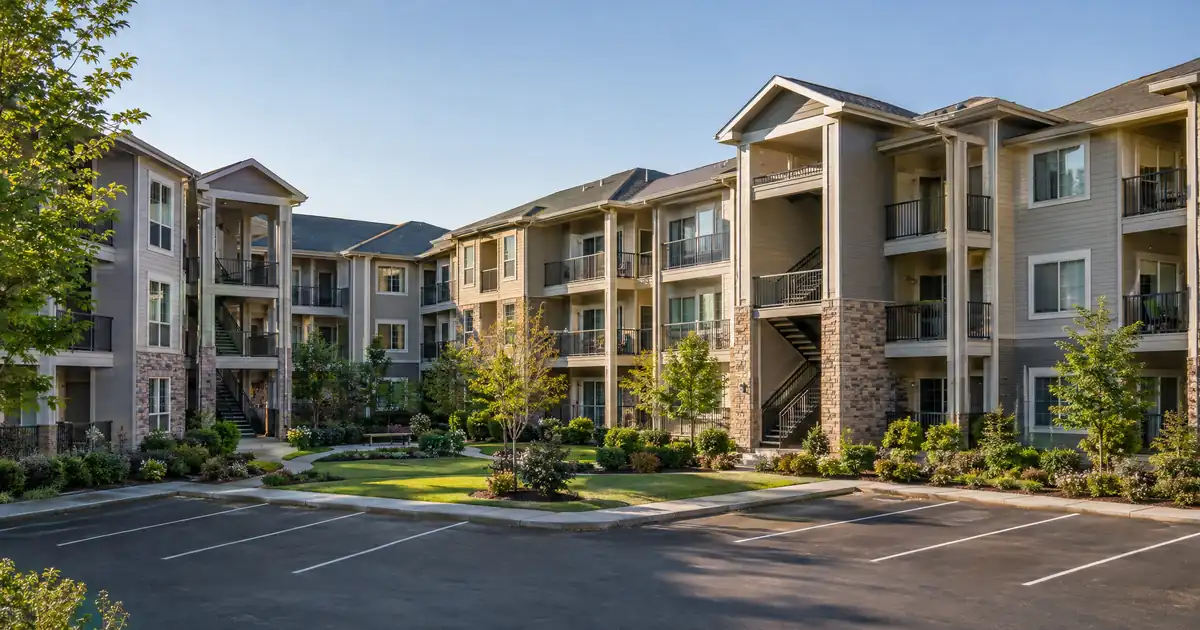
The Quick Read: It depends on the building’s unit count, because an apartment building of five or more units fits only inside the rental portfolio term loan, while the 30-year portfolio DSCR loan takes properties of one to four units, so a mixed pool of apartments and smaller rentals usually runs through the term structure. Subject to lender guidelines, here is what matters most:
- A portfolio DSCR loan, a blanket loan and a cross-collateralized loan are the same thing: one note secured by several rentals.
- The 30-year portfolio DSCR loan covers 2 to 20 properties: single-family, 2-4 unit, condo and townhome.
- Small multifamily of five or more units is eligible only in the rental portfolio term loan.
- Mixed-use and commercial property are ineligible in the pool.
- Coverage is measured on the whole pool, so stronger rentals can offset weaker ones.
What Does One Portfolio DSCR Loan Actually Mean?
It means one note, one payment and one lien package covering several rental properties. The lender adds up the rent from every property in the pool, adds up the debt service, and checks whether the first covers the second.
You will hear three names for this: portfolio DSCR loan, blanket loan and cross-collateralized loan. Here they all mean the same thing. A bank’s portfolio loan, meaning a loan the bank keeps on its own books, is a different use of the word. The two get mixed up constantly, so confirm which one a listing means.
A batch of separate loans closed together is also not a blanket loan. Each property gets its own note and its own risk. Nothing is cross-collateralized.
Lendmire is a broker. It arranges these loans through a wholesale network of DSCR lenders, and the lenders review and approve each file. Portfolio programs are available in most of Lendmire’s 41 markets, including Washington, D.C., though a few markets sit outside the portfolio footprint.
Which Structure Takes Apartment Buildings?
Two structures exist in the network, and they split on the five-unit line. The 30-year portfolio DSCR loan is built for one-to-four unit rentals. The rental portfolio term loan is the one that accepts small multifamily alongside them.
| Feature | 30-year portfolio DSCR loan | Rental portfolio term loan |
|---|---|---|
| Pool size | 2 to 20 properties | 5+ properties or units |
| Loan size | $300,000 to $5,000,000 | $500,000 to $50,000,000 |
| Top leverage | Up to 80% (purchase, rate-and-term) | Up to 75% of value |
| Term | 30-year, interest-only available | 3, 5, 7 or 10 years, balloon |
| Apartments (5+ units) | Not eligible | Eligible as small multifamily |
Larger balances are reviewed case by case on both. Every figure here is a program ceiling or floor, not a quote.
The five-unit line is not arbitrary. Freddie Mac’s multifamily division finances properties with five or more dwelling units, and its seller/servicer guide defines a multifamily mortgage the same way. Agency loans are a different world from DSCR financing. The takeaway is simply that five units is where residential becomes commercial-style multifamily, and underwriting changes with it.
For a deeper look at how DSCR loans work at the property level, the complete DSCR loans guide covers the basics this article skips.
What Property Types Can Sit in the Pool?
Single-family homes, 2-4 unit properties, condos and townhomes fit both structures. Small multifamily fits only the rental portfolio term loan. Owner-occupied property, co-ops, mixed-use buildings and commercial property are ineligible in the pool.
| Property | In the pool? | Structure |
|---|---|---|
| Single-family, condo, townhome | Yes | Either |
| Duplex, triplex, fourplex | Yes | Either |
| Apartment building, 5+ units | Yes, with limits | Term loan only |
| Mixed-use (retail plus apartments) | No | Not eligible |
| Commercial property | No | Not eligible |
| Owner-occupied home | No | Not eligible |
Manufactured and mobile homes are not reviewable on any of these programs.
The mixed-use row trips up many owners. A building with ground-floor retail and apartments above is mixed-use, even if most of the square footage is residential. It does not belong in the pool. A stabilized, fully residential building with five or more units is a different animal.
How Do You Count Doors and Properties?
Count properties for pool size on the 30-year loan, and count properties or units toward the minimum on the term loan. A twelve-unit building is one property, one lien and one appraisal, but twelve units.
That distinction matters in three places:
- The 30-year loan’s 2 to 20 limit counts properties. A duplex is one property, and so is a twelve-unit building (though the twelve-unit building cannot join this structure at all).
- The term loan’s five-or-more minimum counts rental properties or units. A single larger building may satisfy that count on its own, subject to lender guidelines.
- Appraisals and leases work per property. Each building needs its own appraisal, plus a lease or an appraiser-supported market rent.
For 1-4 unit properties, the appraiser’s rent schedule form is the 1007, and small residential income properties use the 1025. Larger buildings get a commercial-style appraisal built on income and operating statements.
How Does the Pooled Coverage Test Work?
The lender divides total rent used for lender review across the pool by total PITIA, and the result must clear 1.00 on the pool. That floor applies to the pool itself, which means stronger properties can offset weaker ones.
PITIA is principal, interest, taxes, insurance and association dues. It is the full monthly obligation on the property. The DSCR ratio compares rent to that obligation and nothing else. Clearing 1.00 does not mean positive cash flow, because repairs, vacancy, management, utilities and capital expenses sit outside the calculation.
The income measure also shifts with building size. On one-to-four unit rentals, the test generally compares gross or market rent to PITIA. On a larger apartment building, underwriters typically deduct vacancy, management and operating expenses first and work from net operating income. The apartment’s rent is therefore trimmed before it enters the pool, so its contribution can look smaller than its gross rent suggests.
Your personal traditional employment income does not enter the test. The pool qualifies primarily on property-level rental income covering the payment, subject to lender guidelines.
A Mixed-Portfolio Example
Run the numbers on a hypothetical owner with six assets: four single-family rentals, a duplex and a twelve-unit apartment building. These coverage figures are modeled assumptions, not market data.
Assume the five smaller rentals cover their debt service at roughly 1.20x together. Assume the apartment building, after vacancy and expenses come out, covers at about 1.05x. Weighted by debt service, the pool lands comfortably above 1.00x.
Now suppose one of the single-family homes drops to about 0.90x on its own. A rental below 1.00 can still sit in the pool, and underwriting tests the pooled coverage, the leverage and the terms. If the pool holds above the floor, that weak house rides along.
That is the real advantage of pooling. It is also the limit. If the apartment building came in thin and two houses slipped as well, the pool could fall short, and the lender would likely ask you to remove an asset, reduce the loan amount or split the structure.
The 30-year portfolio DSCR loan is off the table for this owner, because the apartment building cannot join it. The workable paths are:
1. One rental portfolio term loan for all six assets, accepting a shorter fixed term with a balloon at maturity.
2. Two structures: the five smaller rentals on the 30-year portfolio DSCR loan, and the apartment building on its own term loan.
3. Separate single-property DSCR loans on the small rentals, with the apartment financed separately.
What Do You Give Up With the Term Loan?
You give up the 30-year amortizing structure and take a fixed term of 3, 5, 7 or 10 years with a balloon at maturity. That means a payoff or refinance at the end of the term, and you plan for it on day one.
The term loan also has features the 30-year loan does not:
- Leverage tops out at up to 75% of value, compared with up to 80% on a purchase or rate-and-term refinance on the 30-year portfolio DSCR loan.
- Prepayment uses yield maintenance, a charge that compensates the lender for lost interest if you pay off early. Check how it runs before you sign.
- Recourse varies. Non-recourse structures exist, where the loan looks to the real estate and recourse is limited to carve-outs such as fraud and bankruptcy. A recourse loan carries a personal guarantee.
- Reserves are held for taxes, insurance and capital expenditures.
- Assumption is available as a one-time purchaser assumption on loans above $5,000,000, subject to underwriting and an assumption fee. Below $5,000,000 it is an exception-basis request.
- A special-purpose entity, typically an LLC, is required on some structures, per lender program requirements.
The upside is scale. The term loan allows properties in several markets or states under one note, and its ceiling reaches $50,000,000. Owners with a meaningful apartment holding often find the term structure fits their balance sheet better than forcing the building into a loan it cannot join.
What Can Go Wrong With Cross-Collateralization?
Every property in the pool secures the whole loan, so a problem with one asset can reach all of them. A default can put every property at risk, and a lien or title defect on one asset can change or delay the entire file.
Picture an investor whose pool includes an apartment building with a bad roof and a lender who requires cure before anything moves. If the loan documents bar releasing a healthy house until the problem is fixed, the house cannot be sold to raise the cash. The pool holds everything hostage.
Release terms decide how much flexibility you keep. Partial releases, substitutions and the sale of one property out of the pool follow the loan documents and the lender’s release terms. The release price runs above the property’s allocated balance, and the remaining portfolio must still cover its debt service afterward.
Read these before you sign:
- How a release is priced, and whether it is allowed at all
- Whether you can substitute a replacement property
- What happens if the remaining pool falls below the coverage floor
- The prepayment terms and any balloon at maturity
An owner who plans to sell individual assets in the next few years should compare the blanket against separate loans, or negotiate the release terms up front. Blanket loans suit holders more than flippers.
How Do Cash-Out and Refinance Work on a Pool?
A cash-out on a portfolio loan never exceeds 75% of the pooled value on standard rentals, and never exceeds the structure’s own ceiling. The same cap applies whether you refinance a pool you already own or consolidate separate loans.
Seasoning matters on newer purchases. Inside the first six months of ownership, the loan is also capped at 90% of total cost (purchase price plus documented improvements), and at 100% of total cost from six to twelve months. The leverage ceiling still applies, so the loan is the lower of the two. After twelve months, the appraised value alone is the basis. A rate-and-term refinance is not subject to the cost-basis cap.
Owners who bought over a long stretch can usually pool newer and older properties together. The cost-basis caps bite hardest on the recent purchases, while the older ones are measured on appraised value. Lendmire’s piece Can Rentals Bought Over Two Years Go Into One Portfolio DSCR Loan? walks through that mix in detail.
What Do Lenders Need for Each Property?
Expect a document set per property, plus an entity and credit review for the borrower. The pool is only as clean as its weakest file.
Per property, plan on:
- A lease or an appraiser-supported market rent
- An appraisal (rent schedule or income-based, depending on size)
- Title work and a hazard insurance policy
- Entity documents if the property is titled in an LLC, subject to program terms
For the borrower, the portfolio programs generally set a credit floor of 640, with 680 or 720 on some portfolio structures. Titling must line up across properties, and different states or entities add steps. One mismatched legal description can hold up the whole pool.
Reserves, entity requirements and recourse terms vary by structure, so ask for them early.
When Are Separate Loans the Better Choice?
Separate loans win when you want independence, small pools, or properties that do not fit the same structure. A blanket is not automatically better because it is one loan.
Consider separate DSCR loans when:
- You own two or three rentals. The 30-year structure’s loan-size floor can exclude small pools.
- You plan to sell or refinance one property soon. Independent notes keep each exit clean.
- One asset is weak and the rest are strong. A bad asset in a shared pool puts the strong ones in the same boat.
- An apartment building has its own financing needs. A building with a different hold period and term may be better placed on its own note.
A blanket pays off when you want one closing, one payment and one set of administration, and when stronger properties can carry weaker ones. Tax treatment varies; consult a qualified professional before relying on any deduction.
Key Terms Defined
PITIA: the full monthly obligation on a property: principal, interest, taxes, insurance and association dues.
Pooled coverage: total rent used for lender review across all properties in the loan, divided by their total PITIA.
Cross-collateralization: a setup where every property in the pool secures the whole loan, not just its own share.
Release clause: a loan term that lets one property leave the pool, usually after a payment priced above that property’s allocated balance.
Yield maintenance: a prepayment charge that compensates the lender for lost interest when a fixed-term loan is paid off early.
Non-recourse: a loan that looks to the real estate for repayment, with recourse limited to carve-outs such as fraud and bankruptcy.
Frequently Asked Questions
Can I put a 12-unit apartment building and single-family rentals under one blanket loan?
Usually through the rental portfolio term loan, not the 30-year portfolio DSCR loan. The term structure accepts single-family, 2-4 unit, condo, townhome and small multifamily. Pooled coverage must clear the floor, and each property still needs a lease or an appraiser-supported market rent, subject to lender guidelines.
Is a mixed-use building with a storefront eligible?
No. Mixed-use and commercial property are ineligible in the pool. A fully residential building of five or more units is a different case and may fit the term loan.
Can I hold everything in one LLC?
Often, yes, subject to lender program eligibility. Some structures require a special-purpose entity, typically an LLC. Title, insurance and legal descriptions must line up across every property, and a defect on one asset can affect the whole file.
Can I sell one property later?
Only as the loan documents allow. Partial releases and substitutions follow the lender’s release terms. The release price runs above the property’s allocated balance, and the remaining portfolio must still cover its debt service.
Does a larger down payment fix a thin pool?
It can lift coverage by lowering the monthly obligation, but it does not erase leverage caps, credit floors, reserve rules or property eligibility. The strongest files clear both tests: enough equity and enough rental coverage.
If you are buying or refinancing a rental property and want to see how the numbers work, Lendmire can help you compare DSCR loan options based on the property income, credit profile, leverage, and investor goals.
About Lendmire
As a DSCR and non-QM mortgage broker, Lendmire — NMLS# 2371349 — connects investors with wholesale lending channels across 41 markets, including Washington, D.C. The property’s rental income, not the borrower’s traditional personal-income documentation, is central to lender review, which works for self-employed operators and portfolios beyond four financed properties. Scotsman Guide named Lendmire a Top Mortgage Workplace in both 2025 and 2026.
Get Started
Ready to find the right loan for you?
In about 30 seconds you can review financing options available for your investment property. No commitment required.
Informational only. Not a Loan Estimate, approval, or commitment to lend. Program availability and eligibility are subject to lender guidelines, credit approval, property review, and underwriting.
References
1. Freddie Mac Multifamily: Borrower Overview
2. Freddie Mac Multifamily Seller/Servicer Guide
This article is part of Lendmire’s DSCR loan program — full qualification details, guidelines, and scenarios live on the program page.
Related reading: How to Move Rentals From a Blanket Bridge Loan to a Portfolio DSCR Loan · DSCR Portfolio vs Blanket Loan for Consolidating Rentals: Releases · How to Roll 5 to 20 Rentals Into One DSCR Loan or Use HELOCs
Brandon Miller
Founder & CEO, Mortgage Loan Originator, Lendmire LLC
- Mortgage Loan Originator · NMLS# 1129696 · Verify on NMLS Consumer Access
- North Carolina Real Estate Broker · License# 343312 · Verify on NCREC
- North Carolina Insurance Producer · License# 19053198 · Property, Casualty, Life, Health · Verify on NAIC SBS
- Lendmire LLC · Firm NMLS# 2371349 · Verify firm licensure
Important disclosures. Lendmire (NMLS# 2371349) is a licensed mortgage brokerage. Lendmire is not a direct lender, depository institution, or financial advisor. All loan inquiries are subject to lender underwriting; this article does not constitute a commitment to lend. Rates, terms, and program guidelines are subject to change without notice and vary by borrower profile, property type, and state. Information in this article is general in nature and is not financial, legal, or tax advice. Equal Housing Opportunity. NMLS Consumer Access: nmlsconsumeraccess.org.