
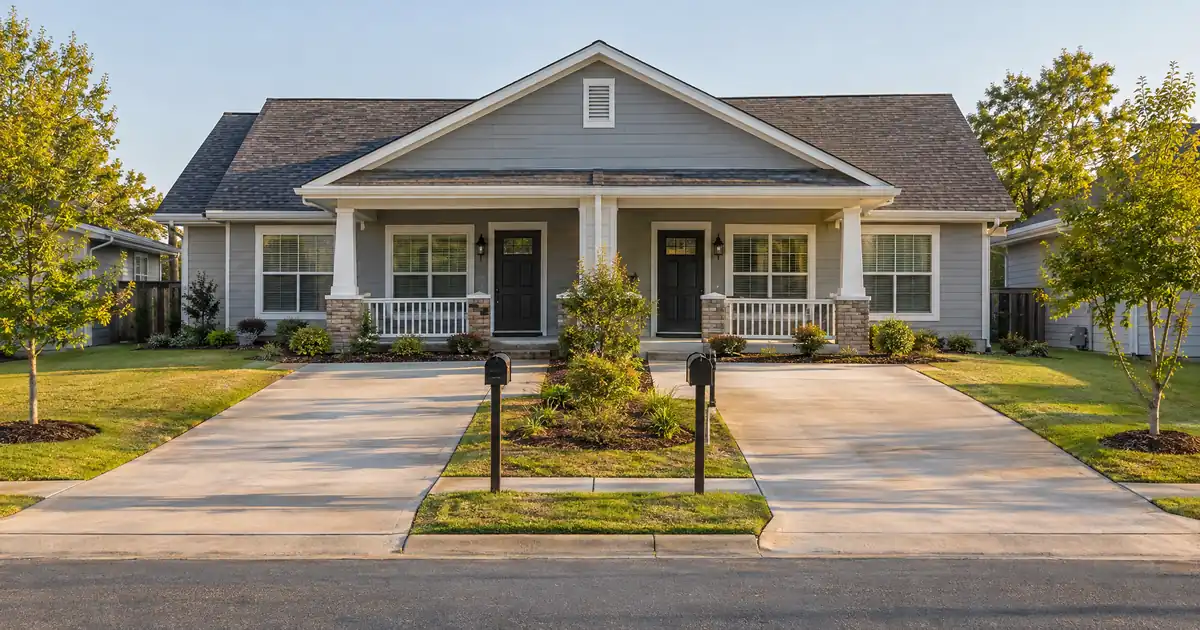
The Quick Read: Splitting a duplex is a legal and title event first and a financing event second. You convert one deed into two titled units, usually through a condominium conversion, and then refinance so each unit carries its own loan. Recording the paperwork does not divide the mortgage on its own.
- A duplex normally sits on one parcel, one deed, and one tax parcel number. The split creates separate ones.
- A condo conversion is the most common route. A lot subdivision is the alternative when the layout and zoning allow it.
- The DSCR refinance is the step that separates the debt, with each unit tested on its own rent against its own payment.
- Splitting adds HOA dues and a separate insurance policy to each unit’s payment. That tends to lower each unit’s coverage compared with the old single-building test.
- Every file is reviewed individually, subject to lender guidelines and credit approval.
You hold a duplex inside an LLC next to other rentals. You want two assets you can finance, sell, or refinance on their own. That works, but the order of operations matters. Get it wrong and you end up with two deeds sitting under one old mortgage. Lendmire is a broker that arranges these loans through select lenders in its wholesale network, across 41 markets including Washington, D.C. Here is how the mechanics run.
DSCR Cash-Out Calculator
Run the cash-out numbers in your market
Rate source: Freddie Mac 30-yr average via FRED® — Federal Reserve Bank of St. Louis · effective Oct 15, 2026
Prefilled with starting assumptions — enter your property’s value, balance, taxes, and insurance for a more accurate picture.
Program parameters update from Lendmire’s centralized guideline source. Taxes and insurance are editable estimates.
As of Oct 15, 2026 · General Freddie Mac market benchmark, not a Lendmire loan offer. Property value, balance, taxes, and insurance are editable estimates. Maximum loan-to-value varies by lender, program, property type, and seasoning. Not a Loan Estimate, approval, or commitment to lend. Program availability and eligibility are subject to lender guidelines, credit approval, property review, and underwriting.
Key Terms Defined
DSCR (debt service coverage ratio): The property’s monthly rent divided by its full monthly obligation. Qualification runs primarily on property-level rental income covering the payment, subject to lender guidelines.
PITIA: Principal, interest, taxes, insurance, and association dues. This is the payment figure the rent is measured against.
Condo conversion: A legal process that divides the airspace inside a building into separately owned units. The land and structure stay under shared ownership.
Lot subdivision: A legal process that divides the land itself into two lots, each held in fee simple. Each lot is treated much like a single-family property.
Vesting: How title is held, whether in the LLC, a second LLC, or your personal name.
Blanket (portfolio) note: One loan secured by more than one property. It cross-collateralizes the units.
Release: A lender’s agreement to remove one property from a blanket lien, typically on stated terms. Read the note for the mechanics.
What Does “Splitting” a Duplex Actually Mean?
It means creating two legal properties out of one. A duplex is normally one parcel with one deed, which LegalClarity notes is why each side can’t be sold on its own as built. After a conversion, each unit gets its own parcel ID, tax bill, and deed.
Two paths exist, and LegalClarity’s guide to splitting a duplex lays out the difference. A lot subdivision divides the land into two legal lots. A condo conversion divides the airspace and keeps shared ownership of the land and structure.
| Factor | Lot split | Condo conversion |
|---|---|---|
| Best layout | Side-by-side with a clean center line | Side-by-side or stacked |
| What you own | Two fee-simple parcels | Unit plus shared elements |
| HOA needed | Usually no | Yes, for shared elements |
| Treated like | Two single-family homes | Two condos |
Stacked duplexes can’t be lot-split. For most owners with an existing building, condo conversion is the realistic path.
The Legal Split, Step by Step
1. Confirm the split is legally possible. Check zoning, building code, and deed restrictions. A title search finds recorded claims or covenants that must be resolved first. Deeds.com notes that some deeds bar converting one title into several. The building also has to function as two independent homes, with separate utilities, code-compliant systems, and fire separation.
2. Get the existing lender’s position. Your current loan is secured by the whole building. Read the note before you file anything. A refinance can trigger a prepayment charge on the old loan, and the lender’s consent or payoff will shape your timeline. Requirements differ by state, so this is a question for your attorney.
3. Prepare the documents. Attorney guides describe a condominium declaration (sometimes called a master deed) plus a surveyed plat or plan, recorded with the county. O’Neil Cannon describes this filing set. SILB Law Firm adds a replat, covenants, and an HOA entity to manage shared items such as the roof, foundation, and shared utility lines. A master insurance policy is typically part of the package.
4. Record and receive new identifiers. Each unit gets its own parcel ID, tax bill, and deed.
5. Decide the vesting. Both unit deeds can stay in the same LLC, or you can move them to separate LLCs. That choice drives the loan structure in the next step.
6. Refinance. This is where the debt actually splits. Costs for the legal and filing work vary by jurisdiction and scope, so budget qualitatively for attorney, survey, and recording expenses.
Does Recording the Condo Declaration Split the Loan?
No. Recording changes the title, not the debt. One California attorney guide from Andy Sirkin says final recordation does not change ownership or financing. All units stay under the same owner and the same mortgage until separate mortgages are placed. That page is specific to San Francisco, but the principle travels.
Think of it this way. After recording, you own two deeds. The old lender still holds one lien across both. Selling one unit means paying off or releasing that lien first. A lender generally will not let you sell half of a mortgaged property while the whole is encumbered.
Another common mistake is deeding one half to a buyer without a proper conversion. A bare deed could technically pass title but would leave the property practically unsellable and possibly non-compliant.
Where the LLC Fits
Your LLC can hold both new units, or each unit can sit in its own entity. Here is how the setups compare.
| Setup | Loan structure | What to know |
|---|---|---|
| Both units, one LLC | Two notes or one blanket | Most flexible; owning two in one LLC does not merge the loans |
| One LLC per unit | Two separate notes | Cleanest for separate sale or refinance |
| Personal name | Varies | Conflicts with LLC protection goals |
A standard DSCR loan is written one property at a time. Owning several properties in one LLC does not turn them into one loan. A pooled test needs a portfolio structure.
Entity setup also doesn’t separate you from the loan. Subject to program terms, DSCR loans can be placed with LLC vesting, but lenders commonly ask for a personal guarantee. A new LLC changes who holds title, not who stands behind the note. Splitting buys exit flexibility more than it buys liability separation.
If you are layering this into a larger portfolio, Lendmire’s piece How to Split an LLC Portfolio Into DSCR Loans Without Personal Recourse covers the guarantor question in depth.
Two Notes or One Blanket Note?
Across the wholesale network, the answer depends on your exit plan. A blanket note is simpler to set up. It also cross-collateralizes the units, so a problem with one affects the other. Separate loans keep each unit independent. Each one carries its own down payment or equity requirement, closing costs, and reserves.
Lean toward separate notes if either unit might be sold, exchanged, or refinanced on its own. Lean toward a blanket only if you are certain you will hold both together.
There is a trap worth naming. Holding one loan on two condos works against the reason you split. Selling one unit later then requires a release, and the terms of that release are written into your note. Read it before you sign.
How DSCR Underwriting Treats Each Unit
Each unit now needs its own rent support, either a lease or a market rent schedule. Each is tested on its rent against its own full payment. The formula stays simple: monthly rent divided by PITIA.
Here is what changes in the split. Each unit picks up its own HOA dues and its own insurance policy. Taxes are assessed separately. The result is that each unit’s coverage is often lower than the combined duplex looked before. Picture a duplex that cleared comfortably at around 1.3x as one building. After the split, each condo might land closer to 1.1x once dues and a separate policy are added. That is an illustrative direction, not a quote.
Most DSCR programs we place files with are built around 1.00 coverage as a starting point for select programs, and stronger ratios open better pricing and leverage. A separate select-lender path takes coverage below 1.00 with leverage and terms adjusted. Clearing 1.00 also doesn’t mean positive cash flow. Repairs, vacancy, management, utilities, and capex all sit outside the calculation.
Typical network guidance for this kind of file:
- Purchase leverage: most files land at 75%–80% LTV on an investment property.
- Cash-out refinance: tops out around 75% LTV on a standard rental, with about 6 months of seasoning as the common expectation.
- Credit: a 620 floor exists in parts of the network, most programs want around 660, and 700+ unlocks the strongest leverage tiers.
- Reserves: commonly around 6 months of PITIA, stepping up to about 9 months on loans above $1,500,000.
- Loan size: up to $3,000,000 on standard programs.
A larger down payment or more equity can lift coverage. It never erases credit floors, reserve rules, or property eligibility. The strongest files clear both tests: enough equity and enough rent.
A 2–4 unit property is appraised on the small-income-property form (Form 1025). How a lender’s appraiser treats a newly created two-unit condo is lender-specific, so confirm before you assume the process. Programs change and every file is underwritten individually. For the full picture of how the loans work, see the complete DSCR loans guide.
DSCR vs. conventional financing
There are two common ways to finance an investment property, and they qualify you differently — here’s how investors weigh them.
Why investors choose it
- Qualifies on the property’s rental income — no personal tax returns, W-2s, or pay stubs needed to document income.
- No personal debt-to-income ceiling to clear, so existing mortgages and obligations don’t cap your borrowing the same way.
- Can be closed in an LLC, keeping the property inside a business entity.
- Built for scaling — not held to the limit on number of financed properties that conventional financing applies.
- Underwriting centers on the deal: generally qualifies when the rent covers the payment, a 1.00x coverage ratio being a common baseline (confirmed in underwriting).
- Designed specifically for investment property, including long-term and, where the program allows, short-term rentals.
Where it’s strong
- Often the lowest ongoing financing cost for a buyer who fully qualifies on personal income — a fit for a first property or a cost-first purchase.
Trade-offs for investors
- Requires full personal income documentation and must fit within a debt-to-income limit — salary, existing debts, and other mortgages all count.
- Typically held in your personal name rather than a business entity.
- Caps how many financed properties you can carry, which can become a ceiling as a portfolio grows.
- Evaluates you as a borrower as much as the property, which usually means more paperwork.
How investors usually choose: a first or single property often optimizes for the lowest financing cost; portfolio builders often optimize for leverage, vesting in an LLC, and scaling past conventional caps. The right answer depends on your goals, the property, and current guidelines — both paths run through select lenders in Lendmire’s wholesale network, with eligibility and terms confirmed in underwriting.
Where the General Rule Breaks
You live in one unit. DSCR loans are designed for non-owner-occupied investment properties. Because they are business-purpose investor loans, they are reviewed differently from a standard owner-occupied mortgage. If you occupy a unit, that is an owner-occupied file, not a DSCR file. Regulation Z commentary treats non-owner-occupied rental credit as business purpose, and an owner who expects to occupy the property more than 14 days in the coming year falls outside that treatment.
Units in different LLCs. Portfolio treatment generally assumes the properties are held under common ownership, and units titled in different entities can break that link. The usual fix is deeding the properties into one entity or keeping separate loans.
Condo project review. With only two units, both owned by you, investor concentration is the likely friction point. Added units owned by one investor can push a building toward non-warrantable status, and a condo or PUD can qualify only after project review adds conditions. Treat this as lender-specific.
Already-platted duplexes. Some duplexes were built or later platted as on-site condos. You may discover that only when the lender searches records. You would still need a master deed, unit deeds, and master insurance.
Twin homes and zero-lot-line builds. These are built with a split down the middle, which makes the separation more straightforward than converting a stacked layout.
Deed restrictions. Some covenants bar sales to individual unit owners for a set term. A title search catches this.
Ineligible property types. Manufactured homes, log homes, and barndominiums are not offered through the network’s DSCR programs. If the building is one of those, this plan does not apply.
Should You Split at All?
It is a genuine toss-up for many owners. The case for splitting is exit flexibility. Separate notes mean one unit can be sold, refinanced, or cash-out refinanced without touching the other. A cash-out refinance can recycle equity without selling, as covered in Lendmire’s piece Term vs. 30-Year Portfolio Cash-Out Refinance for LLC-Held Rentals.
The case against is cost and marketability. The conversion adds legal cost, HOA overhead, and an extra insurance layer. Resale perception depends on the market. In some areas, split units sell worse than a whole duplex, and recombining them later is a legal process of its own. Splitting does not automatically raise value. Any gain depends on comps and underwriter review.
If you plan to hold both units for the long run, refinancing the duplex whole is often simpler. Split when you have a reason to sell, exchange, or borrow against one unit alone.
Handoff Checklist by Professional
| Professional | What they handle |
|---|---|
| Attorney | Declaration, covenants, existing-lender position, vesting |
| Surveyor | Plat or plan, legal descriptions |
| Title company | Title search, new title policies |
| Insurer | Master policy and per-unit coverage |
| Broker and lender | Per-unit rent test, project review, loan structure |
Sequence matters. Confirm legal feasibility and the old note’s terms before you spend on filings. Bring the broker in early so each unit’s coverage is modeled with HOA dues and separate insurance before you commit.
This article is general information, not legal or tax advice. Rules for splitting property vary by jurisdiction, and tax treatment varies; consult a qualified attorney or CPA about your own situation.
Frequently Asked Questions
Can I sell one half of my duplex without a conversion?
Not cleanly. A bare deed to half the building can pass title on paper while leaving the property unsellable and possibly non-compliant. A condo conversion or lot subdivision creates the separate legal units a buyer and lender can use.
Does the LLC need to change when I split?
No. Both units can stay in the same LLC, or you can move each to its own entity. Separate entities generally mean separate loans, subject to lender program eligibility.
Do I need my current lender’s permission?
You need to deal with the existing lien, either by payoff through the refinance or by a release the note allows. Read the note first, including any prepayment charge.
Can both halves be refinanced separately on DSCR?
Often yes. Each unit is tested on its own rent against its own PITIA, and condo project review adds conditions. Qualification is subject to lender guidelines, credit approval, and property review.
What if I live in one of the units?
Then it is an owner-occupied file rather than a DSCR file. A common path is financing the owner-occupied unit one way and placing DSCR loans on your other rentals.
If you are buying or refinancing a rental property and want to see how the numbers work, Lendmire can help you compare DSCR loan options based on the property income, credit profile, leverage, and investor goals.
About Lendmire
Lendmire is a DSCR-focused mortgage brokerage, NMLS# 2371349, placing investor loans across 41 markets, including Washington, D.C. DSCR eligibility is generally reviewed by the lender around a property’s rental income rather than personal income documentation, which fits LLC-held rentals, self-employed investors, and portfolios scaling past conventional financed-property limits. Scotsman Guide named Lendmire a Top Mortgage Workplace in both 2025 and 2026.
Get Started
Ready to find the right loan for you?
In about 30 seconds you can review financing options available for your investment property. No commitment required.
Informational only. Not a Loan Estimate, approval, or commitment to lend. Program availability and eligibility are subject to lender guidelines, credit approval, property review, and underwriting.
References
1. LegalClarity: Duplex Legal Definition and Property Classification
2. LegalClarity: Can You Split a Duplex Into Two Separate Properties?
3. Deeds.com: Selling Property to New Owners With a Condominium Conversion
4. O’Neil Cannon: Turning a Duplex Into a Twindominium
5. SILB Law Firm: How to Sell Your Duplex or Four-Plex as a Condo
6. Andy Sirkin: San Francisco Condominium Conversion Eligibility and Process
7. BankersOnline: Regulation Z §1026.3
This article is part of Lendmire’s DSCR loan program — full qualification details, guidelines, and scenarios live on the program page.
Related reading: Current Mortgage vs DSCR Refinance for a New Landlord: What Each Allows · Closing in an LLC vs Deeding to an LLC After Closing on a DSCR Rental · Should You Close a DSCR Refinance That Leaves Rehab Money In?
Brandon Miller
Founder & CEO, Mortgage Loan Originator, Lendmire LLC
- Mortgage Loan Originator · NMLS# 1129696 · Verify on NMLS Consumer Access
- North Carolina Real Estate Broker · License# 343312 · Verify on NCREC
- North Carolina Insurance Producer · License# 19053198 · Property, Casualty, Life, Health · Verify on NAIC SBS
- Lendmire LLC · Firm NMLS# 2371349 · Verify firm licensure
Compliance and disclosures. Lendmire (NMLS# 2371349) is a licensed mortgage broker and is not a direct lender, depository institution, financial advisor, or tax professional. Content in this article is general market analysis and educational information — not financial, legal, or tax advice for any specific situation. Lendmire does not guarantee loan approval; every transaction is subject to underwriting by the funding lender. Mortgage pricing and loan program guidelines are subject to change at any time without notice and vary by borrower characteristics, property type, and state regulations. Lendmire complies with Equal Housing Opportunity. Licensure verification: NMLS Consumer Access.