
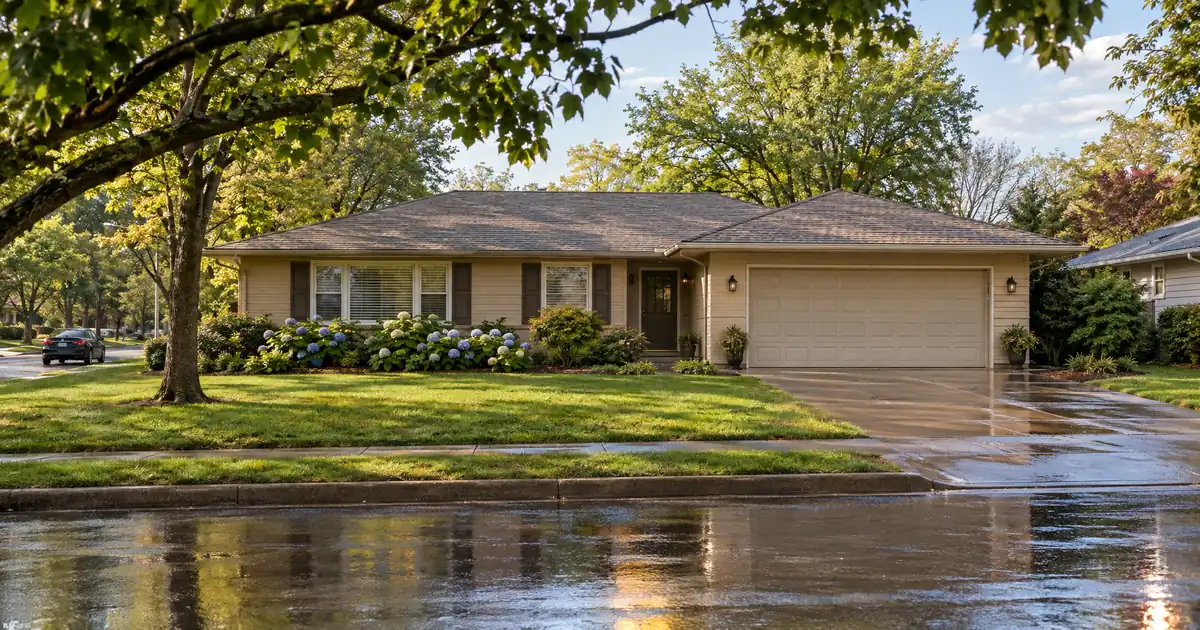
The Quick Read: Only when the cash you pull out earns more than the new loan costs you in closing fees, added interest, and a bigger balance. The cash is borrowed money secured by your rental, not profit, so the refinance is judged by what you do with it.
- The test is simple: the monthly return on the redeployed cash must beat the monthly cost the new loan adds, with room left for vacancy and repairs.
- You also have to hold the property long enough to recover the upfront costs.
- Most programs in the wholesale network cap a cash-out on a standard rental at about 75% LTV. Short-term-rental collateral tops out at 70%.
- Lenders typically want about six months of ownership, counted from the recorded deed.
- Clearing a coverage test of 1.00 does not mean the property cash-flows. Repairs, vacancy, and management sit outside that math.
Key Terms Defined
You will see these terms throughout. Each is defined once here.
- Cash-out refinance: A new, larger loan that pays off the old one and hands you the difference.
- Net proceeds: The cash you actually receive after the old loan payoff, closing costs, and any holdbacks.
- DSCR (debt service coverage ratio): The property’s monthly rent divided by its monthly housing obligation. A result of 1.00 means rent equals the payment.
- PITIA: Principal, interest, taxes, insurance, and any association dues. It is the obligation the rent is measured against.
- LTV (loan-to-value): The loan balance as a percentage of the property’s value.
- Seasoning: The ownership time a lender wants before it will lend against current value.
- Prepayment penalty: A fee some loans charge if you pay them off early.
DSCR Cash-Out Calculator
Run the cash-out numbers in your market
Rate source: Freddie Mac 30-yr average via FRED® — Federal Reserve Bank of St. Louis · effective Oct 15, 2026
Prefilled with starting assumptions — enter your property’s value, balance, taxes, and insurance for a more accurate picture.
Program parameters update from Lendmire’s centralized guideline source. Taxes and insurance are editable estimates.
As of Oct 15, 2026 · General Freddie Mac market benchmark, not a Lendmire loan offer. Property value, balance, taxes, and insurance are editable estimates. Maximum loan-to-value varies by lender, program, property type, and seasoning. Not a Loan Estimate, approval, or commitment to lend. Program availability and eligibility are subject to lender guidelines, credit approval, property review, and underwriting.
What Does “Pays for Itself” Mean Here?
It means two separate things, and you need both. First, the benefit of the cash must exceed the cost of the bigger loan. Second, you must own long enough to recover the upfront costs.
A rate-and-term refinance can pay for itself through payment savings. A cash-out usually cannot. It tends to raise the balance and the monthly obligation, and it often costs more per dollar borrowed than a plain refinance. There is no savings stream to divide the closing costs by.
Fortune’s explainer on investment-property cash-out refinancing makes the same point. The cash is borrowed money secured by the rental, and the math works when the deployed capital earns more than the added costs. It also suggests comparing the second property’s expected return, after expenses, against the higher payment on the first.
So the deal does not pay for itself because the cash arrives. It pays for itself because of what the cash does afterward.
The Pays-for-Itself Test, Step by Step
Run these four lines before you apply. They work for any use of the money.
1. Net proceeds = new loan − old payoff − closing costs − holdbacks.
2. Added monthly cost = new payment on the refinanced property − old payment.
3. Monthly return on the cash = what the redeployed money earns each month. Examples are the new rental’s net cash flow, added rent from a rehab, or interest saved on debt you paid off.
4. It pays for itself when line 3 exceeds line 2 by a margin that survives vacancy, repairs, and capital expenses. You must also hold long enough to recover the upfront costs.
Here is how that reads in practice. Say you pull cash from a rental that covers its payment comfortably and use it as the down payment on a second rental. If the second property’s net cash flow, after vacancy and repairs, clearly exceeds what the first property’s payment went up, you pass. If the two figures are nearly equal, you passed on paper and failed in the first vacant month.
Pulling the maximum cash can also turn a healthy property negative. One investor in a BiggerPockets thread found that cashing out to a high LTV on a modest-cash-flow rental would flip it to a monthly loss. That is anecdotal investor commentary, not data. The logic is still sound.
Which Uses of the Cash Hold Up?
Not every use of proceeds earns a return. This is how the common ones compare.
| Use of proceeds | Typical outcome | What must be true |
|---|---|---|
| Down payment on another rental | Adds income if the deal is sound | New property out-earns the added cost |
| Rehab that lifts rent | Can raise income and appraised value | Comps and underwriter review support it |
| Paying off higher-cost debt | Reduces cost elsewhere | Interest saved exceeds interest added |
| Building reserves | Protects the portfolio | You accept a permanent higher balance |
| Personal spending | No return | Rarely pays for itself |
Rehab deserves one extra note. An improvement may support a higher appraised value, depending on comps and underwriter review. It never guarantees one, so size the loan on the value you can document today.
Debt payoff is the quiet winner when it replaces genuinely expensive debt. It is the weakest when the debt it replaces was cheap.
How the Cash-Out Is Sized on a DSCR Loan
A DSCR cash-out qualifies primarily on property-level rental income covering the payment, subject to lender guidelines. The loan is sized on the property’s value and its rent, not your personal income. DSCR loans are designed for non-owner-occupied investment properties. Because they are business-purpose investor loans, they are reviewed differently from a standard owner-occupied mortgage.
Across the wholesale network Lendmire places files with, the file has to pass three gates in order: seasoning, leverage, and coverage. Strength in one does not buy a pass on another. The complete DSCR loans guide walks through the full qualification picture. These are the gates that matter for a cash-out.
Seasoning. Most programs expect about six months of ownership, measured from the recorded deed. The contract date, the rehab finish, and the lease signing do not start the clock. Seasoning also decides the valuation basis. Early in ownership, many programs size the loan off cost basis, meaning the price plus documented rehab. Later, the appraisal takes over.
Leverage. A cash-out on a standard investment rental typically tops out around 75% LTV. Short-term-rental collateral tops out lower, at 70%. These are ceilings, not targets. Your actual proceeds depend on value, payoff, and costs.
Coverage. A coverage ratio of 1.00 is where many select programs start, and stronger ratios open better pricing and leverage. A separate path takes coverage below 1.00 through select lenders in the network, with leverage and terms adjusted. Either way, the test runs on the new, larger obligation, not the old one.
Credit and reserves matter too. A 620 score is the floor in parts of the network, most programs want around 660, and 700 or higher unlocks the strongest leverage tiers. Reserves commonly run about six months of PITIA, stepping up to about nine months on loans above $1,500,000. Standard programs reach loan sizes up to $3,000,000. Every file is reviewed individually, and none of this is a commitment to lend.
Property type matters as well. Manufactured homes, log homes, and barndominiums are not offered in these programs.
Coverage Is Not Cash Flow
This is the misunderstanding that costs investors the most. DSCR compares rent to PITIA and nothing else. Repairs, vacancy, management, utilities, and capital expenses never enter the ratio.
A property can clear the lender’s test and still lose money each month once those costs show up. A cash-out makes the gap worse because the bigger balance eats into whatever cushion existed. Judge your own deal on net cash flow after realistic operating costs, and treat the lender’s ratio as a hurdle, not a forecast.
Stress-Test the Refinanced Property
Run the post-refinance numbers through bad months, not just the base case. Here is the checklist.
| Scenario | What to check |
|---|---|
| Base case | Does net cash flow stay positive after the new payment? |
| One vacant stretch | Do reserves cover the gap without strain? |
| Rent drops at renewal | Does coverage still clear your own threshold? |
| Low appraisal | Is the smaller cash-out still worth the costs? |
| Higher taxes or insurance | Does the margin absorb the increase? |
The low-appraisal row deserves attention. A low appraisal shrinks proceeds, and a planned cash-out can become a break-even refinance. The closing costs stay the same. Appraisal reconsideration with comparable sales is a routine response, but it is not a promise of a different number.
The Hold Period Changes the Answer
The longer you hold, the more time the refinance has to recover its upfront costs. The shorter you hold, the harder that recovery gets.
- Plan to sell soon: The refinance likely loses, because you will not recover the closing costs. The exception is when the cash funds a clearly strong investment.
- Plan to hold for years: Costs spread out, and the question becomes whether the cash’s return holds up over time.
- Check the old loan first: If it carries a prepayment penalty, that fee comes straight out of the benefit. Add it to your cost line.
A longer hold also stretches the time the larger balance sits on the property. The extra debt does not unwind on its own. A cash-out cannot be reversed without repaying the full larger balance.
When It Does Not Pay for Itself
Skip or shrink the cash-out when any of these is true.
- The cash has no defined use. Idle proceeds cost interest and earn nothing.
- The new property’s expected return, after expenses, barely exceeds the added cost on the old one.
- The refinanced property would sit at or below break-even after the new payment.
- You expect to sell before the upfront costs are recovered.
- The old loan carries a prepayment penalty large enough to erase the benefit.
- The refinance would leave you with thin reserves across the portfolio.
Investors split on negative-cash-flow cash-outs. In another BiggerPockets thread, some called a negative-cash-flow cash-out a no-brainer if the money buys two more cash-flowing properties. Others warned that permanent negative cash flow is a slow bleed and suggested pulling less. It is a genuine toss-up, and the answer turns on whether the second purchase really performs. When you cannot prove that, the safer play is the smaller cash-out.
Decision Rules: Take Less, Wait, or Skip
A practical rule set beats a generic “it depends.”
- Take less cash when the full amount would push the property to or below break-even. Pulling less keeps the margin intact.
- Wait when you are still inside the seasoning window or the appraisal basis would favor you later. Waiting for the appraisal to take over can change the proceeds.
- Skip when the cash has no job, the hold is short, or the only return is a bigger cushion you could build another way.
- Go ahead when the return clearly beats the added cost, the property still cash-flows after operating expenses, and reserves stay healthy.
Cash buyers have a related option. Some can refinance soon after purchase to recover what they put in, depending on the program. Most programs in the network expect about six months from the recorded deed. Rehab financed with hard money has its own exit refinance, and some programs allow it without the standard wait.
Chaining Cash-Outs and Holding Through an LLC
Investors who repeat this move run into a simple rule. A strong first deal does not carry the next one. For the scaling angle, Lendmire’s piece Should a Scaling Investor Cash-Out Refinance to Pay Off a Rental? goes deeper.
If the rental sits in an LLC, the entity package and title have to line up with the loan, subject to lender program eligibility. That also matters when the cash is meant to buy out a partner. Lendmire’s piece Cash-Out Refinance vs Selling an LLC Rental to Pay a Partner covers that decision.
Frequently Asked Questions
Is the cash from a rental cash-out refinance profit?
No. It is debt secured by the rental, and you repay it with interest. Treat it as borrowed capital that has to earn more than it costs. Fortune’s explainer frames it the same way, as borrowed money rather than income.
Can I cash out soon after buying a rental?
Usually not on the standard timeline. Most programs in the network expect about six months of ownership, counted from the recorded deed. Before that, some programs size loans off cost basis, meaning the price plus documented rehab, and a few allow an exit refinance after a hard-money rehab. The details depend on the program and the file.
Does an LLC change how the cash-out works?
It changes the paperwork more than the math. The lender reviews the entity documents, the title, and the ownership structure alongside the property. LLC-titled rentals are eligible depending on program guidelines, so confirm the structure before you apply.
What if my coverage is tight on the new loan?
A tight ratio usually means you should take less cash. A smaller loan lowers the obligation and can lift the coverage number. Coverage below 1.00 is available through select lenders in the network, with leverage and terms adjusted, but expect less cash out and different terms.
How long does it take for a cash-out to pay for itself?
It depends on the return on the cash and the size of the upfront costs. If the redeployed money earns well above the added monthly cost, recovery comes sooner. If the margin is thin, it can take most of your hold period, or never happen. Run the four-line test and use a hold period you can actually commit to.
Running the Numbers on Your Own Rental
If you are buying or refinancing a rental property and want to see how the numbers work, Lendmire can help you compare DSCR loan options based on the property income, credit profile, leverage, and investor goals. Lendmire is a mortgage broker that arranges financing through select lenders in its wholesale network, across 41 markets, including Washington, D.C. The site’s illustrative calculator is a good place to test how much cash a given coverage ratio might support before you commit.
Investors weighing their equity options can start with Lendmire’s guide to cash-out refinance on an investment property.
About Lendmire
Lendmire (NMLS# 2371349), a non-QM mortgage broker serving investors in 41 markets including Washington, D.C., helps structure DSCR scenarios commonly evaluated around a property’s rental income rather than personal income paperwork, subject to lender guidelines. A Scotsman Guide Top Mortgage Workplace in 2025 and 2026, Lendmire places loans through wholesale investor lenders and is not a direct lender.
Get Started
Ready to find the right loan for you?
In about 30 seconds you can review financing options available for your investment property. No commitment required.
Informational only. Not a Loan Estimate, approval, or commitment to lend. Program availability and eligibility are subject to lender guidelines, credit approval, property review, and underwriting.
References
1. Fortune — investment-property cash-out refinance
2. BiggerPockets — cash-out refinance will turn cash flow negative
3. BiggerPockets — refi a rental to cash out but go negative cash flow
This article is part of Lendmire’s investment property cash-out refinance program — full qualification details, guidelines, and scenarios live on the program page.
Related reading: Should You Refinance a Rental With DSCR or Pay It Off in Ten Years? · Is Loan to Value Capped on a Rental Cash-Out Refinance? · Can You Use an Investor Cash-Out Refinance to Pay Off Personal Debt?
Brandon Miller
Founder & CEO, Mortgage Loan Originator, Lendmire LLC
- Mortgage Loan Originator · NMLS# 1129696 · Verify on NMLS Consumer Access
- North Carolina Real Estate Broker · License# 343312 · Verify on NCREC
- North Carolina Insurance Producer · License# 19053198 · Property, Casualty, Life, Health · Verify on NAIC SBS
- Lendmire LLC · Firm NMLS# 2371349 · Verify firm licensure
Legal disclosures. Lendmire (NMLS# 2371349) is a state-licensed mortgage brokerage that arranges financing through wholesale lender relationships. Lendmire is not a direct lender, depository institution, or registered financial advisor. The discussion above is general informational content about real estate financing — it is not financial, legal, or tax advice, and readers should consult licensed professionals for guidance on their individual circumstances. Loan inquiries are subject to lender underwriting; this article does not represent a commitment to lend. Loan terms, rates, and qualification standards vary by borrower, property, and state, and are subject to change at any time. Equal Housing Opportunity. NMLS Consumer Access: nmlsconsumeraccess.org.