
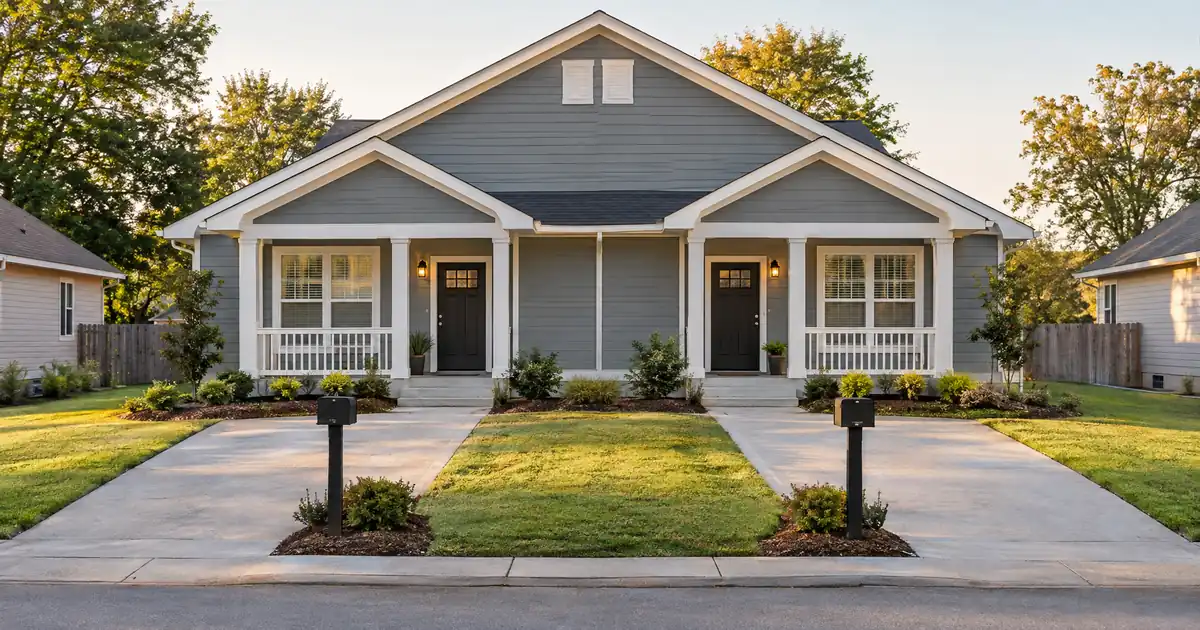
The Quick Read: A DSCR loan needs clear, insurable title held in a name that matches the borrower on the note, the insurance, the lease and the appraisal. Houses, duplexes and condos follow the same core title rules, and each adds its own wrinkle. The property’s rent coverage never replaces a clean title; both tests must pass.
- Title must be insurable, with liens cleared and ownership traceable.
- The vesting name (individual, trust or LLC) should match across every file document.
- An LLC is allowed on a DSCR loan but is never mandatory.
- Duplexes add unit-count and rent-schedule checks; condos add association and project review.
- Title never changes the coverage math, but a title defect can stop the file.
Most investors treat title as paperwork that happens after the real underwriting. On a DSCR file it works differently. Rent coverage is one test, and the title commitment is another. A strong 1.20x property with a vesting mismatch stalls just as surely as a weak one. This piece walks through what the title work checks, how vesting choices play out, and where houses, duplexes and condos diverge.
DSCR Calculator
Run the numbers in your market
Rate source: Freddie Mac 30-yr average via FRED® — Federal Reserve Bank of St. Louis · effective Oct 15, 2026
Prefilled with starting assumptions — enter your own rent or nightly figures, taxes, insurance, and HOA for a more accurate picture.
Program parameters update from Lendmire’s centralized guideline source. Taxes and insurance are editable estimates.
As of Oct 15, 2026 · General Freddie Mac market benchmark, not a Lendmire loan offer. Rent, nightly rate, occupancy, taxes, and insurance are editable estimates. Short-term rental figures are estimates only and vary significantly by season, property type, management approach, and local short-term-rental rules — confirm local regulations before relying on them. Qualifying income for short-term rentals varies by program — some use appraisal market rent, others use documented STR history or projections — and is confirmed in underwriting. Not a Loan Estimate, approval, or commitment to lend. Program availability and eligibility are subject to lender guidelines, credit approval, property review, and underwriting.
Key Terms Defined
Title is the legal right of ownership to a property and the record that proves it.
Vesting is the exact name in which title is held, such as an individual, a trust or an LLC.
Title commitment is the title company’s written preview of what it will insure and what must be cleared first.
Lender’s policy is title insurance that protects the lender’s lien position; the owner’s policy protects the buyer’s equity.
Lien is a legal claim against the property, such as an unpaid tax, judgment or old mortgage.
Due-on-sale clause is a loan term allowing the lender to call the balance if the property transfers without consent.
Guarantor is the person who personally backs the loan, even when an LLC holds title.
What Does Title Have to Show on Any DSCR Loan?
Title has to show that the seller or borrower truly owns the property, that no unresolved claims sit ahead of the new lien, and that the title company will insure it. That is true for every property type. DSCR loans are business-purpose investor loans, so they are reviewed differently from a standard owner-occupied mortgage, but the collateral still has to be clean.
A title search typically checks four things:
1. Who currently holds title, and how that name appears on the deed.
2. Open mortgages, tax liens, judgments and mechanic’s liens.
3. Easements, deed restrictions and, for condos, the declaration.
4. The legal description, so it matches the survey, appraisal and insurance.
Across the wholesale network, the title commitment is read alongside the appraisal and the insurance binder. Mismatches between those three documents cause more small delays than any single credit issue. Catching a misspelled entity name or a missing unit designation before submission costs nothing. Catching it at the end costs a re-issued document.
Title insurance itself is a standard closing cost on these files. An owner’s policy is separate, protects the investor’s own equity, and is usually worth having on a purchase.
Does a DSCR Loan Require an LLC?
No. A DSCR loan does not require an LLC. Individuals, many trusts and LLCs can all hold title, subject to program rules. The LLC question is about liability planning and portfolio organization, not loan eligibility.
Here is why the question comes up so often. Business-purpose loans can lend to an entity, while agency-style owner-occupant loans generally want a natural person on the note.
If an LLC holds title, expect an entity package. Typical items include articles of organization, an operating agreement, an EIN letter and a good-standing certificate. Multi-member LLCs may also need a borrowing resolution naming who signs. These requirements vary by lender and program, and qualification is subject to lender guidelines.
Two points trip people up:
- The guarantee usually stays personal. Credit is generally pulled on the guarantor, not the entity. An LLC changes who holds title and who the insurer covers. It does not usually remove personal exposure to the note.
- A trust is a program-by-program question. Some lenders in the network accept a properly drafted trust; others prefer an individual or LLC.
The flip point is simple. If you hold one rental, have no partners and want the simplest file, vesting in your own name keeps the paperwork light. If you hold several properties, bring in partners, or want a cleaner liability structure, an LLC pays for its paperwork.
Names That Must Match
Every document in the file should carry the same vesting name. The names to align are:
| Document | Should show |
|---|---|
| Note and security instrument | Borrower or entity |
| Title policy | Vesting owner |
| Hazard insurance | Named insured |
| Lease | Landlord |
| Appraisal | Owner of record |
A comma, a dropped “LLC” or a trade name can be enough to trigger a correction. Run the exact legal name from the entity’s formation papers through all five documents before submission.
Deed Into the LLC First, or Vest at Closing?
Buy in the LLC, or vest the LLC at the refinance closing. Deeding a financed rental into a new LLC beforehand is the move that causes trouble.
The reason is the due-on-sale clause in the existing mortgage. Federal law makes these clauses enforceable. The implementing rule, 12 CFR 191.5 at the eCFR, protects only certain transfers on homes the borrower occupies or will occupy, such as a short lease with no purchase option or a transfer into a trust where the borrower stays the beneficiary and occupant. A transfer into an LLC is not on that list, and a rental you do not occupy does not fit the occupancy-based exceptions at all.
Some investors point to the fact that lenders often take no action while a loan stays current. A BiggerPockets thread on transferring a deed while keeping the mortgage reflects that experience. Treat it as anecdote, not a safe harbor. The option to call the loan exists whether or not anyone uses it.
On a refinance, the cleaner path avoids the problem. A new DSCR loan pays off the old one, so no existing lender is left to object. The new loan can close with the LLC already vested at that closing. For help sequencing this on a cash-out, see Lendmire’s discussion of vesting on DSCR cash-out refinances.
Skip that deed-in step on a financed property unless a lawyer who knows your loan documents tells you otherwise.
How Title Differs: House, Duplex, Condo
The core review is the same across all three. The differences are in what else gets checked.
| Factor | House | Duplex | Condo |
|---|---|---|---|
| Title unit | One parcel | One parcel, two units | Unit deed plus share of common areas |
| Extra review | Survey, easements | Unit count vs. zoning | HOA questionnaire, project review |
| Appraisal form | Standard plus rent schedule | Multi-unit income form | Standard plus rent schedule |
| Common snag | Old liens, name variance | Unit count mismatch | Association liens, project issues |
Houses
A single-family house is the simplest collateral. The title company confirms the deed chain, clears liens and checks easements. The usual snags are old mortgages never formally released, unpaid taxes, and name variations between the deed and the borrower’s ID.
Take an investor buying a detached house in an LLC. The seller’s deed, the purchase contract buyer name, the insurance binder and the lease should all read the same entity. If any one differs, fix it before the title commitment is finalized.
Duplexes
A duplex adds a unit-count question. The legal description, zoning classification and appraisal should all agree that the building has two units. The appraiser documents unit-level rents on a small residential income property form; the Fannie Mae Selling Guide’s appraisal forms page names that form, 1025, for two- to four-unit properties, including units in condo projects. That source matters here only for the form’s name. DSCR programs set their own rules.
One quirk is worth checking. Some duplexes were platted as on-site condominiums, which means a master deed and a master insurance policy. A title search usually reveals this, and it turns a “duplex” into something that gets a project-style review. Better to learn that during the offer period than at the commitment.
Condos
Condo title has two layers: the unit and the project. The title company checks the unit deed and any association liens. The lender also reviews the project through an HOA questionnaire.
DSCR programs are not bound by the agency “warrantable” checklist, but they still look at the project. Common review points include investor concentration, pending litigation, a developer still controlling the association, and hotel-style rental features. A non-warrantable condo is often still reviewable on DSCR; certain conditions, such as developer control or mandatory rental pooling, can still rule out a unit. Eligibility depends on lender guidelines and the project’s specifics.
Here is where a mixed portfolio matters. If you finance a house, a duplex and a condo, each loan is its own note underwritten on its own coverage. A strong duplex does not rescue a weak condo. Lendmire’s piece How to Underwrite Condos Alongside Houses and Duplexes in a DSCR Pool covers that portfolio angle.
DSCR vs. conventional financing
There are two common ways to finance an investment property, and they qualify you differently — here’s how investors weigh them.
Why investors choose it
- Qualifies on the property’s rental income — no personal tax returns, W-2s, or pay stubs needed to document income.
- No personal debt-to-income ceiling to clear, so existing mortgages and obligations don’t cap your borrowing the same way.
- Can be closed in an LLC, keeping the property inside a business entity.
- Built for scaling — not held to the limit on number of financed properties that conventional financing applies.
- Underwriting centers on the deal: generally qualifies when the rent covers the payment, a 1.00x coverage ratio being a common baseline (confirmed in underwriting).
- Designed specifically for investment property, including long-term and, where the program allows, short-term rentals.
Where it’s strong
- Often the lowest ongoing financing cost for a buyer who fully qualifies on personal income — a fit for a first property or a cost-first purchase.
Trade-offs for investors
- Requires full personal income documentation and must fit within a debt-to-income limit — salary, existing debts, and other mortgages all count.
- Typically held in your personal name rather than a business entity.
- Caps how many financed properties you can carry, which can become a ceiling as a portfolio grows.
- Evaluates you as a borrower as much as the property, which usually means more paperwork.
How investors usually choose: a first or single property often optimizes for the lowest financing cost; portfolio builders often optimize for leverage, vesting in an LLC, and scaling past conventional caps. The right answer depends on your goals, the property, and current guidelines — both paths run through select lenders in Lendmire’s wholesale network, with eligibility and terms confirmed in underwriting.
Property Types That Never Reach the Title Stage
Manufactured homes (single- and double-wide), log homes and barndominiums are not offered through the network’s DSCR programs. No title fix changes that. Check the structure type before you spend money on a commitment.
Reading a Title Commitment
A commitment is the preview of what the policy will say. Read it in this order:
1. Vesting line. Does the named owner match the seller? On a refinance, does it match you?
2. Legal description. Does it match the appraisal and insurance?
3. Requirements section. These are the items that must be cleared before the policy issues, such as payoffs and releases.
4. Exceptions. These are items the policy will not cover. Easements are normal; unexpected ones deserve a question.
The usual defects and their cures:
| Defect | Typical cure |
|---|---|
| Unreleased old mortgage | Recorded release or payoff |
| Judgment lien | Payoff or release |
| Unpaid taxes | Pay at closing |
| Name variation | Affidavit or corrected deed |
| Association lien (condo) | Payoff from seller proceeds |
| Heir or probate issue | Court or attorney resolution |
Purchase and refinance differ here. On a purchase, the focus is the seller’s chain of title. On a refinance, the focus is existing liens and your own vesting, and the new loan often pays off the old lien at closing.
Does Clean Title Change the DSCR Math?
No. Title and vesting choices affect liability separation, paperwork and logistics. They do not move the coverage ratio, which compares rent to the full monthly obligation of principal, interest, taxes, insurance and any HOA dues. Clearing the program’s coverage floor is also not the same as positive cash flow. Repairs, vacancy, management and capital costs sit outside the calculation.
The program numbers that matter alongside title work, as typical ranges subject to lender guidelines:
- Purchase leverage: most files land at 75%–80% LTV on an investment purchase. Select high-leverage programs go higher with stronger credit.
- Cash-out refinance: tops out around 75% LTV across most of the network.
- Coverage: 1.00 is where select programs start. A separate select-lender path goes below 1.00, with leverage and terms adjusted.
- Credit: a 620 floor exists in parts of the network; most programs want around 660, and 700+ opens the strongest tiers.
- Reserves: commonly about 6 months of PITIA, stepping up to about 9 months on loans above $1,500,000.
A bigger down payment can lift coverage, but it does not erase leverage caps, credit floors or property eligibility. The strongest files clear both tests: enough equity and enough rental coverage. Appraiser market rent often controls the coverage figure, not the lease.
Pre-Submission Title Checklist
1. Confirm the property type is eligible before ordering anything.
2. Decide the vesting: individual, trust or LLC.
3. Pull the entity documents if using an LLC.
4. Ask for a title commitment early and read the vesting line first.
5. Compare names across the contract, insurance, lease and appraisal.
6. For a duplex, confirm the unit count matches zoning and the appraisal.
7. For a condo, request the HOA questionnaire and check for association liens.
8. For a refinance, line up the payoff statements.
9. Confirm who handles closing in your state, since some states use attorneys.
Frequently Asked Questions
Do I need an owner’s title policy on a DSCR purchase?
The lender’s policy is typically required. An owner’s policy is separate and protects your equity. Most investors buying with meaningful money down choose to carry both.
Can I close a DSCR loan in a trust?
Sometimes. Acceptance varies by lender and program, and the trust has to be drafted so the trustee can sign. Federal trust protections on transfers are built around owner-occupied homes, which fits a rental poorly. Ask before you deed anything.
Does a duplex need different title work than a house?
The search is the same, but the unit count, legal description and rent documentation get extra attention. If the duplex was platted as a condo, expect a master deed and project review.
Is a non-warrantable condo automatically ineligible?
No. Many are still reviewable through select lenders. A developer-controlled association, unfinished project or mandatory rental pooling can still disqualify a unit, so project facts decide it.
Does an LLC remove my personal guarantee?
Usually not. Credit is typically pulled on the guarantor, and the guaranty stays personal. The LLC changes who holds title and who the insurer covers.
If you are buying or refinancing a rental property and want to see how the numbers work, Lendmire can help you compare DSCR loan options based on the property income, credit profile, leverage and investor goals. Call 828-256-2183, or read the complete DSCR loans guide for the broader picture.
Clean title is the least glamorous line on a rental file, and it is the one investors can control entirely, before an offer is written.
About Lendmire
A DSCR-focused mortgage broker, Lendmire (NMLS# 2371349) places investor financing across 41 markets — 40 states plus Washington, D.C. — with DSCR eligibility generally reviewed by the lender on property cash flow instead of tax returns, subject to lender guidelines. Scotsman Guide named Lendmire a Top Mortgage Workplace in 2025 and 2026.
Get Started
Ready to find the right loan for you?
In about 30 seconds you can review financing options available for your investment property. No commitment required.
Informational only. Not a Loan Estimate, approval, or commitment to lend. Program availability and eligibility are subject to lender guidelines, credit approval, property review, and underwriting.
References
2. BiggerPockets, transfer deed and retain mortgage
3. Fannie Mae Selling Guide B4-1.2-01
This article is part of Lendmire’s DSCR loan program — full qualification details, guidelines, and scenarios live on the program page.
Related reading: Is a DSCR Loan on Rentals in Three States Harder to Document? · Can You Exit a Hard Money Loan by Refinancing Into a DSCR Loan? · DSCR Portfolio Loan Appraisal Requirements for Every House
Brandon Miller
Founder & CEO, Mortgage Loan Originator, Lendmire LLC
- Mortgage Loan Originator · NMLS# 1129696 · Verify on NMLS Consumer Access
- North Carolina Real Estate Broker · License# 343312 · Verify on NCREC
- North Carolina Insurance Producer · License# 19053198 · Property, Casualty, Life, Health · Verify on NAIC SBS
- Lendmire LLC · Firm NMLS# 2371349 · Verify firm licensure
Compliance and disclosures. Lendmire (NMLS# 2371349) is a licensed mortgage broker and is not a direct lender, depository institution, financial advisor, or tax professional. Content in this article is general market analysis and educational information — not financial, legal, or tax advice for any specific situation. Lendmire does not guarantee loan approval; every transaction is subject to underwriting by the funding lender. Mortgage pricing and loan program guidelines are subject to change at any time without notice and vary by borrower characteristics, property type, and state regulations. Lendmire complies with Equal Housing Opportunity. Licensure verification: NMLS Consumer Access.