
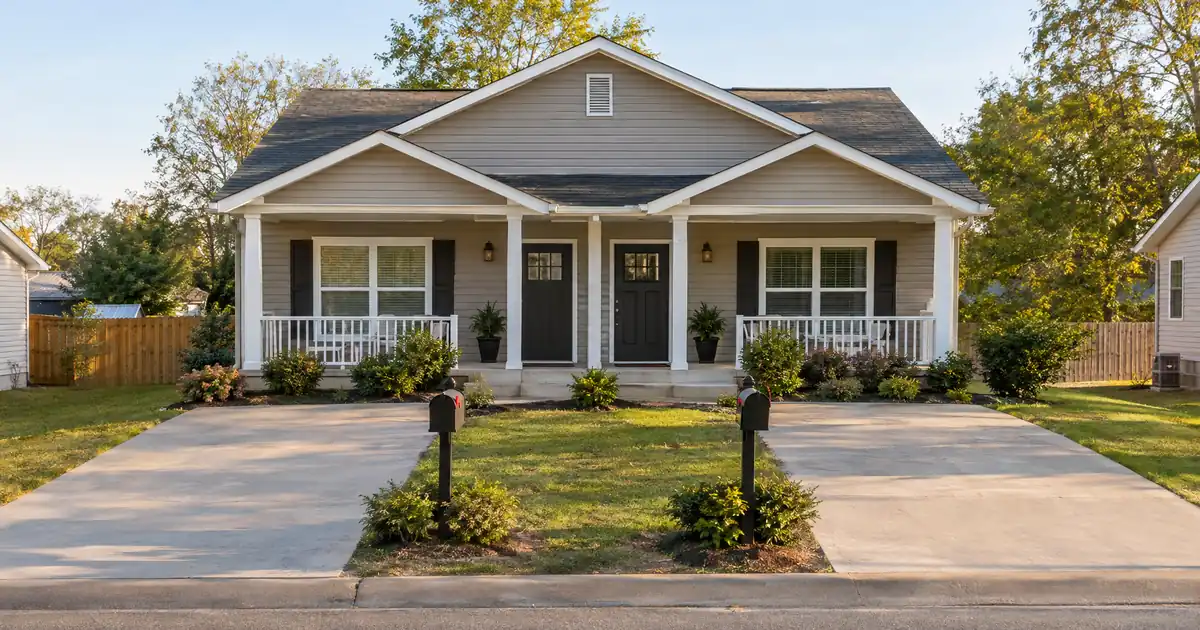
The Quick Read: A condo, a house and a duplex can sit in one DSCR pool, but each one is tested on its own rent and its own payment before any pooled number matters. The rent test is the same for all three. The documents differ, and the condo carries an extra project review that can stop a file even when the rent is strong.
- Coverage is rent divided by PITIA: principal, interest, taxes, insurance and association dues.
- A house is the simplest piece. A duplex adds unit-level rent. A condo adds project review and dues.
- On a portfolio structure, coverage is measured on the pool, subject to lender guidelines.
- A pooled structure ties the properties together, so one weak property can slow the whole file.
- Clearing 1.00 is not the same as positive cash flow.
Most files that mix these three types stall on one thing: the condo paperwork. The rent math is rarely the problem. This is how the mechanics run, step by step, across the lenders Lendmire works with.
What Does “DSCR Pool” Actually Mean?
A DSCR pool is several rentals financed together under one note, so one loan is secured by every property. Lenders also call it a portfolio loan, a blanket loan or a cross-collateralized loan. They all name the same thing here. (A bank’s own “portfolio loan,” meaning a loan the bank keeps on its books, is a different use of the word.)
The wholesale network offers two structures. The 30-year portfolio DSCR loan covers 2 to 20 properties, with loan sizes from $300,000 to $5,000,000 and leverage up to 80% of value on a purchase or rate-and-term refinance, subject to lender guidelines. The rental portfolio term loan covers five or more rental properties or units, with loan sizes from $500,000 to $50,000,000 and leverage up to 75% of value. It runs on fixed terms with a balloon at maturity. Both accept single-family homes, 2-4 unit buildings, condos and townhomes. Small multifamily, meaning five or more units, is eligible only inside the rental portfolio term loan.
A loan on one rental is a different product. That is the standard DSCR loan, where each property stands alone. Most of this article covers how a single property gets tested, because a pool is built from those tests. For the broader product picture, see the complete DSCR loans guide.
How Each Property Gets Tested First
Each property is tested on its own rent and its own payment. A strong rental does not rescue a weak one when the loans are separate. On a pool, the lender measures coverage on pooled rent against pooled debt service, so stronger properties can offset weaker ones. Even then, every property still needs a lease or an appraiser-supported market rent.
DSCR loans are designed for non-owner-occupied investment properties. Because they are business-purpose investor loans, they are reviewed differently from a standard owner-occupied mortgage. The file qualifies primarily on property-level rental income covering the payment, subject to lender guidelines.
The formula is the same for every type:
1. Establish the qualifying monthly rent.
2. Build PITIA from actual documents: the note, the tax bill, the insurance quote and the current association dues.
3. Divide rent by PITIA.
4. Compare the result to the program floor and to the leverage tier.
Dues sit in the denominator. They are not netted against rent. Leave them out and the ratio is overstated, which is how a file that looked clean at intake gets re-run lower at review.
One Framework, Three Property Types
The math is identical. The evidence behind the rent, the appraisal form and the extra review are not.
| Factor | House | Duplex (2-4 unit) | Condo |
|---|---|---|---|
| Rent basis | Lease or market rent | Unit-by-unit rent | Lease or market rent |
| Appraisal rent form | Form 1007 | Form 1025 | Unit appraisal plus rent support |
| Extra review | Little | Vacancy and unit mix | Project review |
| What weakens it | Taxes, insurance | Vacant unit | Dues, project health |
| Pool note | Simplest piece | One building, one payment | Can gate the whole file |
The forms are borrowed, not the rules. Fannie Mae’s Selling Guide lists Form 1025 as the appraisal for two- to four-unit properties, including those in condo projects, and DSCR files use that form for unit-level rent support. A 1007 comparable rent schedule does the same job on a single-family file. Agency rules do not govern DSCR loans. A lender sets its own overlays.
How Rent Gets Credited on Each Type
Rent evidence is where the three types split.
House. One lease, or one appraiser market rent. This is the cleanest evidence on the file.
Duplex. Rent is shown unit by unit, and every unit’s rent sits against one building payment. A duplex or fourplex counts as one rental, not two or four. That structure is why coverage tends to look stronger on a two- to four-unit building than on an equivalent single unit, since several rents carry one PITIA. A vacant unit usually gets the appraiser’s market rent in its place, though treatment varies by program. Picture a fourplex with one empty unit: it can still fall below 1.00 after that substitution, depending on the unit mix and the payment.
Condo. Lease or market rent, plus the project review. The rent number is rarely the issue. The dues number often is.
Across the network, most programs credit the lower of the signed lease and the appraiser’s market rent. A lease above market is capped at market. A lease below market stays at the lease figure. Lease evidence needs to match the rent roll, with no side agreements that contradict the signed documents.
The Condo Layer: Project Review
A condo is underwritten twice, once as a unit and once as a project. The project review checks whether the association is financially healthy enough to protect the collateral. Expect a questionnaire covering reserves, pending litigation, commercial space, delinquent dues and investor-owned units.
Working through it in order:
1. Order the association documents first. These are the budget, the latest reserve study, the master insurance certificate, litigation and special-assessment disclosures, a delinquency report and an estoppel letter.
2. Read the budget before the rent matters. A thin reserve line or a lawsuit can slow or end a file that has strong rent.
3. Confirm the rental rules. The governing documents must permit the planned lease term. A ban at that term is a clear stop, and rules can change after purchase.
4. Run the dues into PITIA. Use the current figure, not last year’s.
5. Check warrantability only as a label. It tells you whether the project meets agency standards. It does not decide DSCR eligibility.
HOA questionnaire completeness is the quiet friction point. Associations sometimes refuse to complete the form, or charge a fee for documents. Ask early, because the unit cannot be reviewed without it.
Warrantable and non-warrantable is a financing label, not a defect. DSCR lenders set their own standards, so a project that fails agency tests can still be reviewed. Eligibility is lender-specific, not automatic.
Agency Contrast: A Moving Label
Agency condo rules are worth one paragraph because the label keeps shifting. Fannie Mae’s Lender Letter LL-2026-03 retired the 50% investment-property concentration limit for established projects under full review, while the presale requirement still applies. A Michigan community association law blog notes that individual lenders remain free to set their own investor-concentration rules, and that many associations keep rental restrictions anyway.
The point: an agency change does not make every investor-heavy building fine. A DSCR program’s own overlays are what apply.
What Breaks a Condo (and Sometimes the Pool)
Some issues block only conventional loans. Others block DSCR too. These are the named edge cases:
- Hotel, resort or rental-pooling operations. Condotels are reviewed case by case because operator income adds volatility.
- Developer control and active litigation. Both can end a review.
- High delinquency. Unpaid dues weaken the project’s budget.
- One entity holding too many units. Concentration is a lender call.
- Too much commercial space. The project may read as mixed-use.
- Short-term rental bans. The governing documents must allow the planned rental term.
- Special assessments. A one-time lump sum is usually a reserves or cash-to-close issue. An assessment converted to a monthly charge is treated like dues inside PITIA.
Property type limits apply too. Manufactured homes are not reviewable on any of these programs. Owner-occupied property, co-ops, mixed-use and commercial property are ineligible in the pool.
Here is the pool-level catch. A rental below 1.00 can sit inside a pool, but underwriting tests the pooled coverage, the leverage and the terms. If a heavy-dues condo drags the pooled number under the floor, the fix is usually to pull that unit, not to argue the ratio.
Combining Them Into One Test
A worked example, in ratios only. Run the numbers on a pool of one house, one duplex and one condo. Say the house covers around 1.2x, the duplex around 1.3x and the condo around 0.95x because dues are heavy. The pooled figure lands above 1.00, so the pool can be reviewed even though the condo alone sits under it. These inputs are modeled assumptions, not market data.
Three things still apply. Underwriting tests the pooled coverage, the leverage and the terms. The pooled floor on the 30-year structure is 1.00, so pooled coverage under it is not available on that structure. And the weakest property can still be a problem on documents alone, because an unreadable condo questionnaire stalls the whole file.
A separate select-lender path for single-property loans takes coverage below 1.00 with leverage and terms adjusted. That is not the pooled structure. No-ratio loans exist only on single-property loans, through select lenders, generally for borrowers who already own a primary residence.
Credit and entity rules matter at pool level. The portfolio programs set a credit floor of 640, with 680 or 720 on some structures, and a special-purpose entity, typically an LLC, is required on some structures, subject to program terms. Recourse loans carry a personal guarantee. The rental portfolio term loan also offers non-recourse structures, where the loan looks to the real estate with recourse limited to carve-outs such as fraud and bankruptcy. Reserves on the term loan are held for taxes, insurance and capital expenditures.
Pool or Keep Separate Notes?
| Situation | Leaning | Why |
|---|---|---|
| Strong duplex carrying a heavy-dues condo | Pool | Pooled coverage offsets the weak unit |
| Condo with litigation or a weak budget | Separate or drop it | One project issue can stall the pool |
| Properties in several markets | Pool (term loan) | Cross-collateralization allows it |
| Plan to sell one unit soon | Separate | Releases follow the loan documents |
| Every property clears on its own | Either | Separate loans give more exit room |
Releases deserve a read before signing. Partial releases, substitutions and the sale of one property out of the pool follow the loan documents and the lender’s release terms. The release price runs above the property’s allocated balance, and the remaining portfolio must still cover its debt service. On the rental portfolio term loan, prepayment is by yield maintenance, which matters if the plan is to sell early.
Leverage, Credit and Reserves on the Single-Property Side
Compare these to the pool figures above. On a loan for one rental, most files land at 75%-80% LTV on a purchase, subject to lender guidelines. Cash-out tops out around 75% of value, and about six months of seasoning is the common expectation. Credit floors start at 620 in parts of the network, most programs want around 660, and 700 or above opens the strongest tiers. Reserves commonly run about 6 months of PITIA, stepping up to about 9 months above $1,500,000. Conservative rate-and-term files at modest leverage can see reserves waived, depending on the lender.
A larger down payment lowers the payment and can lift the ratio. It never erases leverage caps, credit floors, reserve rules or property eligibility. The strongest files clear both tests: enough equity and enough rental coverage.
For a pool in particular, cash-out is never above 75% of pooled value. Inside the first six months of ownership the loan is also capped at 90% of total cost (purchase price plus documented improvements), 100% of total cost from six to twelve months, and the leverage ceiling still applies, so the loan is the lower of the two. After twelve months the appraised value alone is the basis. A rate-and-term refinance is not subject to the cost-basis cap.
A Passing Ratio Is Not Positive Cash Flow
DSCR compares rent to PITIA only. Repairs, vacancy, management, utilities and capital expenditures sit outside the calculation. Each type carries a different expense profile. The house has the most owner-paid maintenance, the duplex has per-unit vacancy, and the condo has dues that rise when an association races to rebuild reserves. A pool that clears the floor can still run thin once those are counted.
On the condo, watch the trend in dues, not just today’s figure. Reserve rules in the agency world have been tightening, and associations working to meet them have been raising dues. That moves PITIA and the ratio with it.
Tax treatment can depend on how the funds are used and how the property is held; investors should keep clear records and speak with a qualified tax professional before relying on any deduction.
Pre-Submission Checklist by Property Type
- House: lease or rent schedule, tax bill, insurance quote, entity documents.
- Duplex: unit-by-unit lease set, rent roll that matches the leases, Form 1025 rent support, one building payment worked out.
- Condo: completed questionnaire, budget, reserve study, master insurance certificate, litigation and assessment disclosures, delinquency report, current dues.
- Pool: entity documents, reserves documentation, and a list of any property that may need to come out.
Short-term rental on a condo is its own file. The program expects roughly 12 months of hosting history, a 640+ score, and 1.00 coverage on purchases and on refinances, with purchase leverage to 75% and cash-out around 70% on short-term-rental collateral. Short-term rental rules can vary by city, county, HOA, and property type, so investors should confirm local rules before relying on projected rental income. Final terms depend on the lender’s guidelines, the property type, and the borrower’s complete credit picture.
Frequently Asked Questions
Can a non-warrantable condo sit in a pool?
Sometimes. Non-warrantable is a financing label, and lenders in the network set their own standards. High investor concentration may still work, but deed restrictions, pending litigation and mandatory rental pooling can disqualify a unit under any rental strategy. Eligibility is reviewed by the lender.
Does the lender test the pool or each property?
Both views matter. A pool is measured on pooled rent against pooled debt service, so stronger properties can offset weaker ones. Each property still needs a lease or an appraiser-supported market rent. On separate loans, each property is tested alone.
What does a two-unit condo mean for the appraisal?
It depends on the ownership structure. One unit inside a condo regime is a condo file. A two-unit building under condo ownership can call for the 2-4 unit appraisal form instead. Using the wrong form is a common reason a file gets kicked back.
Do HOA dues count against the rent?
Yes. Dues sit in PITIA, in the denominator, and are not netted from rent. Leaving them out overstates the ratio.
Can small multifamily go in the same pool?
Only on the rental portfolio term loan, which covers five or more rental properties or units. It is not eligible on the 30-year portfolio structure or on a single-property DSCR loan.
If you are buying or refinancing rental properties and want to see how the numbers work, Lendmire can help you compare DSCR loan options based on the property income, credit profile, leverage, and investor goals. Programs change, every file is underwritten individually, and nothing here is a commitment to lend.
The condo, more than the house or the duplex, decides whether a mixed pool clears, so the association’s paperwork deserves the first request, not the last.
About Lendmire
Lendmire, NMLS# 2371349, is a non-QM mortgage broker serving real estate investors in 41 markets, including Washington, D.C., through DSCR investor loan programs. Qualification is generally reviewed around the subject property’s rental income, not the borrower’s W-2 history — a practical fit for LLC-titled portfolios and self-employed investors. All scenarios remain subject to lender review and program guidelines. Two consecutive Scotsman Guide Top Mortgage Workplace recognitions (2025, 2026).
Get Started
Ready to find the right loan for you?
In about 30 seconds you can review financing options available for your investment property. No commitment required.
Informational only. Not a Loan Estimate, approval, or commitment to lend. Program availability and eligibility are subject to lender guidelines, credit approval, property review, and underwriting.
References
1. Fannie Mae Selling Guide B4-1.2-01
2. Fannie Mae Lender Letter LL-2026-03
3. Michigan Community Association Law Blog
This article is part of Lendmire’s DSCR loan program — full qualification details, guidelines, and scenarios live on the program page.
Related reading: How to Sell a Super Jumbo DSCR Pool in Stages · How to Present Houses Across One Metro to a DSCR Lender · Super Jumbo DSCR vs Private Bank for Luxury Rentals and Houses
Brandon Miller
Founder & CEO, Mortgage Loan Originator, Lendmire LLC
- Mortgage Loan Originator · NMLS# 1129696 · Verify on NMLS Consumer Access
- North Carolina Real Estate Broker · License# 343312 · Verify on NCREC
- North Carolina Insurance Producer · License# 19053198 · Property, Casualty, Life, Health · Verify on NAIC SBS
- Lendmire LLC · Firm NMLS# 2371349 · Verify firm licensure
Disclosures. The information presented in this article is general market commentary, not financial, legal, or tax advice. Lendmire is a mortgage brokerage (NMLS# 2371349) — not a direct lender or depository institution — and loan placement is subject to lender underwriting. Nothing in this content represents a commitment to lend. Loan terms, pricing, and program availability vary based on borrower qualifications, property characteristics, and state of subject property, and are subject to change at any time. Lendmire complies with Equal Housing Opportunity requirements. Consumer access: nmlsconsumeraccess.org.