
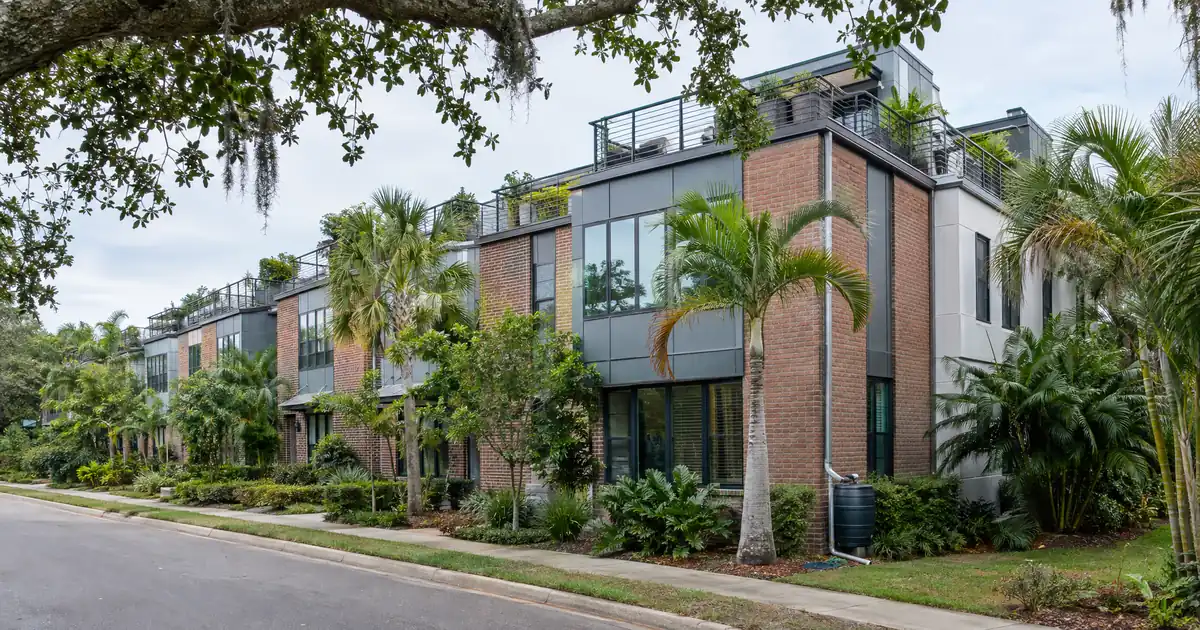
The Quick Read: Usually yes: a DSCR loan can finance a Siesta Key condo you will rent out, as long as the unit is non-owner-occupied, the building’s association allows the lease length you plan, and the rent covers the full monthly payment at a ratio the lender’s program accepts. Four separate gates decide it.
- The loan program: DSCR (debt service coverage ratio) loans qualify primarily on property-level rental income covering the payment, subject to lender guidelines.
- The building: The condo association’s rental rules and financial health can narrow your lender options or end the deal.
- The lease length: Long-term and 30-day-plus leases are the cleanest path. Nightly rentals add more checks.
- The number: Association dues sit inside the payment, so they can pull coverage down fast on a coastal condo.
Siesta Key is our worked example here. The same logic applies to any beach-town condo you are weighing.
DSCR Calculator
Run the numbers in your market
Rate source: Freddie Mac 30-yr average via FRED® — Federal Reserve Bank of St. Louis · effective Oct 29, 2026
Prefilled with starting assumptions — enter your own rent or nightly figures, taxes, insurance, and HOA for a more accurate picture.
Program parameters update from Lendmire’s centralized guideline source. Taxes and insurance are editable estimates.
As of Oct 29, 2026 · General Freddie Mac market benchmark, not a Lendmire loan offer. Rent, nightly rate, occupancy, taxes, and insurance are editable estimates. Short-term rental figures are estimates only and vary significantly by season, property type, management approach, and local short-term-rental rules — confirm local regulations before relying on them. Qualifying income for short-term rentals varies by program — some use appraisal market rent, others use documented STR history or projections — and is confirmed in underwriting. Not a Loan Estimate, approval, or commitment to lend. Program availability and eligibility are subject to lender guidelines, credit approval, property review, and underwriting.
What a DSCR Loan Actually Measures
A DSCR loan compares the property’s rent to its full monthly obligation. That obligation is called PITIA: principal, interest, taxes, insurance, and association dues. Divide the rent the lender counts by PITIA and you get the coverage number.
At 1.00, rent equals the payment. Select programs start there. A separate select-lender path takes coverage below 1.00, with leverage and terms adjusted. Stronger ratios generally open better pricing and more leverage.
DSCR loans are designed for non-owner-occupied investment properties. Because they are business-purpose investor loans, they are reviewed differently from a standard owner-occupied mortgage. You will not be asked to live in the unit, and you cannot.
Here is the catch most new investors miss. Clearing 1.00 is not the same as positive cash flow. The ratio looks only at rent versus PITIA. Repairs, vacancy, management, utilities, and big capital costs sit outside the calculation, and on a condo they still hit your wallet.
For the broader picture, Lendmire’s complete DSCR loans guide covers how these loans work across property types.
What Are the Four Gates a Siesta Key Condo Must Pass?
A condo must clear four checks: the building’s rental rules, the building’s eligibility, the income method, and the ratio. Fail any one and the file stalls. Most deals that die, die at gate one or two, before anyone runs the math.
| Gate | What gets checked | Common failure |
|---|---|---|
| Rental rules | HOA documents, minimum lease length | Plan needs shorter stays than allowed |
| Building review | Reserves, litigation, investor mix | Pending assessment or lawsuit |
| Income method | Lease, rent schedule, or STR history | Nightly income assumed without support |
| Ratio | Counted rent divided by PITIA | High dues drag coverage under target |
Work them in that order. Gate four is the one investors love to start with, and it is the least useful starting point.
Will the Building Let You Rent It?
The building’s documents decide the lease length, not the island. A local brokerage that tracks Siesta Key condos says the minimum stays are association rules, not island law. It describes minimums running from about one week in rental-friendly communities to one, three, or six months elsewhere.
So two condos a block apart can have very different answers. One may allow weekly stays. The next may require a lease of several months. Your loan program cannot override either one.
Get the rental policy in writing before you write an offer. Ask for the declaration, the rules, and any amendments. Rules get amended, and an old listing description is not evidence.
Short-term rental rules can vary by city, county, HOA, and property type, so investors should confirm local rules before relying on projected rental income. That is the one sentence to tattoo on your pro forma. On barrier-island property, the county’s code enforcement guide treats rentals over 30 days differently from shorter stays, tied to how the parcel is zoned. Check the current rule with the county for the specific address.
The practical result is simple. A unit with a legally allowed lease of 30 days or longer is the cleanest DSCR case. Anything shorter needs permission from the zoning, permission from the building, and a program that accepts short-term income.
Is a Non-Warrantable Condo a Deal-Breaker?
No. A non-warrantable condo is not automatically barred from DSCR financing, but it narrows your lender pool. “Warrantable” is an idea borrowed from conventional lending. It describes a project that meets standard agency project rules. Non-warrantable just means the project falls outside them.
DSCR programs run their own project review instead. Trade press has noted that investors adding rental condos often turn to DSCR because it can handle warrantable and non-warrantable units. Across the lenders we place files with, the honest read is this: eligibility varies by program, and many non-warrantable buildings get reviewed case by case.
| Building trait | Typical read |
|---|---|
| High share of investor-owned units | Often reviewable, may limit leverage |
| Some commercial space in the project | Case by case, depends on the lender |
| Active litigation | Red flag, can stop a file |
| Large pending special assessment | Red flag, hits ratio and review |
| Hotel-style services or rental pooling | Most likely to fall outside programs |
Expect extra paperwork on any of these. That usually means the condo questionnaire, the association budget, and the master insurance certificate. Some lenders also adjust leverage for a non-warrantable project.
One more thing. A non-warrantable unit can be harder to sell later, because the next buyer may not get conventional financing. Price that exit risk in now.
How Do Florida Reserve Rules and Dues Change the Math?
They push the payment up, and a higher payment lowers coverage. Association dues sit in the denominator of the ratio. A coastal building with heavy insurance, maintenance, and reserve needs can post dues that wipe out what looked like a comfortable cushion.
Florida adds a layer here. After the Surfside collapse, the state required milestone inspections and structural integrity reserve studies for older, taller buildings. Associations now have to fund reserves that many once skipped. A Florida law firm explains that large special assessments remain common even after later legislative changes.
For you, that means one check:
- Ask about assessments, passed or pending. A pending special assessment is a lender red flag and can change the ratio before you close.
These rules apply mainly to buildings of three or more habitable stories. A low-rise condo may face a lighter version of the same questions.
How Does the Lender Count Rental Income?
Lenders count whichever income you can document for the lease type you plan. Long-term rentals use a signed lease or an appraiser’s market rent figure. Short-term rentals use booking history or a projection, and each program handles that differently.
For a single-unit condo, the appraiser’s rent figure usually comes from a form called the 1007. Multi-unit properties use a different form, the 1025. The 1007 calls for the indicated monthly market rent based on monthly-leased comparables. It does not work by multiplying a nightly rate by 30, and it cannot estimate a nightly fee.
That has a direct consequence. If your plan is Airbnb-style income, the appraisal will not document it. The lender evaluates short-term income separately. An appraisal education provider says the 1007 cannot capture short-term rental rates and that the business-income question belongs to the lender.
On short-term-rental files, the programs we see typically want a 640+ credit score and about 12 months of hosting history. Purchase leverage tops out at 75%, a refinance sits around 70%, and cash-out on short-term-rental collateral runs 70%. On a purchase, coverage of 1.00 is the floor. On a refinance, it is also 1.00. Those are separate programs with separate terms, so never blend them in your head.
Seasonality matters too. Most programs look at a full-year picture, not your best month. A barrier-island condo that books solid in winter and sags in summer will be judged on the whole year.
For most investors, the conservative path is a lease of 30 days or longer, supported by an appraiser’s rent figure. It is boring. It also gets approved more often.
A Worked Example: One Condo, Two Outcomes
Run the numbers on a hypothetical Siesta Key condo bought as a long-term rental. These are modeled assumptions, not market data, and every figure is a ratio.
Scenario one. Say you buy at 75% LTV on a purchase of an investment property. The appraiser’s rent schedule supports a coverage ratio around 1.25x with the building’s current dues included. That clears a 1.00 floor with room to spare. On most files, that is a clean read, subject to credit, reserves, and the building review.
Scenario two. The association then announces higher dues to fund its reserve study. Nothing else changes. Coverage slides to roughly 1.05x. It still clears 1.00, but the cushion is gone, and a small insurance increase could push it under.
Scenario three. Suppose coverage had landed near 0.92x instead. That does not necessarily end the deal. Here are the levers a lender would review:
- More down payment. A larger down payment lowers the monthly payment and can lift the ratio. It does not erase leverage caps, credit floors, reserve rules, or property eligibility.
- A sub-1.00 path. Coverage below 1.00 is available through select lenders in the network, with leverage and terms adjusted.
- A different term structure. The spine is the 30-year fixed. Extended terms and interest-only periods are available through select lenders, and they change the payment side of the ratio.
- A different income method. If a short-term plan is legal and documented, it may support more income than a long-term lease. If it is not, it will not.
The strongest files clear both tests: enough equity and enough rental coverage. Honestly, buyers fixate on the ratio and forget the equity half.
What About Condo-Hotels and Rental Pools?
These are the hardest buildings to finance. A condo-hotel has a front desk, hotel-style services, or an operator that pools rental income among owners. The pool splits income, and the splits change what a lender can count as yours.
Programs often treat these projects as the most restrictive case, or exclude them. If the listing mentions a rental program, a management mandate, or shared income, get the documents early. Do not assume a “rental-friendly” label means “loan-friendly.”
DSCR vs. conventional financing
There are two common ways to finance an investment property, and they qualify you differently — here’s how investors weigh them.
Why investors choose it
- Qualifies on the property’s rental income — no personal tax returns, W-2s, or pay stubs needed to document income.
- No personal debt-to-income ceiling to clear, so existing mortgages and obligations don’t cap your borrowing the same way.
- Can be closed in an LLC, keeping the property inside a business entity.
- Built for scaling — not held to the limit on number of financed properties that conventional financing applies.
- Underwriting centers on the deal: generally qualifies when the rent covers the payment, a 1.00x coverage ratio being a common baseline (confirmed in underwriting).
- Designed specifically for investment property, including long-term and, where the program allows, short-term rentals.
Where it’s strong
- Often the lowest ongoing financing cost for a buyer who fully qualifies on personal income — a fit for a first property or a cost-first purchase.
Trade-offs for investors
- Requires full personal income documentation and must fit within a debt-to-income limit — salary, existing debts, and other mortgages all count.
- Typically held in your personal name rather than a business entity.
- Caps how many financed properties you can carry, which can become a ceiling as a portfolio grows.
- Evaluates you as a borrower as much as the property, which usually means more paperwork.
How investors usually choose: a first or single property often optimizes for the lowest financing cost; portfolio builders often optimize for leverage, vesting in an LLC, and scaling past conventional caps. The right answer depends on your goals, the property, and current guidelines — both paths run through select lenders in Lendmire’s wholesale network, with eligibility and terms confirmed in underwriting.
What Does the Network Typically Require?
Here are the typical ranges we see across the wholesale network. Select lenders set their own terms, programs change, and every file is underwritten individually. Nothing here is a commitment to lend.
| Item | Typical range |
|---|---|
| Purchase LTV, investment property | 75%–80% |
| Cash-out LTV, standard rental | Up to 75% |
| Credit score | 620 floor in parts of the network, most want 660, 700+ for top tiers |
| Coverage | 1.00 on select programs |
| Reserves | About 6 months of PITIA, about 9 above $1,500,000 |
| Loan size | Up to $3,000,000 on standard programs |
Reserves vary by lender, leverage, and loan size. Some conservative rate-and-term files at modest leverage can see them waived. Rate-and-term refinances can reach higher leverage on strong files, topping out around 85%.
Borrowing through an LLC is common for rentals, subject to lender program eligibility. Entity documents go in the file if you use one.
What Documents Should You Gather?
Start collecting early. A condo file has more moving parts than a house.
- The condo questionnaire and the association budget
- The master insurance certificate, plus your own policy quote
- The signed lease, or short-term platform statements or a projection
- Reserve study and any assessment notices
- Entity documents, if an LLC is borrowing
- Proof you are not occupying the unit
That last item matters. DSCR is for investors, not primary residences or second homes.
When Is a DSCR Loan the Wrong Tool?
Sometimes it is simply not the right fit. Be honest with yourself about these cases:
- The building bans your lease length. No program fixes that.
- The project has live litigation or a large unresolved assessment. The file may stall regardless of your income.
- Your pro forma depends on nightly rentals you cannot legally run. That is a denial risk, not a pricing problem.
- The ratio only works with peak-season numbers. Lenders will not use them.
- You want to live in the unit. DSCR is not built for that.
- The property is a manufactured home, log home, or barndominium. These are not offered through these DSCR programs.
If the building is the problem, buying a different building is often a more affordable fix. The same logic shows up in Lendmire’s piece How to Buy a Perdido Key Condo Rental With a DSCR Loan, another Gulf beach condo market.
Key Terms Defined
DSCR: Debt service coverage ratio. Counted rent divided by the full monthly payment.
PITIA: Principal, interest, taxes, insurance, and association dues. It is the payment side of the ratio.
Non-warrantable condo: A condo project that falls outside standard conventional project rules, so lenders review it on its own terms.
Special assessment: A one-time charge the association levies on owners to cover large costs.
Structural integrity reserve study: A required engineering and funding review of a building’s major components, common in Florida buildings of three or more stories.
Rental pool: An arrangement where unit owners share rental income through a central operator.
Tax treatment varies; consult a qualified professional.
Frequently Asked Questions
Can I buy the condo in an LLC?
Often, yes. Many investors close in an LLC, subject to lender program eligibility. The lender will want the entity documents and will usually still review the guarantor’s credit.
Can I buy a vacant unit with no rental history?
Yes, for a long-term rental, the appraiser’s market rent figure typically stands in for a lease. Short-term plans are different. Programs we see generally want around 12 months of hosting history, so a vacant unit with only a projection faces a tougher review.
Can I refinance or pull cash out of a condo I already own?
Often, yes. Cash-out on a standard rental tops out around 75% LTV across most of the network, and about six months of seasoning is the common expectation. Short-term-rental collateral caps lower, at 70% on cash-out.
Do I need a 700 credit score?
No. A 620 floor exists in parts of the network, and most programs want around 660. A 700+ score unlocks the strongest leverage tiers.
Can I stay in the unit myself part of the year?
Not under DSCR. These loans are for non-owner-occupied investment property. Personal use beyond ordinary owner visits can conflict with the occupancy certification you sign at application.
Next Step
If you are buying or refinancing a rental property and want to see how the numbers work, Lendmire can help you compare DSCR loan options based on the property income, credit profile, leverage, and investor goals. Lendmire is a broker that arranges financing through select lenders in its wholesale network, across 41 markets, including Washington, D.C. Call 828-256-2183 or request a quote.
The building’s rulebook, not the island’s reputation, tells you whether a condo can carry a DSCR loan.
About Lendmire
Lendmire (NMLS# 2371349), a non-QM mortgage broker serving investors in 41 markets including Washington, D.C., helps structure DSCR scenarios commonly evaluated around a property’s rental income rather than personal income paperwork, subject to lender guidelines. A Scotsman Guide Top Mortgage Workplace in 2025 and 2026, Lendmire places loans through wholesale investor lenders and is not a direct lender.
Get Started
Ready to find the right loan for you?
See your offer in seconds. No credit pull, no obligation.
Informational only. Not a Loan Estimate, approval, or commitment to lend. Program availability and eligibility are subject to lender guidelines, credit approval, property review, and underwriting.
References
1. Dwelling Well, Siesta Key short-term rental condos
2. Sarasota County Code Enforcement Citizen Guide
3. Scotsman Guide, “Invest in Your Future”
5. Fannie Mae Appraiser Update
6. McKissock, Form 1007 and short-term rental appraisals
This article is part of Lendmire’s DSCR loan program — full qualification details, guidelines, and scenarios live on the program page.
Related reading: Can You Vest a Rental in an LLC Before a DSCR Loan Closes? · How to Buy a Business and Its Rental Building With a DSCR Loan · How to Fix Rental Income Documentation and Get a DSCR Loan Approved
Guides: DSCR Loans in Siesta Key, FL · DSCR Loans in Florida
Brandon Miller
Founder & CEO, Mortgage Loan Originator, Lendmire LLC
- Mortgage Loan Originator · NMLS# 1129696 · Verify on NMLS Consumer Access
- North Carolina Real Estate Broker · License# 343312 · Verify on NCREC
- North Carolina Insurance Producer · License# 19053198 · Property, Casualty, Life, Health · Verify on NAIC SBS
- Lendmire LLC · Firm NMLS# 2371349 · Verify firm licensure
Disclosures. The information presented in this article is general market commentary, not financial, legal, or tax advice. Lendmire is a mortgage brokerage (NMLS# 2371349) — not a direct lender or depository institution — and loan placement is subject to lender underwriting. Nothing in this content represents a commitment to lend. Loan terms, pricing, and program availability vary based on borrower qualifications, property characteristics, and state of subject property, and are subject to change at any time. Lendmire complies with Equal Housing Opportunity requirements. Consumer access: nmlsconsumeraccess.org.