
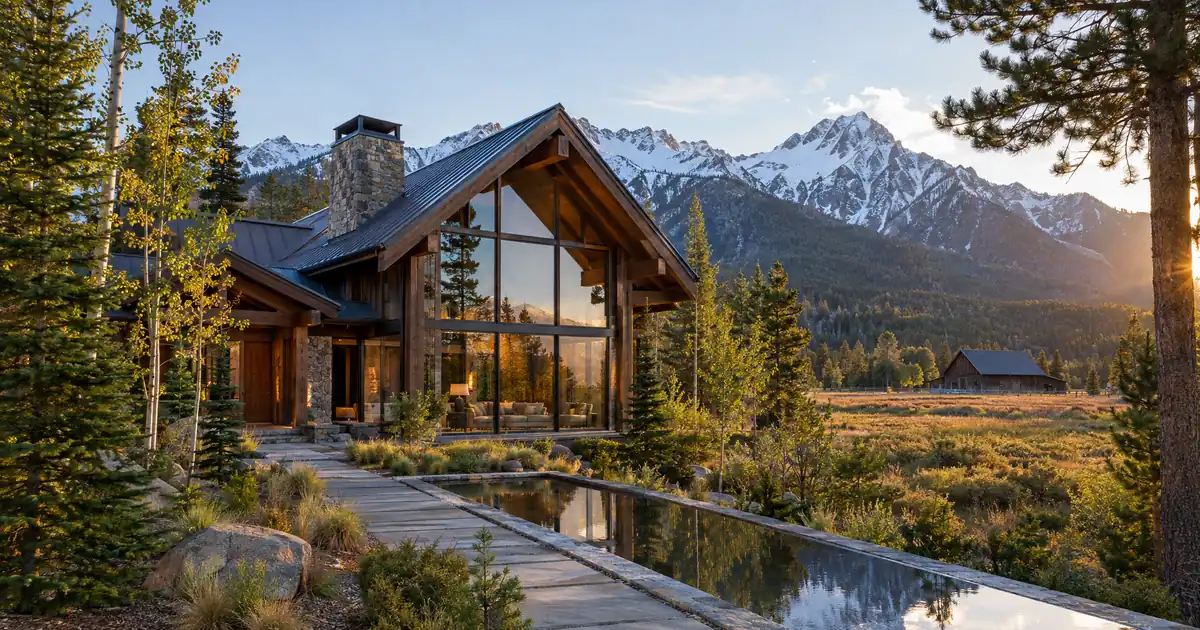
The Quick Read: Yes, when the cabin is a conventionally built investment property and its rental use is legal at that address. A DSCR loan is reviewed primarily on property-level rental income covering the payment, subject to lender guidelines. In South Lake Tahoe, the real gate is usually the vacation home rental permit, not the loan product.
- Eligible: frame-built cabins, condos where the HOA allows rentals, and small multi-unit properties.
- Not offered: log homes, manufactured homes, and barndominiums.
- Typical purchase leverage runs 75%-80% LTV on an investment property.
- Short-term rental income generally needs permit evidence and a documented income path.
- Clearing 1.00 coverage is not the same as positive cash flow.
What Makes a South Lake Tahoe Cabin Eligible?
Most conventionally built cabins are eligible. The property must be a non-owner-occupied investment property, and the construction type matters more than the “cabin” label.
DSCR Calculator
Run the numbers in your market
Rate source: Freddie Mac 30-yr average via FRED® — Federal Reserve Bank of St. Louis · effective Oct 29, 2026
Prefilled with starting assumptions — enter your own rent or nightly figures, taxes, insurance, and HOA for a more accurate picture.
Program parameters update from Lendmire’s centralized guideline source. Taxes and insurance are editable estimates.
As of Oct 29, 2026 · General Freddie Mac market benchmark, not a Lendmire loan offer. Rent, nightly rate, occupancy, taxes, and insurance are editable estimates. Short-term rental figures are estimates only and vary significantly by season, property type, management approach, and local short-term-rental rules — confirm local regulations before relying on them. Qualifying income for short-term rentals varies by program — some use appraisal market rent, others use documented STR history or projections — and is confirmed in underwriting. Not a Loan Estimate, approval, or commitment to lend. Program availability and eligibility are subject to lender guidelines, credit approval, property review, and underwriting.
Across the wholesale network, DSCR programs are built for investment properties. Because they are business-purpose investor loans, they are reviewed differently from a standard owner-occupied mortgage. That means you cannot live in the cabin as a primary residence and use this product.
| Cabin type | Eligibility | What gets reviewed |
|---|---|---|
| Frame-built single-family cabin | Generally eligible | Condition, access, insurability |
| A-frame (conventional framing) | Generally eligible | Condition, appraisal comps |
| Condo or resort-style unit | Eligible if HOA allows rentals | CC&Rs, HOA dues |
| 2-4 unit property | Generally eligible | Rent schedule per unit |
| Log home | Not offered | Outside these programs |
| Manufactured or barndominium | Not offered | Outside these programs |
Here’s the catch: many Tahoe “cabins” are older. Condition issues can affect the appraisal and whether the property can be insured. A cabin that cannot get a binding insurance policy cannot close, regardless of how strong the rent looks.
Is Short-Term Renting Legal at Your Address?
Not automatically. The City of South Lake Tahoe applies its vacation home rental rules whenever an entire dwelling is rented for fewer than 30 days, and it caps residential-area permits at 900.
This is the section that decides most Tahoe files. Per the city, new permit applications go on a waitlist as the city nears that cap in residential zones. South Tahoe Now reports that applicants who were previously disqualified by the old 150-foot buffer could reapply starting April 23. MyNews4 adds that attached condos can qualify unless the HOA prohibits it, renters must be at least 25, and owners must report room nights.
Short-term rental rules can vary by city, county, HOA, and property type, so investors should confirm local rules before relying on projected rental income. Properties outside city limits fall under a different jurisdiction, so the address matters.
Think of it as a sequence:
1. Confirm the cabin sits inside the city, not unincorporated county land.
2. Ask whether a valid permit exists, and whether it will be yours after purchase.
3. Check the HOA’s CC&Rs if it is a condo or planned community.
4. Only then build the income side of the file.
The permit-transfer question deserves extra care. Several local brokerage sources say these permits do not pass to a buyer, and a listing’s “six-figure rental history” may not be permit-backed for you. Treat that as a reason to verify with the city directly, not as settled fact.
If there is no permit and none is obtainable, an underwriter may decline to count short-term income. The file then falls back on long-term market rent. For a high-priced Tahoe cabin, that fallback often leaves coverage thin.
How Do Lenders Count Seasonal Cabin Income?
They count it through one of a few documented paths, and the path chosen often decides whether the ratio clears. Tahoe has a ski peak, a summer lake peak, and slow shoulder months, so the method matters.
The common routes for short-term rental income:
- Trailing history. Roughly 12 months of actual platform or bank-deposit income. This captures the real swings.
- Market projection. A third-party report such as AirDNA, which smooths seasonality into a forecast.
- Appraiser’s rent schedule. The 1007 form for single-family or the 1025 for small multi-unit. These reflect long-term market rent and are usually well below short-term potential.
Across our wholesale network, short-term rental programs commonly expect a 640+ score and about 12 months of hosting history. Purchases go up to 75% LTV with a 1.00 coverage floor. Refinances run around 70% with a 1.00 floor. Cash-out tops out at 70% on short-term rental collateral, versus 75% for a standard rental. All of this is subject to lender guidelines.
A projection helps a purchase where no history exists under your ownership. But it supports income only. Collateral value still comes from the appraisal.
What Does the DSCR Math Look Like on a Tahoe Cabin?
DSCR divides the property’s qualifying monthly rent by its full monthly obligation: principal, interest, taxes, insurance, and any HOA dues. Cleared at or above the program floor, the ratio supports the file.
Run the numbers on a cabin this way. Say the price is in the high six figures, you put 25% down, and the cabin carries HOA dues plus a wildfire-aware insurance policy. Each of those lines lands on the payment side. Dues and insurance matter more here than in a typical suburban rental, because Tahoe insurance can be hard to obtain, and short-term use is often excluded from standard homeowner policies. That premium feeds directly into the ratio.
Now compare the two income methods on the same cabin:
| Income basis | Likely coverage read |
|---|---|
| Appraiser long-term rent | Often below 1.00 |
| Documented short-term income with permit | Can reach 1.00 or higher |
| Projection after expense factor | Depends on the projection |
Lenders typically apply an expense factor to gross short-term income before running the ratio, so the number you see on a booking dashboard is not the number the file uses. Industry commentary has put the haircut around 20-25%, though that is a market-wide figure, not a network rule.
If the ratio falls short on long-term rent, one path is available through select lenders in the network: a program that accepts coverage below 1.00, with leverage and terms adjusted. Most programs start at 1.00, so this is a separate path, not the same product with a lower floor. Reduced leverage and a stronger credit profile are part of the tradeoff.
Honestly, this one is a toss-up for many buyers. A sub-1.00 structure can work for a cabin with a real appreciation story. But if the only way the cabin pencils is by stretching coverage, that is a signal to revisit the property, not the loan type.
Down Payment, Credit, and Reserves
Plan on 20%-25% down for most purchases, which lands at 75%-80% LTV on an investment property. Select high-leverage programs reach 85% LTV with roughly a 700+ score. Remember the short-term rental ceiling of 75% on purchases described above.
Credit floors sit at 620 in parts of the network, most programs want around 660, and 700+ unlocks the strongest leverage tiers. Reserves commonly run around 6 months of PITIA, stepping up to about 9 months on larger loans above $1,500,000. Loan sizes on standard programs go up to $3,000,000. Programs change, and every file is reviewed individually.
A bigger down payment lowers the monthly obligation and can lift the ratio. It never erases credit floors, reserve rules, or property eligibility. The strongest files clear both tests: enough equity and enough rental coverage.
Remember also what DSCR does not measure. Clearing 1.00 is not positive cash flow. Snow removal, management, cleaning, defensible-space upkeep, vacancy, and capital repairs all sit outside the calculation. As one local manager’s guide notes, North Tahoe rarely works as pure cash flow because prices run high relative to rents, and permit rules are a key risk.
DSCR vs. conventional financing
There are two common ways to finance an investment property, and they qualify you differently — here’s how investors weigh them.
Why investors choose it
- Qualifies on the property’s rental income — no personal tax returns, W-2s, or pay stubs needed to document income.
- No personal debt-to-income ceiling to clear, so existing mortgages and obligations don’t cap your borrowing the same way.
- Can be closed in an LLC, keeping the property inside a business entity.
- Built for scaling — not held to the limit on number of financed properties that conventional financing applies.
- Underwriting centers on the deal: generally qualifies when the rent covers the payment, a 1.00x coverage ratio being a common baseline (confirmed in underwriting).
- Designed specifically for investment property, including long-term and, where the program allows, short-term rentals.
Where it’s strong
- Often the lowest ongoing financing cost for a buyer who fully qualifies on personal income — a fit for a first property or a cost-first purchase.
Trade-offs for investors
- Requires full personal income documentation and must fit within a debt-to-income limit — salary, existing debts, and other mortgages all count.
- Typically held in your personal name rather than a business entity.
- Caps how many financed properties you can carry, which can become a ceiling as a portfolio grows.
- Evaluates you as a borrower as much as the property, which usually means more paperwork.
How investors usually choose: a first or single property often optimizes for the lowest financing cost; portfolio builders often optimize for leverage, vesting in an LLC, and scaling past conventional caps. The right answer depends on your goals, the property, and current guidelines — both paths run through select lenders in Lendmire’s wholesale network, with eligibility and terms confirmed in underwriting.
Can You Use the Cabin Yourself?
Limited personal use is a different decision. If you plan to occupy the cabin as a primary or second home, a DSCR loan is the wrong tool. These programs are for non-owner-occupied investment properties.
For an owner who wants weekends at the lake, a second-home loan or conventional financing may carry a lower cost and fit better. DSCR becomes more practical when the cabin is run as a business, held in an LLC (subject to lender program eligibility), or when personal tax returns do not cleanly support the borrowing. The flip point is intent: if the cabin earns its keep as a rental, DSCR fits. If it is mostly yours, it probably does not.
For a related angle on higher-end Tahoe stock, see Lendmire’s piece How a Lake Tahoe Luxury Rental DSCR Loan Works.
What If the Numbers Don’t Work?
Several levers exist, and you should try them in order:
1. Increase the down payment to lower the monthly obligation.
2. Confirm whether permit-backed short-term income can replace the long-term rent schedule.
3. Ask about extended terms or interest-only periods, available through select lenders in the network.
4. Consider the sub-1.00 path through select lenders, with leverage and terms adjusted.
5. Re-examine the property. A different cabin, or a condo with a clear rental path, may pencil better.
Honest “no” cases exist too. A log home, a cabin with no permit and no path to one, or a property that cannot be insured will not work through these programs, however strong the neighborhood.
If the cabin needs a renovation or has a short ownership window, a different structure may fit first. Lendmire’s article Should You Use a Bridge Loan or a DSCR Loan for a Rural Cabin Rental? covers that choice. For the full picture of how these programs work, see the complete DSCR loans guide.
Key Terms Defined
- DSCR: The ratio of a property’s qualifying rental income to its monthly debt obligation.
- PITIA: Principal, interest, taxes, insurance, and association dues, the full monthly cost the ratio is tested against.
- VHR permit: The city’s permit for renting an entire dwelling for fewer than 30 days.
- Trailing 12: Twelve months of actual rental income used to document short-term earnings.
- LTV: Loan-to-value, the loan amount as a share of the property’s value.
Pre-Offer Checklist
- Confirm the address is inside city limits.
- Request permit status and ask the city whether it carries to a new owner.
- Review HOA rules on rentals.
- Get an insurance quote that covers rental use.
- Gather 12 months of income history, if any.
- Decide which income path (history, projection, or appraiser rent) fits the deal.
Frequently Asked Questions
Can short-term rental income be used to qualify?
Yes, through programs that accept it. Many DSCR lenders do not, so program matching matters. Expect permit evidence plus either documented history or a market projection, and about 12 months of hosting history on many programs.
Does a log cabin qualify?
No. Log homes, manufactured homes, and barndominiums are not offered through these DSCR programs. A conventionally built frame cabin is the typical eligible structure.
What happens if the cabin has no rental permit?
An underwriter may refuse to count short-term income and rely on long-term market rent instead. In a capped, waitlisted residential zone, that often means thinner coverage than the listing suggests.
Can I hold the cabin in an LLC?
Often yes, subject to lender program eligibility. Entity-held investment properties are common on DSCR files, though permit and insurance requirements still apply to the entity.
Does a bigger down payment guarantee approval?
No. It can lower the payment and raise coverage, but credit floors, reserves, and property eligibility still apply. Each file is reviewed individually.
If you are buying or refinancing a rental property and want to see how the numbers work, Lendmire can help you compare DSCR loan options based on the property income, credit profile, leverage, and investor goals. Reach the team at 828-256-2183.
Tahoe’s permit cap means the cabin’s paperwork can be worth more to a buyer than its square footage.
About Lendmire
Lendmire is a non-QM mortgage brokerage (NMLS# 2371349) arranging DSCR investor loans in 41 markets, including Washington, D.C. DSCR eligibility is generally reviewed around property-level rental income rather than personal income, subject to lender and program guidelines, a fit for self-employed investors and LLC-owned portfolios. Lendmire was recognized as a Scotsman Guide Top Mortgage Workplace in 2025 and 2026.
Get Started
Ready to find the right loan for you?
See your offer in seconds. No credit pull, no obligation.
Informational only. Not a Loan Estimate, approval, or commitment to lend. Program availability and eligibility are subject to lender guidelines, credit approval, property review, and underwriting.
References
1. City of South Lake Tahoe – Vacation Home Rentals
3. MyNews4
4. MG Vacation Rentals – Investing in North Lake Tahoe
This article is part of Lendmire’s DSCR loan program — full qualification details, guidelines, and scenarios live on the program page.
Related reading: How a DSCR Loan Works for a Sandusky Seasonal Rental · DSCR Refinance vs Keeping the Original Loan on a Rental · How a DSCR Loan Works on an Edgartown Rental
Guides: DSCR Loans in South Lake Tahoe, CA · DSCR Loans in California
Brandon Miller
Founder & CEO, Mortgage Loan Originator, Lendmire LLC
- Mortgage Loan Originator · NMLS# 1129696 · Verify on NMLS Consumer Access
- North Carolina Real Estate Broker · License# 343312 · Verify on NCREC
- North Carolina Insurance Producer · License# 19053198 · Property, Casualty, Life, Health · Verify on NAIC SBS
- Lendmire LLC · Firm NMLS# 2371349 · Verify firm licensure
Important disclosures. Lendmire (NMLS# 2371349) is a licensed mortgage brokerage. Lendmire is not a direct lender, depository institution, or financial advisor. All loan inquiries are subject to lender underwriting; this article does not constitute a commitment to lend. Rates, terms, and program guidelines are subject to change without notice and vary by borrower profile, property type, and state. Information in this article is general in nature and is not financial, legal, or tax advice. Equal Housing Opportunity. NMLS Consumer Access: nmlsconsumeraccess.org.