
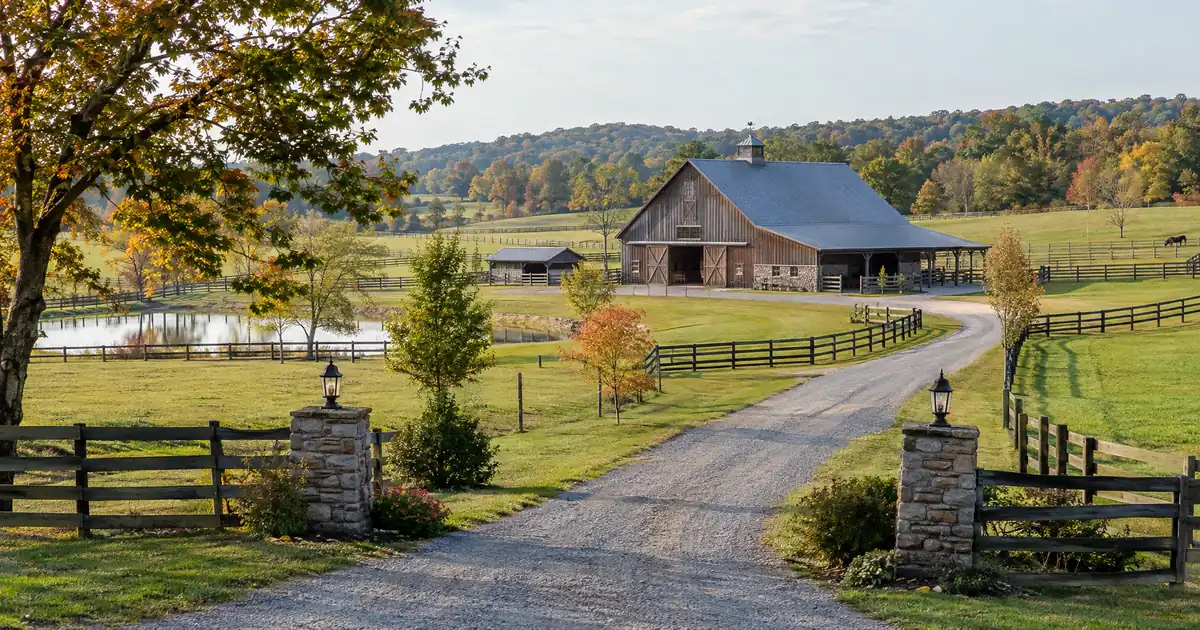
The Quick Read: Across the wholesale HELOC lenders Lendmire works with, a hobby farm rarely qualifies for an equity line when it is zoned agricultural, taxed as farmland, or used to produce income, because lenders judge the property by how it is used rather than by acreage. A parcel zoned and taxed as residential may be reviewed as a single-family home, and that is where a workable program exists.
- On an investment property, lines typically top out at 70% CLTV (combined loan-to-value: every loan against the property, added together, divided by its value). The line maximum is $500,000, and the credit minimum is 700.
- Agricultural zoning, mixed-use property, log homes, and manufactured homes are not eligible.
- Farm sales, hunting leases, and event income are not used to qualify.
- An LLC cannot hold title on these lines. A property already deeded to one needs a vesting change or a different loan.
- If the parcel fails the use test, a DSCR cash-out refinance reviews property type separately and is the usual next stop.
The best program for your situation depends on zoning, tax class, outbuildings, occupancy, and credit. Every figure here is subject to lender guidelines and full file review. None of it is a commitment to lend.
How large a line the equity supports.
An equity line is sized by combined loan-to-value, occupancy, and credit — not by rental coverage. Switch the occupancy or the credit band and the ceiling moves with it.
Investment-property lines require a 700 minimum credit score; second-home lines start at a 640 minimum and primary-residence lines at 600, and the combined-LTV ceiling steps down as the credit band drops on primary-residence and second-home lines and holds on investment-property lines; the line cap steps down on primary-residence lines and holds at every tier on investment-property and second-home lines.
A debt-to-income ratio above 45% requires 680+ credit. Profiles under 640 are limited to single-family homes. At least 75% of the approved line is drawn at closing. Ceilings, floors, and caps update from Lendmire’s centralized guideline source.
Line estimate
Illustrative estimate only — not a quote, Loan Estimate, approval, or commitment to lend. The rate is an editable assumption; equity-line pricing is variable through both the draw and repayment periods and never converts to fixed. Occupancy and credit drive the ceiling together: an investment property tops out at 70% combined LTV (minimum credit 700, line cap $500,000); a second home tops out at 90% combined LTV (minimum credit 640, line cap $500,000), with the ceiling stepping down as the credit band drops (the cap holds at every tier); a primary residence tops out at 90% combined LTV (minimum credit 600), and its $750,000 maximum line is available only at 75% combined LTV or below with a 700-or-better credit profile (720 on the longer-runway program) and a full appraisal. Lines above $500,000 require a full appraisal. Credit, debt-to-income, property type, and full underwriting review all affect the final line.
Key Terms Defined
HELOC: a home equity line of credit. You borrow against the equity in a property as you need it, up to a set limit.
Agricultural zoning: a county land-use label that says the parcel is meant for farming. It is separate from how big the parcel is.
Farm-use tax assessment: a lower tax valuation some counties give land that is actively farmed. A lender reads it as proof the land is a working farm.
Highest and best use: the appraiser’s test of what the property is most sensibly used for. A house on extra land usually passes as a residence. A working farm may not.
Vesting: how title to the property is held. On these lines, that means an individual or a revocable living trust.
Outbuilding: any structure besides the house, such as a barn, shed, silo, or workshop.
Is There Really a Best Program for a Hobby Farm?
No single program wins for every hobby farm. The lender’s question is not how many acres you own. It is whether this is a home on land or a farm with a house on it.
Think of it as a sorting exercise. A four-acre parcel with a house, a two-car garage, and a horse shed sorts as a residence in most files. A forty-acre parcel with hay fields under a farm-use tax assessment sorts as agricultural. Both owners may call it a hobby farm. The lender calls them two different files.
The industry’s own definitions don’t help. Land.com describes a hobby farm as farming for enjoyment, with the owner’s income coming from elsewhere, and notes there is no minimum acreage. That is a lifestyle definition. Underwriting runs on a use definition.
So the practical search is for the program whose property rules your parcel actually fits. A broker earns its keep here. Lendmire is a mortgage broker, not a lender. It places the scenario with the wholesale lender whose guidelines match the property, rather than sending you through one lender’s yes-or-no screen.
How Underwriting Treats a Rural Parcel, Step by Step
A farm or hobby farm file moves through five checks, roughly in this order. Fail an early one and the later ones never matter.
Step 1: Use, zoning, and tax class. This is the gate. Agricultural zoning and mixed-use property are not eligible on the equity lines in the network. A farm-use tax assessment pulls a file into the farm column even when the house itself looks ordinary. Strong credit and big deposits do not change that outcome.
Step 2: Documentation of the land. Expect to supply a survey, legal description, or tax parcel record that shows the acreage. It helps to break the land out by use: lawn, timber, pasture, water.
Step 3: Valuation. On lines at or below $500,000, lenders ordinarily run an automated valuation instead of a traditional appraisal. Rural parcels are the weak spot for those models, because comparable sales are thin. You can request a full appraisal in any case, and every line above $500,000 requires one. Land beyond what is typical for the area may count for little or nothing in the value. Thin comps shrink the supportable value, and the line shrinks with it.
Step 4: The qualifying test. An equity line looks at your personal debt-to-income ratio, with a 50% maximum, and is reviewed around the interest-only payment calculated on the maximum draw. A DSCR product works differently. It measures property rent against the full monthly obligation (principal, interest, taxes, insurance, and any association dues), and it qualifies primarily on property-level rental income covering the payment, subject to lender guidelines. In both cases, income from crops, livestock, hunting leases, or event bookings is left out.
Step 5: Lien position and vesting. The line sits in first or second lien position. Title must be held by you personally or by your revocable living trust. LLCs, corporations, and partnerships cannot hold title on these lines.
What the Line Looks Like When the Parcel Qualifies
Once a parcel clears the use test, the program terms depend on how you occupy it.
On an investment property, the network’s ceiling is 70% CLTV, with lines from $25,000 up to $500,000 and a 700 minimum credit profile. The structure is a five-year interest-only draw period followed by a 25-year fully amortizing repayment period. At least 75% of the line is drawn at closing. Pricing floats through both periods and never converts to fixed. Later draws after closing start at $1,000.
On a primary residence, the ceiling climbs with credit. A 720 or better profile reaches 90% CLTV on a line up to $500,000. A 700 profile reaches 85% on the same size, and lines above $500,000 are limited to primary residences at 75% CLTV with a full appraisal. On a second home, the 90% ceiling also exists only at 720 and above.
That occupancy split matters for hobby farms. Many owners live on the land. A primary-residence line on a residential-zoned, residential-taxed parcel sits in a very different tier than the same acreage held as a rental. State the occupancy first, then read the ceilings above. Never borrow a primary-residence number for an investment file.
One more structural limit. A borrower can hold at most three of these lines, and an owner of more than 15 financed properties is not eligible. Few hobby-farm owners hit that wall, but a portfolio landlord with a rural rental might.
Where the General Rule Breaks: Edge Cases
Rules are tidy. Parcels are not. These are the cases that decide files.
Residential zoning, farm-ish use. A hobby parcel zoned and taxed as residential may be reviewed as a single-family home. The same parcel under a farm-use assessment becomes a different file. Zoning and tax class beat acreage every time.
Leased cropland. An owner with twenty acres, half of it leased out to a neighbor’s orchard, can find the parcel tagged as a farm. The lease income changes how the file reads. Ending the lease and the farming can change the picture, but that is one scenario, not a rule. Ask before you sign the lease, not after.
Barns and outbuildings. Size matters. A mortgage-insurer rural appraisal training deck says a small barn can be acceptable when its contributory value is minimal. It adds that a large barn, a silo, or several animal facilities may signal an agricultural property, even if the appraiser assigns them no value. A big barn is not harmless filler.
Barndominiums, log homes, and manufactured homes. None of the three is offered. A barndominium on a hobby farm is a common surprise, because it looks like both a house and a barn. It is simply outside the programs.
Farm income on a tax return. Schedule F income or leased pasture can push a lender toward the agricultural view. The IRS runs its own nine-factor test to separate a hobby from a business. That test and the lender’s residential-use test are separate. A hobby label for tax purposes does not make the property a residence for lending. Tax treatment can depend on how the funds are used and how the property is held; borrowers should keep clear records and speak with a qualified tax professional before relying on any deduction.
Recently listed property. In several of the states Lendmire serves, a property listed for sale within the past 60 days is ineligible. A farm owner who tested the market and pulled the listing should check the calendar first.
Entity-held property. A farm rental deeded to an LLC cannot take the equity line as-is. The usual fixes are a vesting change or a DSCR cash-out refinance.
The Agency Contrast, Briefly
Conventional agency rules are not the program here, but they show the same logic. Freddie Mac’s Guide FAQ says there are no site-size or acreage limits. It also says a large parcel in an area where commercial farms are typical needs extra analysis to confirm the property is residential. Use drives eligibility, not size. That is the same sorting test, applied one more time.
The myth that a ten-acre cap exists everywhere probably comes from individual lenders setting their own ceilings. Some programs do set acreage limits. They differ from lender to lender, which is one more reason the matching step matters.
When the Line Does Not Fit
Sometimes the parcel lands on the wrong side of the use test. You have options, though none of them are the equity line.
DSCR cash-out refinance. This is the usual alternative for a rental. Property types are reviewed under that program’s own rules, not the equity line’s. Cash-out refinances top out around 75% LTV on a standard rental across most of the network, with about six months of seasoning as the common expectation. Credit floors start around 620 in parts of the network, most programs want around 660, and 700 or better opens the strongest leverage tiers. Loan sizes run up to $3,000,000 on standard programs (smaller balances available through select lenders). Reserves vary, commonly around six months of PITIA (principal, interest, taxes, insurance, and association dues) on a typical file. The same type limits apply, though: log homes, manufactured homes, and barndominiums are not offered, and an agricultural or farm-use parcel still has to pass the property review. Read the complete DSCR loans guide for the full mechanics.
Clearing 1.00 is not the same as positive cash flow. DSCR compares rent to the payment and nothing else. Repairs, vacancy, management, and utilities sit outside the calculation. A rural rental with a long driveway and a well pump has plenty of those.
Separate the land from the house. Many investors keep the residence on its own parcel and the productive land on another, so the home can be financed and refinanced as a house. It is one investor’s strategy, not a rule, and the split has to be legal under the county’s subdivision rules.
An agricultural lender. If the property truly is a farm, the better fit may be a specialty ag lender or a portfolio lender. Those lenders underwrite farm operations, not residential equity. Lendmire does not place them.
(Honestly, many hobby-farm owners hate hearing this. The parcel they call a farm is the exact reason a residential lender cannot lend against it.)
Pre-Screening a Rural Rental Before You Buy
The most affordable time to find a problem is before closing on the property, not when you want the equity out.
- Zoning. Is it residential, agricultural, or mixed-use? Get it from the county, not the listing.
- Tax class. Is there a farm-use assessment? If so, find out whether it would stay in place after you buy.
- Outbuildings. Count them and judge their size. A small shed reads differently than a large barn.
- Comparable sales. Look for recent sales of similar rural homes. If nobody has sold a comparable parcel, the valuation will be thin.
- Income on the land. Hay leases, hunting rights, and event bookings all complicate the file. They do not help it.
- Title. Plan the vesting before you buy. An LLC-held rental closes off the equity line.
- Occupancy. Decide whether you will live there or rent it. The lender’s terms change completely.
How the Parcel Types Usually Read
The table below is a rule of thumb, not a decision. Each file is reviewed individually.
| Parcel profile | Typical lender read |
|---|---|
| Residential zoning, residential tax class, small outbuildings | Reviewed as a single-family home |
| Residential zoning, farm-use tax assessment | Treated as a different file |
| Agricultural zoning | Not eligible on these lines |
| Barndominium or log home | Not offered |
| House on a separate parcel from the farmland | Reviewed as a residence |
Frequently Asked Questions
Can I get an equity line on a hobby farm I rent out?
Only if the parcel is zoned and taxed as residential and is reviewed as a single-family home. On an investment property the ceiling is 70% CLTV, up to $500,000, with a 700 credit minimum, subject to lender guidelines. Agricultural zoning, mixed-use, and farm-use classification take the parcel out of these programs.
Does acreage alone disqualify a property?
No. Use, zoning, and tax class decide it, not size. Some programs set their own acreage ceilings, and those vary by lender. Appraisers may also give little or no value to land beyond what is typical for the area.
Will my farm or lease income help me qualify?
No. Farm sales, hunting leases, and event income are not used to qualify, and they can raise eligibility questions instead. An equity line looks at your debt-to-income ratio. A DSCR loan looks at the rent covering the payment.
My rental is in an LLC. Can I still use an equity line?
Not as it stands. LLCs, corporations, partnerships, and land, blind, or irrevocable trusts cannot hold title on these lines. A vesting change or a DSCR cash-out refinance, subject to program terms, is the usual route.
Is a barndominium eligible?
No. Barndominiums, log homes, and manufactured homes are not offered in the network’s programs, and they also fall outside the equity lines. A conventional-looking house on the same parcel is a different file.
Next Steps
If you are considering a home equity line and want to see how the numbers work, Lendmire can help you compare HELOC options based on the property, the equity available, credit profile, combined leverage, and your goals. HELOC availability through Lendmire is limited to 16 full-service states, which is narrower than its 41-market DSCR footprint, so confirm your state first. For a rural property that fails the use test, the DSCR cash-out path is worth a look before you give up on the equity.
A parcel is judged by what it is used for, and the investors who ask the county about zoning and tax class before they buy are the ones whose equity stays reachable later.
About Lendmire
As a mortgage broker (NMLS# 2371349), Lendmire helps homeowners and real estate investors in its 16 full-service states open home equity lines of credit arranged through wholesale lenders. Lendmire is never the lender; line amounts, ceilings and terms are set by the lender under its guidelines. Scotsman Guide named Lendmire a Top Mortgage Workplace in both 2025 and 2026.
Investors who want the broader program framework can review how DSCR loans work.
Get Started
Ready to find the right loan for you?
See your offer in seconds. No credit pull, no obligation.
Informational only. Not a Loan Estimate, approval, or commitment to lend. Program availability and eligibility are subject to lender guidelines, credit approval, property review, and underwriting.
References
2. Enact rural appraisals training presentation
3. IRS: Five basic tax tips about hobbies
4. Freddie Mac Guide FAQ on acreage
This article is part of Lendmire’s HELOC & home equity loan program — full qualification details, guidelines, and scenarios live on the program page.
Related reading: Best Investment Property HELOC Program Right After a Spousal Quitclaim · Best Investment Property HELOC Program to Buy Rental Property · Best Investment Property HELOC Program in Second Position
Brandon Miller
Founder & CEO, Mortgage Loan Originator, Lendmire LLC
- Mortgage Loan Originator · NMLS# 1129696 · Verify on NMLS Consumer Access
- North Carolina Real Estate Broker · License# 343312 · Verify on NCREC
- North Carolina Insurance Producer · License# 19053198 · Property, Casualty, Life, Health · Verify on NAIC SBS
- Lendmire LLC · Firm NMLS# 2371349 · Verify firm licensure
Legal disclosures. Lendmire (NMLS# 2371349) is a state-licensed mortgage brokerage that arranges financing through wholesale lender relationships. Lendmire is not a direct lender, depository institution, or registered financial advisor. The discussion above is general informational content about real estate financing — it is not financial, legal, or tax advice, and readers should consult licensed professionals for guidance on their individual circumstances. Loan inquiries are subject to lender underwriting; this article does not represent a commitment to lend. Loan terms, rates, and qualification standards vary by borrower, property, and state, and are subject to change at any time. Equal Housing Opportunity. NMLS Consumer Access: nmlsconsumeraccess.org.