
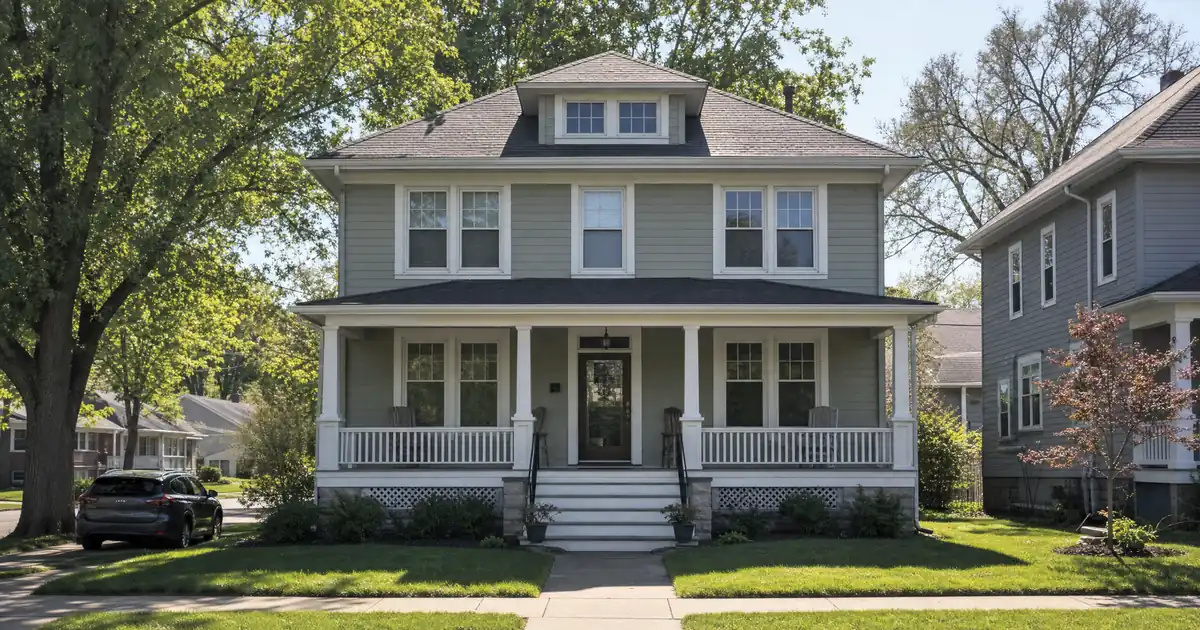
Rate-and-Term Investment Refinance Complete Guide — The Quick Read: A rate-and-term refinance swaps out an existing rental-property loan for a new one. The goal is to change the rate, the term, or both. You don’t pull out much cash at closing. This matters for investors because it clears underwriting easier than a cash-out refinance on the same property — higher leverage, lighter seasoning. It also runs on the property’s rental income, not your personal debt-to-income. But there’s a catch in two spots: the DSCR math on the new payment, and any prepayment penalty still running on the old loan.
Most investors run into this transaction type when they try to convert a bridge loan or hard-money rehab loan into permanent financing. Or they’re trying to escape an adjustable-rate structure before it resets. Either way, the mechanics stay the same. They’re worth understanding fully before you run the numbers on a specific property.
DSCR Calculator
Run the numbers in your market
Rate source: Freddie Mac 30-yr average via FRED® — Federal Reserve Bank of St. Louis · effective Aug 27, 2026
Prefilled with local estimates — enter your own rent or nightly figures, taxes, insurance, and HOA for a more accurate picture.
Program parameters update from Lendmire’s centralized guideline source. Taxes and insurance are editable estimates.
As of Aug 27, 2026 · General Freddie Mac market benchmark, not a Lendmire loan offer. Rent, nightly rate, occupancy, taxes, and insurance are editable estimates. Short-term rental figures are estimates only and vary significantly by season, property type, management approach, and local short-term-rental rules — confirm local regulations before relying on them. Qualifying income for short-term rentals varies by program — some use appraisal market rent, others use documented STR history or projections — and is confirmed in underwriting. Not a Loan Estimate, approval, or commitment to lend. Program availability and eligibility are subject to lender guidelines, credit approval, property review, and underwriting.
What Counts as a Rate-and-Term Refinance on a Rental Property?
A rate-and-term refinance is any refinance where the new loan amount roughly matches the old payoff balance plus closing costs. You don’t draw out equity beyond small proration differences. You can change the rate. You can change the term. You can switch from adjustable to fixed, or shorten a 30-year loan into something that pays off faster. All of that counts as “rate-and-term.” The moment you pull out equity beyond minor differences, the file becomes a cash-out refinance. That triggers a different set of leverage and seasoning rules.
This purpose label isn’t just paperwork. It’s the single factor that decides your maximum loan-to-value, how the lender treats ownership seasoning, and how the file gets priced. Lenders see a rate-and-term file as lower risk than a cash-out file on the same property. Why? You’re not pulling cash from equity that might exist more on paper than in reality.
Key Terms Defined
DSCR (Debt Service Coverage Ratio): This compares your monthly gross rent to the monthly PITIA payment (principal, interest, taxes, insurance, and association dues) on the proposed loan. It’s the core coverage number for these loans.
PITIA: This is the full monthly housing payment used in the DSCR calculation. It covers principal, interest, taxes, insurance, and any HOA dues.
Seasoning: This is how long you must own a property (or how long since a rehab finished) before a lender will use the new appraised value or refinance at full leverage.
Prepayment penalty: This is a fee triggered when you pay off or refinance a loan before a set window closes. It’s common on DSCR loans because these are business-purpose loans. They’re exempt from the consumer prepayment-penalty rule that applies to owner-occupied mortgages.
No-cash-out / limited cash-out: This is industry shorthand for rate-and-term. You’re not converting home equity into spending money, aside from small amounts tied to payoff proration.
How Underwriting Actually Treats It, Step by Step
DSCR underwriting on a rate-and-term refinance follows a set sequence. The property — not your paycheck — carries the weight at every step.
Step 1: Purpose gets coded first. Before anything else, the lender classifies the file as rate-and-term or cash-out. This one flag decides your maximum leverage and how much ownership seasoning matters.
Step 2: The appraisal does double duty. Since the loan gets reviewed based on the property, the appraisal sets both the value for loan-to-value purposes and the rent figure used in the DSCR calculation. For a single one-unit rental, the appraiser fills out the Single-Family Comparable Rent Schedule. This is commonly called Form 1007. It estimates market rent by comparing your property to similar rentals nearby. For two-to-four-unit properties, the appraiser instead fills out the Small Residential Income Property Appraisal Report, Form 1025. These form names are industry-standard whether the loan ends up agency or non-QM. They’re simply how appraisers document rent.
Most programs across the network qualify rent based on whichever is lower: the appraiser’s market-rent opinion, or the actual in-place lease. If a refinanced unit already has a tenant, the lease can cap the number below what the appraiser thinks the unit could rent for on the open market. On a freshly-renovated BRRRR property with no lease history, the file relies entirely on the appraiser’s opinion, since there’s no lease to compare it against.
Step 3: The DSCR math runs on the new payment, not the old one. You divide gross monthly rent by the proposed PITIA on the new loan. A ratio at or above 1.00 means rent covers the payment. Below 1.00 means the property doesn’t fully cover the new debt on paper. This math works the same way on a purchase or a refinance. What changes on a refinance is that the payment being tested is the new loan’s payment.
Step 4: Credit, entity docs, and reserves get reviewed at the same time. If the property title sits in an LLC, the lender reviews entity documentation alongside credit and reserves. None of this touches traditional personal-income documentation or W-2s the way an owner-occupied refinance would. Why? Qualification runs on whether the property’s income covers the payment, subject to lender guidelines. Reserve requirements vary by lender, leverage, and loan size. Standard files commonly land around six months of PITIA. Conservative rate-and-term deals at modest leverage under $1,500,000 sometimes see reserves waived. Larger loans step up toward nine months.
Step 5: Closing reflects the lower-risk profile. Since no real equity leaves the property, rate-and-term refinances routinely price and leverage better than a cash-out refinance on the same asset. That’s the reason this transaction type exists as its own lane instead of getting lumped in with cash-out.
DSCR loans are built for non-owner-occupied investment properties. Because they’re business-purpose investor loans, lenders review them differently than a standard owner-occupied mortgage. That’s why the process above skips consumer income documentation entirely and runs on the property’s numbers instead. The complete DSCR loans guide walks through the qualification framework in more depth, for readers who want the full picture before running a specific scenario.
Rate-and-Term vs. Cash-Out vs. Loan-Type Conversion
Investors often use these terms loosely, but they trigger genuinely different underwriting paths. Here’s the structural comparison:
| Factor | Rate-and-Term | Cash-Out | Loan-Type Conversion |
|---|---|---|---|
| Cash to borrower | None beyond minor proration | Equity extracted at closing | Depends on structure chosen |
| Typical max LTV | Higher (75%-80% common) | Lower (caps near 75%) | Matches destination loan type |
| Seasoning treatment | Often lighter or none on select programs | Ownership seasoning more commonly required | Varies — often tied to rehab completion |
| Common use case | Rate change, ARM-to-fixed, term shortening | Pulling equity for reinvestment | Bridge/hard-money into permanent DSCR |
The loan-type conversion column matters most to BRRRR investors. It’s the step that turns a short-term, higher-cost rehab or bridge loan into a long-term fixed structure once a unit is rented and stable. Structurally, this conversion usually happens as a rate-and-term refinance. You’re not pulling cash out — you’re just replacing expensive short-term debt with permanent financing. The rate-and-term refinance for investment property page breaks down that specific conversion path in more detail.
Where the General Rule Breaks: Named Edge Cases
The clean version of this transaction goes: apply, appraise, qualify at or above 1.00, close. But there are real exceptions worth knowing before you assume the standard path applies.
Seasoning is the biggest difference between refinance types. Since a rate-and-term deal doesn’t pull out equity, some lenders in the network will refinance a property with little to no ownership seasoning at all. This detail matters a lot to BRRRR investors trying to convert rehab financing into permanent debt as soon as a unit leases up. Cash-out refinances are where a waiting period before using the full appraised value most often gets imposed. Treating the two types as interchangeable on timing is one of the most common planning mistakes active investors make.
The prepayment penalty on the old loan — not the new one — often decides whether refinancing makes sense. DSCR loans commonly come with declining, multi-year prepayment penalties in exchange for better pricing. Refinance before that penalty window closes, and you trigger the fee — whether the new loan is rate-and-term or cash-out doesn’t matter. This exists because business-purpose DSCR loans sit outside the consumer prepayment-penalty rule that governs owner-occupied mortgages. A step-down penalty on this type of loan is a negotiated pricing tool, not a red flag. Before you assume better market conditions make a refinance worth it, run the penalty cost against your projected savings.
Coverage below 1.00 is a real path, not a dead end. Programs below 1.00 DSCR are available through select lenders in the network, though leverage and terms adjust to make up for the weaker coverage. No-ratio qualification is also available, but only through select lenders, and generally only for borrowers who already own a primary residence. It’s not a blanket option, and it isn’t priced or leveraged like a standard file. Neither path should be your default choice — they’re tools for specific situations where the property’s rent alone doesn’t clear the bar a lender wants to see.
Interest-only structures change the math itself. Where a program allows an interest-only payment, the DSCR calculation swaps full PITIA for ITIA — dropping principal from the calculation. That mechanically raises the ratio for the same rent and loan amount. That’s why comparing a DSCR quote on an amortizing structure against one on an interest-only structure isn’t apples-to-apples unless you account for the payment type. Extended 40-year terms and interest-only periods are both available through select lenders in the network, for investors who want to manage the ratio this way.
State overlays cap leverage in a handful of markets. Purchases in Connecticut, Florida, Illinois, and New Jersey generally cap near 75% LTV, no matter what your credit profile might otherwise support. Overlay-state deals also tend to cap around $2,000,000 in loan size. If you’re refinancing a property in one of these states, expect the ceiling to sit below the 80% figure that applies elsewhere in the network.
Property type sets a hard boundary, not a pricing adjustment. Manufactured homes — single- or double-wide — along with log homes and barndominiums, aren’t offered through the network’s DSCR programs. This isn’t about stricter terms. These property types fall outside the guidelines entirely, and no compensating factor changes that.
Across the wholesale network, files that hit a wall on rate-and-term refinances almost never fail on the DSCR math itself. They get stuck on penalty timing or missed seasoning windows the investor didn’t check before ordering the appraisal. The single most repeatable friction point on this transaction: a borrower calls a broker four months into a rehab-loan penalty clock, expecting to refinance the same week. Check the penalty schedule on your existing note before ordering an appraisal. It saves more deals than any leverage tier does.
The Investor Decision in Practice
This isn’t a niche corner of the mortgage market anymore. Polygon Research estimated the non-QM market at roughly $239 billion in recent activity — about 10% of total U.S. mortgage origination volume. Optimal Blue data showed non-QM reaching a meaningful share of total origination volume. Within that pool, investor/DSCR loans account for 28.7% of non-QM volume. Forward-looking industry forecasts project non-QM originations climbing toward $175 billion, up from roughly $108 billion, with DSCR and investor loans cited as the main driver. Capital markets clearly want this product — it’s a repeatable, liquid transaction type, not an experiment.
For an individual investor, the decision usually comes down to a handful of concrete scenarios:
- Escaping an adjustable structure before it resets. If your current loan is a bridge or ARM product approaching a reset date, converting to a fixed rate-and-term refinance locks in your payment structure without the friction of a cash-out underwrite.
- Converting rehab or bridge debt into permanent financing. This is the classic BRRRR exit — once a unit is rented, you refinance out of short-term, higher-cost debt using the property’s now-provable rent.
- Term optimization for cash-flow goals. Shortening a term builds equity faster but raises the payment (and can push DSCR lower). Lengthening a term or moving to an interest-only structure lowers the payment and raises DSCR — but you pay down principal more slowly.
- Portfolio scaling past agency limits. Since DSCR lender review runs on the property rather than your personal debt-to-income, if you’ve hit conventional financed-property caps, you can still refinance individual assets in the DSCR channel without those limits applying.
None of these scenarios come free of tradeoffs. A larger down payment on a purchase — or simply paying down principal before a refinance — lowers your payment and can lift the DSCR ratio. But it never overrides a leverage cap, a credit floor, a reserve requirement, or property-type eligibility. The strongest files clear both tests at once: enough equity to hit the LTV target, and rent that comfortably covers the payment on its own. A property with plenty of equity but weak rent stalls out in underwriting. So does a property with strong rent but too little equity to hit the leverage tier — even though each one looks fine on one measure. Exact terms depend on the lender’s guidelines, property type, leverage, and a full review of your file.
It’s also worth being precise about what a DSCR at or above 1.00 actually means. Clearing 1.00 says rent covers the loan payment. It doesn’t mean the property is cash-flow positive in your pocket. Repairs, vacancy, property management, utilities, and capital expenses all sit outside the DSCR calculation. If you treat “DSCR clears 1.15” as “I’m making money,” you’re skipping several real costs that never touch this ratio.
For investors with short-term rental properties, the leverage and seasoning rules diverge from long-term rental refinances. Purchases on short-term rentals top out around 75% LTV. Refinances run closer to 70%. Cash-out sits around 70% as well — each treated separately, never blended into one figure. Programs typically want a 640+ credit score and roughly 12 months of hosting history, with a 1.00 coverage floor applying on both purchases and refinances. The short-term rental financing complete guide covers that qualification path in full.
Loan sizes across the network generally run up to $3,000,000 on standard programs. Smaller balances route through select lenders that specialize in that range. Above $2,500,000, the network generally sticks to 30-year fixed structures rather than the extended-term or ARM options available on smaller loans. If you have sizable equity, you might also weigh a rate-and-term refinance against tapping an investment-property HELOC instead. Those lines cap at $500,000 total across the network, with no tier above that ceiling. If you’re nearing retirement and weighing how a refinance interacts with income planning, the senior refinance investment property resource addresses that overlap directly.
Frequently Asked Questions
Does a rate-and-term refinance require the same DTI check as a regular mortgage refinance?
No. DSCR-based rate-and-term refinances qualify mainly on whether the property’s rental income covers the payment, subject to lender guidelines — not on your personal debt-to-income or W-2 documentation. That’s the core structural difference from an owner-occupied refinance. It’s why the process moves through appraisal and entity review rather than traditional personal-income review.
Can an investor refinance out of a hard-money loan with no seasoning period at all?
Some lenders in the network will refinance with little to no ownership seasoning specifically because the transaction is rate-and-term rather than cash-out. This is common for BRRRR investors converting rehab financing into permanent debt once a unit is rented. Seasoning treatment still varies by lender and loan size, so confirm it on your specific file before assuming the timeline.
What happens if the property’s DSCR comes in below 1.00 on the refinance?
Sub-1.00 coverage is available through select lenders in the network, with leverage and terms adjusted to compensate. It isn’t the default path and it isn’t priced the same as a file clearing 1.00 or better. But it’s a real option, not an automatic decline.
Will a prepayment penalty on my current DSCR loan block a rate-and-term refinance?
It won’t block the refinance, but it can make the timing costly. DSCR loans commonly carry declining, multi-year prepayment penalties. Refinance before that window closes, and you trigger the fee whether the new loan is rate-and-term or cash-out. Run the penalty cost against your projected savings before committing to a refinance date.
Does an interest-only option change how the DSCR ratio is calculated?
Yes. Where a program permits an interest-only payment, the DSCR calculation uses ITIA instead of full PITIA — dropping principal from the payment. This raises the ratio for the same rent and loan amount, compared to an amortizing structure.
If you’re weighing whether a rate-and-term refinance makes sense against your property’s current rent and equity position, Lendmire can help compare DSCR loan options based on the property income, credit profile, leverage, and your goals. Reach the team at 828-256-2183 or request a quote directly through the mortgage quote form.
Tax treatment can depend on how you use loan proceeds and how you hold the property. Keep clear records and speak with a qualified tax professional before relying on any deduction.
About Lendmire
Lendmire is a mortgage broker (NMLS# 2371349) that arranges DSCR investor loan financing through select lenders in its wholesale network, covering 40 markets including Washington, D.C. It doesn’t fund or underwrite loans directly. The lender reviewing each file determines approval, terms, and eligibility, subject to program guidelines. For a broader look at how refinance strategy fits into an overall portfolio plan, the investment property refinance playbook is a useful next stop. Scotsman Guide named Lendmire a Top Mortgage Workplace in both 2025 and 2026.
Get Started
Ready to find the right loan for you?
In about 30 seconds you can review financing options available for your home or investment property. No commitment required.
Informational only. Not a Loan Estimate, approval, or commitment to lend. Program availability and eligibility are subject to lender guidelines, credit approval, property review, and underwriting.
References
1. Fannie Mae Selling Guide, B3-3.1-08 — Rental Income
2. Scotsman Guide — Which Groups Are Driving Non-QM Lending?
Brandon Miller
Founder & CEO, Mortgage Loan Originator, Lendmire LLC
- Mortgage Loan Originator · NMLS# 1129696 · Verify on NMLS Consumer Access
- North Carolina Real Estate Broker · License# 343312 · Verify on NCREC
- North Carolina Insurance Producer · License# 19053198 · Property, Casualty, Life, Health · Verify on NAIC SBS
- Lendmire LLC · Firm NMLS# 2371349 · Verify firm licensure
Compliance and disclosures. Lendmire (NMLS# 2371349) is a licensed mortgage broker and is not a direct lender, depository institution, financial advisor, or tax professional. Content in this article is general market analysis and educational information — not financial, legal, or tax advice for any specific situation. Lendmire does not guarantee loan approval; every transaction is subject to underwriting by the funding lender. Mortgage pricing and loan program guidelines are subject to change at any time without notice and vary by borrower characteristics, property type, and state regulations. Lendmire complies with Equal Housing Opportunity. Licensure verification: NMLS Consumer Access.


