
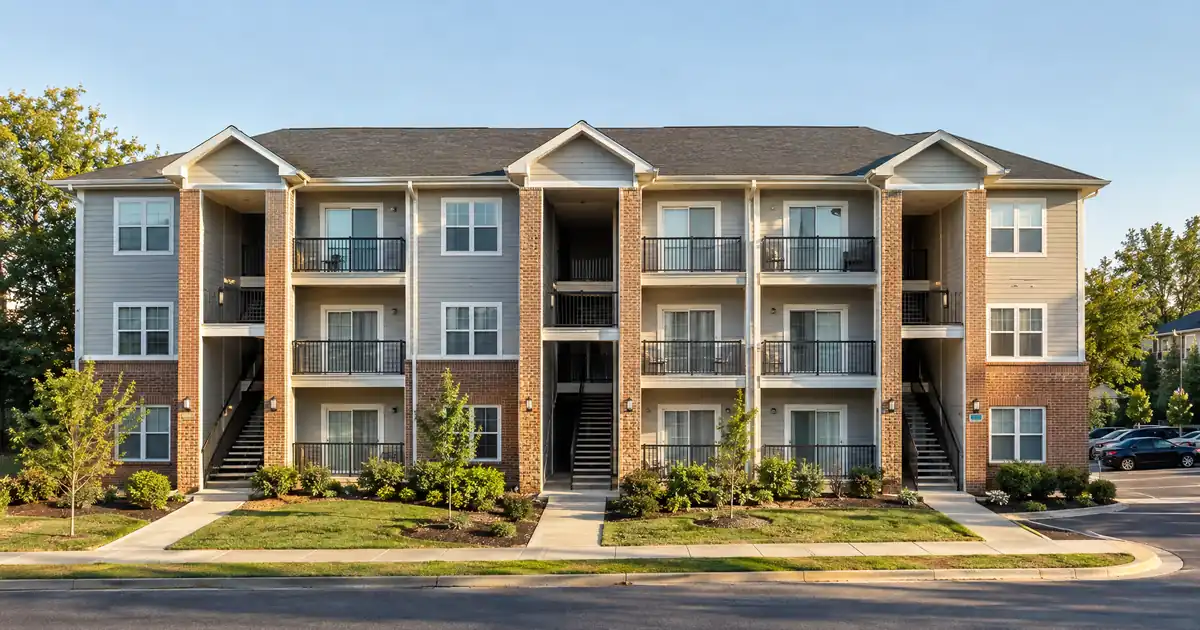
Complete Guide For A DSCR Loan On Multifamily 5+ Properties — The Quick Read: Once a property hits five units, financing shifts from residential rules to a commercial-style underwriting approach — even though DSCR loans themselves stay outside agency programs entirely. The lender still asks a simple question: does the property’s income cover the payment? But how that income gets calculated, appraised, and documented changes completely. This guide walks through the mechanics step by step, the leverage and credit ranges you’ll actually see, and where the general rule breaks down.
Key Terms Defined
DSCR (debt service coverage ratio): a number that compares a property’s rental income to its full monthly payment. Above 1.00 means the rent covers the payment; below 1.00 means it doesn’t, on paper.
DSCR Calculator
Run the numbers in your market
Rate source: Freddie Mac 30-yr average via FRED® — Federal Reserve Bank of St. Louis · effective Sep 17, 2026
Prefilled with local estimates — enter your own rent or nightly figures, taxes, insurance, and HOA for a more accurate picture.
Program parameters update from Lendmire’s centralized guideline source. Taxes and insurance are editable estimates.
As of Sep 17, 2026 · General Freddie Mac market benchmark, not a Lendmire loan offer. Rent, nightly rate, occupancy, taxes, and insurance are editable estimates. Short-term rental figures are estimates only and vary significantly by season, property type, management approach, and local short-term-rental rules — confirm local regulations before relying on them. Qualifying income for short-term rentals varies by program — some use appraisal market rent, others use documented STR history or projections — and is confirmed in underwriting. Not a Loan Estimate, approval, or commitment to lend. Program availability and eligibility are subject to lender guidelines, credit approval, property review, and underwriting.
PITIA: principal, interest, taxes, insurance, and association dues (if any) — the full monthly obligation a lender counts as debt service.
NOI (net operating income): what’s left of a property’s income after operating expenses, before the mortgage payment. On 5+ unit deals, NOI replaces gross rent as the income figure lenders actually use.
Non-QM: short for “non-qualified mortgage” — a loan that doesn’t fit the standard consumer-mortgage rulebook (Rental income is reviewed instead of personal-income documentation), used for business-purpose investment lending like DSCR.
Seasoning: the waiting period a lender wants between buying a property and refinancing it, usually measured in months of ownership.
Why Five Units Changes Everything
Five units is the line where residential financing stops and commercial-style underwriting starts. This isn’t just a DSCR quirk. It’s baked into how the entire housing-finance industry classifies properties. DSCR lenders largely mirror the same split, even though they operate outside agency programs.
On the agency side, Fannie Mae’s Multifamily Guide defines an eligible multifamily loan as one secured by a property with at least five dwelling units. Freddie Mac’s small-balance program draws the identical line. DSCR lenders in Lendmire’s wholesale network follow the same practical logic. A duplex, triplex, or fourplex gets treated as residential investment property. But a five-unit building — even one door bigger — gets treated more like small commercial real estate.
That single-unit jump changes three things at once: the appraisal format, the income analysis, and the documentation pile. Here’s how each one plays out.
How the Appraisal Changes
A 2-4 unit property gets a standard residential income-property appraisal, built on comparable sales. A 5+ unit property gets a narrative commercial appraisal built on income, not comps — and that shift alone can add real time and cost to a file.
The residential form works fine for a fourplex. But it isn’t built for anything bigger. Once a property crosses into five units, the appraiser switches to a full narrative report. This report follows income-approach valuation, not sales-comparison. That means the appraiser looks at market rents, vacancy assumptions, and operating expenses. These numbers produce a net operating income figure. That figure then gets turned into a value using a capitalization rate pulled from comparable income-producing sales. This is a very different document — and a very different appraisal process — than the grid-form report used on a duplex or triplex.
How the Income Calculation Shifts (This Is the Real Underwriting Change)
On a 1-4 unit DSCR file, the lender typically compares gross market rent to the monthly PITIA payment — a simple ratio. On a 5+ unit file, the lender instead builds a full income-and-expense picture and works from net operating income against the debt obligation.
This is the single biggest mechanical difference in the entire 5+ unit DSCR process. The underwriter doesn’t just pull one rent figure off a lease or an appraiser’s rent schedule. Instead, they want operating statements covering the trailing year (sometimes two). They also want year-to-date income and expenses, plus a sample of the leases in place. Vacancy, maintenance, management fees, utilities the owner covers, and reserves for replacement all get factored into NOI before the DSCR math ever runs.
Practically speaking, this means a 5+ unit DSCR file leans harder on the property’s actual operating history than a smaller residential file does. A duplex with one lease and a clean rent roll is a fast, simple review. A 12-unit building with a full trailing-twelve-month operating statement is a heavier lift — but it also means an investor who’s improved NOI through rent increases or expense control sees that improvement flow directly into the appraised value and the loan amount the property can support. That feedback loop between operations and financing is tighter here than almost anywhere else in real estate lending.
What Lenders Actually Want: Credit, Leverage, and Coverage
Across the wholesale network Lendmire works with, most 5+ unit DSCR files land in a fairly consistent band, though every lender’s overlays differ. On purchases, expect typical leverage in the 75%-80% LTV range, meaning 20%-25% down on most files. A handful of programs in the network push to 85% LTV for borrowers with stronger credit profiles, generally north of a 700 score.
Credit requirements run on a similar tiered structure. A 620 floor exists in parts of the network, but most programs are looking for something closer to 660, and the strongest leverage tiers — the 85% LTV programs, better pricing — tend to open up around 700 and above.
Coverage requirements vary by program. Some lenders in the network set 1.00 as a starting floor — not a universal standard, just where select programs begin — with stronger ratios unlocking better leverage and pricing. Clearing 1.00 does not mean the property is generating positive cash flow, worth repeating clearly: DSCR only measures rent against PITIA. Repairs, vacancy, property management, utilities, and capital expenditures all sit outside that ratio. A property clearing 1.05 on paper can still run negative in real life once those costs land.
Loan sizes on standard 5+ unit programs generally run up to $3,000,000, with smaller-balance deals routed through select lenders that specialize in that segment. Above roughly $2,500,000, the network generally holds to 30-year fixed structures rather than adjustable options — a point worth knowing if a bigger deal is on the table.
Reserves — the liquid funds a borrower needs on hand after closing — vary by lender, leverage, and loan size. Around 6 months of PITIA is common on most files. Conservative rate-and-term refinances at modest leverage under $1,500,000 sometimes see reserves waived entirely. Loans above that size typically step up to around 9 months. None of these are universal; they shift file by file based on the specific lender and program.
Cash-Out Refinancing a 5+ Unit Property
Cash-out refinances on 5+ unit multifamily generally cap around 75% LTV across most of the network. Lenders commonly expect roughly 6 months of ownership seasoning before they’ll consider it. That seasoning period exists because lenders want to see the property has stabilized under the current owner. They want this proof before they base a new loan on improved value or income.
The mechanics here follow the same NOI-driven logic as a purchase. If an investor raises rents to market, tightens expenses, or adds ancillary income like laundry or parking, that improved NOI can support a stronger appraised value at refinance — which in turn supports a larger loan amount within the LTV cap. This is the stabilize-then-refinance pattern that shows up constantly in 5+ unit investing: buy an underperforming building, fix the operations, then refinance against the improved numbers once seasoning is met.
For investors weighing whether a cash-out refinance or a fresh purchase loan makes more sense on a given deal, Lendmire’s investment property refinance playbook walks through that comparison in more depth.
Where the Rule Bends: Named Edge Cases
Mixed-use commercial space. Some 5+ unit buildings include ground-floor retail or office space alongside residential units. HUD’s 223(f) program — used here only for contrast, since it’s not a DSCR product — caps commercial space at 25% of total net rentable area and 20% of underwritten gross income. Non-QM DSCR programs set their own commercial-space ceilings, and those limits differ program to program, so this is a detail to confirm on a deal-by-deal basis rather than assume.
Investor experience doesn’t always mean what borrowers think. Agency small-balance programs have historically required prior ownership of a 5+ unit property to count as qualifying “multifamily experience.” Freddie Mac later expanded that definition to let a portfolio of 2-4 unit properties count, provided the borrower owns at least 10 units total, has held each for at least two years, and controls all of them. That change illustrates a broader point for DSCR lenders too: how a borrower’s existing smaller-property portfolio counts toward a 5+ unit deal varies by program and is never a fixed, universal rule.
DSCR vs. conventional financing
Two common ways to finance an investment property in this market. They qualify you differently — here’s how investors weigh them.
Why investors choose it
- Qualifies on the property’s rental income — no personal tax returns, W-2s, or pay stubs needed to document income.
- No personal debt-to-income ceiling to clear, so existing mortgages and obligations don’t cap your borrowing the same way.
- Can be closed in an LLC, keeping the property inside a business entity.
- Built for scaling — not held to the limit on number of financed properties that conventional financing applies.
- Underwriting centers on the deal: generally qualifies when the rent covers the payment, a 1.00x coverage ratio being a common baseline (confirmed in underwriting).
- Designed specifically for investment property, including long-term and, where the program allows, short-term rentals.
Where it’s strong
- Often the lowest ongoing financing cost for a buyer who fully qualifies on personal income — a fit for a first property or a cost-first purchase.
Trade-offs for investors
- Requires full personal income documentation and must fit within a debt-to-income limit — salary, existing debts, and other mortgages all count.
- Typically held in your personal name rather than a business entity.
- Caps how many financed properties you can carry, which can become a ceiling as a portfolio grows.
- Evaluates you as a borrower as much as the property, which usually means more paperwork.
How investors usually choose: a first or single property often optimizes for the lowest financing cost; portfolio builders often optimize for leverage, vesting in an LLC, and scaling past conventional caps. The right answer depends on your goals, the property, and current guidelines — both paths run through select lenders in Lendmire’s wholesale network, with eligibility and terms confirmed in underwriting.
Stabilized versus lease-up. Buildings still filling vacancies, mid-renovation, or freshly constructed generally don’t fit a standard DSCR file the same way a stabilized, occupied building does. Lenders in the network typically want to see a property performing before treating it as a straightforward DSCR purchase rather than something closer to a bridge scenario.
Scattered-site portfolios don’t automatically combine. Some investors assume a group of duplexes and triplexes they own can be packaged into one “5+ unit” loan. Generally, that only works if the buildings sit on the same or adjoining tax parcel — genuinely separate, non-contiguous 1-4 unit buildings don’t automatically aggregate into 5+ unit treatment. Confirm this deal-by-deal; it trips up more investors than almost any other structural assumption.
Tax classification runs on a different test entirely. This is the edge case that surprises the most investors, and it cuts against the assumption that “5 units = commercial” everywhere. For depreciation purposes, the IRS doesn’t care about unit count at all. Under IRS Publication 527, a building qualifies as residential rental property if 80% or more of its gross rental income comes from dwelling units — a threshold confirmed in the underlying statutory language at 26 U.S.C. §168(e)(2). A fully residential 20-unit or 50-unit building still depreciates on the 27.5-year residential schedule, not the 39-year nonresidential schedule — even though that same building is treated as commercial for financing purposes at 5+ units. Lending classification and tax classification are simply two different tests that happen to look similar.
Tax treatment can depend on how the funds are used and how the property is held; investors should keep clear records and speak with a qualified tax professional before relying on any deduction.
Ineligible Property Types
A few property categories fall outside DSCR programs entirely, regardless of unit count: manufactured homes (both single- and double-wide), log homes, and barndominiums are not offered through the network’s DSCR products. Worth knowing before spending time on a deal that structurally can’t fit.
What Underwriting Actually Sees Across Files
We work DSCR files across the wholesale network every day. A pattern shows up on nearly every 5+ unit submission: the files that move cleanest are the ones where the operating statements and the rent roll already agree with each other before the lender sees them. Here’s the most common problem that slows a 5+ unit file down: a rent roll shows one set of rents, but a trailing operating statement shows a different collected-income figure. Cleaning that up before submission saves real friction later.
Sub-1.00 Coverage and No-Ratio Structures
Not every deal clears 1.00 on paper, and that doesn’t automatically take a property off the table. Sub-1.00 coverage is available through select lenders in the network, though leverage and terms get adjusted to offset the weaker ratio. No-ratio structures — where the property’s rent isn’t the qualifying factor at all — are also available, but only through select lenders, and generally for borrowers who already own a primary residence. Both paths are real, but neither is a fit for every borrower or every property; qualification runs through lender guidelines, credit review, and the specific deal.
Are you weighing a no-ratio path more seriously? Lendmire’s guide on no-ratio DSCR loans for 5+ unit multifamily covers that structure in depth. Some investors use interest-only structuring to boost coverage ratios in the early years of a hold. This gets its own treatment in Lendmire’s interest-only DSCR guide for multifamily 5+ properties.
DSCR Versus Debt Yield: Why Larger Deals Run Both
DSCR tells you whether income covers the loan payment under the current rate and amortization. It doesn’t tell you whether the loan amount itself is reasonable relative to the property’s income — that’s what debt yield measures, calculated as year-one NOI divided by the loan amount, and it’s unaffected by interest rate or amortization assumptions. On larger 5+ unit multifamily deals, commercial and institutional lenders increasingly run both metrics side by side, because a deal can pass one test and fail the other depending on how the loan is structured. DSCR programs in the non-QM space generally center on the DSCR test alone, but it’s worth understanding the difference if a deal is ever compared against commercial financing.
State Overlays Worth Knowing
A handful of states carry their own program limits inside the network. Connecticut, Florida, Illinois, and New Jersey purchases generally cap near 75% LTV, and overlay-state deals in general cap around $2,000,000 in loan amount. These aren’t universal — they reflect how specific lenders in the network price risk in those states — but they’re worth factoring into any leverage assumptions for a deal in one of those markets.
For the broader mechanics of how DSCR lender review works outside the 5+ unit context, Lendmire’s complete DSCR loans guide covers the fundamentals.
Frequently Asked Questions
Does a 5+ unit DSCR loan require personal income documentation like traditional personal-income documentation?
No. DSCR loans qualify primarily on the property’s rental income covering the payment, subject to lender guidelines — not traditional personal-income documentation or W-2s. The 5+ unit version still uses property-level documentation, just a heavier version of it: operating statements, rent rolls, and leases rather than a single rent schedule.
Can I use my existing duplex or triplex portfolio to qualify as an experienced multifamily investor? Sometimes, depending on the program. Some agency-adjacent frameworks now let a large enough portfolio of 2-4 unit properties count toward multifamily experience, but non-QM DSCR programs vary independently on this and shouldn’t be assumed to follow the same rule. Confirm with the specific lender.
Is a 5+ unit building always taxed as commercial property?
No — financing classification and tax classification are separate tests. A fully residential building still depreciates on the 27.5-year residential schedule under IRS rules regardless of unit count, even though it’s treated as commercial for lending purposes at five units and above.
What happens if the property isn’t fully stabilized yet?
A property still filling vacancies or mid-renovation generally doesn’t fit a standard 5+ unit DSCR file the way a stabilized building does. Lenders typically want to see occupancy and operating history in place first; a bridge or construction-focused product may be the better fit until the property stabilizes.
Are DSCR loans on 5+ unit properties subject to the same consumer mortgage disclosures as a home loan? No. DSCR loans are business-purpose investment loans, which places them outside TRID’s consumer-disclosure requirements like the Loan Estimate and three-day rescission period that apply to owner-occupied home loans.
Are you looking at buying or refinancing a 5+ unit property? Do you want to see how leverage, coverage, and credit fit together for your deal? Lendmire can help. We compare DSCR loan options based on the property’s income, your credit profile, and your investment goals. Call the team at 828-256-2183 or request a quote directly.
About Lendmire
Lendmire (NMLS# 2371349) is a mortgage brokerage built around DSCR investor lending, with programs available in 40 markets, including Washington, D.C. DSCR lenders commonly evaluate rental-income coverage instead of personal income paperwork — a practical fit for LLC-owned and multi-property investors. Terms vary by lender, property, leverage, and program. Scotsman Guide named Lendmire a Top Mortgage Workplace in both 2025 and 2026.
Get Started
Ready to find the right loan for you?
In about 30 seconds you can review financing options available for your home or investment property. No commitment required.
Informational only. Not a Loan Estimate, approval, or commitment to lend. Program availability and eligibility are subject to lender guidelines, credit approval, property review, and underwriting.
References
1. Fannie Mae Multifamily Guide – Attributes and Characteristics
3. Cornell Law – 26 U.S.C. §168(e)(2)
Brandon Miller
Founder & CEO, Mortgage Loan Originator, Lendmire LLC
- Mortgage Loan Originator · NMLS# 1129696 · Verify on NMLS Consumer Access
- North Carolina Real Estate Broker · License# 343312 · Verify on NCREC
- North Carolina Insurance Producer · License# 19053198 · Property, Casualty, Life, Health · Verify on NAIC SBS
- Lendmire LLC · Firm NMLS# 2371349 · Verify firm licensure
Disclosures. The information presented in this article is general market commentary, not financial, legal, or tax advice. Lendmire is a mortgage brokerage (NMLS# 2371349) — not a direct lender or depository institution — and loan placement is subject to lender underwriting. Nothing in this content represents a commitment to lend. Loan terms, pricing, and program availability vary based on borrower qualifications, property characteristics, and state of subject property, and are subject to change at any time. Lendmire complies with Equal Housing Opportunity requirements. Consumer access: nmlsconsumeraccess.org.


