
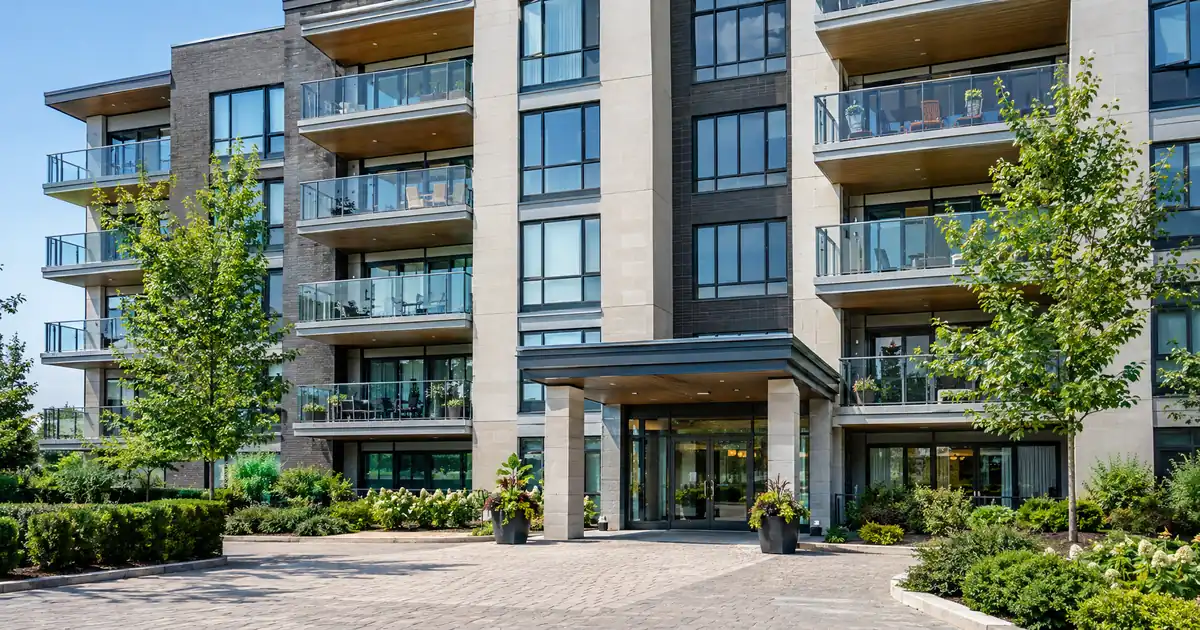
No-Ratio DSCR Loan on Condo Properties: A Complete Guide — The Quick Read: A no-ratio DSCR loan lets an investor buy or refinance a condo without the lender ever running a rent-to-payment ratio. Qualification runs on credit score and equity instead. This is a real, select-lender path. It’s not just a marketing term. It exists next to standard DSCR programs, which still require rent to cover the payment. Condos add a second layer on top of that choice. The lender also has to underwrite the building itself — its HOA finances, its insurance structure, its warrantability status. That happens no matter which qualifying method the borrower uses. Get both layers right, and a no-ratio condo file can close on a property that would never pass a standard rent-coverage test.
Key Takeaways
- A no-ratio DSCR loan removes the rent-coverage test entirely. No coverage number gets calculated as a qualifying threshold, and none is required to clear.
- This is different from a sub-1.00 DSCR loan. That loan still computes a ratio but allows it to fall below 1.00, with leverage and terms adjusted to match.
- Condo files carry building-level risk — HOA delinquency, litigation, insurance structure, warrantability. This risk exists no matter which qualifying method the borrower picks.
- No-ratio condo files generally come with tighter leverage than a strong standard DSCR file. They also carry their own eligibility exclusions.
- The right choice depends on whether the deal’s weak point is the rent number or the borrower’s documentation — not on which program sounds more flexible.
Key Terms Defined
DSCR (debt-service coverage ratio): a number that compares a property’s rent to its full monthly housing payment. Divide the rent by the payment. Anything over 1.00 means the rent covers the payment.
DSCR Calculator
Run the numbers in your market
Rate source: Freddie Mac 30-yr average via FRED® — Federal Reserve Bank of St. Louis · effective Aug 27, 2026
Prefilled with local estimates — enter your own rent or nightly figures, taxes, insurance, and HOA for a more accurate picture.
Program parameters update from Lendmire’s centralized guideline source. Taxes and insurance are editable estimates.
As of Aug 27, 2026 · General Freddie Mac market benchmark, not a Lendmire loan offer. Rent, nightly rate, occupancy, taxes, and insurance are editable estimates. Short-term rental figures are estimates only and vary significantly by season, property type, management approach, and local short-term-rental rules — confirm local regulations before relying on them. Qualifying income for short-term rentals varies by program — some use appraisal market rent, others use documented STR history or projections — and is confirmed in underwriting. Not a Loan Estimate, approval, or commitment to lend. Program availability and eligibility are subject to lender guidelines, credit approval, property review, and underwriting.
PITIA: the full monthly housing obligation a lender counts against rent. It adds up principal, interest, taxes, insurance, and any HOA dues.
No-ratio DSCR loan: a DSCR program where the lender skips the qualifying coverage ratio completely. The file gets approved on credit, equity, and reserves instead of a rent-versus-payment calculation.
Business-purpose loan: a loan made to a business or investment entity for a non-owner-occupied property. This is why DSCR loans get reviewed differently than a standard owner-occupied mortgage.
Warrantable condo: industry shorthand for a condo project that meets the underwriting rules large secondary-market buyers use to judge project risk. Think HOA delinquency levels, commercial-space ratio, ownership concentration, and similar factors.
HO-6 policy: the individual condo owner’s insurance policy. It covers the unit’s interior — everything the HOA’s master policy doesn’t.
What “No-Ratio” Actually Means on a Condo File
A no-ratio DSCR loan means the lender never runs the rent-to-payment math as a pass/fail test. Credit score carries the file. So does the down payment or equity position, along with documented liquid reserves. The property’s rent may still get estimated on the appraisal for pricing or file documentation. But it isn’t the gate.
Across the network, this path typically allows purchase leverage around 75% loan-to-value. Rate-and-term refinances usually run around 70%. Cash-out refinances usually run around 65%. All three are tighter than what a strong standard DSCR file can reach. Credit expectations run a bit higher too. Most no-ratio files want a credit score of at least 640. A few categories get excluded outright: vacant properties at closing, first-time homebuyers, and files where the borrower has one credit score or none at all. These exclusions exist for a reason. The whole structure leans on a track record — credit history, prior ownership, documented liquidity — to replace the thing it isn’t testing.
This matters a lot on condos, because condo carrying costs are the least predictable line item in the DSCR calculation. HOA dues can jump fast. A special assessment, a reserve-funding catch-up, or an insurance renewal that outpaces the building’s budget can all push dues higher. A ratio test built on last year’s HOA statement can be stale by closing. Removing the ratio doesn’t remove that HOA risk. It just changes who’s responsible for pricing it in.
How a Standard DSCR Condo Loan Works, for Contrast
A standard DSCR condo file divides the appraiser’s estimated market rent (or a signed lease) by the full monthly payment, HOA dues included. That number has to clear a lender’s coverage threshold. Select programs set that floor at 1.00. Select sub-1.00 options allow room to go lower, and better pricing kicks in above that line. Most files in the network run on credit tiers around 620, 660, 680, and 700. Higher tiers unlock better leverage. Purchase LTV generally lands in the 75%–80% range. Cash-out refinances top out around 75%. Reserves run about six months of PITIA on most deals — closer to nine months once the loan balance climbs past roughly $1.5 million.
The condo appraisal uses the same rent-survey form as a single-family investment property — the Single-Family Comparable Rent Schedule, Fannie Mae’s Form 1007. That form estimates monthly market rent for a unit leased the conventional way. It’s built around standard long-term leasing. That’s one reason condotel-style condo files often route through a different qualifying path entirely.
DSCR loans are business-purpose investor loans. That’s why they get reviewed differently than a standard owner-occupied mortgage. It’s the structural reason a lender can skip personal income documentation and qualify on the property’s income instead, subject to lender guidelines. For the deeper mechanics of how that ratio gets built and priced, Lendmire’s complete DSCR loans guide walks through it property type by property type.
Where Condos Complicate Underwriting: The Project, Not the Unit
The biggest thing that separates condo DSCR underwriting from single-family underwriting is this: the lender isn’t just reviewing the unit. It’s reviewing the building. That’s true whether or not the ratio is gating the loan.
Non-QM lenders don’t need to sell condo loans to a GSE, so they aren’t bound by agency warrantability rules. But most build a looser version of the same checklist, because it’s a reasonable proxy for building-level risk. Fannie Mae’s own ineligibility criteria offer a useful reference point here. A project is considered ineligible if more than 35% of its space is commercial or mixed-use. It’s also ineligible if more than 15% of units are 60-plus days delinquent on HOA dues, if a single entity owns more than 20% of the units, or if the association charges mandatory dues to a separate third-party organization. None of these rules bind a portfolio-held non-QM loan legally. But they’re the industry’s working definition of a risky project. A no-ratio structure doesn’t waive any of it — the lender still wants HOA financials, a litigation questionnaire, and a delinquency snapshot before closing.
New or newly-converted condo projects draw even more scrutiny. A no-ratio file assumes the property is rentable at a stable value. A project still under developer control, with an unfinished budget and no seasoned rent history, breaks that assumption. That’s true no matter how strong the borrower’s credit is. On the other end of the spectrum, small self-contained condo buildings — two to four units, or five to ten units not tied to a larger master association — often get a lighter project review than a large high-rise. There’s simply less HOA complexity to underwrite in the first place.
The Insurance Stack Nobody Explains Well
Condos carry two insurance policies where a single-family rental only needs one. A no-ratio file leans on reserves and equity harder than a ratio file. That’s exactly why the insurance stack deserves more attention, not less. The HOA’s master policy typically covers the building structure and common areas. The owner’s individual HO-6 policy covers everything inside the unit.
The exact split depends on how the master policy is written. A “bare walls-in” form puts the most responsibility on the owner. It only insures the structure up to the unfinished interior surface of the perimeter walls. That leaves drywall, flooring, cabinets, and fixtures for the HO-6 to cover. A “single entity” or “all-inclusive” master form shifts more of that burden onto the HOA. Latent Insure’s breakdown of these structures is a good plain-English reference if a borrower has never seen the distinction laid out before. An underwriter reviewing a condo file — no-ratio or not — has to confirm there’s no gap between where the master policy’s coverage ends and where the HO-6’s coverage picks up. A gap there is an uninsured loss waiting to happen.
The Edge Cases
Condotels sit in a different category entirely. A condo with a front desk, mandatory rental pool, and nightly bookings can fail a project checklist on its operating structure alone. That happens no matter how strong the borrower’s credit or reserves look. No-ratio doesn’t rescue a condotel from that kind of project-level decline. A weak rent number is fixable with a different qualifying method. A hotel-style operating agreement usually isn’t.
Florida condos carry a post-Surfside overhang that a no-ratio structure doesn’t see. New structural inspection and reserve-funding requirements are producing large special assessments in some buildings. Decades of underfunded reserves are getting caught up all at once. ManageCasa’s industry data puts some of these assessments in the $40,000 to $60,000 per unit range. A no-ratio underwriting decision can look completely clean at closing while that assessment sits on the horizon. It stays invisible to any qualifying test — ratio or no ratio — unless the lender’s HOA document review specifically catches it. That’s a reason for an investor to read the HOA’s reserve study personally, not just trust that the loan closed.
Mixed-use buildings with heavy ground-floor commercial space draw closer scrutiny across the non-QM world generally. This happens even where a lender doesn’t formally adopt a hard commercial-space cap. The tenant risk and insurance complexity affect both the appraisal and the master-policy review.
Honestly, the sharper edge case investors miss isn’t the condotel or the mixed-use building. It’s the ordinary, boring condo with a quietly underfunded reserve fund. No file structure fixes that.
A Worked Example: Qualifying a Condo Without a Ratio
Picture an investor targeting a condo. The current rent, based on the appraiser’s rent survey, covers only about 0.85x the full monthly payment once HOA dues get added in. On a standard DSCR file, that number fails the coverage threshold outright. The deal doesn’t move forward without a rent increase, a lower purchase price, or a different program.
DSCR vs. conventional financing
Two common ways to finance an investment property in this market. They qualify you differently — here’s how investors weigh them.
Why investors choose it
- Qualifies on the property’s rental income — no personal tax returns, W-2s, or pay stubs needed to document income.
- No personal debt-to-income ceiling to clear, so existing mortgages and obligations don’t cap your borrowing the same way.
- Can be closed in an LLC, keeping the property inside a business entity.
- Built for scaling — not held to the limit on number of financed properties that conventional financing applies.
- Underwriting centers on the deal: generally qualifies when the rent covers the payment, a 1.00x coverage ratio being a common baseline (confirmed in underwriting).
- Designed specifically for investment property, including long-term and, where the program allows, short-term rentals.
Where it’s strong
- Often the lowest ongoing financing cost for a buyer who fully qualifies on personal income — a fit for a first property or a cost-first purchase.
Trade-offs for investors
- Requires full personal income documentation and must fit within a debt-to-income limit — salary, existing debts, and other mortgages all count.
- Typically held in your personal name rather than a business entity.
- Caps how many financed properties you can carry, which can become a ceiling as a portfolio grows.
- Evaluates you as a borrower as much as the property, which usually means more paperwork.
How investors usually choose: a first or single property often optimizes for the lowest financing cost; portfolio builders often optimize for leverage, vesting in an LLC, and scaling past conventional caps. The right answer depends on your goals, the property, and current guidelines — both paths run through select lenders in Lendmire’s wholesale network, with eligibility and terms confirmed in underwriting.
On a no-ratio file, that 0.85x figure may still show up in the appraisal for documentation. But it isn’t tested against anything. The lender instead looks at three things. First, the borrower’s credit score against the roughly 640 floor common on these files. Second, the down-payment or equity position against the program’s leverage caps. Third, the borrower’s documented liquid reserves. If those three hold up — and the condo project itself clears the HOA and insurance review — the file can move forward. That’s true even though the rent, on paper, doesn’t yet cover the payment. That’s the trade the investor is making: skip the coverage gate, and take on responsibility for confirming the deal actually cash-flows over time.
Files like this come up constantly in condo markets with a lot of under-rented inventory. Think of units where the seller hasn’t raised rent in years, or where light renovation is needed before the unit can command what the building next door is getting. The no-ratio structure is built precisely for that gap between current rent and real potential.
No-Ratio vs. Sub-1.00 DSCR vs. Standard DSCR
| Factor | Standard DSCR | Sub-1.00 DSCR | No-Ratio DSCR |
|---|---|---|---|
| Coverage ratio | Calculated, must clear select-program floor (often 1.00) | Calculated, allowed below 1.00 | Not calculated as a qualifying test |
| Purchase LTV | Typically 75%–80% | Reduced from standard caps | Typically up to 75% |
| Cash-out LTV | Typically up to 75% | Reduced from standard caps | Typically up to 65% |
| Credit floor | Tiers around 620, 660, 680, 700 | Varies by lender | Typically around 640 |
| Best fit | Rent already covers the payment | Rent falls short, but not by much | Rent doesn’t cover the payment yet, or won’t be documented |
Sub-1.00 DSCR programs are available through select lenders in the network. Leverage and terms get adjusted to offset the weaker ratio. Never assume a specific numeric floor here, since none is fixed across the network. No-ratio goes a step further. It’s available only through select lenders, generally for borrowers who already own a primary residence and can show the credit and liquidity to stand in for a rent test entirely.
Cash-Out Refinance and Renovation Nuances
Cash-out refinances on condos tend to move slower through underwriting than purchases. Mostly, that’s because the HOA and insurance documentation has to be current, not just present at closing. Across the network, cash-out on condos generally caps around 75% LTV on standard DSCR files and around 65% on no-ratio files. Lenders usually expect roughly six months of seasoning before they’ll use the property’s current value rather than its original purchase price.
Say the plan is to force appreciation through renovation before pulling equity. The file typically needs documentation to support the new value. That means a scope of work, paid invoices, and before-and-after photos, at minimum. Lendmire’s investment property refinance playbook covers this seasoning-and-documentation sequence in more depth for investors planning a refinance exit from the start.
Non-QM production overall is on a steep growth curve, and investor/DSCR products make up a meaningful share of it. HousingWire reports non-QM origination volume is forecast to reach roughly $175 billion, up from about $108 billion the prior year, with DSCR and other investor products making up roughly half of that collateral. More lenders competing for this paper generally means more program variety for condo investors specifically. But it also means underwriting overlays on condo projects are still evolving lender to lender. That’s exactly why shopping more than one program matters on a condo file.
Files like these run through Lendmire’s wholesale network constantly. The pattern that shows up most on condo deals isn’t the ratio — it’s the HOA paperwork. A file with strong credit and solid reserves can still stall for weeks waiting on a current HOA questionnaire, a litigation letter, or a master insurance declaration that the association is slow to produce. Getting that packet started before the appraisal is even ordered is the single biggest thing that keeps a condo file — ratio or no ratio — moving on schedule.
Deciding Which Path Actually Fits the Deal
If the rent already covers the payment with room to spare, a standard DSCR file is almost always the better deal. It typically unlocks more leverage and better pricing than either alternative. There’s no reason to give up either one. If the rent falls modestly short — not dramatically, just short — a sub-1.00 program lets the coverage number exist honestly on paper while adjusting leverage to compensate. That keeps the file simpler for future refinances.
No-ratio earns its place when the rent number itself is the problem. Picture a vacant-at-close purchase in a value-add plan, a unit priced below what renovated rent could support, or a condo where the appraiser’s rent survey simply can’t capture a realistic post-renovation number yet. It’s not a workaround for a weak borrower profile. The credit and reserve bar is arguably higher, not lower, than a standard file, because those factors are doing all the work the ratio would otherwise do.
For a companion look at how standard DSCR condo files get built from the ground up, Lendmire’s complete guide to DSCR loans on condo properties covers the base mechanics in more detail. Investors comparing condo cash flow against a small multifamily alternative may also find Lendmire’s guide to DSCR loans on 2-4 unit properties useful for weighing property types side by side.
Tax treatment can depend on how the funds are used and how the property is held. Investors should keep clear records and speak with a qualified tax professional before relying on any deduction.
Lendmire arranges DSCR financing — no-ratio included — through select lenders across 40 markets, including Washington, D.C. Investors comparing a condo purchase or refinance against these three qualifying paths can reach Lendmire at 828-256-2183 or request a quote directly to see how a specific file lines up against current program guidelines.
Frequently Asked Questions
Does a no-ratio DSCR loan still require an appraisal? Yes. The appraisal establishes the property’s value and typically includes a rent estimate for file documentation. That rent figure just isn’t tested against the payment as a qualifying threshold.
Can a non-warrantable condo use a no-ratio DSCR loan? Often, yes, as long as the project clears the lender’s HOA and insurance review. Warrantability is a secondary-market classification, not a rule that blocks portfolio non-QM lending. The building still has to pass its own risk checklist, no matter which qualifying method the borrower uses.
Is a condotel eligible for a no-ratio DSCR loan? Condotels get reviewed on a project-by-project basis and often carry restrictions tied to their hotel-style operating structure. Front desk service, mandatory rental pools, and nightly booking arrangements draw closer scrutiny than a traditional residential condo. A no-ratio structure doesn’t override a project-level decline.
How is a no-ratio DSCR loan different from a sub-1.00 DSCR loan? A sub-1.00 file still calculates a coverage ratio and simply allows it to land below 1.00, with leverage and terms adjusted to compensate. A no-ratio file skips that calculation as a qualifying test entirely, leaning on credit and equity instead.
Does a special assessment show up in the DSCR calculation? Not automatically, and this is true whether the loan is ratio-based or no-ratio. A special assessment levied after closing works as a separate, undocumented obligation. Reviewing the HOA’s reserve study and delinquency rate before closing is on the investor, not just the underwriting file.
About Lendmire
As a DSCR and non-QM mortgage broker, Lendmire — NMLS# 2371349 — connects investors with wholesale lending channels across 40 markets, including Washington, D.C. Lender review centers on the property’s rental income, not the borrower’s tax returns. That works well for self-employed operators and portfolios beyond four financed properties. Scotsman Guide named Lendmire a Top Mortgage Workplace in both 2025 and 2026.
Get Started
Ready to find the right loan for you?
In about 30 seconds you can review financing options available for your home or investment property. No commitment required.
Informational only. Not a Loan Estimate, approval, or commitment to lend. Program availability and eligibility are subject to lender guidelines, credit approval, property review, and underwriting.
References
1. Fannie Mae Appraiser Update, June 2024
2. Fannie Mae Selling Guide B4-2.1-03, Ineligible Projects
3. Latent Insure — Condo HO-6 Insurance Structures
4. ManageCasa — State of HOA & Community Association Management
5. HousingWire — Non-QM originations set to reach $175B in 2026
Brandon Miller
Founder & CEO, Mortgage Loan Originator, Lendmire LLC
- Mortgage Loan Originator · NMLS# 1129696 · Verify on NMLS Consumer Access
- North Carolina Real Estate Broker · License# 343312 · Verify on NCREC
- North Carolina Insurance Producer · License# 19053198 · Property, Casualty, Life, Health · Verify on NAIC SBS
- Lendmire LLC · Firm NMLS# 2371349 · Verify firm licensure
Disclosure information. Lendmire is a state-licensed mortgage brokerage under NMLS# 2371349. Lendmire is not a depository institution, direct lender, or financial advisor — all loans referenced are placed through wholesale lender partners and are subject to each lender's underwriting standards. This article is provided for general informational purposes and is not a commitment to lend, nor does it constitute financial, legal, or tax advice. Loan programs, terms, rates, and qualification standards change without notice and depend on borrower profile, property type, and the state in which the subject property is located. Equal Housing Opportunity provider. NMLS Consumer Access: nmlsconsumeraccess.org.


