
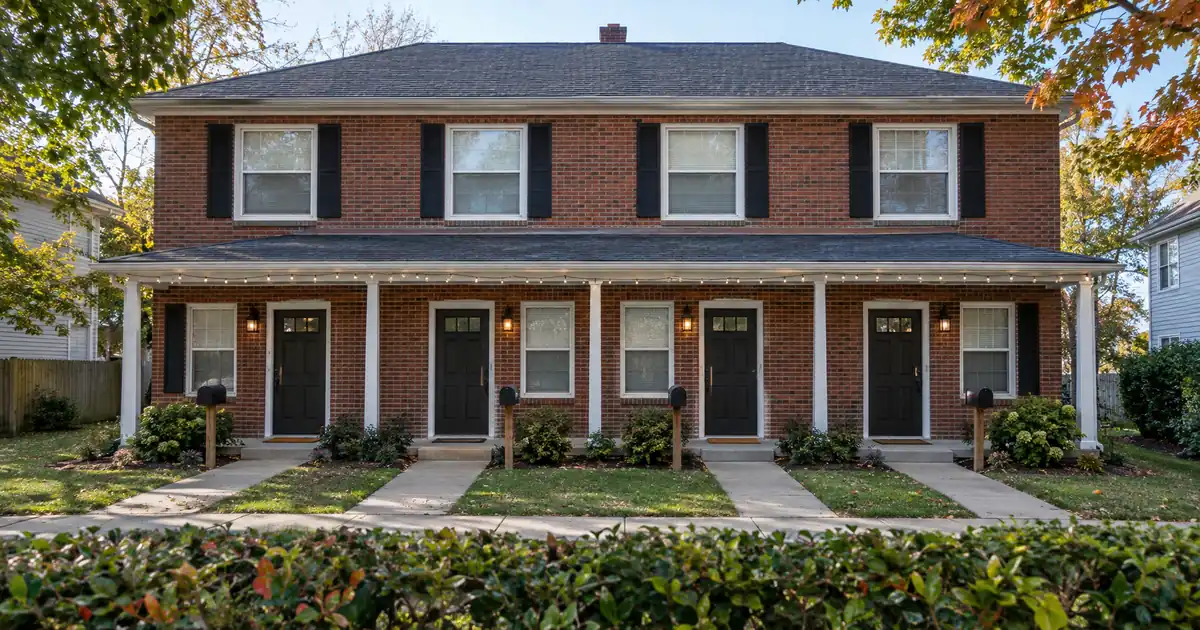
The Quick Read: A conventional cash-out refinance on a fourplex means an agency-conforming loan that pays off the current mortgage and returns cash, with the borrower’s personal income, credit and debt load driving the approval. The fourplex sits in the tightest leverage tier of the agency track, and it brings an income-property appraisal, a title clock and a reserve test. Investors who run out of room on that path often move the same building to a DSCR cash-out, which looks at the property’s rent instead.
- A fourplex still counts as residential collateral. Five or more units move the building to commercial financing.
- Agency cash-out leverage on a 2-4 unit investment property is lower than on a one-unit rental.
- The borrower must have held title for a minimum period before the new loan funds.
- A 2-4 unit appraisal uses an income-property report with unit-level rents.
- The DSCR cash-out path across Lendmire’s wholesale network tops out around 75% LTV on a standard rental, subject to lender guidelines.
What a Conventional Cash-Out on a Fourplex Actually Is
“Conventional” in this context means the loan is written to agency guidelines so it can be sold to Fannie Mae or Freddie Mac. It is not an FHA or VA product. Those programs generally don’t offer cash-out on a pure investment property.
DSCR Cash-Out Calculator
Run the cash-out numbers in your market
Rate source: Freddie Mac 30-yr average via FRED® — Federal Reserve Bank of St. Louis · effective Oct 29, 2026
Prefilled with starting assumptions — enter your property’s value, balance, taxes, and insurance for a more accurate picture.
Program parameters update from Lendmire’s centralized guideline source. Taxes and insurance are editable estimates.
As of Oct 29, 2026 · General Freddie Mac market benchmark, not a Lendmire loan offer. Property value, balance, taxes, and insurance are editable estimates. Maximum loan-to-value varies by lender, program, property type, and seasoning. Not a Loan Estimate, approval, or commitment to lend. Program availability and eligibility are subject to lender guidelines, credit approval, property review, and underwriting.
A cash-out refinance pays off the existing liens and hands the borrower the difference. The Fannie Mae Selling Guide defines the transaction by what it does, not by what the borrower calls it. A new loan on a property that carries no lien is also treated as cash-out.
A fourplex is still residential for lending purposes. BiggerPockets explains that a building with more than four units is treated as commercial. At four units, an investor can use a residential mortgage, which keeps long-term fixed structures in play.
How Underwriting Treats It, Step by Step
Agency files run on a fixed sequence. Each step is a place where a file can stall.
1. Classify the transaction. The loan is cash-out if it returns money beyond payoff and costs. Underwriters apply the cash-out leverage cap, not the rate-and-term cap.
2. Check the title clock. At least one borrower must have been on title for a minimum period before the new loan disburses. The guide’s figure is six months. A recent purchase can trip this.
3. Check the age of the loan being paid off. Practitioners describe a second, separate clock on the existing first mortgage. Confirm that rule against the current guide before promising a borrower a date.
4. Order the right appraisal. A 2-4 unit property is appraised on Form 1025, the small income property report. The Fannie Mae appraiser resource page lists it. A one-unit rental uses a different form with a rent schedule. The 1025 carries unit-level rents and an operating income statement, so rent roll clarity matters before the appraiser walks the building.
5. Qualify the borrower. Agency files are underwritten on personal income and debt-to-income. Rental income is counted under agency rules that differ from how a DSCR lender reads rent. DTI also drives reserves: the Selling Guide ties a six-month reserve requirement to files where DTI exceeds 45%. Terms depend on the lender’s guidelines, the property type, the leverage, and a full review of the credit profile.
6. Size the loan. Take the appraised value, multiply by the leverage cap for the unit count, then subtract the existing balance and closing costs. What remains is the cash-out.
What decides the outcome: appraised value, the unit-count leverage tier, seasoning, reserves, credit, DTI, and how the appraiser treats the rents.
Why the Fourplex Gets the Tight Tier
Agency caps on investment property sit below those on a primary home. Within investment property, the 2-4 unit tier sits below the one-unit tier. Agency cash-out ceilings are lower for multi-unit rentals, and the cap is the number that shrinks proceeds. Check the current agency eligibility matrix before quoting any figure to a client, since the 2-4 unit cash-out row has to be read directly from the matrix.
The practical effect is simple. Two owners with the same equity percentage can pull different cash if one holds a single-family rental and the other holds a fourplex. For a BRRRR refinance, where the goal is to recycle capital into the next purchase, that gap matters.
Variations and Structures
Delayed financing. Recent all-cash buyers have an exception to the title wait. The guide requires a settlement statement showing no mortgage financing was used. The new loan is capped at the documented investment plus financed closing costs, and the cash-out leverage caps still apply. It waives only the wait. Post-rehab value does not raise proceeds, so it is no way around leverage limits.
Owner-occupied versus fully rented. Living in one of the four units changes the occupancy class, and the leverage tier changes with it. A fully rented building is an investment property for every test above.
The DSCR alternative. Across the wholesale network, DSCR cash-out files qualify primarily on property-level rental income covering the payment, subject to lender guidelines. Cash-out tops out around 75% LTV on most programs, with about 6 months of seasoning as the common expectation. Credit floors start at 620 in parts of the network, most programs want around 660, and 700+ opens the strongest tiers. Reserves commonly run around 6 months of PITIA, stepping up to about 9 months above $1,500,000. Loans run up to $3,000,000 on standard programs.
Coverage of 1.00 is where select programs start. A separate select-lender path takes coverage below 1.00, with leverage and terms adjusted. Clearing 1.00 is not the same as positive cash flow: repairs, vacancy, management, utilities and capex sit outside the calculation.
| Factor | Conventional (agency) | DSCR cash-out |
|---|---|---|
| Reviewed on | Personal income, DTI | Property rent vs PITIA |
| Fourplex leverage | Lowest agency tier | Around 75% LTV, standard rental |
| Appraisal | Form 1025 | Rent and value review |
| Title/entity | Generally individual name | LLC possible, per lender program requirements |
| Financed-property count | Agency cap can apply | Not governed by agency cap |
Where the General Rule Breaks
Five or more units. The building moves to commercial financing. BiggerPockets discussions on converting a fourplex to five units point to a changed loan class, a different insurance policy type and a different buyer pool at sale. Adding a fifth unit is a financing decision, not just a construction one.
LLC or trust title. Agency loans generally fund in an individual’s name, and how ownership time counts depends on the guide’s wording. Treat it as a question for the underwriter before the file goes in. A BiggerPockets discussion makes the same point: residential loans are personal borrowing, not entity borrowing. DSCR programs can accommodate entity-titled rentals, subject to program terms.
Many financed properties. The agency track limits how many financed 1-4 unit properties a borrower can carry. Active investors often hit that ceiling first. It is a common reason a file leaves the agency path. Confirm the current cap in the guide itself.
Inheritance and legal awards. Practitioners treat these as exceptions to the title clock. Read the exact guide wording before relying on it.
Ineligible property types. Manufactured homes, log homes and barndominiums are not offered in the network’s DSCR programs, and mixed-use buildings fall outside standard residential eligibility.
The Decision in Practice
Picture an investor with strong traditional employment income, one or two financed properties and a fourplex held well past six months. The conventional path can work. Pricing, DTI and the reserve test drive it, and a lower leverage tier simply means less cash.
Now say an investor is self-employed with heavy write-offs and five financed properties. Personal DTI and the financed-property cap make the agency path hard to use. A DSCR cash-out reads the building’s rent against the full payment instead.
The strongest files clear both tests: enough equity and enough rental coverage. A larger down payment on a purchase can lower the payment and lift the ratio, but it never erases leverage caps, credit floors, reserve rules or property eligibility. For a file that has outgrown the agency track, Lendmire’s complete DSCR loans guide covers the structure. A related piece goes further: how to pool an older conventional rental into a DSCR cash-out refinance.
Document habits that keep these files clean: a current rent roll with signed leases, a settlement statement for any recent purchase, entity documents if title is not personal, and reserve statements that match the stated balance. Most stalls come from gaps in those four items, not from the math.
Key Terms Defined
Cash-out refinance: a new loan that pays off the old one and returns the leftover equity as cash.
Seasoning: the minimum time a borrower has owned the property or held the existing loan before a refinance can fund.
Form 1025: the appraisal report for 2-4 unit income properties, with unit-level rents and an operating income statement.
Delayed financing: an exception for recent all-cash buyers that waives the title wait but keeps the leverage caps.
DSCR: the property’s rent divided by its full monthly obligation, including principal, interest, taxes, insurance and HOA dues.
Frequently Asked Questions
Can I get a conventional cash-out refinance on a fourplex rental?
Yes, if the building has four units or fewer and meets agency eligibility. It sits in the tightest investment-property leverage tier, and the borrower’s personal income, credit and DTI drive approval.
Does a fourplex get the same leverage as a single-family rental?
No. Agency caps on investment property step down for 2-4 units, so the same equity yields less cash on a fourplex. Read the current agency eligibility matrix for the exact figure.
Can FHA or VA do a cash-out on my rental?
Generally not on a pure investment property. Conventional or DSCR cash-out are the usual routes.
What happens if I add a fifth unit?
The building moves to commercial financing, which changes the loan class, the insurance policy type and the buyer pool at sale.
When does a DSCR cash-out make more sense?
When personal DTI, tax returns, entity title or the number of financed properties block the agency path. DSCR qualifies primarily on property-level rental income covering the payment, subject to lender guidelines, with leverage around 75% LTV on a standard rental.
If you are buying or refinancing a rental property and want to see how the numbers work, Lendmire can help you compare DSCR loan options based on the property income, credit profile, leverage, and investor goals. As a broker, Lendmire arranges DSCR financing through select lenders in its wholesale network across 41 markets, including Washington, D.C. This is not a commitment to lend.
Tax treatment varies; consult a qualified professional.
Investors weighing their equity options can start with Lendmire’s guide to cash-out refinance on an investment property.
About Lendmire
Lendmire — NMLS# 2371349 — is a DSCR and non-QM mortgage brokerage with investor loan programs in 41 markets, including Washington, D.C. DSCR eligibility is commonly reviewed by the lender around property-level rent rather than personal income documentation, subject to lender guidelines, and the brokerage helps arrange financing for LLC-owned portfolios beyond conventional financed-property limits. Recognized by Scotsman Guide as a Top Mortgage Workplace in 2025 and 2026.
Get Started
Ready to find the right loan for you?
See your offer in seconds. No credit pull, no obligation.
Informational only. Not a Loan Estimate, approval, or commitment to lend. Program availability and eligibility are subject to lender guidelines, credit approval, property review, and underwriting.
References
1. Fannie Mae Selling Guide: Cash-Out Refinance Transactions
2. BiggerPockets: Investing in a Fourplex
3. Fannie Mae: Appraisers and Property Underwriting
4. BiggerPockets: Converting a 4-plex to 5 Units
5. BiggerPockets: Residential vs Commercial Loan for Multiple Fourplexes
This article is part of Lendmire’s investment property cash-out refinance program — full qualification details, guidelines, and scenarios live on the program page.
Related reading: Does a Fourplex Get the Same DSCR Cash-Out Terms as a House? · Should You Use a Cash-Out Refinance on One Rental to Buy a Fourplex? · Fourplex DSCR Refinance vs Cash-Out on a Paid-Off Rental · How to Complete a Cash-Out Refinance on a Fourplex Rental · DSCR Cash-Out Requirements on a Fourplex for a Portfolio Owner
Brandon Miller
Founder & CEO, Mortgage Loan Originator, Lendmire LLC
- Mortgage Loan Originator · NMLS# 1129696 · Verify on NMLS Consumer Access
- North Carolina Real Estate Broker · License# 343312 · Verify on NCREC
- North Carolina Insurance Producer · License# 19053198 · Property, Casualty, Life, Health · Verify on NAIC SBS
- Lendmire LLC · Firm NMLS# 2371349 · Verify firm licensure
Required disclosures. Lendmire (NMLS# 2371349) operates as a licensed mortgage broker, not a direct lender or depository. The discussion in this article is general in nature and should not be relied upon as financial, legal, or tax advice — every investment scenario is unique and should be reviewed by a qualified professional. Any loan inquiry is subject to lender underwriting, and this article is not a commitment to lend or a guarantee of approval. Mortgage rates, loan terms, and program guidelines vary by borrower, property, and state, and may change without notice. Equal Housing Opportunity. Verify licensure at NMLS Consumer Access.