
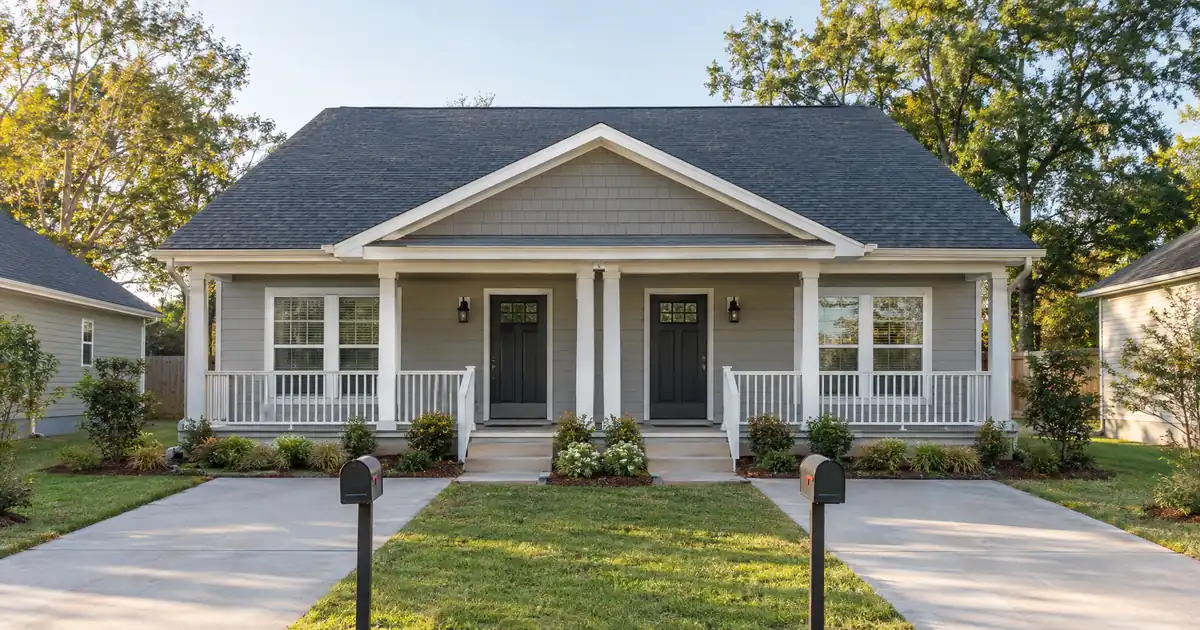
The Quick Read: The program that fits depends on your file, but the strongest match treats the duplex as your primary residence and underwrites you as the borrower rather than the rent roll, so an empty unit changes how much income a lender can add instead of whether the file qualifies at all.
- Living in one unit makes the duplex owner-occupied. Primary-residence terms apply, with a ceiling of 90% CLTV that exists only at a 720-or-better credit profile.
- A rent-based investor line is not an option while you live there. Those lines are for non-owner-occupied property only.
- Title must sit with you personally or in a revocable living trust.
- Move-out changes the product. An investment line on the same building tops out at 70% CLTV and $500,000, with a 700 minimum credit score.
What Makes a HELOC Program the Best Fit for an Owner-Occupied Duplex With One Unit Vacant?
The best program is the one whose underwriting method matches your facts. For a live-in duplex, five criteria decide that: how the lender classifies occupancy, whether the line is underwritten on you or on the building, how title is held, how large the line needs to be, and whether you plan to move out.
How large a line the equity supports.
An equity line is sized by combined loan-to-value, occupancy, and credit — not by rental coverage. Switch the occupancy or the credit band and the ceiling moves with it.
Investment-property lines require a 700 minimum credit score; second-home lines start at a 640 minimum and primary-residence lines at 600, and the combined-LTV ceiling steps down as the credit band drops on primary-residence and second-home lines and holds on investment-property lines; the line cap steps down on primary-residence lines and holds at every tier on investment-property and second-home lines.
A debt-to-income ratio above 45% requires 680+ credit. Profiles under 640 are limited to single-family homes. At least 75% of the approved line is drawn at closing. Ceilings, floors, and caps update from Lendmire’s centralized guideline source.
Line estimate
Illustrative estimate only — not a quote, Loan Estimate, approval, or commitment to lend. The rate is an editable assumption; equity-line pricing is variable through both the draw and repayment periods and never converts to fixed. Occupancy and credit drive the ceiling together: an investment property tops out at 70% combined LTV (minimum credit 700, line cap $500,000); a second home tops out at 90% combined LTV (minimum credit 640, line cap $500,000), with the ceiling stepping down as the credit band drops (the cap holds at every tier); a primary residence tops out at 90% combined LTV (minimum credit 600), and its $750,000 maximum line is available only at 75% combined LTV or below with a 700-or-better credit profile (720 on the longer-runway program) and a full appraisal. Lines above $500,000 require a full appraisal. Credit, debt-to-income, property type, and full underwriting review all affect the final line.
No single lender’s guidelines answer all five for every borrower. Lendmire is a mortgage broker, not a lender. It places equity-line files with select wholesale partners and matches the scenario to the program whose rules fit. That matters on a duplex because lender appetite for 2-4 unit collateral varies widely. Some lenders decline it outright. The ones that write it differ on minimum score, how they treat rent, and what they do with an empty unit.
On the network, these lines are available in Lendmire’s 16 full-service states only. That is narrower than the 41-market DSCR footprint, so confirm availability before building a plan around one.
How Does a Lender Classify the Duplex When One Unit Is Empty?
If you sleep in one of the units, the file is classified as a primary residence. The vacancy does not change that label. It affects the file’s income picture and, in some cases, the lender’s comfort, but the occupancy class stays tied to where you live.
That classification matters because it sets the best terms on the table. Primary-residence lines reach up to 90% CLTV, and only at a 720-or-better credit profile. Second-home lines share that ceiling. Investment-property lines top out at 70% CLTV. So the same building can sit in very different columns depending on your own address.
Duplexes, triplexes, and fourplexes are all eligible property types. The program with the longer interest-only draw period sets a 640 minimum score on 2-4 unit collateral. Mixed-use buildings, manufactured homes, co-ops, condotels, and log homes are not offered on these programs.
Whether an empty unit between tenants gets extra scrutiny is the lender’s call on the file facts. A unit that sat vacant for a week after a move-out reads very differently from a unit that has never been rented. The next section covers how.
Borrower-Underwritten Lines vs. Rent-Based Investor Lines
A standard HELOC on a primary residence is underwritten on the borrower. The lender reviews credit, personal income or bank-statement income, debts, and combined loan-to-value. The building’s rent is a supporting item at most, so one empty unit may not sink the file.
A rent-based investor line works the opposite way. DSCR, or debt service coverage ratio, compares the monthly rent to the monthly housing payment: principal, interest, taxes, insurance, and any HOA dues. On a duplex with one empty unit, half the rent drops out of that test, which is why a vacant unit is nearly always a coverage problem there. DSCR programs also serve non-owner-occupied property only. Because they are business-purpose investor loans, they are reviewed differently from a standard owner-occupied mortgage.
So a live-in owner should not shop a DSCR line at all. The occupancy basis has to match real use. Describing a property as non-owner-occupied when you live in it creates serious exposure, and the reverse misstatement is also misrepresentation.
For the full picture of how coverage-based investor loans work, see the complete DSCR loans guide. It matters later, if you move out.
One more mechanic on the income side: rent rarely counts at full value. When a lender adds rental income to your qualifying income, it counts a discounted share of gross rent. The unit you live in produces none. A vacant unit’s rent is either excluded or taken from the appraisal’s market-rent schedule, and that treatment is lender-specific. Ask before you apply, not after.
How Different Kinds of Vacancy Read to an Underwriter
Not every empty unit looks the same on paper. The reason it is empty matters more than the fact that it is empty.
| Vacancy type | Typical read | What helps |
|---|---|---|
| Between tenants | Routine, usually minor | Listing, rent-ready photos |
| Never rented | Rent unproven | Market-rent support |
| Under renovation | Often a problem | Finish work first |
| Held for family or personal use | Not rental income | Honest disclosure |
Between tenants is the easy case. A borrower-underwritten line may not hinge on that unit at all, and the lender can leave its rent out of income without affecting the file.
A never-rented unit leaves the rent unproven, so a lender either excludes it or relies on the appraiser’s market-rent schedule. Neither approach is guaranteed to be used.
A unit under active renovation is the weakest case. A HELOC is usually unavailable on the rental you are rehabbing, and the rehab itself can be a reason a lender pauses. If the work is cosmetic and finished, say so with photos. If it is a gut job, finish it before applying.
A unit kept for family or personal use is not a vacancy in the rental sense. Report it that way. The plan on the page has to match the plan in your head, and a planned move-out should be disclosed, since the file follows the real plan.
Worked Example: A Live-In Duplex With the Other Side Empty
Run the numbers on a modeled file. These are assumptions for illustration, not market data. A borrower lives in one side of a duplex. The other side has been empty for a short stretch between tenants. The borrower has a 720-or-better credit profile, and the existing first mortgage sits at 60% of the property’s value.
On a primary residence at that credit tier, the ceiling is 90% CLTV. That leaves room for a line of up to 30% of value, subject to the line cap, the debt-to-income test, and the valuation.
Now the underwriting. The lender reviews credit and personal income. Debt-to-income tops out at 50%, and a ratio above 45% requires a 680 minimum score. Profiles from 600 to 679 are held to 45%. The test is run on the interest-only payment calculated on the maximum draw, not on what you plan to draw.
The vacant unit enters in one place only: rent. If the lender adds rental income, the empty side contributes either nothing or a market-rent figure, and the live-in side contributes nothing. If the borrower’s own income carries the debt-to-income test, the vacancy barely registers.
Valuation follows the line size. Lines at or below $500,000 ordinarily run an automated valuation with no traditional appraisal, although a higher CLTV can require a secondary valuation. A full appraisal is required above $500,000, and a borrower can request one anyway. Where a full appraisal is ordered on a 2-4 unit property, expect the small-residential-income form (Form 1025), which is why the rent schedule gets attention there.
Line size runs from $25,000 to $750,000. Anything above $500,000 is primary-residence only and needs a credit profile of 700 or better (720 on the longer-runway program). It is also capped at 75% CLTV and requires a full appraisal. Eligibility depends on lender guidelines, full file review, and credit approval.
Should You Lease the Unit Before Applying?
Leasing first helps, but it is not a requirement on a borrower-underwritten line. On a live-in duplex, the application path is built around you, so a signed lease is supporting evidence and not the foundation.
A lease helps in two ways. It shows the lender the rent is real, which matters if rent is added to income. It also removes the vacancy question before it is asked.
Waiting for a tenant has costs, though. Holding the application while the unit sits empty delays access to the equity, and the lender may not care either way. The cleaner call usually depends on why you want the line. If the funds are for the next purchase, timing the line before you move out matters more than timing the lease.
That last point deserves weight. In one BiggerPockets house-hack thread, the top reply advised getting the line before moving out, because many borrowers only think about it once they are under contract on the next property. Another reply in the same thread warned that borrowing the down payment leaves you fully leveraged. Both points hold up. A live-in line is easiest to get while the building is still your primary residence, and borrowing against your own home to fund the next one adds risk on both properties.
Lendmire’s piece Best Investment Property HELOC Program With One Unit Vacant covers the case where you have already moved out.
Document and Legal Traps on a Live-In Duplex
Most problems on these files are not credit problems. They are paperwork and covenant problems that show up late.
Occupancy and rental clauses. Read the line agreement before you sign. The CFPB’s HELOC booklet warns that renting your home out to other people may be prohibited under the terms of your line of credit. On a duplex, renting the second unit is the whole plan, so confirm the lender allows it. On the network, renting the other unit is permitted when you live in one.
Collateral. A line on your own home puts your home at risk. A line on a rental puts the rental at risk. That is a real difference when you decide which product to use for the next down payment.
The right to cancel. Because the duplex is your main residence, the FTC explains that you can cancel a HELOC within three business days for any reason and without penalty. That right generally does not apply to a pure rental. It is one more reason the occupancy label matters.
The first mortgage. Borrowers worry that a second lien triggers the first lender’s call. For residential property with fewer than five units, federal law bars a lender from calling the loan over a subordinate lien that does not transfer occupancy rights, as quoted in this law-firm summary of the statute. That protection does not extend to buildings of five or more units, commercial property, or mixed-use real estate. If your first lien is a DSCR loan, also read its documents to confirm a second lien is allowed.
Title and vesting. Title must be held by an individual or a revocable living trust. LLCs, corporations, partnerships, and irrevocable, blind, or land trusts cannot hold title on these lines. If the duplex already sits in an LLC, the choices are a vesting change first or a DSCR cash-out instead. That is the sharpest structural difference from a DSCR loan, which can be held in an entity, depending on program guidelines.
Exposure limits. A borrower is limited to three lines. Combined exposure caps at $2,000,000 on the higher-leverage program and $750,000 on the longer-runway program, and a borrower with more than 15 financed properties is not eligible.
HELOC, First-Lien Line, or Move-Out Products: A Comparison
Which product fits depends on whether you live there now and what you want the funds to do.
| Product | Fits a live-in duplex? | Underwritten on |
|---|---|---|
| Primary-residence HELOC (second lien) | Yes | Borrower |
| First-lien line replacing your mortgage | Yes | Borrower |
| Investment-property HELOC | Only after move-out | Borrower |
| DSCR cash-out refinance | Only after move-out | Rent vs. payment |
The first-lien option replaces your existing mortgage with the line, which reprices everything. It is rarely the right call if your current first mortgage is one you want to keep.
After a move-out, the investment-property HELOC runs 70% CLTV, up to $500,000, with a 700 minimum score. Credit above 700 buys eligibility, not leverage, since 720 and 700 both reach 70%. Lines at that size run on automated valuation. Investment lines use the five-year draw and 25-year repayment structure only, and the draw does not convert to fixed.
A DSCR cash-out refinance on a standard rental reaches about 75% LTV, with about six months of seasoning as the common expectation. Coverage of 1.00 is where select programs start, and stronger ratios open better terms. A separate select-lender path goes below 1.00, with leverage and terms adjusted. Keep in mind that clearing 1.00 is not the same as positive cash flow. DSCR compares rent to the housing payment only, and repairs, vacancy, management, utilities, and capex sit outside it. Final terms depend on lender guidelines, property type, leverage, and the borrower’s complete credit picture.
What to Have Ready Before You Apply
A clean packet gives the lender fewer gaps to chase. Most of it is routine.
- Government ID and proof you live in the building, such as utility bills or a driver’s license at the property address.
- Mortgage statement and current balance on the first lien.
- Leases for any occupied unit, plus the rental line from your tax return if you want rent counted.
- For the vacant unit, rent-ready photos, a listing, or a market-rent estimate.
- Income documentation under the applicable program, subject to lender guidelines.
- Credit report details. The report must be no more than 90 days old at closing, and the score model keys to the primary wage earner.
- Title documents showing how the property is vested.
Why Duplex HELOC Files Get Declined
Most declines trace to one of a handful of causes, and most have a fix.
Title in an LLC. Fix it with a vesting change before applying, or switch to a DSCR cash-out.
Debt-to-income above the limit. The test runs on the interest-only payment at the maximum draw. A smaller requested line, paying down debts, or a stronger score may help.
Credit below the floor. The program floor is 600, and 2-4 unit collateral on the longer-runway program starts at 640. Recent derogatory history can also block a file. A bankruptcy needs four years of seasoning from discharge or dismissal, and foreclosure-family history is handled differently by each program.
Misclassified occupancy. Applying as an investor while living in the building, or the reverse, is the fastest way to lose a file.
Property type. Mixed-use, manufactured, co-op, condotel, and log properties are not offered.
Lender appetite. Some lenders simply do not write duplex collateral. A broker that shops multiple wholesale lenders can route around that.
The Application Path, Step by Step
1. Confirm occupancy. Decide whether the duplex is your primary residence now and whether you plan to move out. Disclose the plan.
2. Check title. Confirm the property is held individually or in a revocable living trust.
3. Compute CLTV. Add every loan against the property and divide by its value, then compare the result to the ceiling for your credit tier.
4. Gather documents. Pull the packet above, including the vacancy support.
5. Match the program. Share the scenario with the brokerage so it can place the file with the wholesale lender whose duplex guidelines fit.
6. Review the draw terms. At least 75% of the line is drawn at closing, and pricing floats through both the draw and repayment periods. Read the occupancy and rental clauses before signing.
Key Terms Defined
CLTV: Combined loan-to-value, meaning all loans against the property added together and divided by its value.
Owner-occupied: A property where the borrower lives in at least one unit as a primary residence.
Borrower-underwritten line: An equity line approved mainly on the borrower’s credit, income, and debts rather than the property’s rent.
DSCR: Debt service coverage ratio, the monthly rent divided by the monthly housing payment of principal, interest, taxes, insurance, and any HOA dues.
Vesting: The legal form in which title to the property is held, such as an individual or a revocable living trust.
Subordinate lien: A second loan recorded behind the first mortgage, which is what a standard HELOC on a mortgaged home is.
Frequently Asked Questions
Can I get a HELOC on a duplex if one unit has no tenant?
Yes, it is possible on a primary residence. A line underwritten mainly on you may not depend on that unit’s rent. The vacancy mostly affects how much rental income a lender can add, and treatment varies by lender and file.
Does a vacant unit change my duplex from owner-occupied to investment?
No. Where you live sets the occupancy class. Living in one unit keeps the file in the primary-residence column, with the vacancy affecting the income picture rather than the label.
Can I use a DSCR line on a duplex I live in?
No. DSCR lines serve non-owner-occupied property only. Once you move out and every unit is rented, the property can qualify under a DSCR program, subject to program terms.
Do triplexes and fourplexes get the same treatment as duplexes?
Eligibility is the same across 2-4 unit property types, including the 640 minimum on the longer-runway program. Rent matters more as unit count grows, so vacancy can weigh more on a fourplex than a duplex.
What if the duplex is held in an LLC?
An LLC cannot hold title on these lines. The options are a vesting change into your name or a revocable trust first, or a DSCR cash-out refinance, subject to lender program eligibility.
Next Steps
If you are considering a home equity line and want to see how the numbers work, Lendmire can help you compare HELOC options based on the property, the equity available, credit profile, combined leverage, and your goals. Reach the team at 828-256-2183 or through the quote request page.
Duplex owners who plan to buy again usually have a narrow window, and it closes the day they move out.
About Lendmire
Lendmire — NMLS# 2371349 — is a mortgage broker that arranges home equity lines of credit in its 16 full-service states through wholesale lenders, on primary residences, second homes and investment properties. Every line is subject to the lender’s guidelines and full underwriting. Scotsman Guide named Lendmire a Top Mortgage Workplace in both 2025 and 2026.
Get Started
Ready to find the right loan for you?
See your offer in seconds. No credit pull, no obligation.
Informational only. Not a Loan Estimate, approval, or commitment to lend. Program availability and eligibility are subject to lender guidelines, credit approval, property review, and underwriting.
References
1. BiggerPockets – Owner-occupied duplex HELOC thread
3. FTC – Home equity loans and home equity lines of credit
4. Lone Star Land Law – Due-on-sale in Texas (Garn-St Germain text)
This article is part of Lendmire’s HELOC & home equity loan program — full qualification details, guidelines, and scenarios live on the program page.
Related reading: Can You Get a HELOC on a Condotel? · Can You Get an Investment Property HELOC on Business Deposits? · How to Qualify for an Investment Property HELOC With One Unit Vacant
Brandon Miller
Founder & CEO, Mortgage Loan Originator, Lendmire LLC
- Mortgage Loan Originator · NMLS# 1129696 · Verify on NMLS Consumer Access
- North Carolina Real Estate Broker · License# 343312 · Verify on NCREC
- North Carolina Insurance Producer · License# 19053198 · Property, Casualty, Life, Health · Verify on NAIC SBS
- Lendmire LLC · Firm NMLS# 2371349 · Verify firm licensure
Compliance and disclosures. Lendmire (NMLS# 2371349) is a licensed mortgage broker and is not a direct lender, depository institution, financial advisor, or tax professional. Content in this article is general market analysis and educational information — not financial, legal, or tax advice for any specific situation. Lendmire does not guarantee loan approval; every transaction is subject to underwriting by the funding lender. Mortgage pricing and loan program guidelines are subject to change at any time without notice and vary by borrower characteristics, property type, and state regulations. Lendmire complies with Equal Housing Opportunity. Licensure verification: NMLS Consumer Access.