
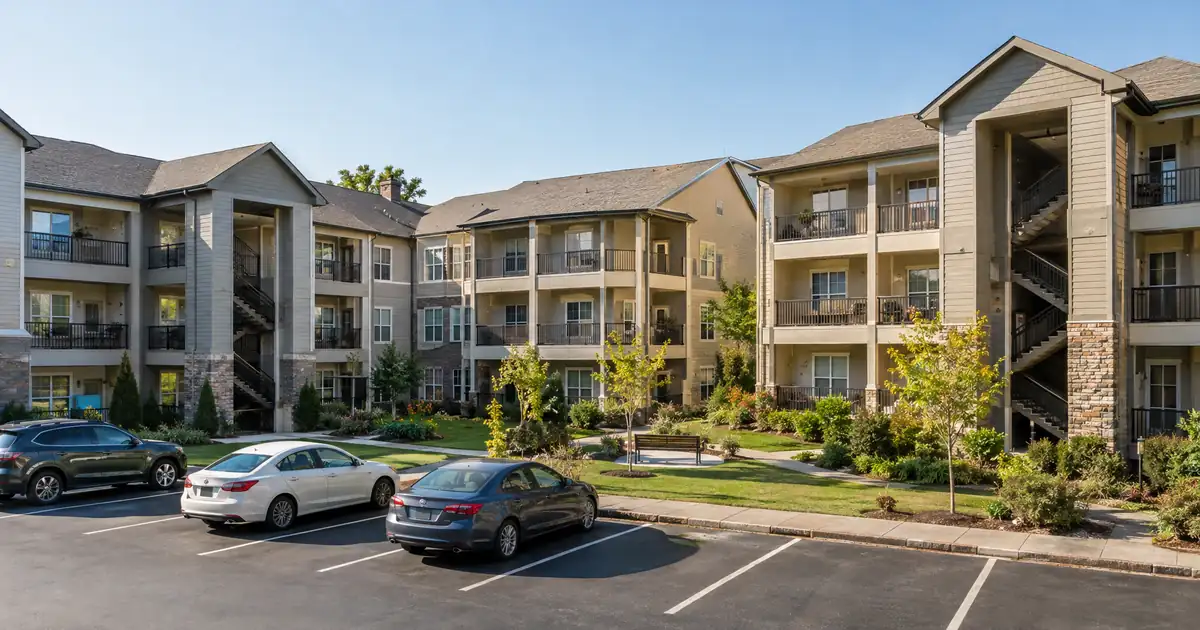
The Quick Read: It depends on unit count: a two- to four-unit building usually can get a DSCR cash-out refinance, because lenders treat it as residential-style investment property, while a building with five or more units is generally treated as commercial and usually routes to a different kind of loan. DSCR stands for debt service coverage ratio, which compares the rent to the monthly housing payment. Qualification runs primarily on property-level rental income covering the payment, subject to lender guidelines.
- 2-4 units: these run through standard DSCR cash-out programs, with up to 75% LTV on a cash-out refinance of an investment property on most files.
- 5+ units: the loan usually moves to a commercial lane such as bank portfolio, agency, HUD, or a small-balance commercial lender.
- Seasoning: expect to own the building about six months before cash-out, measured from title recording.
- The ratio: 1.00 is where many select programs start, and stronger coverage opens better leverage and terms.
- The catch: passing the ratio does not erase leverage caps, credit floors, reserves, or property eligibility.
What Does a DSCR Cash-Out Refinance Mean on an Apartment Building?
A DSCR cash-out refinance replaces your current mortgage with a new, larger loan and pays you the difference in cash. The lender looks mainly at the building’s rent, not your pay stubs or traditional personal-income documentation. Cash-out means you borrow more than you owe and keep the gap.
DSCR Cash-Out Calculator
Run the cash-out numbers in your market
Rate source: Freddie Mac 30-yr average via FRED® — Federal Reserve Bank of St. Louis · effective Oct 8, 2026
Prefilled with starting assumptions — enter your property’s value, balance, taxes, and insurance for a more accurate picture.
Program parameters update from Lendmire’s centralized guideline source. Taxes and insurance are editable estimates.
As of Oct 8, 2026 · General Freddie Mac market benchmark, not a Lendmire loan offer. Property value, balance, taxes, and insurance are editable estimates. Maximum loan-to-value varies by lender, program, property type, and seasoning. Not a Loan Estimate, approval, or commitment to lend. Program availability and eligibility are subject to lender guidelines, credit approval, property review, and underwriting.
The word “apartment building” covers very different properties. A duplex, a triplex, and a fourplex sit in one lane. A five-unit building and a forty-unit complex sit in another. Most of the confusion online comes from writers who mean different things by the same phrase.
DSCR loans are designed for non-owner-occupied investment properties. Because they are business-purpose investor loans, they are reviewed differently from a standard owner-occupied mortgage.
Across the wholesale network Lendmire works with, the smaller lane is where DSCR cash-out lives. For the full picture of how these loans work, see the complete DSCR loans guide.
Key Terms Defined
DSCR (debt service coverage ratio): the building’s rent divided by its monthly housing payment. A result of 1.00 means rent equals the payment.
PITIA: principal, interest, taxes, insurance, and any association dues. It is the full monthly payment used in the ratio.
LTV (loan-to-value): the loan balance divided by the appraised value. A 75% LTV means the lender stops at three-quarters of value. Final terms depend on the lender’s guidelines, the property type, and the borrower’s complete credit picture.
Seasoning: the waiting period after you buy before a lender will let you pull cash out.
NOI (net operating income): rent minus operating expenses and vacancy. Commercial lenders judge larger buildings on this number.
Rent roll: a unit-by-unit list of tenants, rents, and lease dates.
How Many Units Counts as Small?
Four units is the line. At four units or fewer, the building is treated like a residential investment property. At five or more, it is treated as commercial multifamily.
That split shows up in the appraisal paperwork. Fannie Mae’s Selling Guide lists Form 1025, the small residential income property appraisal report, for two- to four-unit properties. HUD’s archived reference guide shows the same form has long been required for two-, three-, and four-unit appraisals. An appraiser’s Form 1025 explainer says the form is not meant for apartment properties above four units.
DSCR loans are not agency products. The forms are useful only as a map of where residential ends and commercial begins.
| Units | Treated as | DSCR math | Appraisal |
|---|---|---|---|
| 2-4 | Residential-style | Rent vs. PITIA | Comparable sales, rent schedule |
| 5+ | Commercial | NOI vs. debt service | Income approach |
A fourplex and a five-unit building can look almost identical from the street. Financially, they land in different worlds.
How Does DSCR Work on a 2-4 Unit Building?
On a two- to four-unit building, the lender divides the building’s qualifying gross rent by the full monthly PITIA. The formula is short: rent divided by PITIA equals the coverage ratio.
The appraiser values the building using comparable sales and documents the rents on a rent schedule. No personal income documents are used. The loan pays off the old mortgage, and you receive the remainder.
The cash you can pull depends on four things, listed below.
- the appraised value
- the program’s LTV cap, which tops out around 75% on a cash-out refinance of an investment property across most of the network
- the coverage ratio
- how long you have owned the building
Take a modeled fourplex whose rents cover the payment at about 1.25x. That clears the 1.00 starting point for select programs with room to spare. Strong coverage can help with leverage and pricing, subject to lender guidelines.
One caution matters here. Clearing 1.00 does not mean the building throws off positive cash flow. DSCR compares rent to PITIA only. Repairs, vacancy, management, utilities, and capital expenses sit outside the calculation, so you should budget for them separately.
What Changes at Five Units and Above?
At five units or more, the lender stops asking whether rent covers the payment and starts asking what the building earns after real costs. The ratio becomes NOI divided by annual debt service, and expenses, vacancy, and management all count.
The appraisal changes too. Instead of comparing sales of similar buildings, the appraiser estimates value from income. NOI is divided by a cap rate drawn from comparable sales. Documents look commercial: a rent roll, leases, trailing operating statements, and a commercial appraisal.
Lendmire’s DSCR lane across its network is built for the two- to four-unit property. A five-plus-unit building typically routes to one of these channels:
- Bank portfolio loans: a local or regional bank keeps the loan on its books.
- Agency or CMBS loans: these are larger-balance commercial products.
- HUD financing: a federally insured refinance program for existing multifamily rentals of five or more units. It is documentation-heavy and usually fits larger loans.
- Small-balance commercial lenders: some non-QM specialists write five- to eight-unit DSCR-style loans, and terms differ widely by lender.
That last item explains why you read conflicting answers online. Some pages say larger buildings cannot use DSCR, and others say they can. Both are describing real programs: a residential-style DSCR lane that stops at four units, and a small commercial niche that borrows the DSCR label. If your building has five to eight units, the question is program by program, and the lender’s own guidelines decide it.
Market surveys report that commercial-style programs for these buildings often ask for borrower experience and more conservative leverage than the residential lane. Do not assume the 2-4 unit terms carry over.
The Same Building, Two Lenses
Here is a modeled comparison. The ratios are assumptions chosen for illustration, not market data.
| Scenario | Method | Modeled ratio | Read |
|---|---|---|---|
| Fourplex, full occupancy | Rent / PITIA | About 1.25x | Clears 1.00 |
| Same rents, 5-unit commercial lens | NOI / debt service | About 0.95x | Falls short |
| Fix: take less cash | Rent / PITIA | About 1.35x | Stronger |
The point is not the exact numbers. Once vacancy, management, and operating costs enter the ratio, the same rent roll can look thinner. Investors who built a portfolio on rent-versus-PITIA math are sometimes surprised by this when they step up to five units.
What Lenders Look at Beyond the Ratio
A passing ratio gets you into the conversation. These factors decide where it goes.
Equity. Cash-out tops out around 75% LTV on a cash-out refinance of an investment property across most of the network. Equity left after cash-out is your cushion, not a guaranteed cash figure. Each figure is subject to lender guidelines and a complete review of property type, leverage, and credit.
Seasoning. About six months of ownership is the common expectation, measured from title recording. If you paid cash, the clock still runs from the deed date.
Credit. A 620 floor exists in parts of the network. Most programs want around 660, and 700 or higher unlocks the strongest leverage tiers.
Reserves. These are liquid funds held after closing. They vary by lender, leverage, loan size, and transaction type, and they commonly run around six months of PITIA. Loans above $1,500,000 typically step up to about nine months.
Loan size. Standard programs run up to $3,000,000. Above $2,500,000 the network generally holds to 30-year fixed structures. Smaller balances route through select lenders in the network.
Property type. Manufactured homes, log homes, and barndominiums are not offered, regardless of unit count.
A larger equity cushion lowers the payment and can lift the ratio, but it never erases leverage caps, credit floors, reserve rules, or property eligibility. The strongest files clear both tests: enough equity and enough rental coverage. All figures here are typical ranges, subject to lender guidelines and individual underwriting.
What If Your Building Does Not Pass?
A failing ratio is usually a structure problem you can adjust. Try these in order:
1. Take less cash. A lower loan amount lowers the payment and lifts coverage.
2. Raise rents at renewal. Rents below market drag the ratio down. Document the new leases before you apply.
3. Fill vacant units first. Lenders generally look at in-place leases, so a stabilized rent roll helps.
4. Reshape the term. Extended terms of 40 years and interest-only periods are available through select lenders in the network, and ARM structures exist for investors who want them.
5. Look at the sub-1.00 path. Coverage below 1.00 is available through select lenders in the network, with leverage and terms adjusted.
No-ratio structures also exist. They are available only through select lenders, generally for borrowers who already own a primary residence.
If none of these works, the building may simply not be ready to refinance yet. Waiting for a better rent roll beats forcing a loan.
DSCR vs. conventional financing
There are two common ways to finance an investment property, and they qualify you differently — here’s how investors weigh them.
Why investors choose it
- Qualifies on the property’s rental income — no personal tax returns, W-2s, or pay stubs needed to document income.
- No personal debt-to-income ceiling to clear, so existing mortgages and obligations don’t cap your borrowing the same way.
- Can be closed in an LLC, keeping the property inside a business entity.
- Built for scaling — not held to the limit on number of financed properties that conventional financing applies.
- Underwriting centers on the deal: generally qualifies when the rent covers the payment, a 1.00x coverage ratio being a common baseline (confirmed in underwriting).
- Designed specifically for investment property, including long-term and, where the program allows, short-term rentals.
Where it’s strong
- Often the lowest ongoing financing cost for a buyer who fully qualifies on personal income — a fit for a first property or a cost-first purchase.
Trade-offs for investors
- Requires full personal income documentation and must fit within a debt-to-income limit — salary, existing debts, and other mortgages all count.
- Typically held in your personal name rather than a business entity.
- Caps how many financed properties you can carry, which can become a ceiling as a portfolio grows.
- Evaluates you as a borrower as much as the property, which usually means more paperwork.
How investors usually choose: a first or single property often optimizes for the lowest financing cost; portfolio builders often optimize for leverage, vesting in an LLC, and scaling past conventional caps. The right answer depends on your goals, the property, and current guidelines — both paths run through select lenders in Lendmire’s wholesale network, with eligibility and terms confirmed in underwriting.
Special Situations Worth Knowing
You live in one unit. DSCR loans are built for non-owner-occupied properties. A house-hack with an owner in one unit typically follows a different loan path, and a DSCR cash-out usually becomes an option once the building is fully rented.
Mixed-use buildings. Retail or office space below apartments can change eligibility. Treatment varies by lender, so confirm how much commercial space a program tolerates before you plan around it.
LLC title. Many investors hold buildings in an LLC. This is workable, subject to lender program eligibility, and the entity documents become part of the file.
Bridge or renovation payoff. If a short-term loan funded your purchase, the refinance can replace it once seasoning and coverage are in place.
Documents to Gather
- Current leases and a rent roll
- Proof of insurance on the building
- Your latest mortgage statement for the payoff
- Entity documents, if an LLC holds title
- Statements showing reserves
- A government ID and the usual credit authorization
You do not submit personal income documents, but you do submit property documents.
How the Process Runs
1. Count the units and confirm the building fits the 2-4 unit lane.
2. Estimate coverage using rent over the full PITIA.
3. Choose a cash-out amount that stays inside the LTV cap.
4. Submit the property and entity documents for lender review.
5. Order the appraisal, which includes the rent schedule.
6. Review the lender’s decision and terms, then sign if the terms fit.
Each file is underwritten individually, and programs change.
DSCR Cash-Out vs. Other Ways to Pull Equity
| Option | Best for | Limit to know |
|---|---|---|
| DSCR cash-out | Larger draws on 2-4 units | Resets your whole loan |
| Investment HELOC | Small, flexible draws | Lines cap at $500,000 total |
| Commercial loan | 5+ unit buildings | Full-document income analysis |
If you only need a small draw, you may not want to replace your whole mortgage. Lendmire’s piece on HELOC versus cash-out for a small draw walks through that tradeoff. If you own several small buildings, the article Portfolio Cash Out Refinance For Small Landlords covers how to think about it across properties.
Tax treatment can depend on how the funds are used and how the property is held; investors should keep clear records and speak with a qualified tax professional before relying on any deduction.
When DSCR Is the Wrong Tool
Skip DSCR when the building has five or more units and you want the same terms a fourplex gets. It is also the wrong tool when the rent roll is unstable, because lenders want in-place leases. Likewise, if you only need a small amount of cash, the cost of a full refinance may outweigh the benefit.
The honest read: this lane works well for stabilized two- to four-unit buildings with solid equity. Past that line, you are shopping a different market, and a commercial lender’s guidelines decide the outcome.
Frequently Asked Questions
Can a fourplex get a DSCR cash-out refinance?
Yes, generally. A fourplex sits at the top of the residential-style range and runs through standard DSCR cash-out programs. Expect up to 75% LTV on a cash-out refinance of an investment property, about six months of ownership, and coverage that clears the program’s floor, all subject to lender guidelines.
Can a five-unit building use the same DSCR program?
Usually not. Five units and above are treated as commercial, so the loan typically moves to a bank, agency, HUD, or small-balance commercial lender. Some specialists write five- to eight-unit DSCR-style loans, but their terms differ from the 2-4 unit lane.
Does DSCR mean I submit no documents?
No. It means qualification runs primarily on the property’s rental income covering the payment, subject to lender guidelines. You still provide leases, a rent roll, insurance, an appraisal, and entity documents if an LLC holds title.
How much cash can I take out of a small apartment building?
It depends on the appraised value, the 75% LTV cap on a cash-out refinance of an investment property, your payoff, the coverage ratio, and reserves. Equity alone does not set the amount. The ratio and reserves can reduce it. Leverage, reserves, and pricing vary by lender and program; the final terms follow the full file review.
Does a recent cash purchase count toward seasoning?
Seasoning is generally measured from when title records, whether you paid cash or financed. About six months is the common expectation, though it varies by lender.
If you are buying or refinancing a rental property and want to see how the numbers work, Lendmire can help you compare DSCR loan options based on the property income, credit profile, leverage, and investor goals. Lendmire is a broker that arranges financing through select lenders in its wholesale network across 41 markets, including Washington, D.C., and nothing here is a commitment to lend.
The line at four units is the one fact that should shape your plan before you chase any cash-out number.
For how equity extraction works on an investment property, see Lendmire’s guide to cash-out refinance on an investment property.
About Lendmire
Lendmire, NMLS# 2371349, is a mortgage brokerage focused on investor financing, arranging DSCR loans in 40 states plus Washington, D.C. — 41 markets total. Qualification is based on the property’s income rather than personal income documentation, subject to lender guidelines, making it a fit for LLC-held rentals and scaling portfolios. Scotsman Guide named Lendmire a Top Mortgage Workplace in both 2025 and 2026.
Get Started
Ready to find the right loan for you?
In about 30 seconds you can review financing options available for your investment property. No commitment required.
Informational only. Not a Loan Estimate, approval, or commitment to lend. Program availability and eligibility are subject to lender guidelines, credit approval, property review, and underwriting.
References
2. HUD Archives Reference Guide, Form 1025 appraisal requirement
This article is part of Lendmire’s investment property cash-out refinance program — full qualification details, guidelines, and scenarios live on the program page.
Related reading: Cash-Out Refinance Title Requirements on an Inherited Tenanted Rental · Probate and Title Requirements for an LLC-Held Inherited Rental Refinance · How to Stress-Test DSCR on a Short-Term Rental Cash-Out Refinance
Brandon Miller
Founder & CEO, Mortgage Loan Originator, Lendmire LLC
- Mortgage Loan Originator · NMLS# 1129696 · Verify on NMLS Consumer Access
- North Carolina Real Estate Broker · License# 343312 · Verify on NCREC
- North Carolina Insurance Producer · License# 19053198 · Property, Casualty, Life, Health · Verify on NAIC SBS
- Lendmire LLC · Firm NMLS# 2371349 · Verify firm licensure
Compliance and disclosures. Lendmire (NMLS# 2371349) is a licensed mortgage broker and is not a direct lender, depository institution, financial advisor, or tax professional. Content in this article is general market analysis and educational information — not financial, legal, or tax advice for any specific situation. Lendmire does not guarantee loan approval; every transaction is subject to underwriting by the funding lender. Mortgage pricing and loan program guidelines are subject to change at any time without notice and vary by borrower characteristics, property type, and state regulations. Lendmire complies with Equal Housing Opportunity. Licensure verification: NMLS Consumer Access.