
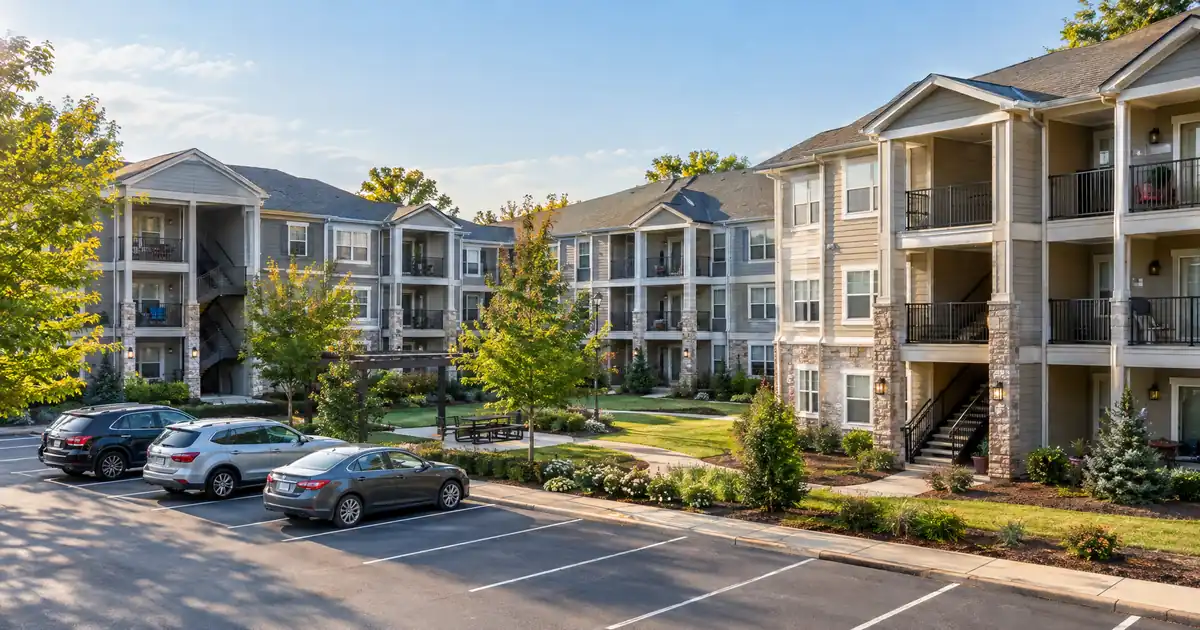
Apartment Investment Property Refinance Loan — The Quick Read: An apartment investment property refinance loan replaces an existing loan on a rental building with a new one. You might do this to get better terms, pull cash out, or exit a bridge loan. The mechanics change a lot depending on unit count. If the building has 2-4 units, it usually refinances through DSCR-style non-QM programs. These programs qualify you based on rental income. If the building has 5+ units, it becomes a true apartment building. That moves you into commercial underwriting. Commercial underwriting looks at net operating income and debt yield, not a simple rent-to-payment ratio. Getting the classification right up front matters. It sets the appraisal form, the paperwork, and the leverage ceiling for everything that follows.
Key Terms Defined
DSCR (Debt Service Coverage Ratio): This ratio compares a property’s rental income to its full monthly debt obligation. That obligation includes principal, interest, taxes, insurance, and association dues — often shortened to PITIA. A ratio above 1.00 means rent covers the payment. But it says nothing about repairs, vacancy, or management costs.
DSCR Calculator
Run the numbers in your market
Rate is an editable market assumption — the live benchmark loads when available.
Prefilled with local estimates — enter your own rent or nightly figures, taxes, insurance, and HOA for a more accurate picture.
Program parameters update from Lendmire’s centralized guideline source. Taxes and insurance are editable estimates.
Fallback assumption · General Freddie Mac market benchmark, not a Lendmire loan offer. Rent, nightly rate, occupancy, taxes, and insurance are editable estimates. Short-term rental figures are estimates only and vary significantly by season, property type, management approach, and local short-term-rental rules — confirm local regulations before relying on them. Qualifying income for short-term rentals varies by program — some use appraisal market rent, others use documented STR history or projections — and is confirmed in underwriting. Not a Loan Estimate, approval, or commitment to lend. Program availability and eligibility are subject to lender guidelines, credit approval, property review, and underwriting.
NOI (Net Operating Income): This is a commercial-scale figure. Take gross rental income and subtract operating expenses (not debt service). Lenders use NOI to value and underwrite 5+ unit buildings instead of using a simple rent-to-payment ratio.
Debt Yield: Divide NOI by the total loan amount, and you get debt yield. This calculation ignores amortization or rate assumptions. It works as a secondary leverage check on larger commercial multifamily deals. It can cap the loan amount even when DSCR and LTV both look fine.
Seasoning: This is the length of time you must hold title, or hold the current loan, before a lender will refinance against today’s value instead of original cost. Lenders set this overlay themselves on non-agency products. It’s not a fixed rule from any regulator.
Rate-and-Term Refinance: This type of refinance pays off the existing loan and adjusts the rate, term, or structure. It doesn’t meaningfully increase the loan amount. Some people call this a limited cash-out refinance.
Cash-Out Refinance: Here, the new loan amount exceeds the payoff of the old loan. You get the difference in proceeds at closing.
What Actually Happens When You Refinance an Apartment Property?
A refinance pays off your existing loan with a new one. How that new loan gets classified — rate-and-term or cash-out — sets the leverage ceiling for the rest of the file. Everything else branches from two decisions made earlier: how many units the building has, and whether cash comes back to you at closing. That includes the appraisal type, the income documents you’ll need, and the coverage-ratio math.
For a 2-4 unit residential income property, the appraisal typically runs on the Small Residential Income Property Appraisal Report. This is Fannie Mae’s Form 1025 or Freddie Mac’s Form 72. Lenders built this form specifically for two-to-four-unit buildings. It folds a rental income analysis directly into the valuation (Fannie Mae Form Library). Once a building hits 5+ units, that residential form no longer applies. Appraisal practitioners are clear on this: properties with more than four units get treated as commercial. They get valued under narrative income-capitalization reports instead of a standard residential form (Appraisal Colorado). That’s not a soft line. It’s a hard cutoff. It changes which appraiser gets the job, what documents the lender asks for, and which coverage-ratio math applies to your file.
The paperwork side splits just as sharply. Commercial multifamily underwriting for 5+ unit buildings starts with the seller’s trailing 12-month operating statement (T12) and current rent roll. Without both, underwriting is basically a guess (Tilt Analytics). On the 2-4 unit DSCR side, you need something simpler: a lease or market-rent analysis and the appraisal’s rent schedule. That feeds a simpler rent-to-PITIA calculation. If you’re researching how this differs from a standard rental refinance, start with Lendmire’s investment property refinance overview. It walks through the mechanics for single-family and small multifamily assets before scaling into larger buildings.
Rate-and-Term vs. Cash-Out: What’s the Difference?
Rate-and-term refinancing swaps your existing loan for a new one without pulling much equity out. The goal here is better structure, not more cash. Cash-out refinancing works the opposite way. The new loan amount exceeds the old payoff, and you get the difference at closing.
| Factor | Rate-and-Term | Cash-Out |
|---|---|---|
| Cash to borrower | Minimal or none | Yes, up to program limits |
| Typical purpose | Improve loan structure | Fund acquisitions, renovation, debt payoff |
| Leverage ceiling | Generally higher | Generally lower |
| Seasoning expectations | Shorter or waived in some cases | Around 6 months is a common expectation |
Across Lendmire’s wholesale network, cash-out refinances on investment properties typically top out around 75% loan-to-value. Lenders commonly expect roughly six months of seasoning before they’ll lend against current appraised value rather than original cost. No regulator sets that seasoning window. Lenders set it themselves because these are non-QM, non-agency products. That means you should always confirm the exact figure against a given program’s current guidelines rather than assume it. If you’re weighing whether pulling equity makes sense for a specific building, check Lendmire’s apartment investment property refinance financing page alongside your own numbers.
Purchase-side leverage runs a bit higher than cash-out. Most purchase files land at 75%-80% LTV. Select high-leverage purchase programs reach 85% LTV for borrowers around a 700+ credit score. None of these purchase-side figures apply to cash-out transactions. Cash-out deals hold to the 75% LTV ceiling described above no matter your credit profile. The gap between purchase and cash-out leverage exists for a plain reason. Refinances against appreciated value carry more valuation uncertainty than a fresh purchase price that a buyer and seller already agreed to.
How Does DSCR Qualification Actually Work Here?
DSCR lender review compares your monthly rental income to the full monthly debt obligation. It doesn’t measure profitability. Clearing 1.00 is not the same as positive cash flow. Repairs, vacancy, property management, utilities, and capital expenses all sit outside the ratio. That’s why a property that clears 1.00 can still lose money in a given month.
Most standard DSCR programs across the network build around a 1.00x coverage benchmark. That means rent covers the full payment at that level. But 1.00 is a floor for select programs only — never a universal standard. Some lenders in the network will review deals below 1.00 with adjusted leverage and terms. A few will consider no-ratio structures. These are generally reserved for borrowers who already own a primary residence, where the property’s rent isn’t the qualifying factor at all. Neither path is guaranteed. Both come with tradeoffs in leverage and pricing that a straightforward 1.20x file wouldn’t face.
Credit matters more than most investors expect going in. A 620 floor exists in parts of the network. But most programs want something closer to 660. A 700+ score generally unlocks the strongest leverage tiers, including the 85% LTV purchase programs mentioned above. A larger down payment lowers your monthly obligation and can lift the DSCR ratio. But it never overrides a credit floor, a reserve requirement, or a property eligibility rule. The cleanest files clear two separate tests at once: enough equity in the deal, and enough rental coverage on the income side. One without the other still creates friction.
For a fuller walkthrough of how DSCR mortgage broker review works across property types, check Lendmire’s complete DSCR loans guide. It covers the mechanics in more depth than fits here.
Where Does Debt Yield Come In on Larger Buildings?
Debt yield is a secondary leverage check. You get it by dividing net operating income by the total loan amount. It matters more as building size and unit count grow. It can cap a loan amount independent of both DSCR and appraised value. Debt yield doesn’t reference interest rate or amortization assumptions. That makes it behave differently than a coverage ratio tied to a specific loan structure.
An industry example shows how this works. Say a lender requires a minimum 8% debt yield on a multifamily property with $750,000 in NOI. The maximum loan amount comes out to $9,375,000 ($750,000 divided by 0.08). That number holds regardless of what the appraisal says the property is worth or what a straightforward LTV calculation would allow (Primior). Most competitors covering apartment refinancing skip this piece entirely. But it’s the reason a property can pass its DSCR test and its LTV test, and still see the loan amount trimmed on the commercial side.
This is squarely a larger-multifamily phenomenon. A standard 1-4 unit DSCR file qualifies on rent-to-PITIA math and has no equivalent debt-yield floor sitting underneath it. Debt yield only becomes relevant once a building has crossed into true commercial-scale territory.
The BRRVR Exception: Delayed Financing
Delayed financing lets a cash buyer refinance sooner than the standard seasoning window would normally allow. But the recoverable loan amount is capped at documented cost basis, not current appraised value. That distinction matters if you’re running a buy-rehab-rent-refinance strategy on small multifamily properties.
In practice, this means the cash-out amount can’t exceed the documented purchase price plus closing costs plus receipted renovation costs. It recovers what you already put into the deal. It doesn’t let you cash out forced appreciation ahead of schedule (Crowdfunded Wealth). Say you bought a fourplex in cash, put a modest sum into renovations with receipts, and now want to refinance before the standard seasoning window closes. You can generally recover that documented basis. But appreciation created by the renovation above that cost basis still requires the full standard seasoning period to access. It’s a narrower tool than “instant equity access.” Still, it’s real, and it’s the exception that lets recycled-capital investors move faster than the default timeline allows. If you’re comparing this against a standard hold-and-refinance path, check Lendmire’s page on refinancing an investment property for the baseline comparison.
What About Prepayment Penalties?
Non-QM apartment refinance loans don’t fall under the three-year prepayment-penalty cap that applies to Qualified Mortgages, because they sit outside that framework entirely. A step-down structure is the standard shape for these penalties across the industry. Lenders commonly write this as 5-4-3-2-1: paying off the loan in year one costs 5% of the balance, year two costs 4%, and so on down to zero (a market source). DSCR loans are business-purpose and non-agency, so the Fannie Mae and Freddie Mac selling guides simply don’t apply. Lenders aren’t bound by the QM prepayment cap (Crowdfunded Wealth). Structures and lengths vary by lender in the network. If you’re planning an early exit or a future refinance-of-the-refinance, confirm the exact step-down structure before locking into a specific program.
DSCR loans are built for non-owner-occupied investment properties. Because they’re business-purpose investor loans, lenders review them differently than a standard owner-occupied mortgage. That’s also why these loans fall outside the Truth in Lending Act’s disclosure timelines. There’s no Loan Estimate, no Closing Disclosure, and no three-business-day rescission period the way there is on an owner-occupied mortgage. That’s a plain exemption, not a shortcut.
A Practitioner’s Read on What Actually Slows These Files Down
Across files that come through the wholesale network, the most common friction point isn’t the DSCR math. It’s the unit-count classification getting assumed instead of confirmed. Say an investor refinances a building they’ve owned for years and describes it loosely as a “small apartment building.” The file can get routed toward a residential appraisal before anyone confirms whether it’s actually five units instead of four. That single miscount can send the appraisal order to the wrong form entirely and add real time to the file. The second most common friction point is seasoning. Borrowers sometimes treat it as a fixed number they remember from a prior deal. But lenders set it individually, and it can shift based on how much value has been created since acquisition. Confirming both of these up front — unit count and current seasoning expectations — saves more headaches than any amount of rate-shopping later.
Loan Sizes, Terms, and Reserves Investors Should Expect
Standard DSCR programs across the network generally run up to $3,000,000. Smaller-balance deals route through select lenders that work that end of the market. Above roughly $2,500,000, the network generally holds to 30-year fixed structures rather than shorter or adjustable terms. Still, extended 40-year terms and interest-only periods are available through select lenders if you want lower monthly obligations up front. Adjustable-rate structures exist too, for investors who prefer them.
Reserve requirements vary by lender, leverage, loan size, and transaction type. A common baseline runs around six months of PITIA. Conservative rate-and-term files at modest leverage under $1,500,000 sometimes see reserves waived entirely. Loans above that threshold typically step up to around nine months instead. None of these are fixed law. They’re guidelines that shift file-to-file. That’s why every scenario ultimately gets underwritten individually rather than approved off a generic table.
State overlays exist too. Connecticut, Florida, Illinois, and New Jersey purchases generally cap near 75% LTV. Overlay-state deals more broadly tend to cap around $2,000,000 regardless of what a national program would otherwise allow. And a few property types fall outside these programs altogether. Manufactured homes (single- and double-wide), log homes, and barndominiums aren’t offered through the network’s DSCR programs, no matter their unit count.
If you’re exploring how a cash-out on a small multifamily building might work in practice, look at Lendmire’s apartment investment property refinance page for a closer look at that specific structure. Lendmire’s apartment investment property refinance-finance overview covers the financing side in more depth.
Titling, Entities, and Tax Treatment
How you title a property — individually or through an LLC — affects paperwork and program eligibility more than it affects the underlying coverage-ratio math. Most DSCR programs in the network accommodate LLC-held title, subject to program eligibility. Tax treatment can depend on how you use the funds and how you hold the property. Keep clear records and speak with a qualified tax professional before relying on any deduction.
Frequently Asked Questions
Does a 4-unit building refinance the same way as a 6-unit building?
No. A 4-unit property qualifies for the Small Residential Income Property Appraisal Report. It typically routes through DSCR-style underwriting on rent-to-PITIA math. A 6-unit building crosses into commercial territory entirely — narrative appraisal, NOI-based valuation, and potentially a debt-yield floor that a 4-unit file never faces.
Can I refinance an apartment building that’s currently free and clear?
Yes. A free-and-clear property often has an easier path since there’s no existing loan payoff to factor into the classification. The refinance would typically get treated as a cash-out transaction, since the entire new loan amount counts as proceeds to you. It’s subject to the same 75% LTV ceiling and seasoning expectations that apply to any cash-out file.
What happens if my building has mixed residential and commercial space?
Lenders evaluate mixed-use buildings individually. The residential-versus-commercial appraisal question typically hinges on unit count and how the income gets generated across the building. This is exactly the kind of file where confirming classification early — before ordering an appraisal — saves time down the line.
Can I blend short-term and long-term rental income on the same refinance?
Some lenders in the network will consider blended income. But short-term rental programs carry their own separate leverage and coverage requirements. Short-term rental rules can vary by city, county, HOA, and property type. Confirm local rules before relying on projected rental income from that source.
Does owning the property through multiple LLC entities complicate a refinance?
It can add documentation steps. But most DSCR programs in the network accommodate entity-held title, subject to program eligibility. The bigger factor is usually whether the entity structure creates any confusion about who controls the property and who’s signing for the loan. Clean, simple entity documentation moves faster than a layered ownership structure.
About Lendmire
Lendmire, NMLS# 2371349, is a mortgage broker that arranges DSCR investor loans through select lenders across a 41-market footprint, including Washington, D.C. Lendmire doesn’t fund, underwrite, or approve loans directly. Every file gets reviewed individually against a given lender’s current guidelines. If you’re weighing rate-and-term against cash-out on a specific building, call 828-256-2183 or request a quote directly to compare structures side by side. Scotsman Guide named Lendmire a Top Mortgage Workplace in both 2025 and 2026.
No loan is guaranteed, and nothing here is a commitment to lend. Every scenario described here is subject to lender approval and to borrower, property, and program guidelines that can change without notice. This article is general information only and is not financial, legal, or tax advice.
Get Started
Ready to find the right loan for you?
In about 30 seconds you can review financing options available for your home or investment property. No commitment required.
Informational only. Not a Loan Estimate, approval, or commitment to lend. Program availability and eligibility are subject to lender guidelines, credit approval, property review, and underwriting.
References
1. Fannie Mae Form 1025 / Freddie Mac Form 72 — Small Residential Income Property Appraisal Report
2. Appraisal Colorado — Small Residential Income Property Appraisal Report Scope
3. Tilt Analytics — Multifamily Underwriting Step-by-Step Guide
4. Primior — Understanding Debt Yield
5. Crowdfunded Wealth — How to Refinance a DSCR Loan
This article is part of Lendmire’s DSCR loan program — full qualification details, guidelines, and scenarios live on the program page.
Related reading: Apartment Investment Property Refinance Mortgage Loan · Apartment Investment Property Refinance Finance · Can I Refinance A DSCR Loan?
Brandon Miller
Founder & CEO, Mortgage Loan Originator, Lendmire LLC
- Mortgage Loan Originator · NMLS# 1129696 · Verify on NMLS Consumer Access
- North Carolina Real Estate Broker · License# 343312 · Verify on NCREC
- North Carolina Insurance Producer · License# 19053198 · Property, Casualty, Life, Health · Verify on NAIC SBS
- Lendmire LLC · Firm NMLS# 2371349 · Verify firm licensure
Required disclosures. Lendmire (NMLS# 2371349) operates as a licensed mortgage broker, not a direct lender or depository. The discussion in this article is general in nature and should not be relied upon as financial, legal, or tax advice — every investment scenario is unique and should be reviewed by a qualified professional. Any loan inquiry is subject to lender underwriting, and this article is not a commitment to lend or a guarantee of approval. Mortgage rates, loan terms, and program guidelines vary by borrower, property, and state, and may change without notice. Equal Housing Opportunity. Verify licensure at NMLS Consumer Access.