
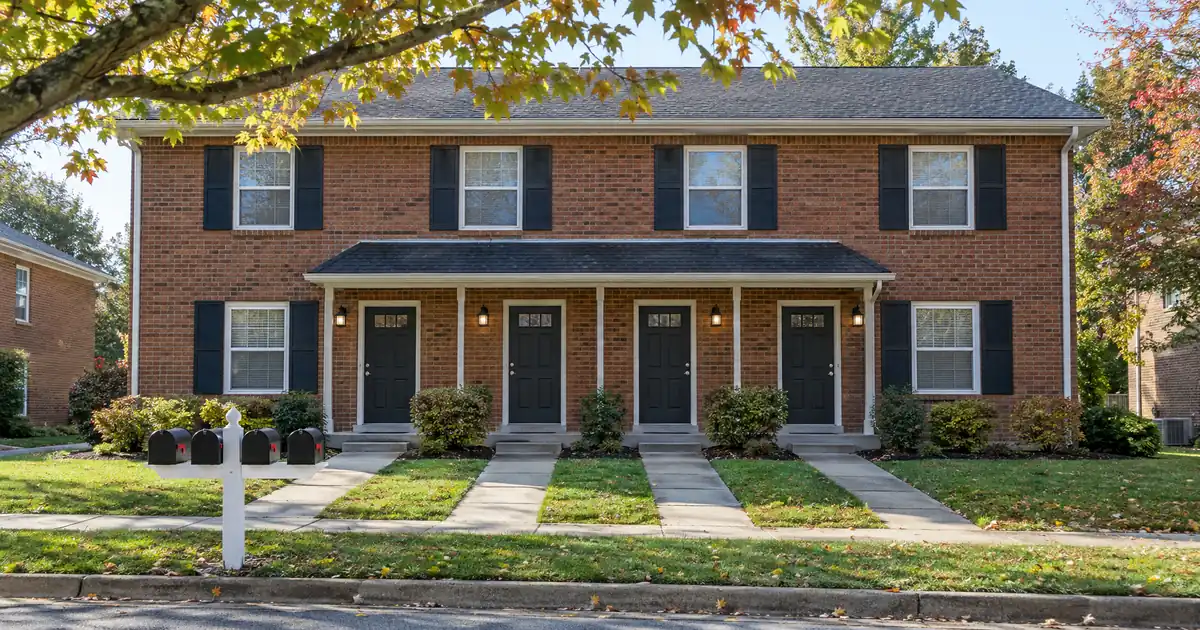
The Quick Read: A fourplex with one empty unit can still support a DSCR rent roll, because the empty door goes on the roll as vacant and the lender credits it at the appraiser’s market rent or, under some programs, at zero. Occupied units are typically credited at the lower of the lease or market rent. The credited rents are added up and divided by PITIA (principal, interest, taxes, insurance, and association dues).
- List all four units. Mark the empty one “Vacant” with no tenant and no lease dates.
- Keep contract rent and market rent in separate columns, plus a third “credited rent” column.
- Back every leased line with an executed lease and matching deposits.
- Expect the vacant unit’s credit to depend on the program, the transaction, and the unit’s condition.
- Clearing the coverage number is not the same as positive cash flow.
Most fourplex investors with a vacancy ask the wrong first question. They ask whether a lender will “allow” the empty unit. The better question is how each program in a wholesale network credits it, because the answer moves the ratio by a lot. Lendmire arranges DSCR investor loans through select lenders across 41 markets, including Washington, D.C., and the vacant-unit question is one of the most common places files diverge. This piece walks through the build, step by step, and shows where the general rule breaks. The complete DSCR loans guide covers the wider program picture.
DSCR Calculator
Run the numbers in your market
Rate source: Freddie Mac 30-yr average via FRED® — Federal Reserve Bank of St. Louis · effective Oct 15, 2026
Prefilled with starting assumptions — enter your own rent or nightly figures, taxes, insurance, and HOA for a more accurate picture.
Program parameters update from Lendmire’s centralized guideline source. Taxes and insurance are editable estimates.
As of Oct 15, 2026 · General Freddie Mac market benchmark, not a Lendmire loan offer. Rent, nightly rate, occupancy, taxes, and insurance are editable estimates. Short-term rental figures are estimates only and vary significantly by season, property type, management approach, and local short-term-rental rules — confirm local regulations before relying on them. Qualifying income for short-term rentals varies by program — some use appraisal market rent, others use documented STR history or projections — and is confirmed in underwriting. Not a Loan Estimate, approval, or commitment to lend. Program availability and eligibility are subject to lender guidelines, credit approval, property review, and underwriting.
Key Terms Defined
Rent roll: A unit-by-unit report of tenant, lease dates, rent, deposit, and occupancy status; G3 Manage’s rent roll explainer describes the same core fields.
Contract rent: The rent written in an executed lease.
Market rent: The appraiser’s opinion of what a unit would rent for today, supported by comparable rentals.
Credited rent: The rent figure the lender actually counts for a unit when it calculates coverage.
PITIA: Principal, interest, taxes, insurance, and association dues. This is the denominator in the coverage ratio.
DSCR: The debt service coverage ratio, which here means credited monthly rent divided by monthly PITIA.
Rent-ready: A unit that is clean, repaired, and listable today with no work outstanding.
What Is the Lender Actually Testing?
The lender tests whether the building’s credited rent covers its full monthly obligation. DSCR loans are designed for non-owner-occupied investment properties. Because they are business-purpose investor loans, they are reviewed differently from a standard owner-occupied mortgage. The loan is reviewed primarily on property-level rental income covering the payment, subject to lender guidelines.
Three pieces matter on a fourplex:
1. The numerator. Credited rent summed across all four units.
2. The denominator. PITIA, not just principal and interest.
3. The threshold. 1.00 is where select programs start. Stronger ratios open better pricing and leverage. Available through select lenders in the network, a separate path takes coverage below 1.00 with leverage and terms adjusted.
The whole question of a vacant unit lives in the numerator. Rates are not quoted here. The appraisal form’s own instructions direct the appraiser to reconcile indicated market rents into a market rent opinion for each unit. That is why an empty unit is underwritable at all. The appraisal supplies a rent opinion where no lease exists.
One boundary matters here. The form is only an appraisal tool. DSCR rules come from the lender and investor, not from the agencies. Even HUD’s Mortgagee Letter 2023-17, written for owner-occupant FHA loans, relies on the same form for proposed rent on 2-4 unit properties. It shows the form is the standard tool when rent history is missing. It does not set DSCR rules.
Step 1: Build the Unit-by-Unit Roll
Start with four rows, one per unit. There is no single required template, but a usable roll carries these columns:
| Column | What goes in it | Why it’s there |
|---|---|---|
| Unit | Number or label | Ties to the appraisal |
| Beds/baths, sq ft | Unit description | Supports rent comps |
| Tenant | Name, or “Vacant” | Occupancy status |
| Lease start/end | Dates from the lease | Shows term and expiry |
| Contract rent | Monthly rent per lease | What the tenant owes |
| Deposit | Amount held | Reconciles to the lease |
| Market rent | Your estimate, later the appraiser’s | Used for the lower-of test |
| Credited rent | Lower of contract or market | What coverage uses |
For the vacant unit, write “Vacant” in the tenant field. Leave lease dates blank. Leave the contract rent column empty or zero. Do not type an aspirational rent into the in-place column. That is the most common formatting mistake, and it makes the roll read like a claim instead of a record. The target rent belongs in the separate market rent column.
Step 2: Tie Every Leased Line to Proof
A rent roll is a claim until documents back it up. Underwriters compare the roll against executed leases and against deposits. A typical package for the three occupied units includes:
- Executed leases for each unit
- The rent roll itself, dated currently
- Bank statements showing deposits that match each lease amount
- On a purchase, estoppel statements or lease assignments from the seller, where the transaction calls for them
Disagreements between the roll, the leases, and the deposits cause rework. A manager’s summary used in place of the lease, a concession that never made it onto the roll, or a mix of contract and collected rent in one column all invite questions. Expired and month-to-month leases generally fall back to market rent, and rent that cannot be documented gets treated as if the unit were vacant.
For the empty door, the proof is different. Keep a short status note (turnover date, work completed, listing live), listing history, photos showing rent-ready condition, and the rent comps you used. For a deeper look at assembling documents across several buildings, Lendmire’s piece How to Build a Rent Roll and Lease Package for a Portfolio DSCR Loan goes further than this single-building walk-through.
Step 3: How the Vacant Unit Gets Its Number
The appraiser assigns market rent to each unit separately, including the empty one. The appraiser cannot simply assume the vacant unit follows the strongest unit, so rent-ready condition and good comparable rentals both matter. A tired unit with no listing history draws a more conservative opinion.
Then the lender picks which rent counts. Across the programs Lendmire places files with, the conventions look like this, subject to lender guidelines:
- Leased units: credited at the lower of the lease or market rent.
- Vacant unit: credited at appraised market rent in many programs, and at zero in others until it is leased.
- Above-market lease: does not raise the ratio, because the credit is capped at market.
- Below-market lease: caps the credit at the lease. Signing a cheap lease just to fill the unit before the appraisal can cost you coverage.
This is where programs split, and it’s the single most useful thing to learn before choosing one. Ask the lender directly which treatment applies to a vacant unit on your transaction type.
Step 4: Sum and Divide
Add the credited rents across all four units. Divide by PITIA. That is gross rent over the full housing obligation, which is how most residential DSCR files work. Commercial explainers often divide net operating income by debt service instead, and cite coverage of 1.25 or higher. That is a different lane. It is not the residential investor-loan floor discussed here.
Illustrative Math: Market Rent Versus Zero
Take a fourplex with four equal-rent units that covers its payment at 1.20x when fully rented. This is plain arithmetic, illustrative and not a market fact.
- Empty unit credited at market rent: coverage stays about 1.20x.
- Empty unit credited at zero: credited rent falls to 75% of the total, so coverage is 1.20 × 0.75 = 0.90x.
Same building, same payment, same appraiser. The only change is the program’s treatment of one door. If the zero treatment pulls the file below 1.00, a few paths may be worth reviewing. Select lenders in the network offer sub-1.00 programs with leverage and terms adjusted. Another option is moving the file to a program that credits market rent. A third is leasing the unit first and applying afterward. Each is subject to lender guidelines, credit review, and property review.
Unequal unit mixes sharpen the point. If the empty unit is the highest-rent door in the building, the zero treatment hurts more than if it is the smallest. Run the sensitivity both ways before you pick a program.
Where the General Rule Breaks
The lower-of rule and market-rent credit are conventions, not laws. These cases bend them.
Purchase versus refinance. On a purchase, a vacant property in turnkey condition is generally workable. On a refinance, programs usually want the unit leased or an operating history, and some will accept one rent-ready empty unit in a multifamily building. Leverage on a purchase typically runs 75%-80% LTV, and a cash-out refinance tops out around 75% LTV, with about 6 months of seasoning the common expectation. Select high-leverage purchase programs reach 85% LTV with roughly a 700+ score.
Light rehab versus heavy rehab. A clean, nearly rent-ready unit can often be underwritten on market rent comps. A unit that is torn open is a different story. The practical route is usually a short-term bridge or other renovation funding first, then a DSCR refinance once the unit is finished and leased.
Owner occupancy. A fourplex where you live in one unit is not a DSCR file. These loans are for non-owner-occupied investment property. House-hacking a 2-4 unit building belongs to a different loan type. After you move out and the property becomes a pure rental, it can move to DSCR.
Mixed use. Ground-floor commercial income sits outside the residential rent schedule method. It does not count toward the Form 1025 rent figure.
Rent control. The form asks whether the property is subject to rent control, and a controlled market rent may cap the credited number.
Short-term rental units. A unit used as a short-term rental is documented with platform history, not a long-term rent schedule. Programs typically look for a 640+ score and about 12 months of hosting history. Purchase leverage tops out at 75% LTV, and cash-out refinance at 70%. Short-term rental rules can vary by city, county, HOA, and property type, so investors should confirm local rules before relying on projected rental income.
Five or more units. That is a different product lane, not a fourplex.
Property types not offered. Manufactured homes, log homes, and barndominiums are not offered in these DSCR programs.
DSCR vs. conventional financing
There are two common ways to finance an investment property, and they qualify you differently — here’s how investors weigh them.
Why investors choose it
- Qualifies on the property’s rental income — no personal tax returns, W-2s, or pay stubs needed to document income.
- No personal debt-to-income ceiling to clear, so existing mortgages and obligations don’t cap your borrowing the same way.
- Can be closed in an LLC, keeping the property inside a business entity.
- Built for scaling — not held to the limit on number of financed properties that conventional financing applies.
- Underwriting centers on the deal: generally qualifies when the rent covers the payment, a 1.00x coverage ratio being a common baseline (confirmed in underwriting).
- Designed specifically for investment property, including long-term and, where the program allows, short-term rentals.
Where it’s strong
- Often the lowest ongoing financing cost for a buyer who fully qualifies on personal income — a fit for a first property or a cost-first purchase.
Trade-offs for investors
- Requires full personal income documentation and must fit within a debt-to-income limit — salary, existing debts, and other mortgages all count.
- Typically held in your personal name rather than a business entity.
- Caps how many financed properties you can carry, which can become a ceiling as a portfolio grows.
- Evaluates you as a borrower as much as the property, which usually means more paperwork.
How investors usually choose: a first or single property often optimizes for the lowest financing cost; portfolio builders often optimize for leverage, vesting in an LLC, and scaling past conventional caps. The right answer depends on your goals, the property, and current guidelines — both paths run through select lenders in Lendmire’s wholesale network, with eligibility and terms confirmed in underwriting.
Should You Submit Now or Wait?
Wait if more than one unit is empty, if the vacant unit is not rent-ready, or if the only available program credits an empty door at zero and the math lands under 1.00. Submit now if the vacant unit is turnkey, you hold comps and a live listing, and the credited-at-market case clears the number you need.
This is a genuine toss-up for investors with one empty unit and a program that zeroes it. Leasing first costs time and carrying cost. Submitting early costs coverage or leverage. The break-even depends on how far the file sits above 1.00 with all four units rented.
A practitioner note: files with one empty door tend to go sideways at the appraisal, not at the roll. When the appraiser’s market rent for the vacant unit comes in lower than the investor’s estimate, coverage shifts and leverage choices narrow with it. Pulling three or four comparable rentals before the appraisal, and handing over the listing history, prevents most of that surprise.
What Else Counts Beyond Coverage
A larger down payment lowers the monthly obligation and can lift the ratio. It never erases leverage caps, credit floors, reserve rules, or property eligibility. The strongest files clear both tests: enough equity and enough rental coverage.
On credit, a 620 floor exists in parts of the network, most programs want around 660, and 700+ unlocks the strongest leverage tiers. Reserves vary by lender, leverage, loan size, and transaction type. About 6 months of PITIA is common, and loans above $1,500,000 typically step up to about 9 months. Standard programs run up to $3,000,000.
One caution deserves its own line. DSCR compares rent to PITIA only. Clearing 1.00 is not positive cash flow. Repairs, vacancy, management, utilities, and capex all sit outside the calculation. A fourplex can clear the number and still lose money month to month, so underwrite your own operating budget separately.
Tax treatment varies; consult a qualified professional.
Mistakes That Trigger Underwriting Questions
- Entering a hoped-for rent in the in-place column for the vacant unit
- Using a manager’s summary instead of leases
- Leaving out concessions or free-rent periods
- Mixing contract rent and collected rent in one column
- Dating the roll months before submission
- Signing a below-market lease right before the appraisal
- Assuming an above-market lease will raise coverage
Frequently Asked Questions
Does one vacant unit automatically disqualify a fourplex?
No. A turnkey vacant unit is generally workable, especially on a purchase. The real variable is how the program credits the empty door, at appraised market rent or at zero. Qualification remains subject to lender guidelines, credit review, and property review.
Can I use my own projected rent for the empty unit?
Not as the final number. The appraiser’s per-unit market rent opinion is what counts. Your estimate is useful for pre-appraisal planning and for supporting the comps you hand over, but the lender credits what the appraisal concludes.
Will a high lease on an occupied unit boost my coverage?
Usually not. On programs that apply the lower-of test, credit is capped at market rent. A lease below market, by contrast, caps credit at the lease itself.
What if I live in one of the four units?
That makes it an owner-occupied loan, not a DSCR file. DSCR programs cover non-owner-occupied investment property. Once you move out and the building is fully a rental, it can be reviewed as a DSCR candidate.
Is clearing 1.00 the same as the building making money?
No. The ratio counts rent against PITIA only. Vacancy, repairs, management, utilities, and capex sit outside it, so the property can clear the number and still run thin on actual cash flow.
If you are buying or refinancing a rental property and want to see how the numbers work, Lendmire can help you compare DSCR loan options based on the property income, credit profile, leverage, and investor goals. Reach the team at 828-256-2183 or request a quote. Programs, leverage, and terms vary by lender and borrower, and nothing here is a commitment to lend.
A fourplex gives one advantage a single-family rental never will: when one door sits empty, three others still carry rent, so the vacancy is a coverage question to solve rather than a dead file.
About Lendmire
Lendmire — NMLS# 2371349 — is a mortgage brokerage specializing in DSCR investor loans, helping arrange financing across 41 markets, including Washington, D.C., through wholesale and investor-lending channels. The model centers on property-level rental income reviewed by the lender rather than W-2 documentation, subject to lender guidelines, suiting entity-owned and multi-property investors. Lendmire holds Scotsman Guide Top Mortgage Workplace recognition for 2025 and 2026.
Get Started
Ready to find the right loan for you?
In about 30 seconds you can review financing options available for your investment property. No commitment required.
Informational only. Not a Loan Estimate, approval, or commitment to lend. Program availability and eligibility are subject to lender guidelines, credit approval, property review, and underwriting.
References
1. G3 Manage’s rent roll explainer
2. Fannie Mae (document 12376)
3. HUD Mortgagee Letter 2023-17
This article is part of Lendmire’s DSCR loan program — full qualification details, guidelines, and scenarios live on the program page.
Related reading: How to Get a DSCR Lender to Use Your Lease Rent · Can a First-Time Landlord Use Market Rent for a DSCR Loan? · Lease vs Appraiser Rent on a DSCR Loan for a First-Time Landlord
Brandon Miller
Founder & CEO, Mortgage Loan Originator, Lendmire LLC
- Mortgage Loan Originator · NMLS# 1129696 · Verify on NMLS Consumer Access
- North Carolina Real Estate Broker · License# 343312 · Verify on NCREC
- North Carolina Insurance Producer · License# 19053198 · Property, Casualty, Life, Health · Verify on NAIC SBS
- Lendmire LLC · Firm NMLS# 2371349 · Verify firm licensure
Important disclosures. Lendmire (NMLS# 2371349) is a licensed mortgage brokerage. Lendmire is not a direct lender, depository institution, or financial advisor. All loan inquiries are subject to lender underwriting; this article does not constitute a commitment to lend. Rates, terms, and program guidelines are subject to change without notice and vary by borrower profile, property type, and state. Information in this article is general in nature and is not financial, legal, or tax advice. Equal Housing Opportunity. NMLS Consumer Access: nmlsconsumeraccess.org.