
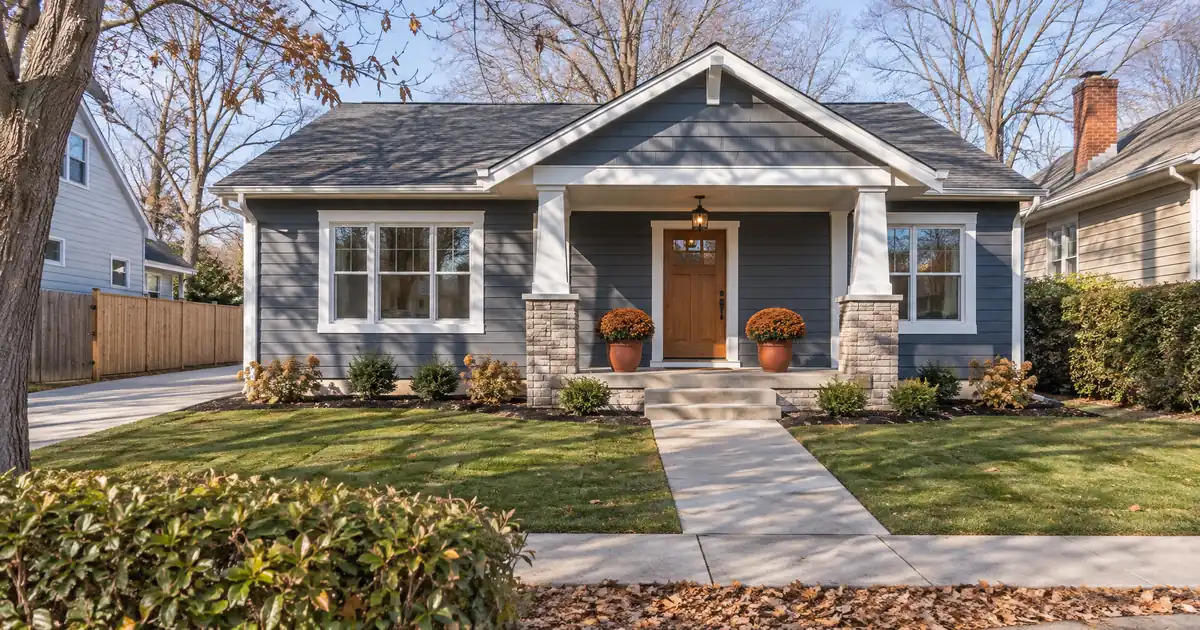
The Quick Read: Usually not while major repairs remain, because a DSCR (debt service coverage ratio) exit loan is sized on the finished, rentable property the appraiser sees, and the lender needs the house habitable, insurable, and ready to rent before it pays off the hard money loan, though small cosmetic items are sometimes tolerated.
- Major open work generally means finishing the rehab first, extending the bridge, or selling.
- Safety items, open permits, and incomplete systems stop a file even when the projected rent looks strong.
- The DSCR lender values the house as it stands, not at the after-repair value you planned.
- Seasoning matters only when the DSCR loan returns cash at closing. Finishing the rehab does not start that clock, which runs from the date title was recorded.
- Plan the exit before you buy, and test it at a conservative rent and a conservative appraisal.
A hard money loan is short-term, interest-only financing for buying or rehabbing an investment property. The long-term loan that replaces it is usually a DSCR loan. DSCR compares the property’s rent to its full monthly obligation: principal, interest, taxes, insurance, and any association dues, which together make up PITIA. The loan is reviewed primarily on property-level rental income covering the payment, subject to lender guidelines. That is why the property has to look like a rental on the day the lender checks.
DSCR Cash-Out Calculator
Run the cash-out numbers in your market
Rate source: Freddie Mac 30-yr average via FRED® — Federal Reserve Bank of St. Louis · effective Nov 5, 2026
Prefilled with starting assumptions — enter your property’s value, balance, taxes, and insurance for a more accurate picture.
Program parameters update from Lendmire’s centralized guideline source. Taxes and insurance are editable estimates.
As of Nov 5, 2026 · General Freddie Mac market benchmark, not a Lendmire loan offer. Property value, balance, taxes, and insurance are editable estimates. Maximum loan-to-value varies by lender, program, property type, and seasoning. Not a Loan Estimate, approval, or commitment to lend. Program availability and eligibility are subject to lender guidelines, credit approval, property review, and underwriting.
Why Do Lenders Want the House Finished?
A DSCR lender is being asked to treat the house as a stable rental. A house with a torn-out kitchen, an open roof, or missing safety items cannot produce a reliable rent or a reliable value. Hard money was built for that unfinished stage. The DSCR exit was built for what comes after.
Three things drive the lender’s thinking:
- Value. The lender orders its own appraisal. Your after-repair-value estimate is a planning number for you, not an input the lender adopts.
- Rent. The appraisal also produces a market-rent figure. For a single-family home that comes from a rent schedule, Form 1007. For a two- to four-unit building it comes from an operating income form, Form 1025. The loan terms themselves come from the DSCR program.
- Insurability. A house with open hazards, water intrusion, or an unfinished roof can be difficult to insure, and the lender will not close without coverage in force.
The stall point many investors miss is rent. A finished house with no tenant can still use the appraisal’s market-rent schedule, so a signed lease is helpful but not required. A house that needs real repairs before it would rent at market has neither a lease nor a defensible market rent.
What Does the Appraiser Actually Look At?
The appraiser documents condition, and the report can come back subject to repairs. A subject-to report has to be cleared before the loan funds. An as-is report values the house in its current state. A subject-to-completion report values it assuming the work gets done, and the lender will usually want proof of completion before it funds.
Appraisers describe condition on a six-point scale. Fannie Mae’s published condition ratings run from C1 (new) to C6 (the house has severe deficiencies affecting safety or livability). Under those definitions, a C6 property is not eligible until the repairs are made. DSCR lenders are not bound by that guide, and their own overlays set the real limits. Still, the scale is useful shorthand for how an appraiser and a lender think about condition. A house with heavy deferred maintenance sits at the bad end of it.
Proof of completion usually comes through a completion certification. This is commonly Form 1004D, in which the appraiser confirms the repairs were finished. HUD’s guidance on the form describes its purpose as updating an appraisal or certifying that completion occurred.
How Much Unfinished Work Is Too Much?
Cosmetic items are often tolerable. Safety, habitability, and permit items are not. Across the wholesale network, the exact tolerance varies by lender, so there is no single threshold to quote. A plain-language test works better than a dollar line.
Ask whether a stranger could move in the day after closing without a safety or legal problem. If yes, the remaining items are probably cosmetic. If no, the file likely stalls.
| Remaining work | Likely exit path | What the lender looks at | Main risk |
|---|---|---|---|
| Paint touch-ups, minor trim | DSCR exit, often fine | Rent, value, condition notes | Appraiser flags items |
| Appliances or fixtures missing | Finish first, then apply | Habitability, market rent | Subject-to report |
| Open permits, unfinished systems | Stay in bridge or extend | Permit status, insurability | Appraisal stops |
| Roof, structure, water intrusion | Finish, extend, or sell | Condition rating, safety | Ineligible as-is |
| Vacant but fully finished | DSCR exit on market rent | Appraisal market-rent schedule | Lease-up stall |
Items that usually block closing
- Open permits or unpermitted additions.
- A roof at the end of its useful life, or active water intrusion.
- Missing safety devices, broken handrails, or visible mold.
- Utilities that are not connected or systems that do not run.
- Missing certificate of occupancy where one is required.
Items that often do not block closing
- Minor paint, caulk, or landscaping touch-ups.
- Small trim or hardware work.
- Cosmetic punch-list items an appraiser notes without calling them safety concerns.
The second list depends on the lender and the appraiser’s wording. Treat it as a likely tolerance, never a promise.
What Does the Numbers Test Look Like?
The DSCR loan is sized by the lower of two limits: what the appraisal supports and what the rent can carry. Both have to clear. A strong rent cannot rescue a low appraisal, and a strong appraisal cannot rescue weak coverage.
Here are the program ranges as the network generally works them, always subject to lender guidelines and varying by borrower, property, and loan scenario:
- A DSCR cash-out refinance on a standard rental tops out around 75% LTV. About 6 months of seasoning, measured from title recording, is the common expectation.
- A DSCR rate-and-term refinance of an investment property can reach higher leverage, up to 85% LTV, but it returns no cash at closing.
- Coverage of 1.00 is where many select programs start. A separate select-lender path takes coverage below 1.00, with leverage and terms adjusted.
- A 620 credit score is the floor in parts of the network. Most programs want around 660, and 700 or higher opens the strongest leverage tiers.
- Reserves vary. About 6 months of PITIA is common, and loans above $1,500,000 typically step up to about 9 months.
The break-even question is simple. Take your hard money payoff plus the costs of the exit, then divide by the leverage cap. The appraised value has to reach that number, or the refinance needs cash from you. At a 75% cash-out cap, the appraised value must be well above the payoff, not just equal to it. A house that appraises low because it is unfinished can turn a planned cash-out into a refinance that needs your cash. Final terms depend on lender guidelines, property type, leverage, and the borrower’s complete credit picture.
A coverage ratio at or above 1.00 also does not mean the property makes money. It only means rent covers PITIA. Repairs, vacancy, management, utilities, and capital expenses sit outside the calculation.
Two Scenarios: Nearly Done and Midway
Picture a duplex in a rehab that is nearly complete. The hard money loan is a 12-month term, and the work is finished except paint and a few hardware items. A market-rent schedule supports coverage around 1.2x on the new loan. The appraisal supports a payoff at modest leverage. The investor finishes the punch list before ordering the appraisal, so the report reads as a rentable property. This file has a plausible path to a DSCR refinance, subject to lender guidelines and credit approval.
Now run the numbers on a house that is only midway. The kitchen is gutted, the permit for the electrical work is still open, and the bridge matures soon. The investor hopes the DSCR lender will value the house at its finished worth. It will not. The appraisal comes back at the as-is value, which is far below the payoff plus costs. Coverage on the projected rent is irrelevant because no one can rent the house. The investor’s real options are to extend the bridge, finish the work with fresh capital, or sell.
The difference between those two files has little to do with rent. It comes down to whether the property can be appraised as a rental on the day the lender checks.
What Is the Decision Order If the Loan Is About to Mature?
Work down this ladder in order. Hard money terms commonly run 6 to 18 months, interest-only, with no prepayment penalty, though terms vary by lender, property, and experience.
1. Finish the work first. If the remaining scope is small, completing it before applying protects both value and rent conclusions.
2. Extend the bridge. An extension costs money, but it buys time to finish, lease, and season.
3. Take a payoff-only DSCR loan. If the house is finished but seasoning is short, a refinance with no cash back may fit. Eligibility and any seasoning expectation depend on the lender.
4. Wait for seasoning, then cash out. Once about 6 months have passed since title recording, a DSCR cash-out at up to 75% LTV may be on the table, subject to lender guidelines.
5. Sell. If the numbers do not work, selling ends the carry cost.
Selling right after a DSCR refinance deserves one caution. Some DSCR programs carry prepayment penalties, and others do not. Compare that term before choosing a program if a sale is a real possibility.
Overruns hurt because bridge interest keeps accruing while you finish. Plan the exit before you buy. Test it at a conservative rent and a conservative appraisal rather than at the hoped-for after-repair value. Lendmire’s piece DSCR Loan vs Hard Money for a Rental That Needs Repairs walks through that comparison.
How Do You Sequence the Exit?
Count backward from maturity, and finish before you apply. A workable order looks like this:
1. Finish the punch list, including every safety item, and close out permits.
2. Gather the bridge note and draw history, rehab invoices, a payoff letter, and entity, title, and reserve documents.
3. Place a tenant, or plan on the appraisal’s market-rent schedule if the house will be vacant but finished.
4. Order the appraisal only once the house reads as a finished rental.
5. Apply with enough room before maturity to absorb a low appraisal and a reconsideration request.
Start earlier than feels necessary. A low appraisal can be challenged with stronger comparable sales, but that step needs time. The process also needs a calendar cushion for insurance and title items. Many investors in this position look at a hard money exit refinance before the bridge term is half spent, so they can see the real leverage and coverage before the pressure builds.
What Do People Get Wrong About This?
The Myth: the lender will value the house at its after-repair value. The lender values the house as it stands. A stale after-repair estimate does not carry over.
The Myth: finishing the rehab or signing the lease starts the seasoning clock. It does not. Seasoning runs from the recorded purchase.
The Myth: strong rent overrides condition. An unfinished property or open permits can stop the appraisal no matter how good the rent looks.
The Myth: a DSCR loan skips the appraisal. Lenders in the network order an appraisal, because it supports both value and market rent.
The Myth: clearing 1.00 means positive cash flow. It means rent equals the PITIA payment, nothing more.
Key Terms Defined
As-is appraisal: an appraisal that values the house in its current condition, with no assumption of finished work.
Subject-to-completion appraisal: an appraisal that values the house assuming repairs get completed, which the lender then verifies before funding.
Seasoning: the waiting period between buying a property and refinancing with cash out, measured here from title recording.
Bridge loan: short-term financing, such as hard money, that carries you until the permanent loan replaces it.
Extension: a paid agreement to lengthen the term of the bridge loan beyond its original maturity.
PITIA: principal, interest, taxes, insurance, and any association dues, the full monthly obligation the rent has to cover.
Frequently Asked Questions
Can I finish the repairs after the DSCR loan closes?
Generally not. The lender wants the work finished and proven before it funds, because the loan is sized on the property as it will be appraised. Appraisers can write a report subject to completion, but the repairs still have to be verified before closing.
Does the house need a tenant before I apply?
Not always. A finished, vacant house can be reviewed on the appraisal’s market-rent schedule. A signed lease can still make the file easier to review, but it is not a requirement.
What if my hard money loan matures before the rehab is done?
Extending the bridge is the usual first move, since an extension keeps the file alive while you finish. A payoff-only DSCR loan with no cash back is another path once the house is finished. Selling is the last resort.
Does a strong rent let me skip finishing the work?
No. Rent and condition are tested separately. Open permits or unfinished work can stop the appraisal, regardless of coverage.
Can coverage below 1.00 still work on a finished house?
Sometimes. A select-lender path in the network accepts coverage below 1.00, with leverage and terms adjusted. Eligibility depends on the borrower, the property, and lender guidelines.
If you are buying, rehabbing or refinancing an investment property on a short timeline and want to see how the numbers work, Lendmire can help you compare hard money options based on the project, the exit plan, leverage, and your goals. As a broker with a DSCR platform across 41 markets, including Washington, D.C., Lendmire arranges these loans through select lenders in its wholesale network. For the full picture, see the complete DSCR loans guide.
About Lendmire
Lendmire is a non-QM mortgage brokerage (NMLS# 2371349) arranging DSCR investor loans in 41 markets, including Washington, D.C., through wholesale and investor-lending channels. DSCR loans are evaluated by the lender on rental income rather than personal income, subject to lender guidelines — a fit for LLC-owned portfolios, self-employed investors, and operators scaling beyond conventional loan caps. Recognized as a Scotsman Guide Top Mortgage Workplace in 2025 and 2026.
Get Started
Ready to find the right loan for you?
See your offer in seconds. No credit pull, no obligation.
Informational only. Not a Loan Estimate, approval, or commitment to lend. Program availability and eligibility are subject to lender guidelines, credit approval, property review, and underwriting.
References
1. Fannie Mae Selling Guide B4-1.3-06: Property Condition and Quality Construction Improvements
This article is part of Lendmire’s hard money loan program — full qualification details, guidelines, and scenarios live on the program page.
Related reading: How to Replace Private Money With a Conventional Cash-Out Refinance · How to Get an Investor Cash-Out Refinance in TX, CA, NJ or FL · Can You Still Do a Hard Money Cash-Out Refinance If the Appraisal Comes in Low?
Brandon Miller
Founder & CEO, Mortgage Loan Originator, Lendmire LLC
- Mortgage Loan Originator · NMLS# 1129696 · Verify on NMLS Consumer Access
- North Carolina Real Estate Broker · License# 343312 · Verify on NCREC
- North Carolina Insurance Producer · License# 19053198 · Property, Casualty, Life, Health · Verify on NAIC SBS
- Lendmire LLC · Firm NMLS# 2371349 · Verify firm licensure
Important disclosures. Lendmire (NMLS# 2371349) is a licensed mortgage brokerage. Lendmire is not a direct lender, depository institution, or financial advisor. All loan inquiries are subject to lender underwriting; this article does not constitute a commitment to lend. Rates, terms, and program guidelines are subject to change without notice and vary by borrower profile, property type, and state. Information in this article is general in nature and is not financial, legal, or tax advice. Equal Housing Opportunity. NMLS Consumer Access: nmlsconsumeraccess.org.