
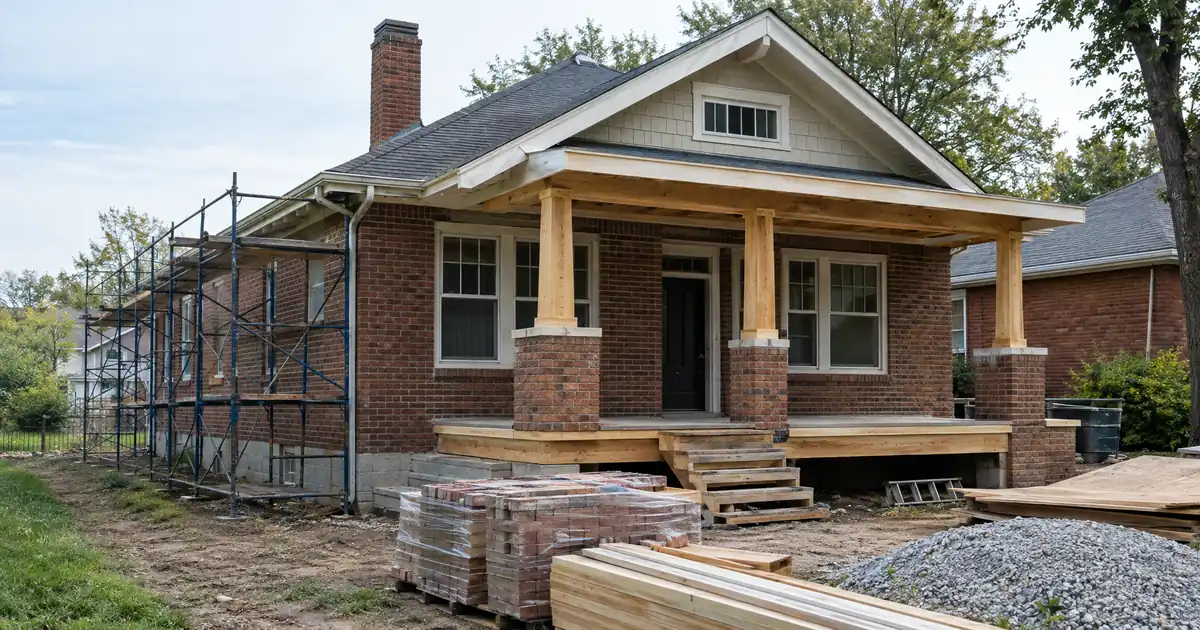
The Quick Read: A conventional cash-out refinance can replace a hard money loan, but only when the property has been owned long enough, appraises high enough, and you pass personal income and debt tests that hard money never asks about. The cash you walk away with is usually much smaller than the headline leverage suggests.
- Conventional lenders review your file on personal income, credit and debts, while hard money looks at the property, the plan and the exit.
- Net proceeds equal appraised value times the maximum leverage, minus the hard money payoff, minus closing costs.
- A hard money purchase usually fails the delayed-financing exception because the loan is a lien on the property, so you generally face a seasoning wait.
- A low appraisal can turn a cash-out into a cash-in.
- When conventional underwriting does not fit, a DSCR refinance that qualifies primarily on property-level rental income covering the payment, subject to lender guidelines, is the usual fallback.
Why Cash-Out Refinance for Hard Money Shoppers Is a Different Problem
Most cash-out refinance advice is written for a homeowner with a paid-down mortgage. A hard money borrower arrives with a short-term, interest-only loan, a fresh purchase or rehab, and a maturity date approaching. That changes almost every part of the math.
On a Lendmire hard money file, the loan is sized to project cost and after-repair value. Terms typically run 6 to 18 months, interest-only, with no prepayment penalty. Leverage, terms and eligibility vary by lender, property, and experience, and nothing here is a commitment to lend. Because the loan is short and carries no prepayment penalty, the exit is the whole plan, and a conventional cash-out refinance is one candidate exit.
The question is whether that candidate works for your deal. The answer depends on three tests. The first is time, meaning whether the property has been owned long enough. The second is value, meaning whether the appraisal supports the leverage you need. The third is you, meaning whether your personal finances pass underwriting.
How Does Conventional Underwriting Differ From Hard Money?
Conventional underwriting qualifies the borrower first and the property second. Hard money reverses that order. This is the single biggest adjustment for a hard money shopper, so here is the side-by-side, with a DSCR column because that is the path most investors end up weighing next.
| Factor | Hard Money | Conventional | DSCR |
|---|---|---|---|
| Reviewed on | Property, plan, exit | Your income and debts | Rent versus full payment |
| Term shape | 6-18 months, interest-only | Long-term amortizing | Long-term, 30-year fixed spine |
| Cash-out leverage | Up to 65% of value | Lower than purchase leverage | About 75% LTV, standard rentals |
| Paperwork | Project-focused | Traditional personal-income documentation, W-2s, debts | Property-focused |
| Prepayment penalty | None on this program | Varies | Varies by program |
The hard money figure applies to cash-out and rate/term refinances on the hard money program, and it varies by lender, property, and experience. The DSCR figure is a typical network ceiling on a cash-out of a standard rental and varies by lender and file.
A conventional file asks for the documents Bankrate’s BRRRR guide lists as qualification factors: credit score, debt-to-income ratio (your monthly debts divided by your monthly income), equity retained after the cash-out, and seasoning. Seasoning is the waiting period a lender wants between buying a property and refinancing it.
The Conventional Checklist: Can You Qualify?
Run this list before you count on a conventional exit. Failing any one item can push you to another path.
Time owned. Market surveys report that conventional cash-out refinances typically carry a six-month seasoning requirement, per Bankrate. The DSCR programs we place files with commonly expect about six months as well. Some lenders make exceptions once a rehab is complete and the property is eligible, but those exceptions vary by lender and should be confirmed early.
Credit. Bankrate describes 620 as the general conventional minimum. In our network, a 620 floor exists in parts of the network, most programs want around 660, and 700 or higher unlocks the strongest leverage tiers. On the hard money side, 620 is the minimum score, with added conditions below 660.
Debt-to-income. Bankrate reports that lenders often cap debt-to-income at 43%. Here is where many investors get surprised. Every financed rental you own adds to your debts, and a self-employed investor’s write-offs shrink the income the lender counts. Strong rents do not rescue a failed ratio in conventional underwriting.
Equity left after the cash-out. Bankrate also reports that most lenders require about 20% equity retained. That requirement stacks on top of the cash-out leverage cap.
Property type and units. Multi-unit rentals often face lower leverage caps than single-family homes. Our hard money collateral is non-owner-occupied residential property of one to four units.
Entity vesting. Hard money loans often sit in an LLC. Conventional lenders typically want an individual borrower, so you may need to move title. DSCR loans can close in an LLC, subject to lender program eligibility.
Occupancy. If you live in one unit of a small multifamily, different rules apply than on a pure investment refinance. Flag that to the lender at the start.
Run the Numbers: From Hard Money Payoff to Cash in Hand
The core formula is simple. Appraised value times maximum leverage, minus your hard money payoff, minus closing costs, equals net cash to you. The payoff is more than your original balance. It includes principal, accrued interest, any fees due at exit, and per-diem interest through the payoff date. Request a payoff statement early so there are no surprises.
Closing costs deserve respect. NerdWallet says refinance closing costs and fees can run 2% to 6% of the loan amount, which can take a big bite out of the cash you receive at closing.
Here is a hypothetical walk-through. These are modeled assumptions, not a quote and not a market average. Express everything as a share of the after-repair value you expected, set at 100 points. Assume the refinance lender’s cash-out limit on a standard rental is a cap on the new loan relative to appraised value, set at 75 points in this model, and your hard money payoff is 70 points. That payoff is a separate figure from the hard money loan’s own structure, which is sized on project cost rather than as a share of value. Terms vary by lender guidelines, property type, leverage, credit profile, and full file review.
| Scenario | New loan | Costs | Net cash |
|---|---|---|---|
| Appraises at 100, costs 3% | 75.00 | 2.25 | +2.75 |
| Appraises at 100, costs 6% | 75.00 | 4.50 | +0.50 |
| Appraises at 95, costs 3% | 71.25 | 2.14 | -0.89 |
| Appraises at 90, costs 3% | 67.50 | 2.03 | -4.53 |
Read the table this way. In the best case, you net under 3 points of value. A 5% appraisal miss turns the deal into a small cash-in at closing. A 10% miss means bringing real money to the table. This sketch also ignores accrued interest and exit fees, which pull every row lower.
The lesson is that a hard money loan sized near the cap leaves no room for a conventional cash-out. If you borrowed 85% or more of project cost and your payoff sits near the refinance cap, you are really looking at a payoff-only refinance. That can be a fine outcome, because it gets you into long-term debt. It is just not a cash-out.
Do a second pass with a cushion. A realistic appraisal, not your best-case after-repair value, should be your base case. Appraisers use sales comps and, for rentals, a rent schedule. Conservative inputs beat hopeful ones.
What Does Waiting Cost You?
Time is the hidden line item. If seasoning is not met when your hard money maturity approaches, you have four options: pay for an extension, refinance payoff-only, switch to a program with different seasoning, or sell. Your hard money term is 6 to 18 months, so a six-month wait can consume a third to all of a short term.
Build a simple break-even in words. On one side sits the cost of staying in hard money: monthly interest-only carry, times the months until you are eligible, plus any extension cost. On the other side sits what the longer-term loan saves you: lower ongoing carry, plus any extra cash-out the conventional route offers over alternatives. If the wait costs more than the savings, conventional is not the cheaper route for this deal, regardless of how it looks on paper.
Add one more variable, which is your own paperwork time. Conventional underwriting needs a full borrower file and a new appraisal. Start the process before your maturity date is close, not after.
Where the General Rule Breaks
Several edge cases change the answer.
The delayed-financing exception. Some agency-style programs let you refinance cash-out soon after an all-cash purchase. The purchase must be documented as made without mortgage financing, and title must show no liens. A hard money loan is a lien, so a hard money purchase generally fails the test, as BiggerPockets reproduces from the rule text. Hard money buyers typically need a payoff-only exit or a seasoning wait.
Payoff-only structure. A refinance that only repays the old loan and costs can generally proceed without a long wait. The catch is that no cash comes out when hard money has already used most of the available leverage.
Rehab-completed exceptions. Some lenders allow higher leverage with no seasoning once a rehab is finished and the property is eligible. This varies widely by lender, so treat it as something to verify, not assume.
Cash-out versus rate-and-term. A refinance counts as cash-out when meaningful cash comes out. In its research, the CFPB Office of Research treats a refinance as cash-out when the new balance exceeds the prior balance by more than five percent. A refinance that only rolls in costs can be treated differently by the lender. Ask which side of that line your loan sits on, because leverage, seasoning and reserves can differ.
Rent can bind before value does. Even where leverage is available, the property must carry the new payment. A high appraisal needs strong rent behind it.
Lower leverage on cash-out than on purchase. Market surveys report that 75% loan-to-value is the cash-out cap with many lenders on standard rentals, per BiggerPockets, though not all lenders. A short-term rental cash-out generally sits lower, around 70%. In our network, a DSCR cash-out tops out around 75% LTV on a standard rental.
When Conventional Doesn’t Fit: The DSCR Route
If you are self-employed, hold many financed properties, or simply do not want to hand over a full personal file, DSCR is the common alternative. DSCR means debt service coverage ratio, which compares a property’s rent to its full monthly obligation of principal, interest, taxes, insurance and any HOA dues. A DSCR loan is reviewed primarily on property-level rental income covering the payment, subject to lender guidelines. DSCR loans are designed for non-owner-occupied investment properties. Because they are business-purpose investor loans, they are reviewed differently from a standard owner-occupied mortgage.
The mechanics look like this across the network:
- Many select programs start at a 1.00 coverage ratio, and stronger ratios open better pricing and leverage.
- A separate select-lender path takes coverage below 1.00, with leverage and terms adjusted.
- Cash-out on a standard rental tops out around 75% LTV, with about six months of seasoning as the common expectation.
- On a short-term rental, cash-out generally runs near 70%, with about 12 months of hosting history and a 640 or higher score expected.
- Loan sizes run up to $3,000,000 on standard programs (smaller balances available through select lenders).
- Reserves commonly run around six months of PITIA (principal, interest, taxes, insurance and any association dues), but they vary by lender, leverage, loan size and transaction type. For how they are counted after a hard money loan, see Lendmire’s piece How Reserves Are Counted on a BRRRR Cash-Out Refinance After Hard Money.
One caution matters here. Clearing 1.00 coverage is not the same as positive cash flow. The ratio compares rent to PITIA only, so repairs, vacancy, management, utilities and capital expenses sit outside it. Each cash-out also raises the payment on the property it came from, which lowers coverage on that property.
The strongest files clear both tests: enough equity and enough rental coverage. A larger down payment or lower leverage can lift the coverage ratio, but it never erases credit floors, reserve rules or property eligibility. Not offered in the network are manufactured homes, log homes and barndominiums.
Many investors refinance out of hard money into long-term DSCR financing once the property is stabilized, and Lendmire brokers that path. For the full picture, see the complete DSCR loans guide.
When Hard Money Is Still the Right Call
Hard money earns its cost on short holds, speed-critical purchases and rehab-heavy deals where a conventional lender will not fund the project. It sizes to project cost and after-repair value, and up to 100% of the rehab budget can fund in draws against completed work. That draw figure is a rehab-budget number, never a purchase loan-to-value.
Bridge purchases without rehab go up to 80% of purchase price. Fix-and-flip leverage runs from 85% to 93% of project cost depending on completed projects, always capped at 75% of after-repair value, and the top tier is reserved for experienced investors. All of this varies by lender, property, and experience.
If you can sell, or if your hold is a few months, paying for a longer-term loan you will not keep is wasteful. If you are keeping the property, hard money is the bridge, and the permanent loan is the destination. Decide which one you are shopping for before you compare costs.
If you want to know how a hard money lender treats a cash-out refinance directly, Lendmire’s article Will A Hard Money Lender Cash Out Refinance covers it. For the hard money program itself, cash-out and rate/term refinances go up to 65% of value, which is lower than the long-term options above.
Proceeds, Records and One Tax Note
Cash-out proceeds typically go toward paying off short-term debt, funding the next purchase, or building reserves. Net cash decides how many deals you can repeat, so every point of closing cost and every day of per-diem interest shrinks your capital recycling.
Tax treatment can depend on how the funds are used and how the property is held; investors should keep clear records and speak with a qualified tax professional before relying on any deduction.
Key Terms Defined
Cash-out refinance: A new, larger mortgage that replaces the existing one and pays you the difference in cash.
Payoff-only refinance: A refinance that repays the existing loan and costs without paying you meaningful cash.
Seasoning: The waiting period a lender requires between acquiring a property and refinancing it against a new value.
Loan-to-value (LTV): The loan balance divided by the property’s appraised value.
Loan-to-cost: The loan balance divided by what you paid plus rehab budget, used in hard money sizing.
DSCR: Monthly rent divided by the full monthly payment on the property, used to qualify investment loans.
PITIA: Principal, interest, taxes, insurance and association dues, the full monthly carrying payment.
Frequently Asked Questions
Can I do a conventional cash-out refinance right after a hard money rehab?
Usually not without a wait. Conventional cash-out loans typically carry a seasoning requirement of around six months, and some lenders allow exceptions once rehab is complete, but exceptions vary by lender. If you need out sooner, a payoff-only refinance or a DSCR program with different seasoning terms may fit better.
Does delayed financing work after a hard money purchase?
Generally no. The exception is built for purchases made without mortgage financing, and a hard money loan places a lien on the property at purchase. That breaks the fact pattern for most lenders.
How much cash will I actually net?
Often far less than the headline leverage suggests. Net cash equals appraised value times the leverage cap, minus your full hard money payoff, minus closing costs. As the table above shows, a modest appraisal miss can turn it negative.
What if I’m self-employed or own many financed rentals?
Conventional underwriting may be difficult because it counts your personal income and debts. A DSCR loan is reviewed primarily on property-level rental income covering the payment, subject to lender guidelines, and is the common fallback. Credit, reserves and property eligibility still apply.
Does clearing 1.00 DSCR mean the property cash flows?
No. The ratio only compares rent to PITIA. Repairs, vacancy, management, utilities and capital expenses are outside the calculation, so budget for them separately.
Next Steps
If you are buying, rehabbing or refinancing an investment property on a short timeline and want to see how the numbers work, Lendmire can help you compare hard money options based on the project, the exit plan, leverage, and your goals. You can reach the team at 828-256-2183.
About Lendmire
Lendmire (NMLS# 2371349) is a DSCR-focused mortgage broker that helps arrange investor financing across 41 markets, including Washington, D.C., through wholesale and investor-lending channels. DSCR eligibility is generally reviewed by the lender around the property’s rental income rather than personal income documentation, subject to lender guidelines — which works for self-employed investors, LLC operators, and portfolios above four financed properties. Scotsman Guide named Lendmire a Top Mortgage Workplace in both 2025 and 2026.
Get Started
Ready to find the right loan for you?
In about 30 seconds you can review financing options available for your investment property. No commitment required.
Informational only. Not a Loan Estimate, approval, or commitment to lend. Program availability and eligibility are subject to lender guidelines, credit approval, property review, and underwriting.
References
2. NerdWallet cash-out refinance explainer
3. BiggerPockets discussion of delayed financing criteria
4. CFPB Office of Research blog on cash-out refinance mortgages
5. BiggerPockets discussion of cash-out refinance cap and rehab exceptions
This article is part of Lendmire’s hard money loan program — full qualification details, guidelines, and scenarios live on the program page.
Related reading: How to Refinance an Existing FHA Loan and a HELOC Into One FHA Cash-Out · Can You Use a Cash-Out Refinance as a Down Payment on a Rental? · Cash-Out Refinance vs HELOC for a Homeowner Over the HELOC Limit
Brandon Miller
Founder & CEO, Mortgage Loan Originator, Lendmire LLC
- Mortgage Loan Originator · NMLS# 1129696 · Verify on NMLS Consumer Access
- North Carolina Real Estate Broker · License# 343312 · Verify on NCREC
- North Carolina Insurance Producer · License# 19053198 · Property, Casualty, Life, Health · Verify on NAIC SBS
- Lendmire LLC · Firm NMLS# 2371349 · Verify firm licensure
Disclosure information. Lendmire is a state-licensed mortgage brokerage under NMLS# 2371349. Lendmire is not a depository institution, direct lender, or financial advisor — all loans referenced are placed through wholesale lender partners and are subject to each lender's underwriting standards. This article is provided for general informational purposes and is not a commitment to lend, nor does it constitute financial, legal, or tax advice. Loan programs, terms, rates, and qualification standards change without notice and depend on borrower profile, property type, and the state in which the subject property is located. Equal Housing Opportunity provider. NMLS Consumer Access: nmlsconsumeraccess.org.