
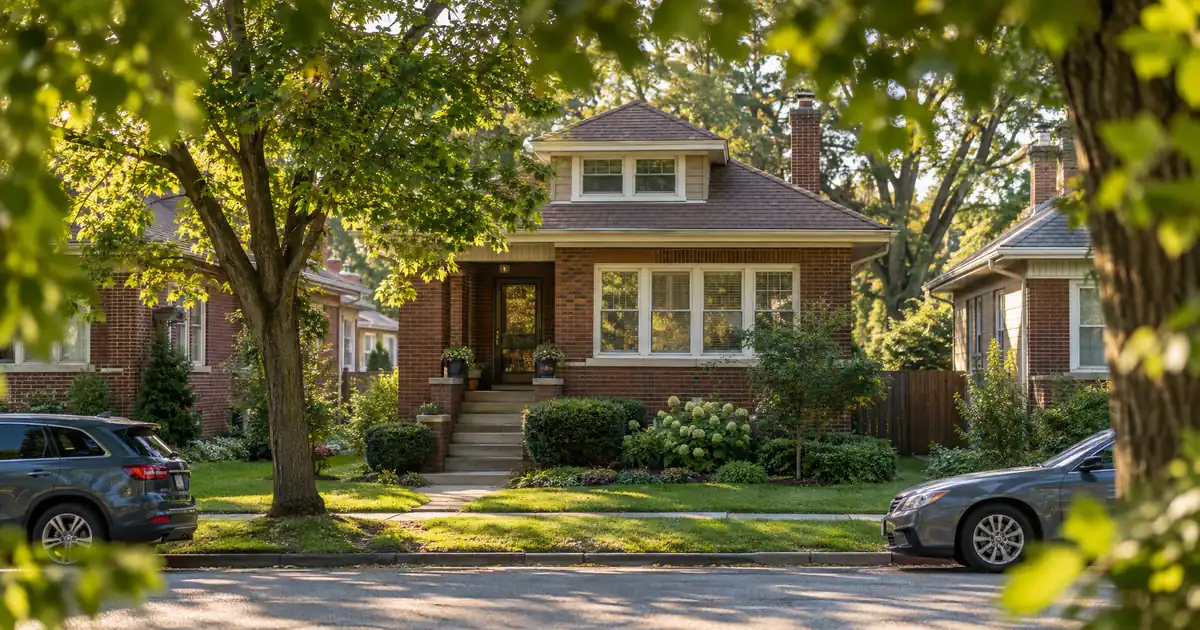
Redfin puts Bartlett’s median sale price at $400K, up 5.3 percent year over year, with homes drawing an average of 4 offers. That is appreciation an owner can borrow against. It is also a price level that makes rent-to-debt coverage thin. The cash-out question in Bartlett is not whether equity exists. It is whether the rent supports a 75 percent loan once taxes and insurance are in the number.
TL;DR: A DSCR cash-out refinance on a Bartlett, Illinois rental is underwritten primarily on the property’s rental income measured against its full monthly obligation, with the loan amount capped by appraised value, ownership seasoning and reserves, subject to lender guidelines.
DSCR Cash-Out Calculator
Run the cash-out numbers in Bartlett, IL
Rate source: Freddie Mac 30-yr average via FRED® — Federal Reserve Bank of St. Louis · effective Oct 1, 2026
Prefilled with starting assumptions — enter your property’s value, balance, taxes, and insurance for a more accurate picture.
Program parameters update from Lendmire’s centralized guideline source. Taxes and insurance are editable estimates.
As of Oct 1, 2026 · General Freddie Mac market benchmark, not a Lendmire loan offer. Property value, balance, taxes, and insurance are editable estimates. Maximum loan-to-value varies by lender, program, property type, and seasoning. Not a Loan Estimate, approval, or commitment to lend. Program availability and eligibility are subject to lender guidelines, credit approval, property review, and underwriting.
- Redfin shows a $400K median sale price citywide, which compresses coverage at 75 percent LTV.
- Lower-priced pockets near Woodland Heights show the best rent-to-value in this market.
- Cash-out typically needs about 6 months of ownership from title recording.
- Reserves of about 6 months PITIA are typical; the 75 percent LTV ceiling is a hard cap.
Bartlett Market Snapshot
A quick read on the Bartlett investor landscape — figures come from the cited sources below. Confirm current property-level numbers before underwriting.
| Metric | Detail |
|---|---|
| Typical rents | $1,845 average (Apartments.com Streamwood) |
| Recent appreciation | +5.3% yoy (Redfin Bartlett Housing Market) |
| Employment | 1,000+ food-cluster jobs (Village of Bartlett: Brewster) |
| Vacancy | Rental 4.1% (Wikipedia: Bartlett, Illinois) |
The Cheaper Pockets Carry the Coverage
Start with the lower-priced pockets. Redfin’s city guide lists Woodland Heights at a $320,500 median sale price, with East Streamwood at $324,900 and West Streamwood at $354,900. Golden Corridor sits at $390,000. Woodland Hills is the outlier at $599,900. Those are neighborhoods “in and around” Bartlett, so check the parcel’s actual address before assuming it belongs to a given submarket.
Rents don’t fall as fast as prices do. RentHop shows 3-bedroom rents at $2,800, up 8.39 percent year over year. Pair that rent with a price near $320K and the monthly rent-to-value works out to roughly 0.86 to 0.87 percent. That is a derived figure, not a sourced one. At the $400K citywide median, the same rent gives about 0.70 percent. The gap between those two numbers is the whole story for a cash-out here.
Rent sources need care. RentHop’s sample is small, and its zip-level data leans on Schaumburg zips. Homes.com reports a $2,950 median rent, built on 23 listings. Treat both as directional. The lender’s appraisal rent schedule and any signed lease will carry more weight than a listing aggregator.
Run the Numbers at 75 Percent
Say you own a 3-bedroom that appraises at $400,000. Assume a modeled rent of $2,800, in line with the RentHop figure. At the 75 percent LTV ceiling, coverage including taxes and insurance lands right around 1.0x, rounded down. That is the benchmark floor for most standard DSCR programs. It leaves no cushion.
Drop the ask to 65 percent LTV on the same house and coverage rises to roughly 1.1x. Run the same rent against a home appraising near $320,000 and 75 percent LTV produces coverage in the low 1.2s. All of these are modeled assumptions, built on full PITIA rather than principal and interest alone.
If a Bartlett file comes in under 1.00x, the paths are known. A sub-1.00 program, an interest-only structure or a smaller loan amount are all options a lender may review. Eligibility depends on lender guidelines, credit approval and property review. Some of those paths come with lower leverage or different pricing.
This is why the 75 percent cap matters more here than in cheaper markets. Homes.com shows a price-to-rent ratio of 11.8. That is a moderate-yield suburb, not a cash-flow machine. The equity is real. The coverage has to be earned.
Appreciation Does the Heavy Lifting
Cash-out on a Bartlett rental is mostly an appreciation story. The investor owns the property, the appraisal comes in higher than the original basis, and the 75 percent ceiling decides how much of that gain is accessible. Redfin’s median sale price per square foot sits at $225, up 4.4 percent from last year. Price growth of that size, compounded across a hold period, is what creates the usable equity.
Three mechanical points control the outcome:
- Seasoning. Lenders typically want about 6 months of ownership, measured from title recording. The settlement statement is the evidence. Files that assume seasoning away get kicked back.
- Reserves. About 6 months of PITIA is typical, and roughly 9 months above a $1,500,000 loan. Statements need to show the funds, and cash-out proceeds generally can’t be counted twice.
- Credit. Program tiers run at 620, 660, 680 and 700, with 620 as the floor. Higher scores generally open better leverage and pricing, per lender program requirements.
Proceeds are not a guaranteed figure. Equity available depends on rent used for lender review, PITIA, reserves and the 75 percent ceiling. The cash-out qualification details lay out how those pieces interact.
Working DSCR brokers see a recurring pattern in high-income, owner-occupied suburbs like this one: the appraisal is rarely the problem, but the rent evidence is. Single-family rentals are a small slice of stock, so comps are sparse. Files that arrive with a signed lease, proof of deposit and a rent comparison from the same price tier tend to move through review with fewer questions.
Who Rents Here
Tenant demand comes from jobs, not from one anchor. Data USA shows the largest resident sectors as Health Care and Social Assistance at 3,077 people, Manufacturing at 3,032 and Retail Trade at 2,243. Homeownership is 89.2 percent, so the rental pool is small and competition among landlords is light.
Inside the village, jobs cluster at Brewster Creek. The Village of Bartlett says the food companies there together employ more than 1,000 people. German-based manufacturers and auto-supply firms sit alongside them. A Choose DuPage article counts 90 businesses in the park. Earlier JobsEQ data, from Choose DuPage, shows Wholesale Trade as the largest jobs sector in the village at 1,529 workers. That data is dated, so use it for direction only.
Commuting matters as well. Per Choose DuPage, US Route 20, IL Route 59, I-90 and the Elgin-O’Hare Expressway all serve the village. A Metra station, which the village says was built in 1873, connects downtown to Chicago. Elgin Community College is the named workforce-training partner. A tenant base that works in healthcare, manufacturing and logistics across several job centers supports renewals. That is the kind of rental durability a lender wants to see.
Which Property Types Pencil
The Redfin city guide shows a $440,000 single-family median, a $404,990 townhouse median and a $300,000 condo median. Homes.com rents run $3,000 for single-family, $2,600 for townhouses and $2,050 for condos. The condo ratio looks best on paper, but condo files add HOA questionnaire completeness and condo certification to the review. Not every project clears. Request the questionnaire early if the subject is a condo.
NeighborhoodScout says single-family detached homes are 70.65 percent of units. Multi-unit stock inside the village is thin, and no source here shows a duplex or fourplex rent. If the plan is to use cash-out proceeds on a small multifamily, the likelier buy is next door. Apartments.com puts Streamwood’s average apartment rent at $1,845. Pricing and available terms vary by lender, borrower profile, property type, and full underwriting review.
Rent per door falls quickly moving west. Redfin’s Elgin listings show 1-bedrooms from $1,141 to $1,295 and 2-bedrooms from $1,308 to $1,600. A multi-unit building in Elgin has to be underwritten at Elgin rents, not Bartlett-area rents. (Streamwood’s $1,925-plus 2-bedroom asks make the contrast obvious.)
Where the Proceeds Go
The usual use of Bartlett cash-out proceeds is a second property in a higher-yield market. A three-bedroom here that covers at roughly 1.0x to 1.2x supplies the capital. The next purchase has to cover better than that.
What Trips Cash-Out Files Here?
Four things recur on suburban Chicago cash-out files:
1. Seasoning clocks. Recording date, not contract date, starts the count. A borrower who closed recently should pull the recorded deed before applying.
2. Thin rent evidence. One listing is not a lease. Provide the signed lease, or an appraisal rent schedule that stands up against comparable homes.
3. Entity paperwork. Operating agreement, articles and EIN letter should match the vesting on title. Mismatches cost days of correspondence, and cash-out files make that worse because title has to clear before funds are released.
4. Reserves documentation. Statements need to show the months of PITIA the program expects, and the funds must be seasoned in the account.
Assume the appraisal comes in light on a $400K-plus home. A reconsideration request with recent in-neighborhood sales and condition adjustments is a routine step, not a fire drill. Verify current local rental rules, property taxes and insurance with qualified local professionals before committing. They vary by parcel.
Frequently Asked Questions
How do you qualify for a DSCR loan in Bartlett, Illinois?
The property’s rent used for lender review has to cover its full monthly obligation, including taxes and insurance, at or above a 1.00x benchmark on most programs. Credit tiers start at a 620 floor, and reserves of about 6 months PITIA are typical. Final eligibility depends on lender guidelines, the borrower’s profile and property review.
DSCR vs. conventional financing
There are two common ways to finance an investment property in Bartlett, IL, and they qualify you differently — here’s how investors weigh them.
Why investors choose it
- Qualifies on the property’s rental income — no personal tax returns, W-2s, or pay stubs needed to document income.
- No personal debt-to-income ceiling to clear, so existing mortgages and obligations don’t cap your borrowing the same way.
- Can be closed in an LLC, keeping the property inside a business entity.
- Built for scaling — not held to the limit on number of financed properties that conventional financing applies.
- Underwriting centers on the deal: generally qualifies when the rent covers the payment, a 1.00x coverage ratio being a common baseline (confirmed in underwriting).
- Designed specifically for investment property, including long-term and, where the program allows, short-term rentals.
Where it’s strong
- Often the lowest ongoing financing cost for a buyer who fully qualifies on personal income — a fit for a first property or a cost-first purchase.
Trade-offs for investors
- Requires full personal income documentation and must fit within a debt-to-income limit — salary, existing debts, and other mortgages all count.
- Typically held in your personal name rather than a business entity.
- Caps how many financed properties you can carry, which can become a ceiling as a portfolio grows.
- Evaluates you as a borrower as much as the property, which usually means more paperwork.
How investors usually choose: a first or single property often optimizes for the lowest financing cost; portfolio builders often optimize for leverage, vesting in an LLC, and scaling past conventional caps. The right answer depends on your goals, the property, and current guidelines — both paths run through select lenders in Lendmire’s wholesale network, with eligibility and terms confirmed in underwriting.
What are the requirements for an investment property loan in Bartlett, Illinois?
Expect an appraisal with a rent schedule, proof of ownership seasoning for cash-out and reserves documentation. Entity documents are needed if an LLC holds title, subject to program terms. Manufactured homes, log homes and barndominiums fall outside these DSCR programs. Loan amounts run up to $3,000,000 on standard programs.
Which Bartlett price points give the best coverage on a cash-out?
The lower-priced pockets near Woodland Heights, at a $320,500 median, show the best rent-to-value, per Redfin. Modeled with a $2,800 rent, coverage including taxes and insurance runs in the low 1.2s at 75 percent LTV. At the $400K citywide median it sits near 1.0x. Confirm the rent on a specific Bartlett comp.
How reliable is Bartlett rent data for a cash-out appraisal?
It is directional. RentHop’s sample is small, Homes.com rests on 23 listings, and Census median gross rent of $1,935 from City-Data includes older leases and runs well below asking rents. The appraisal’s rent schedule and a signed lease carry more weight in review than any aggregator.
Can Lendmire help structure DSCR financing for small multifamily investment properties in Bartlett?
Yes, within program guidelines. Lendmire arranges DSCR investor loans. Cash-out refinances are available up to 75 percent LTV, and loan amounts run up to $3,000,000 on standard programs. Multi-unit stock inside Bartlett is scarce, so most small multifamily files involve nearby Streamwood or Elgin. Call 828-256-2183 to discuss a specific property.
Where the Gap Sits
Bartlett’s rents hold up against its prices in the lower-priced pockets, not at the median. Woodland Heights and the adjacent Streamwood areas, priced in the low $320Ks, produce the widest spread between rent-to-value and the 75 percent LTV ceiling. A 3-bedroom or townhouse in that band, owned past seasoning, is the asset the market underprices against a commuter and manufacturing tenant base.
For current guidelines and terms, see Lendmire’s DSCR loan programs page.
About Lendmire
Lendmire is a non-QM mortgage brokerage (NMLS# 2371349) arranging DSCR investor loans in 41 markets, including Washington, D.C. DSCR eligibility is generally reviewed around property-level rental income rather than personal income, subject to lender and program guidelines, making it a fit for self-employed investors and LLC-owned portfolios. Lendmire was recognized as a Scotsman Guide Top Mortgage Workplace in 2025 and 2026, per a 2025 Scotsman Guide Top Workplace listing, a top-ranked workplace in 2026 and the Top Workplace press announcement.
For broader investor-financing rules and property-type coverage across the state, see Illinois DSCR loans.
Get Started
Ready to find the right loan for you?
In about 30 seconds you can review financing options available for your investment property. No commitment required.
Informational only. Not a Loan Estimate, approval, or commitment to lend. Program availability and eligibility are subject to lender guidelines, credit approval, property review, and underwriting.
References
1. Redfin: Bartlett Housing Market
3. Village of Bartlett: Brewster Creek Business Park
4. Wikipedia: Bartlett, Illinois
6. RentHop: Average Rent in Bartlett
7. Homes.com: Bartlett Rentals
10. Choose DuPage
12. NeighborhoodScout: Bartlett
13. Elgin listings
14. City-Data
15. a 2025 Scotsman Guide Top Workplace
16. Scotsman Guide — Top Workplaces 2026
17. the Top Workplace press announcement
This article is part of Lendmire’s investment property cash-out refinance program — full qualification details, guidelines, and scenarios live on the program page.
Related reading: Luxury Rental DSCR Loans In New Jersey · Jersey Shore Vacation Rental Loans: DSCR Financing In Ocean City, Cape May And Long Beach Island · DSCR Cash-out Refinance In New Jersey: Pulling Equity From A Rental
Guides: Investment Property Cash-Out Refinance in Illinois
Brandon Miller
Founder & CEO, Mortgage Loan Originator, Lendmire LLC
- Mortgage Loan Originator · NMLS# 1129696 · Verify on NMLS Consumer Access
- North Carolina Real Estate Broker · License# 343312 · Verify on NCREC
- North Carolina Insurance Producer · License# 19053198 · Property, Casualty, Life, Health · Verify on NAIC SBS
- Lendmire LLC · Firm NMLS# 2371349 · Verify firm licensure
Disclosure information. Lendmire is a state-licensed mortgage brokerage under NMLS# 2371349. Lendmire is not a depository institution, direct lender, or financial advisor — all loans referenced are placed through wholesale lender partners and are subject to each lender's underwriting standards. This article is provided for general informational purposes and is not a commitment to lend, nor does it constitute financial, legal, or tax advice. Loan programs, terms, rates, and qualification standards change without notice and depend on borrower profile, property type, and the state in which the subject property is located. Equal Housing Opportunity provider. NMLS Consumer Access: nmlsconsumeraccess.org.